The practical answer to single pique vs double pique starts with construction: the names describe knitted structures, not fixed weights or quality grades. Neither label alone establishes which fabric is heavier, softer, more breathable, or better suited to a polo. Apparel Wiki provides independent educational guidance; its Sponsor page explains that sponsorship does not mean control over editorial content.
Compare the construction description alongside fiber, yarn, measured fabric weight, finishing, and the actual sample. A lighter, flexible candidate might suit a soft silhouette; a firmer candidate might suit a more structured body. Those choices require evidence from the specific fabrics.
What Single Pique and Double Pique Mean
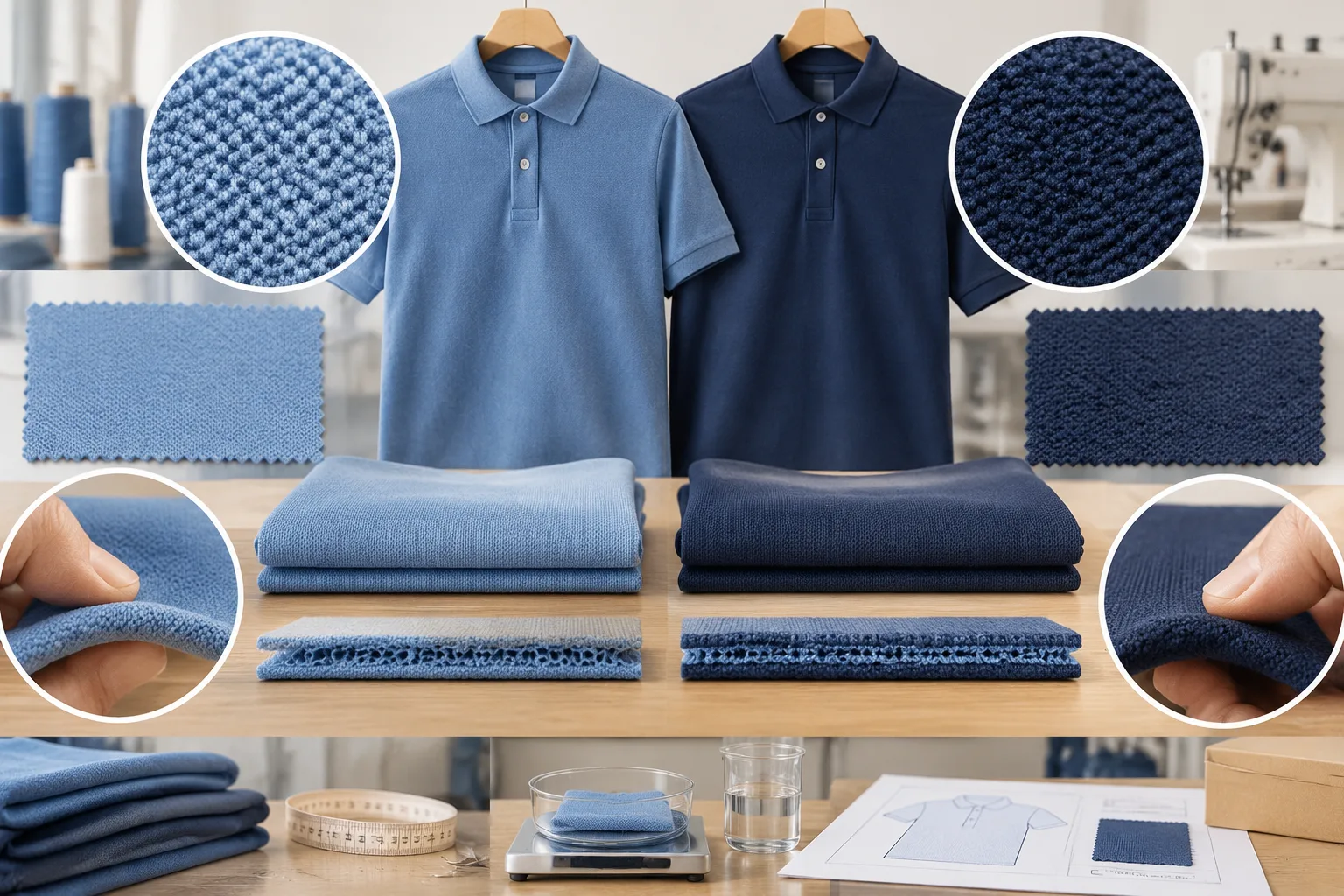
In polo-fabric discussions, single pique and double pique are construction terms within knitted pique fabrics. Pique is not a fiber name. A single pique fabric or double pique fabric still needs a separate description of its composition, yarn, weight, and finishing.
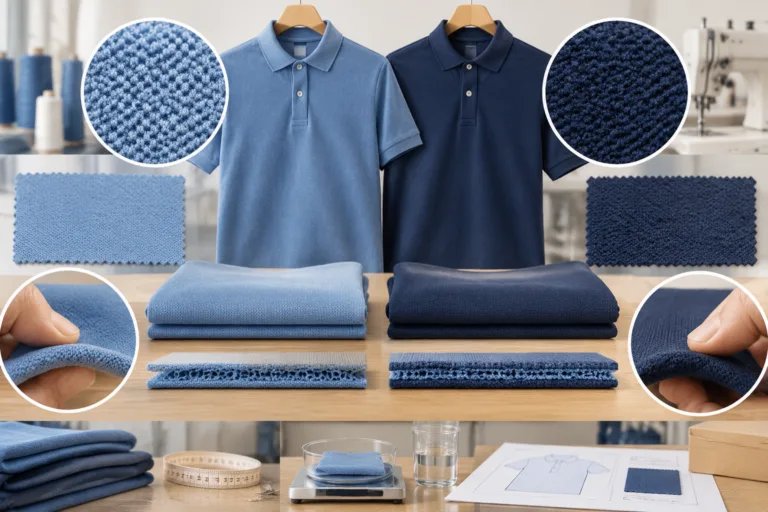
The structural distinction to establish is how the yarn loops are arranged and repeated within each candidate. Ask for a construction description or technical sheet that explains what the supplier means by each name. A photograph can help identify surface differences, but it cannot replace that description.
Supplier terminology and regional commercial usage can differ. Do not interpret “double” as a promise of twice the weight, two fabric layers, or a particular knitting-machine arrangement. Keep the comparison general until the construction information establishes the meaning in that supplier’s range.
Read fabric identity in layers. Fiber content identifies the material composition. Yarn information describes what forms the loops. Construction describes their arrangement. Finishing describes subsequent treatment. These details belong together, but none substitutes for the others.
This distinction matters when comparing pique polo fabric samples with similar names. Matching construction labels do not establish matching specifications or behavior. Conversely, different labels do not establish how large the practical difference will be in a garment.
Use a consistent comparison frame: construction, measured GSM, thickness or cover, stretch and recovery, dimensional stability, surface appearance, and end use. Here, cover means how closed or open the fabric appears; recovery concerns its return after stretching. Dimensional stability concerns retention of size and shape under specified conditions. Treat these as separate questions rather than conclusions supplied by the name.
How Knit Structure Can Affect Fabric Weight and Hand
Knitted fabric consists of interconnected yarn loops. Their arrangement helps explain the structure, but fabric mass also involves yarn size and how much yarn occupies a given area. Stitch density, composition, and finishing belong in that explanation. Construction alone cannot determine the resulting weight or thickness.
GSM means grams per square meter: mass per unit area. A higher measured GSM establishes more mass over the same area under comparable conditions. It does not establish greater thickness, opacity, warmth, durability, or quality. Each of those questions requires separate evidence.
Thickness describes the distance between fabric surfaces under the measurement conditions. Hand describes how fabric feels during handling, including perceived softness, fullness, and firmness. Drape describes how it hangs. Two samples with similar GSM can therefore still need separate assessments for thickness, hand, and drape.
This is why double pique is not automatically heavier than single pique. The label supplies no measured mass. Compare the reported pique fabric GSM rather than estimating weight from the word “double,” the visible texture, or how substantial a swatch feels.
For a polo, investigate the relationship between handling and silhouette. Does the sample fall softly when suspended, or hold a firmer shape? Does it feel open or closely covered? These observations help assess the brief, but they do not establish breathability or finished-garment performance.
Compare specifications in a stated condition. Identify whether each sample is unfinished, finished, or already washed. Moisture contributes to mass, so measurement conditions matter when interpreting weight differences. Record the method and sample condition rather than treating unlike supplier figures as directly interchangeable.
Record width separately, including whether it means total or usable width. Width does not define GSM, but it identifies the supplied fabric format and supports a meaningful specification comparison. A useful side-by-side record therefore keeps construction, composition, GSM, width, finishing state, and sample condition together. Resolve differences in those descriptions before attributing a weight or handling difference to construction.
Single Pique vs Double Pique: A Practical Comparison
Use this table to connect fabric evidence with the polo brief. Initial signals concern the actual candidate; they are not rankings of single and double pique.
| Comparison area | What to observe in the fabric or specification | Possible implication for a polo | Initial choice signal | Variables that could change the choice |
|---|---|---|---|---|
| Construction description | Documented structure and repeat | Defines the construction being considered | Description matches the requested fabric | Supplier terminology; incomplete technical details |
| Measured GSM | Mass per area in comparable conditions | Establishes the fabric-weight comparison | Fits the brief’s weight requirement | Finishing state; moisture condition |
| Thickness or cover | Thickness information; visible openness | Helps assess body coverage and bulk | Coverage suits the intended appearance | Color; yarn; measurement conditions |
| Surface texture | Face and reverse appearance | Shapes the polo’s visible character | Texture matches the design direction | Yarn character; color; finishing |
| Stretch and recovery | Extension and return in relevant directions | Raises movement and shape-retention questions | Response fits the intended ease | Composition; direction; evaluation conditions |
| Dimensional stability | Size and distortion after intended care | Informs assessment of retained shape | Documented response meets project requirements | Care conditions; finishing; garment assembly |
| Drape and firmness | Hanging shape and handling resistance | Helps assess the proposed silhouette | Observed handling matches the desired body | Yarn; finish; pattern proportions |
| Care or finishing considerations | Specified finish; appearance and hand after care | Identifies changes relevant to use | Evaluated condition suits care expectations | Care procedure; finish; sample state |
For a lightweight knit polo emphasizing ease and soft drape, single pique could be an initial candidate if its sample supports that direction. Compare actual GSM, recovery, and wash response. A different fiber blend or finish could reverse that preference.
For a polo requiring a more stable-looking body, double pique could be an initial candidate if it shows the desired substance and firmness. Compare cover, distortion after care, and behavior at seams and hems. Its name cannot establish the finished-garment result or greater durability.
Keep observations separate from verified measurements: a swatch that looks stable has not thereby demonstrated dimensional stability. The useful preference is the one supported by comparable evidence for the stated silhouette and care expectations.
Choosing Between the Two for a Polo Fabric Brief
Begin with the garment brief, not the construction label. Record the intended silhouette, body coverage, drape, surface appearance, movement, climate context, color range, and expected care. These requirements define what “better for” the polo means. A fabric selected for a relaxed, soft-looking body may need different handling from one intended to support a more stable-looking silhouette.
Request comparable information for both candidates. The specification should identify fiber content, yarn or fabric description when available, construction description, GSM, usable width, finishing state, and sample condition. Clarify whether the stated width includes selvedges. Also record whether the samples represent the same color, finish, and stage of care or processing.
Then evaluate each fabric in the actual polo context. Look at how the hand relates to the body panels, and inspect the likely interaction with the collar, cuffs, placket, seams, and hem. Consider whether the fabric creates unwanted bulk, loses its intended shape at an opening, or needs a different ease allowance. Print and embroidery areas also deserve inspection because surface texture and firmness can affect the chosen decoration process; do not assume either construction guarantees a result.
Fiber blend and finishing can change the decision substantially. Two fabrics carrying the same single-pique or double-pique label may handle differently because their composition, yarn, finishing, or manufacturing settings differ. Climate and comfort are also evaluation variables, not conclusions that follow from the name. Compare the actual fabric under the use conditions that matter to the product.
Separate initial selection from approval. A promising swatch provides a direction, but it does not establish finished-garment performance. Use “better for” only beside a stated requirement: for example, a candidate may be better for a firmer silhouette if its sample shows the required cover and handling. The preference should remain open until the relevant observations, measurements, and care-response evidence support it.
How to Evaluate Samples Before Making the Choice
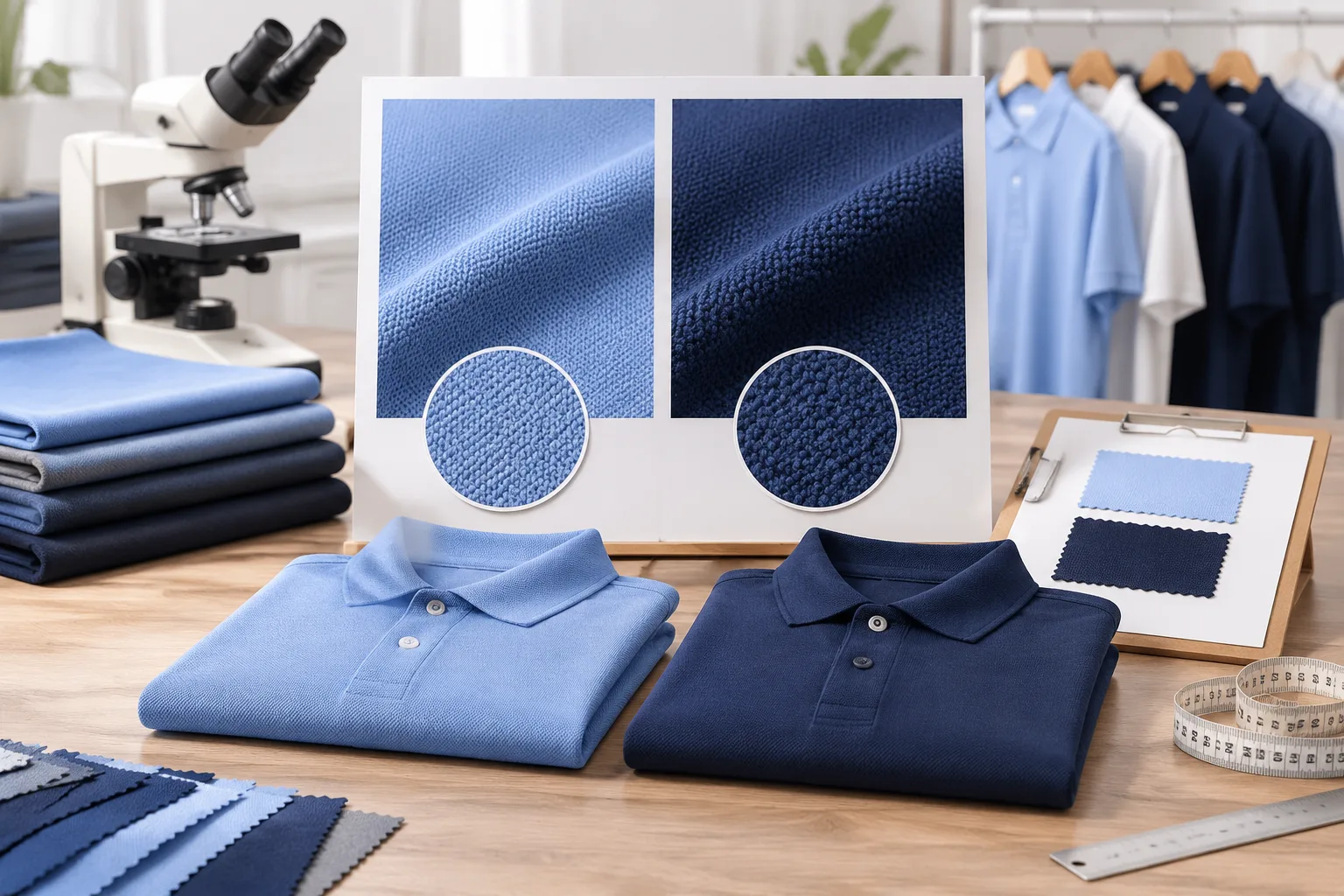
Start a sample record before comparing appearance or hand. Note the supplied construction name, fiber content, GSM and measurement condition, width definition, finish, color, lot or sample reference, and whether the material is before or after relevant care. This prevents a visually appealing swatch from being separated from the specification that explains it.
Place the samples side by side under comparable conditions. Review surface texture, cover, thickness, firmness, drape, stretch response, recovery, and visible distortion. Mark each point as an observation, a supplier specification, or a verified measurement. “Feels stable” is an observation; it is not proof of dimensional stability. Likewise, a listed GSM is a specification, not evidence of a particular thickness or hand.
- Compare construction descriptions and GSM only when the measurement conditions are understood.
- Check whether the stated width means total width or usable cutting width.
- Inspect the surface and cover in the intended color, since appearance can affect the design decision.
- Consider stretch, recovery, firmness, and drape in relation to the planned silhouette.
- Record visible distortion rather than converting it into an unsupported performance rating.
Review the candidates in representative garment areas. A swatch may not show how fabric behaves at a collar, cuff, placket, hem, seam, or embroidered area. A small garment or pattern-context review can reveal handling questions that remain hidden in a flat sample. Treat this as product-development evaluation, not as a substitute for a formal test when a validated result is required.
Plan care-response checks around the product requirements. Identify which changes matter, such as altered dimensions, surface appearance, or hand, then select an applicable validated evaluation method if a formal result is needed. Do not create acceptance limits from a general fabric name. Keep the issue open when the appropriate method or project requirement has not been established.
A useful decision record has five fields: requirement, observed evidence, verified measurement, unresolved variable, and decision status. If evidence remains incomplete, compare the fabrics qualitatively, request clarification, or schedule appropriate evaluation. Do not treat a supplier label or first impression as proof of stretch recovery, colorfastness, abrasion resistance, pilling behavior, or seam performance.
Make the Fabric Choice From Evidence, Not the Label
Single pique versus double pique is a construction comparison, not a universal quality contest. Read construction together with GSM, fiber, yarn, finishing, garment design, and use conditions. Create a side-by-side record for the matched samples, then identify which open questions need further inspection or a validated measurement. Before finalizing the product decision, check that any performance claim is supported by an applicable evaluation method and the relevant sample condition.
Frequently Asked Questions
Is double pique always heavier than single pique?
No. Construction can influence mass and handling, but yarn, stitch density, fiber content, finishing, and measurement conditions also affect GSM. Compare matched specifications and actual samples rather than inferring weight from the label.
Does single pique or double pique make a polo shirt more breathable?
Neither label alone establishes breathability. Fiber, cover, thickness, finishing, garment ease, and use conditions can all affect comfort and moisture behavior. Treat breathability as a characteristic to evaluate, not a guaranteed result of construction.
Which fabric construction is better for a structured polo?
The better choice is the candidate that supports the required silhouette after considering cover, firmness, GSM, finishing, and care response. Double pique may be an initial candidate when its sample shows the desired substance, but the construction name alone is not sufficient.
What specifications should be compared when buying pique fabric?
Compare fiber content, construction description, yarn information when available, GSM and measurement condition, usable width, finishing state, sample condition, color, and relevant care expectations. Record unresolved variables instead of treating missing information as confirmation.
Can the same single-pique or double-pique label describe different fabric performances?
Yes. Commercial naming can vary, and fabrics with the same label may differ in composition, yarn, settings, finishing, GSM, cover, and handling. Confirm the construction description and compare the actual specification and sample.
When should a pique fabric comparison include formal testing?
Use formal testing when a performance claim matters to product approval, care response, appearance, or another defined requirement that observation cannot establish. Select a method applicable to the material and condition, and set acceptance criteria from the project brief rather than inventing universal limits.