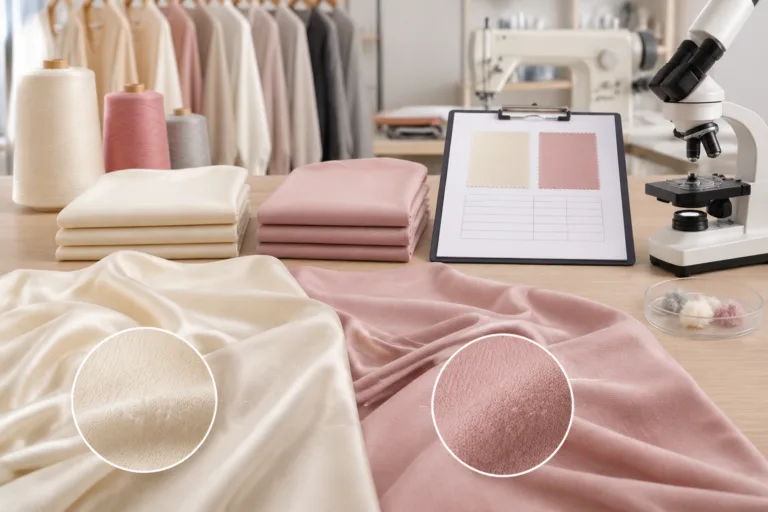
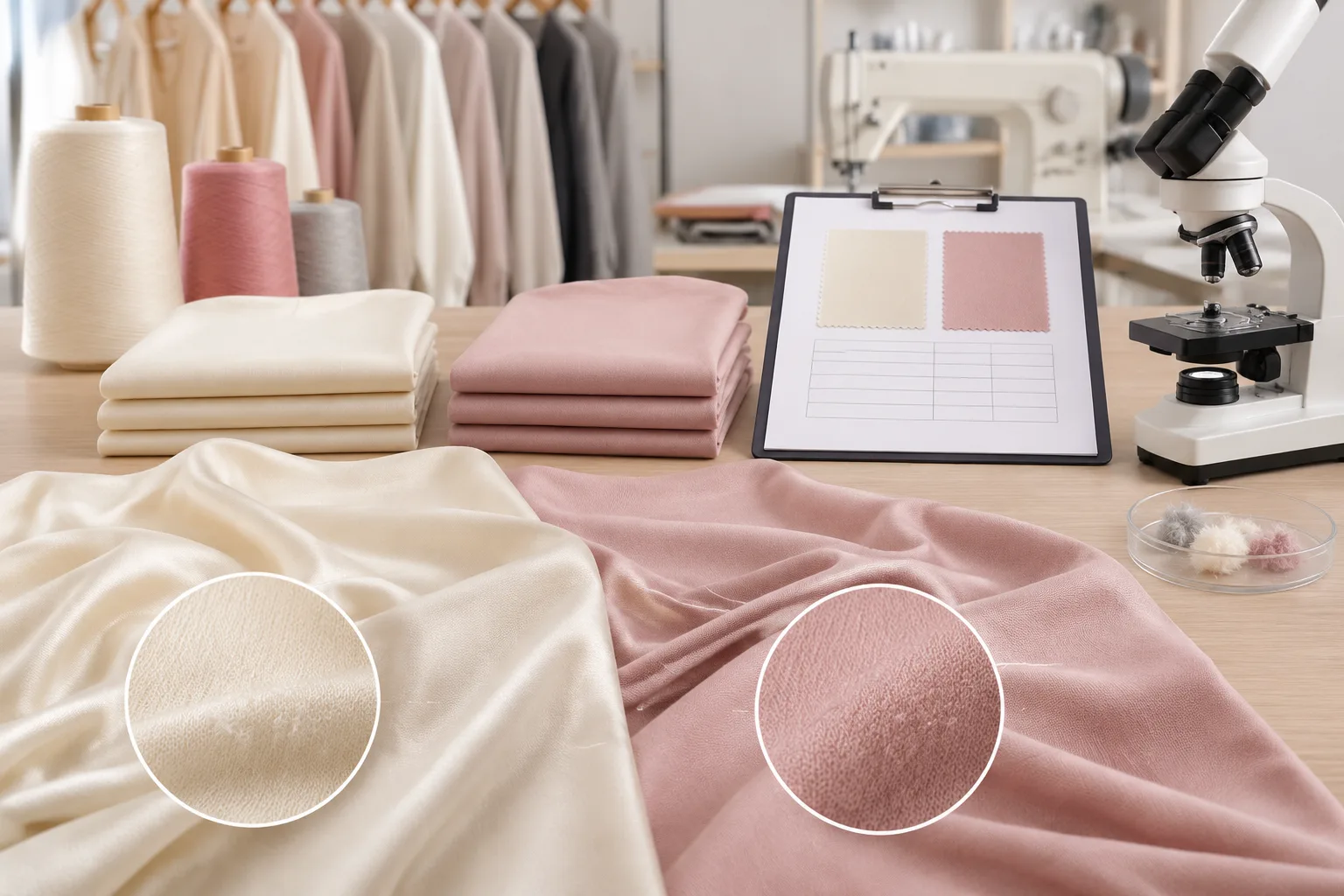
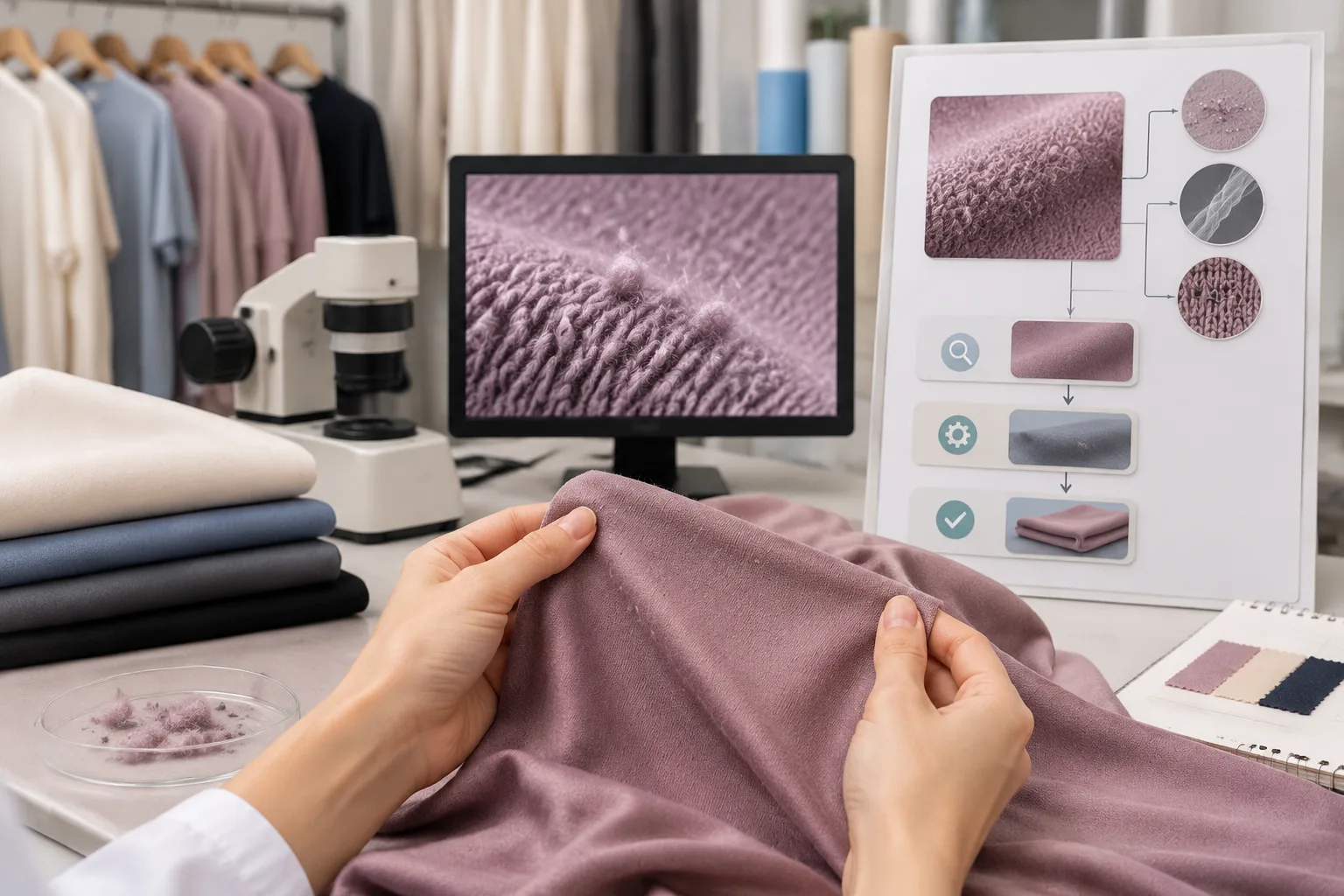
Silk jersey pilling can occur when loose surface fibers form fuzz and become entangled during rubbing or repeated contact. However, the pills do not identify why those fibers became exposed or which variable contributed most. Material claims should therefore remain independent and evidence-based, consistent with the editorial principle described on Apparel Wiki’s Sponsor page.
“Silk” identifies a fiber, while “jersey” identifies a knitted structure. Yarn characteristics, knitting variables, finishing, garment construction, use, and care add further layers. Investigating why silk jersey pills requires separating those layers instead of treating the fabric name or one photograph as a diagnosis.
What Silk Jersey Pilling Means—and What It Does Not Prove
Pilling is an observable surface condition. Small masses of entangled fibers remain attached to the fabric, often amid a fuzzed area. Abrasion may help produce this sequence by bringing fibers to the surface and moving them together. This is a general mechanism, not proof that abrasion alone caused a particular garment’s problem.
Several similar-looking conditions need to be separated. Fuzzing raises fibers without necessarily forming distinct pills. A snag or pulled loop displaces part of the knitted structure. Shedding involves fibers leaving the surface. Broader abrasion damage may include thinning, glazing, holes, or loss of surface material. These conditions can coexist, but they are not interchangeable.
A useful fabric identity has at least four layers:
- Fiber composition: what fibers are stated to be present and in what blend, if known.
- Yarn: the yarn description and condition, including any available production or batch information.
- Structure: the jersey loop construction and other recorded fabric specifications.
- Finishing: treatments or processing applied after knitting, when that information is available.
The label “silk jersey” provides only part of this identity. It does not establish that two fabrics use comparable yarns, loop constructions, finishes, or production conditions. Nor does it show that two garments experienced comparable contact, wear, storage, washing, or drying.
Possible contributors therefore remain open. Fiber and yarn behavior, knitting variables, finishing, garment interfaces, laundering, and repeated contact may each warrant review. More than one may be involved. A photograph can establish appearance and location, but it cannot isolate these variables or confirm a root cause.
Accordingly, neither silk content nor jersey construction proves a fixed pilling tendency. A meaningful comparison must hold relevant material and use conditions as constant as practical. Otherwise, a visible difference could reflect several uncontrolled differences rather than the variable being blamed.
Describe the Pills Before Guessing the Cause
A fabric pilling investigation should begin with a repeatable description of the symptom. The following checklist is an editorial investigation practice, not a formal inspection standard. Its purpose is to turn a broad complaint into evidence that can support or challenge competing explanations.
- Map the location. Mark pills on the body, sleeves, underarm, collar, cuffs, hems, seams, edges, and areas touching another garment or accessory. Concentration at a contact zone supports examining local interaction, but does not prove it caused the damage.
- Record direction and distribution. Note whether the condition follows a seam, fold, panel, knitting direction, or contact path. Distinguish isolated spots from repeated clusters or broad surface coverage.
- Describe the appearance. Record whether the surface shows loose fuzz, distinct attached pills, pulled loops, snags, thinning, or several conditions together. Avoid using “pilling” as a catch-all term.
- Photograph consistently. Keep garment orientation, lighting, distance, and background as consistent as practical. Include a scale and both overview and close views. Do not treat one enlarged image as a root-cause determination.
- Establish timing. Record when the condition was first noticed and which wear, handling, washing, drying, or storage events preceded it. Note whether it existed on uncut fabric, appeared during construction, or emerged only in use.
- Capture identity and history. Retain the stated composition, fabric or yarn description, roll and batch references, finish information, panel location, care instructions, and actual care history when available.
Comparison samples add context. Examine retained fabric from the same roll, unused garments from the same batch, corresponding panels, and unaffected areas of the same garment when available. Differences between them can direct the next check, although they still require careful interpretation.
For every proposed cause, write down one supporting observation and one possible contradiction. Pills near a seam may support reviewing seam contact, for example. Pills on unused fabric from the same roll would preserve a fabric-level hypothesis. This approach prevents the most familiar explanation from becoming the conclusion before alternatives are examined.
Compare the Main Cause Hypotheses
Similar-looking pills can develop through different pathways. The matrix below allocates investigation effort; it does not report test findings. Each initial choice should be revised when new evidence supports or contradicts the working hypothesis.
| Observable input | Possible implication | Initial investigative choice | What could change that choice |
|---|---|---|---|
| Fiber or yarn information differs between records, rolls, or batches | The compared materials may not share the same identity. | Reconcile specifications and batch records before blaming one fiber. | Confirmed matching records or evidence that the difference is only clerical. |
| The condition appears on unused or uncut fabric | A fabric-level variable remains plausible before garment wear. | Compare yarn, knitting, finishing, handling, and batch consistency. | Clean retained fabric or evidence that damage occurred during storage or handling. |
| Distribution follows loops, panels, or fabric direction | Construction or panel-specific variation may deserve review. | Compare affected and unaffected areas with their orientation recorded. | A matching pattern across unrelated directions or garment zones. |
| Pills concentrate at seams or contact zones | Local rubbing or a garment interface may be relevant. | Review construction, fit, adjacent materials, and contact history. | Equivalent pilling in protected areas or on unused fabric. |
| The change is first seen after washing or drying | Care conditions belong in the comparison. | Compare documented before-and-after specimens and actual care history. | Pre-existing pills, unmatched samples, or uncertain treatment records. |
| Appearance changes with lighting, scale, or observer | Inspection conditions may be influencing the judgment. | Repeat observations under consistent conditions. | A stable difference that remains visible across comparable views. |
The smallest useful check is the one that separates the leading hypotheses without introducing avoidable new variables. For example, pilling found before garment use should shift attention toward fabric identity, yarn, knitting, finishing, handling, and batch evidence. It still does not show that silk itself caused the condition.
Likewise, a post-care change justifies comparing care histories, not declaring laundering to be the cause. Contact-zone concentration justifies reviewing garment interaction while preserving material and care explanations. Until matched evidence distinguishes them, these remain investigative priorities rather than confirmed findings.
Build a Fair Comparison Before Changing the Specification
A fair comparison begins with matched evidence. Compare silk jerseys that are alike in the variables most likely to affect the observation: stated composition, fabric construction, finishing, weight, width, batch, garment panel, and care history. Comparing an unused lightweight panel with a different finished garment may show a difference, but it cannot identify which variable produced it.
Separate fabric-level evidence from garment-level evidence. When available, examine unused or uncut material alongside the constructed garment. Review the same fabric near seams, at high-contact zones, and in areas that receive little contact. This helps distinguish a condition that was present in the material from one that became visible after cutting, sewing, fitting, wear, or laundering. It still does not prove a cause by itself.
Record the comparison conditions as carefully as the visible result. Note the specimen or panel identity, pre-existing condition, handling and care history, observation date, and exact area examined. Use consistent orientation, lighting, viewing distance, and image scale. These records reduce confusion when small surface changes are compared later. They are an editorial investigation practice, not a universal inspection standard.
A simple evidence plan can keep the investigation proportionate:
- State the leading suspected cause, such as a fabric-level issue, a contact-zone interaction, a care event, or an observation problem.
- Write down the observation that would support that explanation.
- Write down what could contradict it, such as similar pilling on protected or unused material.
- Choose the least elaborate check that can separate the leading explanations.
For example, a surface condition found on unused material deserves a fabric and batch review before a garment-contact explanation is favored. A condition limited to a seam or repeated contact area justifies reviewing construction and use while retaining the fabric hypothesis. The comparison should narrow the possibilities, not force a conclusion.
An informal wear or care comparison can reveal a pattern, but it should not be reported as a standardized performance result. Numerical ratings, formal conclusions, and specification decisions based on a recognized test require the applicable validated method and competent testing. Weight or GSM can be recorded as part of fabric identity, but GSM is mass per area, not a direct quality grade or proof of pilling performance.
Interpret Findings and Choose the Next Corrective Check
Interpretation should connect evidence to the next check without turning a priority into a finding. The useful question is not simply “What usually causes pilling?” It is “Which observation is strong enough to justify reviewing this variable next, and what evidence could change that choice?”
If fabric identity or batch behavior appears inconsistent, review composition, yarn information, knitted construction, finishing records, and batch details together. Changing only the fiber label may leave the relevant variable untouched. A material review is especially appropriate when the condition is visible before garment use or appears across areas with different contact histories.
If pilling is concentrated at seams, fit-related contact points, or garment interfaces, review construction and use conditions. Consider adjacent materials, repeated rubbing, and the location of the affected panel. This pattern supports a garment-interaction review, but it does not eliminate fabric, finishing, or care explanations. A separate fabric-level comparison remains useful.
If the change follows a documented washing or drying event, compare the actual treatment with the care instructions and with an appropriately matched untreated or differently treated specimen. One before-and-after observation may show timing, but timing alone does not establish causation. It should not become a universal care rule for every silk jersey garment.
Conflicting observations are also findings. If one panel shows pilling but a comparable panel does not, or if the appearance changes with lighting and scale, report the uncertainty and collect the missing comparison. Do not select a definitive cause because it fits a familiar list of possibilities.
Corrective actions should therefore be framed as investigation steps: check the specification, compare retained samples, review construction interfaces, document actual care, or seek a validated textile test when a formal performance conclusion is needed. None of these steps guarantees an anti-pilling result. They improve the basis for deciding whether a specification change is justified.
Use the Evidence to Plan the Next Check
Create a one-page evidence record covering location, timing, material layers, care history, comparison samples, supporting observations, contradictions, and the next check. Then compare matched fabric or garment evidence before changing a specification. When a formal conclusion is necessary, consult the applicable validated test method or qualified textile-testing guidance. Silk jersey pilling is an investigation problem, not a diagnosis settled by a fabric name or one photograph.
Frequently Asked Questions
Can silk jersey pill even when the fabric is made from silk?
Yes. Silk content identifies a fiber, while pilling describes a surface condition. The visible pills may involve fiber, yarn, knitted structure, finishing, garment contact, care, or several variables together. Silk alone does not establish either a fixed tendency or a root cause.
Does the word jersey explain why a silk garment is pilling?
No. Jersey identifies a knitted structure, not a complete fabric specification. Yarn details, composition, finishing, garment construction, use, and care history remain relevant. The word jersey can help describe the material, but it cannot explain the symptom by itself.
How can I tell whether pilling began in the fabric or after garment construction?
Compare unused or uncut material with constructed panels and affected garment zones when those specimens are available. Record their condition before handling, construction, wear, and care. A difference in timing can guide the investigation, but matched evidence is needed before assigning a cause.
Which garment locations are most useful to document when investigating pilling?
Document high-contact areas, seams, edges, fit-related interfaces, protected areas, and any broadly affected panels. Record the garment orientation and compare similar zones. Location helps prioritize a contact or construction review, but location alone does not prove the mechanism.
Can a home wear or wash comparison prove the root cause of silk jersey pilling?
No. A documented home comparison may reveal a useful pattern, especially when matched specimens and care histories are available. It is not automatically a standardized performance test or proof of causation. Avoid reporting informal observations as formal ratings or universal care rules.
When should a silk jersey pilling issue be checked with a formal textile test?
Use formal textile-testing guidance when a numerical rating, specification decision, dispute resolution, or other performance conclusion is required. The applicable method depends on the question and material. A visual comparison can organize the issue, but it cannot replace a validated method when formal evidence is needed.