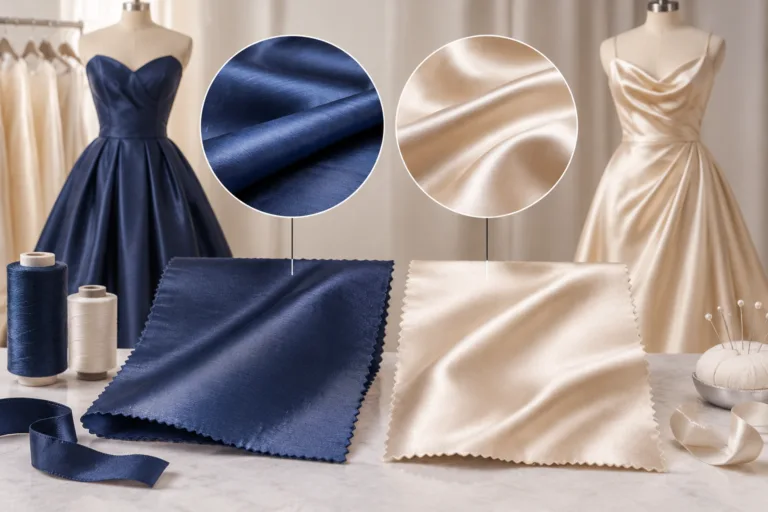
Taffeta vs satin is not a choice between two fixed performance packages. Taffeta fabric is commonly associated with a crisper hand and more controlled structure, while satin fabric is commonly associated with a smoother face and directional sheen. Fiber content, yarn, construction, finishing, fabric weight, and garment design can change the result. This independent guide keeps editorial information separate from Sponsor matters and focuses on how to make a defensible starting choice for eveningwear.
The practical rule is simple: start with the silhouette and surface effect, then verify the specific fabric. A name can suggest a direction, but a sample and its accompanying specification should determine whether the material supports the design.
What Taffeta and Satin Actually Describe
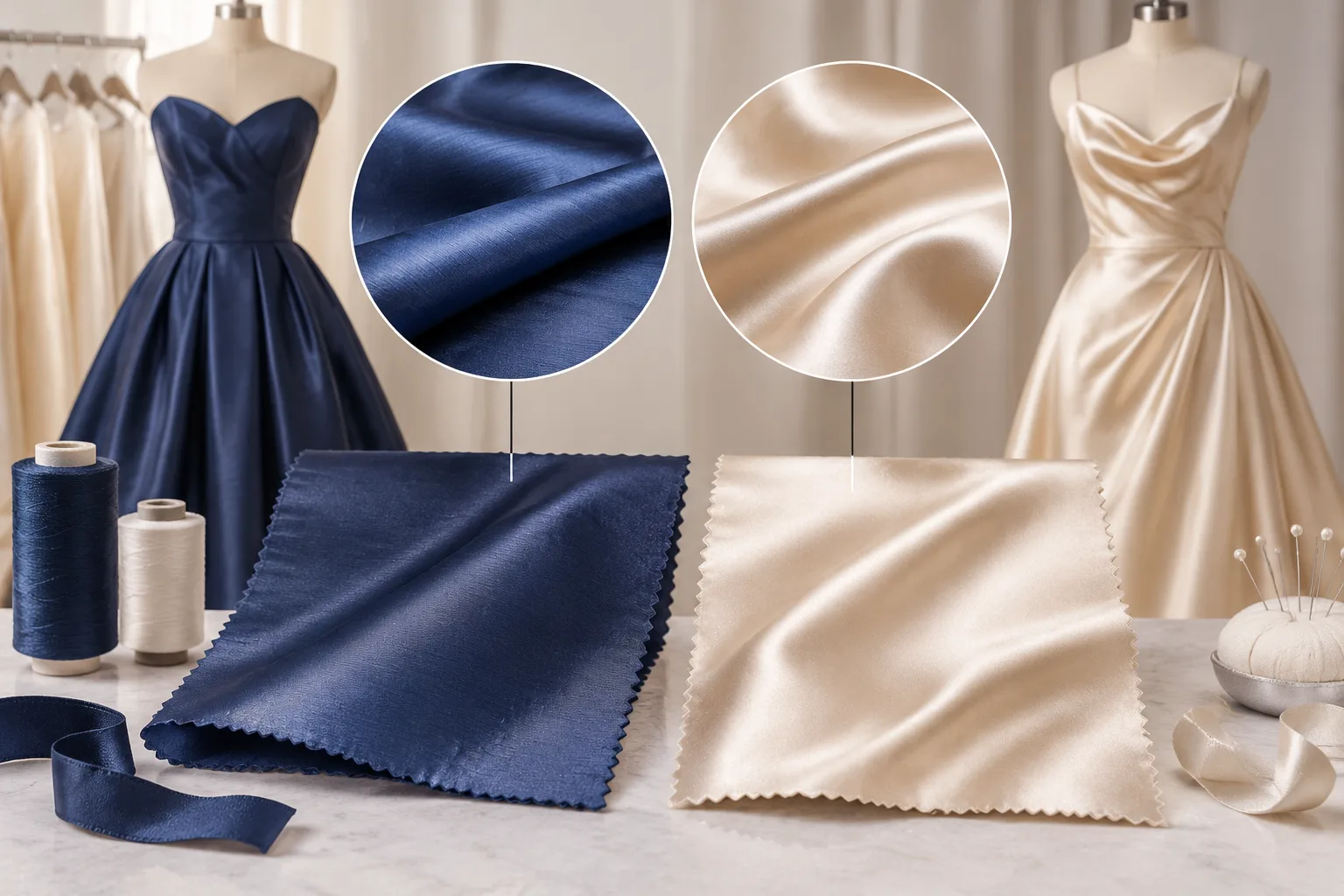
Taffeta and satin describe different layers of fabric information. Taffeta is a fabric category commonly recognized by a relatively crisp hand, a clean surface, and a tendency toward a more structured appearance. Those are useful descriptive tendencies, not universal specifications. A particular taffeta can vary with its fiber, yarn, density, finishing, and weight.
Satin primarily describes a woven construction or surface arrangement associated with a smooth face and sheen. Satin is therefore not automatically silk. Silk can be used to make satin, but satin may also use other fiber types. The commercial name should be read alongside the fiber-content statement and construction description.
This distinction explains much of the taffeta and satin difference. Fabric identity has several layers:
- Fiber content: the material used to form the textile.
- Yarn: the way that fiber is spun, twisted, or otherwise formed into a strand.
- Construction: how yarns are arranged to create the fabric.
- Finishing: treatments or processes that influence the surface and hand.
Two fabrics with the same commercial name can therefore look or behave differently. Conversely, two fabrics with different names may overlap in appearance when their specifications and finishes are similar. The label alone does not establish mass per area, thickness, stretch, drape, recovery, opacity, or care response. Those properties require the actual specification, a relevant evaluation, or both.
In eveningwear, the shorthand remains useful. Choose taffeta as an initial direction when the design needs crisp definition, controlled folds, or a fuller outline. Choose satin as an initial direction when a smooth surface, flowing appearance, or directional light response matters more. Then test the particular fabric against the silhouette instead of treating either name as a guarantee.
How Construction Shapes Structure and Sheen
Sheen begins with the surface that light meets. A smoother surface can reflect more light in a concentrated direction, producing the characteristic shine associated with satin. As the garment, viewer, or light source moves, that reflection can shift. Satin sheen may therefore look different across folds, viewing angles, and photography conditions.
Surface appearance does not tell the whole structural story. Yarn arrangement, fabric density, fiber type, finishing, and fabric mass can all influence hand and movement. A crisp taffeta hand may help a fold hold a sharper outline or support controlled volume, but the final result also depends on the fabric’s particular specification, the pattern, the lining, and the way seams are engineered.
This is why construction should be treated as evidence of a likely behavior rather than proof of a fixed result. A glossy fabric is not automatically fluid, and a crisp fabric is not automatically thick or rigid. Sheen alone does not establish stiffness, drape, opacity, stretch, breathability, durability, or recovery.
Layering adds another variable. A garment made with lining or interlining will not necessarily move like the outer fabric held by itself. Grain direction, pleat depth, gathers, seam placement, and edge treatment can change how the material bends and how its surface catches light. A coating or other finish can also alter the hand and visual response of the fabric.
For eveningwear, separate two questions. First, what does the surface communicate under the intended lighting: subdued, smooth, directional, or highly reflective? Second, what does the construction support in the intended silhouette: fluid movement, defined folds, or controlled volume? The answers may point toward different materials, and neither answer can be inferred reliably from sheen alone.
The same caution applies to wear, pressing, and care. A fabric term describes a material characteristic, not a promise about every finished garment. The more consequential the design decision, the more important it becomes to compare like-for-like specifications and observe the fabric in a construction that resembles the proposed garment.
Taffeta vs Satin for Eveningwear Design Decisions
The most useful eveningwear fabric comparison begins with the design brief. Identify the intended silhouette, the required movement, and the visual effect under actual lighting. Then use taffeta or satin as an initial direction, not as a final approval.
| Design or fabric input | What to observe | Likely implication | Initial direction | What could change the choice |
|---|---|---|---|---|
| Defined folds or controlled volume | Whether the sample keeps a crisp outline when folded or shaped | A more structured appearance may support architectural lines | Taffeta | Weight, finishing, lining, interlining, and pattern shaping |
| Fluid silhouette or continuous surface | How smoothly the sample falls and how its surface reflects light | A smoother, more directional surface may support flowing movement | Satin | Fiber, construction, fabric mass, grain direction, and garment layers |
| Lighting and movement brief | Whether sheen changes attractively or becomes visually uneven | The surface effect may depend strongly on angle and motion | Test both directions | Light source, photography, folds, seams, and finished shape |
For a structured evening dress, taffeta is often a sensible starting direction because its commonly recognized crispness can support defined folds and controlled volume. That does not make it universally better. A lighter or differently finished sample may not create the intended outline, while lining and interlining may alter the result substantially.
For a fluid evening garment, satin is often a sensible starting direction when a smooth face and changing light response are central to the brief. Its surface may look different on a stationary form, a moving wearer, and a photographed garment. The sample must be viewed in conditions that resemble the intended use.
Construction can reverse the first choice. Seam design, pleat depth, grain direction, pattern shaping, lining, and interlining may make a satin garment more controlled or a taffeta garment less architectural than expected. Choose the fabric whose tested sample supports the design brief, then confirm construction and care requirements from the actual specification rather than relying on the label.
Match the Fabric Choice to the Garment Brief
Begin with the garment brief, not the fabric name. Define whether the design needs controlled volume, crisp definition, fluid movement, a smooth reflective surface, or a combination of these effects. Then compare samples against that requirement.
For a lightweight evening garment where a clean, fluid appearance is central, satin is a reasonable initial direction. Its smooth face may support the intended visual effect, but the particular fiber, fabric mass, lining, and construction still need review. A satin with a different specification may produce a different hand or silhouette than the name suggests.
For a design built around defined folds, fuller shape, or an architectural outline, taffeta is often a useful starting direction. Its commonly recognized crispness may support those goals. The preference should be reconsidered if the sample lacks the required hand, surface response, or shape after the intended construction is applied.
The first choice can change when development variables change. Check fiber content, yarn and fabric construction, finishing, mass per area, grain direction, lining or interlining, seam engineering, lighting, movement, and care context. These factors belong in the comparison because they affect what the finished design may communicate and how confidently a sample can represent it.
Use a short selection record for each candidate:
- Design priority: controlled volume, crisp folds, fluid movement, surface sheen, or another defined goal.
- Required visual effect: how the garment should appear at rest, in motion, and under the intended lighting.
- Sample observations: surface direction, hand, fold behavior, noise, bulk, and response to the planned construction.
- Unresolved variables: missing specification details, untested lining combinations, or differences in grain and finishing.
- Next evaluation: the comparison, construction trial, or appropriate expert review needed for any performance claim.
When comparing materials, request like-for-like specifications and measurement conditions. A fabric name alone is not enough for a defensible choice, and a sample observation does not establish durability, colorfastness, care performance, or production approval.
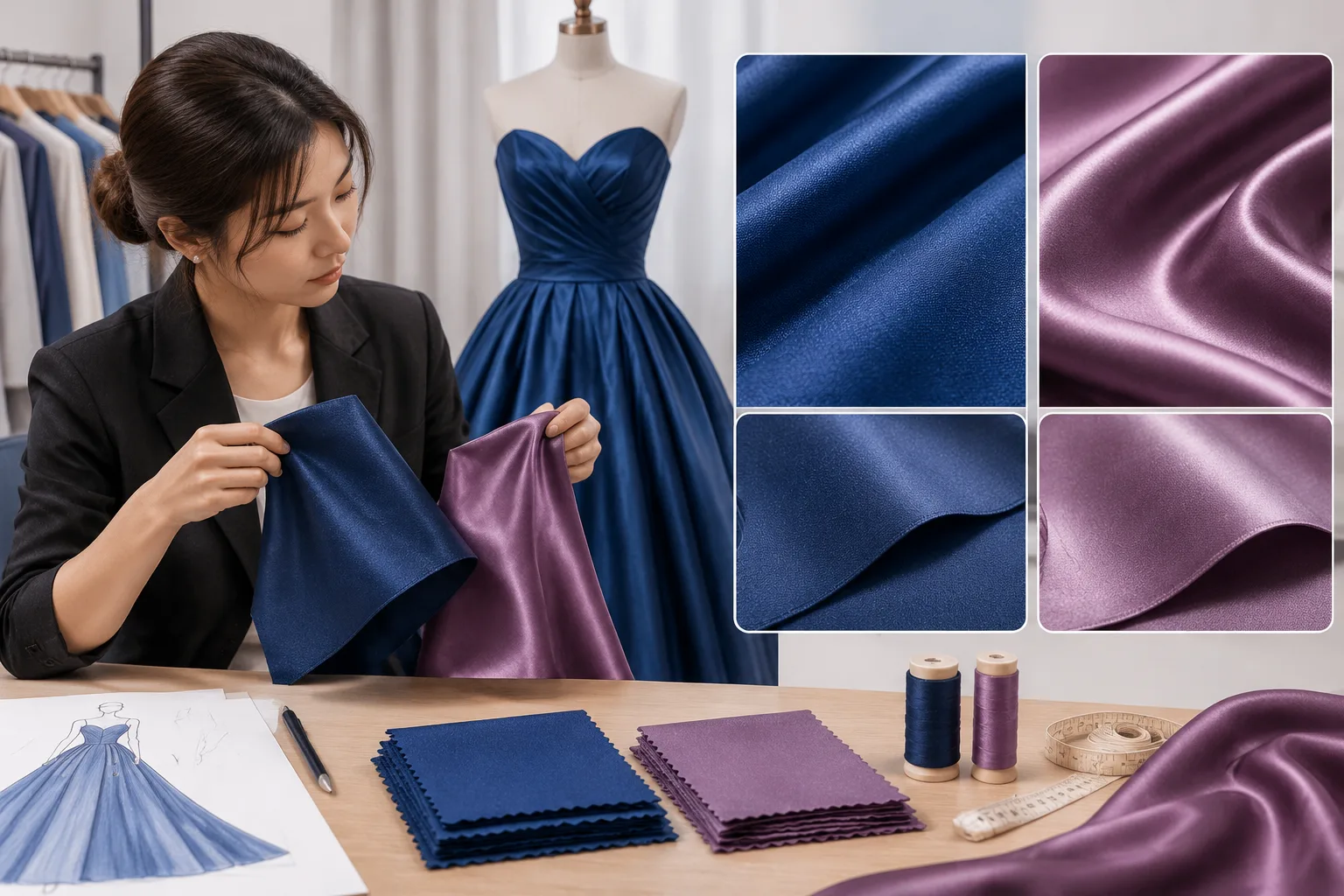
Make the Choice from the Sample and the Brief
For a concise taffeta vs satin comparison, treat taffeta as an initial direction for crisp structure and satin as an initial direction for smooth sheen or fluidity. The actual specification and garment construction control the result. Before finalizing the design direction, compare fiber, construction, finishing, mass per area, usable width, and intended garment layers. Record what the sample shows, identify unresolved variables, and check the applicable evaluation method for any performance claim.
Frequently Asked Questions
Is satin always made from silk?
No. Satin primarily describes a smooth, sheen-producing fabric construction or surface arrangement. It may use different fibers, so check the stated fiber content rather than treating satin as a synonym for silk.
Which is better for a structured evening dress, taffeta or satin?
Taffeta is often the better starting direction when the brief requires crisp folds, controlled volume, or an architectural outline. The actual sample, weight, finishing, lining, and pattern design can change that initial preference.
Which fabric is more fluid for eveningwear, taffeta or satin?
Satin is often the initial direction for a smooth, fluid appearance. That tendency is not guaranteed by the name. Fiber content, fabric mass, construction, finishing, and garment engineering should be checked on the specific sample.
Can fabric sheen predict how a taffeta or satin garment will drape?
No. Sheen describes how the surface responds to light. It does not by itself establish drape, stiffness, opacity, durability, stretch, or care response. A construction trial gives more useful evidence for the intended garment.
What should I compare on taffeta and satin samples before choosing one?
Compare fiber content, construction description, finishing, mass per area, usable width, measurement state, surface response, hand, fold behavior, and performance in the intended lining or garment construction. Record observations separately from verified specifications.
Do lining and finishing change the difference between taffeta and satin?
Yes, they can change the garment’s hand, shape, surface response, and visual effect. Treat the fabric sample as evidence about that material, then review it again with the planned lining, interlining, grain, seams, and pattern shaping.