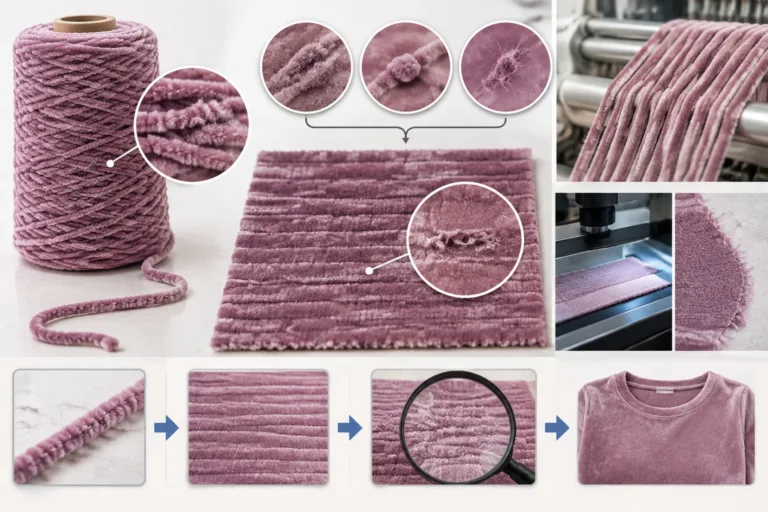
To trace suspected chenille yarn defects, describe the fabric symptom and its distribution, connect it to yarn-lot and process records, then test competing explanations. Appearance alone cannot confirm the cause. Location, repetition, batch concentration, and the stage when the fault appeared provide stronger direction than one close-up photograph. Apparel Wiki approaches this as independent educational analysis; its Sponsor information also explains the publication’s editorial independence.
In this context, chenille yarn quality means the yarn identity, construction, surface consistency, and condition relevant to the fabric under review. The investigation should compare affected and unaffected material under comparable conditions. It should not begin with an assumption that every visible irregularity originated in the yarn.
What Chenille Yarn Defects Can Look Like in Fabric
A possible yarn-related symptom may appear as a local surface irregularity, recurring line, uneven coverage, or apparent thick-thin area. These descriptions are observations, not universal defect classifications. The same appearance could reflect the yarn, fabric construction, equipment conditions, finishing, washing, handling, or even inconsistent inspection conditions.
Start by asking where the fault sits and how it repeats. An isolated mark on one garment carries different information from a line continuing through a fabric roll. A pattern associated with one material batch also differs from a fault found across several yarn lots. In knitted fabric, a suspected line may be described by course or wale direction when that terminology is known. Otherwise, record its direction without guessing.
Repetition can guide the first checks. A fault that consistently follows a yarn path makes package identity, yarn continuity, joins, and feeding history useful subjects for review. It does not prove that the yarn caused the problem. A fault concentrated near one fabric edge, machine position, finishing batch, or handling point may reprioritize other explanations.
Create a fault description record before separating samples. Include:
- the visible appearance and viewing conditions;
- the position and direction within the fabric;
- frequency, continuity, and spacing, without inventing a tolerance;
- the garment, panel, roll, or batch location;
- the yarn lot and package identity, if traceable; and
- whether the symptom was visible before or only after finishing or washing.
Photographs should show both detail and context. Preserve the surrounding fabric whenever possible, because cropping can hide recurrence or alignment. These records allow investigators to rank hypotheses and choose a useful comparison. They do not constitute a laboratory diagnosis, production approval, or formal pass/fail decision.
Map Fabric Symptoms to Possible Yarn-Level Clues
Fabric fault analysis works best as a comparison, not a visual lookup exercise. The table below maps observations to initial yarn-level clues while retaining alternatives. Each row points to evidence that could strengthen, weaken, or redirect the yarn hypothesis.
| Observable fabric input | Possible yarn-level clue | Competing explanation | Useful record or observation | What could change the priority |
|---|---|---|---|---|
| Localized surface irregularity | Local yarn damage, join, contamination, or surface inconsistency | Handling damage or a local fabric-formation event | Preserve the area and any corresponding yarn sample | Whether the mark crosses multiple yarn paths |
| Repeated streaking or striping | Continuity associated with one package, lot, or feed history | Machine position or fabric-construction variation | Map direction, recurrence, package changes, and machine position | Whether the line remains when the yarn or position changes |
| Inconsistent pile or coverage | Possible variation in yarn construction or surface condition | Fabric density, finishing, washing, or viewing conditions | Compare affected and unaffected areas under the same lighting | Whether the difference existed before finishing |
| Apparent thick-thin variation | Possible change in yarn continuity or description | Distortion, tension-related appearance, or uneven fabric formation | Check retained yarn, package transitions, and fabric position | Whether the apparent variation persists outside the fabric |
| Faults concentrated in one material batch | A lot-linked yarn difference becomes more relevant | A batch-specific process or finishing route | Compare lot, receipt, production, and process records | Whether unaffected fabric used the same lot and route |
For example, a recurring line in a lightweight chenille knit or woven fabric would justify checking yarn-lot identity, package changes, and feeding history early. Yet fabric construction and machine settings could change that priority. The smallest informative comparison may be an affected area against an unaffected area made with the same yarn description and process route.
Record evidence against the favored explanation as carefully as supporting evidence. If the same yarn lot appears in unaffected fabric, that does not automatically clear the yarn, but it narrows the conditions under which a yarn-related effect could occur.
Check Chenille Yarn Quality Before Calling It the Root Cause
A useful chenille yarn inspection starts with traceability. Build an evidence block containing the supplier or internal lot identity, package or cone identity where available, complete yarn description, production or receipt records, affected fabric location, and retained samples. Link each photograph and sample to that record rather than relying on filenames or memory.
Preserve the yarn numbering system exactly as supplied. Tex, denier, and dtex are direct linear-density units, while indirect count systems express count differently. They should not be compared as bare numbers. Likewise, a notation such as 30/2 needs confirmation: determine what count system is being used and whether the notation describes the single yarn and its plying. Do not infer construction from the number alone.
Compare affected and unaffected yarn or fabric for visible continuity, surface consistency, package transitions, joins, contamination, and damage. Keep lighting, viewing distance, fabric construction, and process history comparable where practical. These are qualitative observations. They may direct the investigation, but they do not prove performance or establish an acceptance threshold.
Fiber content and yarn construction also belong in the comparison. Mixed-fiber yarns or differently constructed yarns can behave differently within a fabric, but the effect cannot be assigned to fiber content alone. Record the fiber description, yarn structure, and fabric construction together, then check whether the affected and reference materials actually match.
Routine record review must remain separate from validated testing. If the decision requires a numerical result, named test method, sampling plan, or specification limit, identify the applicable authoritative method and the required measurement context. Do not create a limit from visual comparison or from a result expressed in an incompatible unit.
The initial conclusion should therefore be narrow: the records and matched observations either support, weaken, or leave unresolved the possibility of a yarn contribution. Calling chenille yarn quality the root cause requires stronger evidence than resemblance between a fabric symptom and a familiar defect description.
Separate Yarn Defects from Fabric and Process Causes
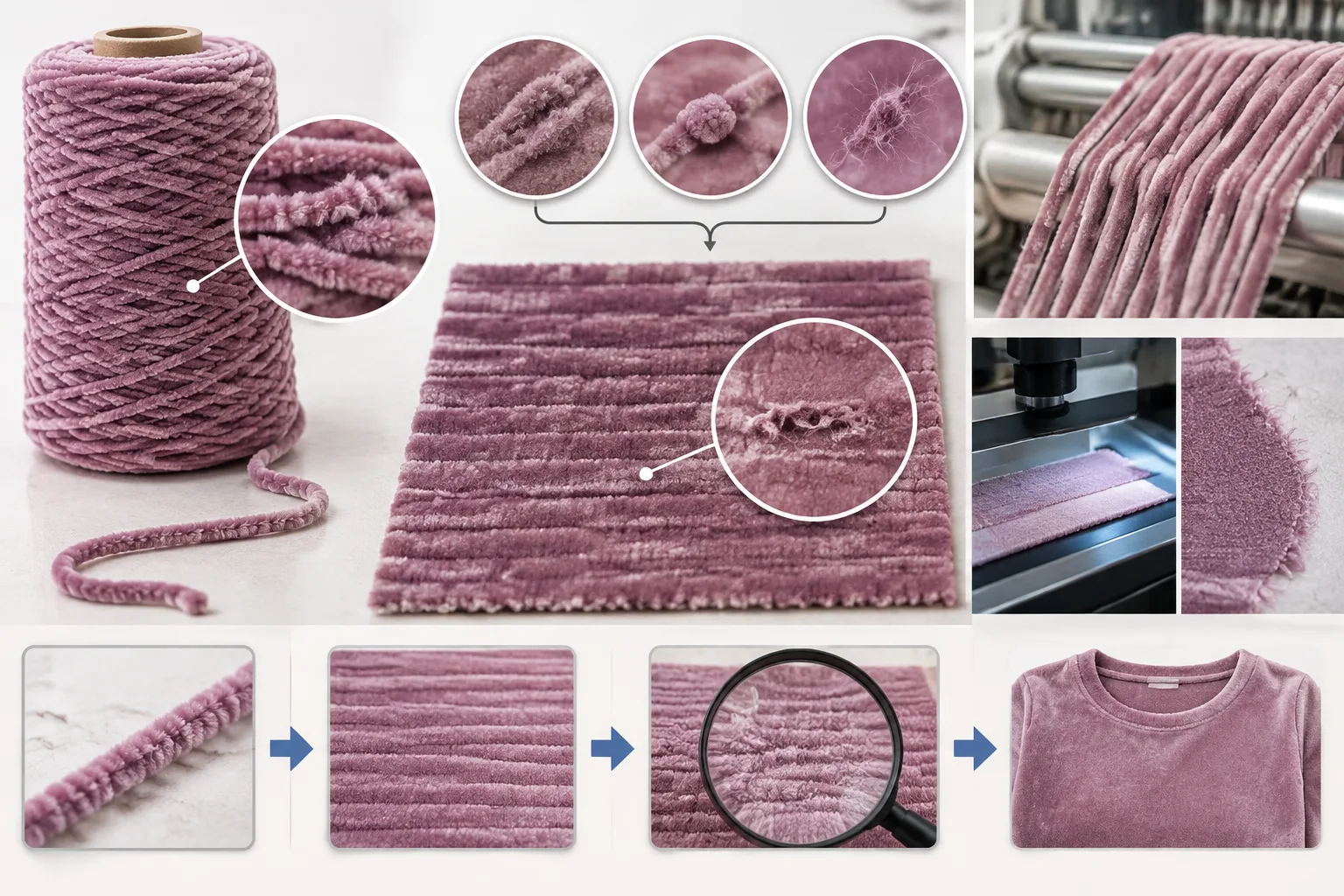
A fabric symptom should be traced through the stage where it first appears. If a similar irregularity is visible in the yarn package or retained yarn sample, a yarn contribution deserves review. If it appears only during fabric formation, after finishing, after washing, or during handling, other explanations remain active.
This sequence does not prove causation. A yarn-related variation may become visible only after the yarn is formed into fabric or exposed to a later process. Conversely, fabric construction, equipment conditions, finishing, washing, handling, or inspection conditions can create an appearance that resembles a yarn defect. The useful question is not “Which cause is most familiar?” but “Which explanation best fits the complete pattern?”
Compare affected and unaffected material using matched observations wherever practical:
- the same yarn description, fiber content, and construction;
- the same fabric structure and comparable fabric position;
- the same machine, feeding position, or production route where records are available;
- the same finishing and washing history; and
- the same handling and viewing conditions.
Pattern evidence can reprioritize the investigation. Continuity along a yarn path, recurrence at a consistent fabric position, or concentration within one yarn lot may increase the value of checking package identity, yarn records, or feeding history. These observations still do not establish that the yarn caused the fault. They indicate where the next comparison may be most informative.
Consider a surface irregularity that is absent in an unfinished sample but visible after finishing. It would be premature to assign the result to chenille yarn quality. The finishing route, fabric structure, pre-existing material variation, and the way the fabric was inspected should remain in the comparison. The important observation is the stage at which the appearance changed, not the assumption that the last visible material must be responsible.
Preserve samples from before and after each relevant process stage when possible. Mark their identity and location, then record what changed between stages. Photographs should retain enough surrounding fabric to show direction, spacing, and position. A close image can document appearance, but it cannot replace process history or matched material evidence.
Use a Traceable Investigation to Confirm or Reject the Yarn Hypothesis
A useful investigation turns a visual concern into a documented comparison. Start by describing the fabric symptom without assigning a cause. Record its appearance, direction, continuity, frequency, fabric location, garment or roll location, and the stage when it was first noticed.
- Isolate matched material. Preserve affected and unaffected fabric, and retain relevant yarn samples or packages when available. Keep identifiers attached to each sample.
- Link the records. Connect the fabric location to yarn lot or package identity, fabric construction, machine or position records, finishing route, and care or handling history where available.
- List competing hypotheses. Include yarn contribution, fabric formation, equipment or feeding conditions, finishing, washing, handling, and inspection or measurement error when relevant.
- Choose the smallest useful comparison. Where practical, change one relevant variable, such as yarn lot or package identity, while keeping fabric structure and process conditions comparable. This is an investigation principle, not a universal trial specification.
- Record support and counterevidence. For each hypothesis, note what supports it, what would weaken it, and what observation or validated test would provide the next useful distinction.
- State the result narrowly. Describe the yarn hypothesis as confirmed, weakened, unresolved, or requiring validated testing. Do not use certainty language based only on visual resemblance.
The comparison should be designed around the question being asked. If a fault follows one yarn package but not a matched reference package, that pattern may support further yarn review. If the same appearance occurs across different yarn identities but at one fabric position, fabric formation or equipment conditions may deserve greater attention. Either result remains a ranked interpretation until the available evidence supports a stronger conclusion.
A handoff-ready evidence package should include photographs with context, sample identifiers, a map of the affected fabric location, yarn and batch records, process-stage observations, matched reference details, and the reason any external test or method review is being considered. Keep visual inspection, record review, and formal measurement clearly separated. A formal result requires the applicable method, units, sampling context, and specification or decision rule.
This workflow also allows an unresolved outcome. Missing records, unmatched samples, or a fault that appears only after several process stages may prevent a reliable attribution. Recording that limitation is more useful than forcing a yarn diagnosis that the evidence cannot support.
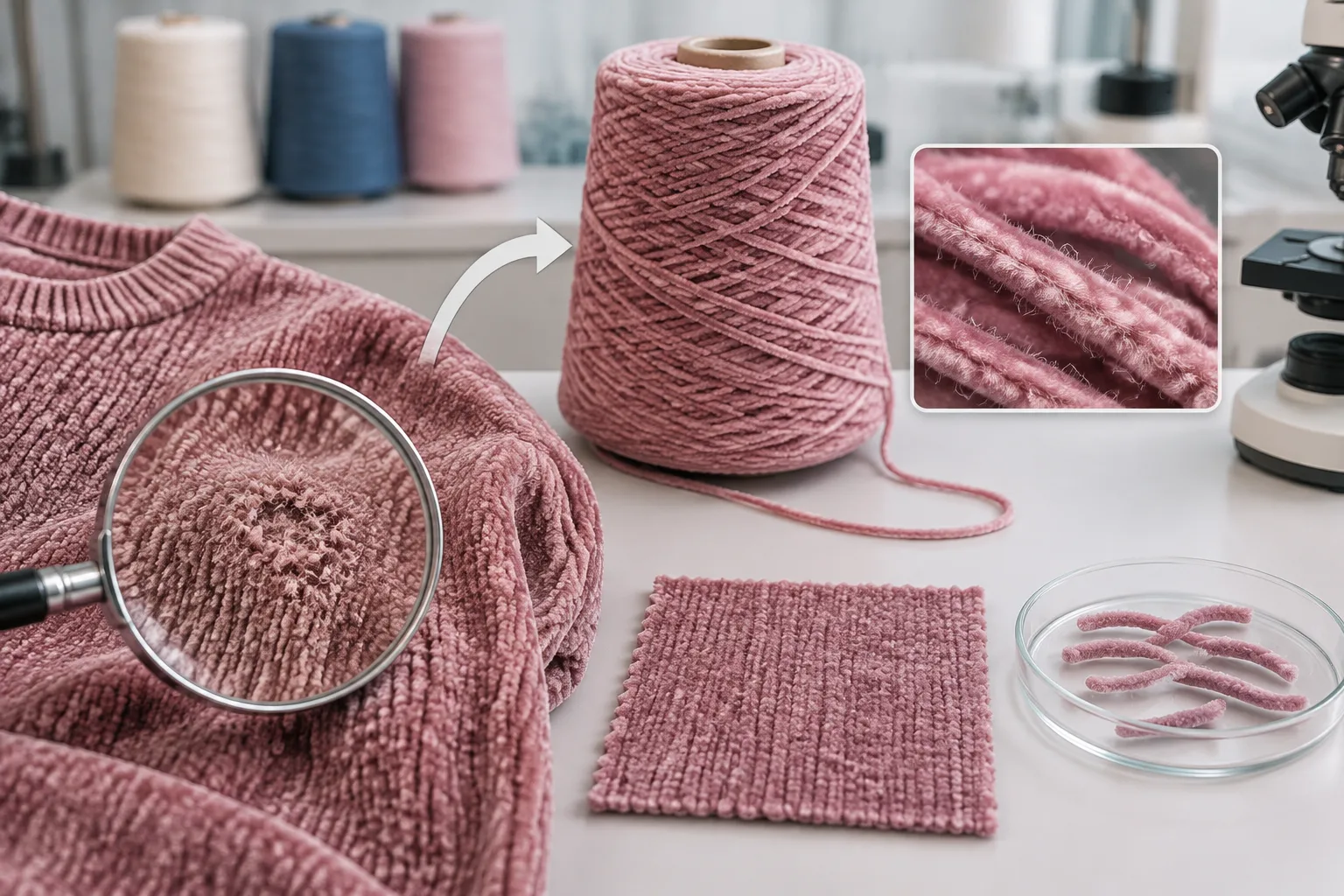
Build the Yarn-to-Fabric Fault Trail
Chenille yarn defects are one possible explanation for a fabric symptom, not a diagnosis from appearance alone. Describe the fault precisely, connect it to traceable yarn and process evidence, compare competing causes, and state what remains unknown. As the educational next step, create a matched-sample comparison record, preserve the relevant specifications and production history, and check the applicable authoritative method when visual evidence cannot resolve the cause.
Frequently Asked Questions
Can a fabric photograph confirm a chenille yarn defect?
No. A photograph can document appearance, direction, continuity, and surrounding context, but it cannot establish whether the cause was yarn, fabric formation, finishing, handling, or inspection. Compare the image with matched samples and traceability records before treating yarn quality as the root cause.
Which fabric observations are most useful when tracing a fault back to chenille yarn quality?
Record the fault’s location, direction, repetition, frequency, continuity, batch concentration, and the stage when it first appeared. These details are more informative than an isolated close-up because they help compare yarn, fabric construction, equipment, finishing, and handling explanations.
How should affected and unaffected chenille yarn or fabric samples be compared?
Use matched observations where possible: the same yarn description, fabric construction, machine or position, finishing route, and handling history. Keep sample identities attached, compare under similar viewing conditions, and label visible differences as observations rather than proof of performance.
How can I tell whether a chenille fabric fault began during yarn formation or fabric production?
Compare retained yarn or package samples with fabric from relevant process stages. A feature present in the yarn may support a yarn hypothesis, while a feature first appearing during fabric formation may reprioritize process causes. Neither pattern proves causation without sufficient supporting evidence.
What yarn information should be recorded before investigating a chenille fabric fault?
Record the supplier or internal lot, package or cone identity where available, yarn description, fiber content, construction, production or receipt records, affected fabric location, and retained samples. Preserve the original counting system and clarify any notation describing single or plied yarn.
When is an authoritative test method needed instead of a visual yarn inspection?
Use the applicable authoritative method when the decision requires a numeric result, named test method, sampling plan, specification limit, or formal production decision. Visual and record review can guide the investigation, but they do not create a validated threshold or laboratory result.