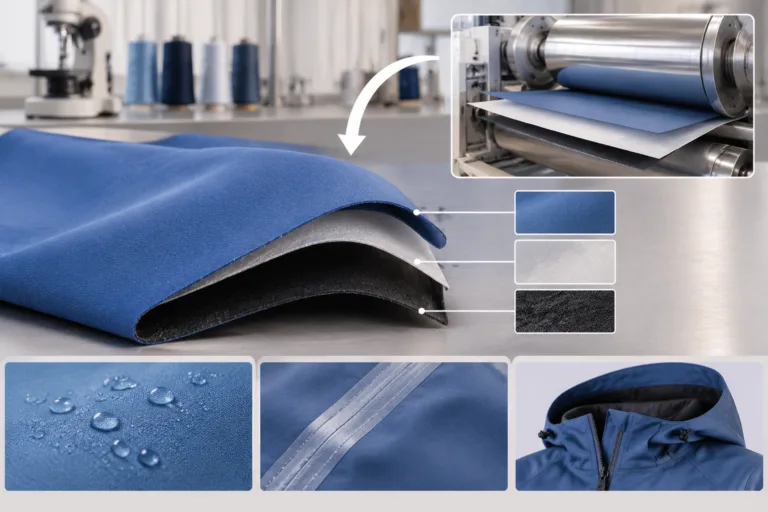
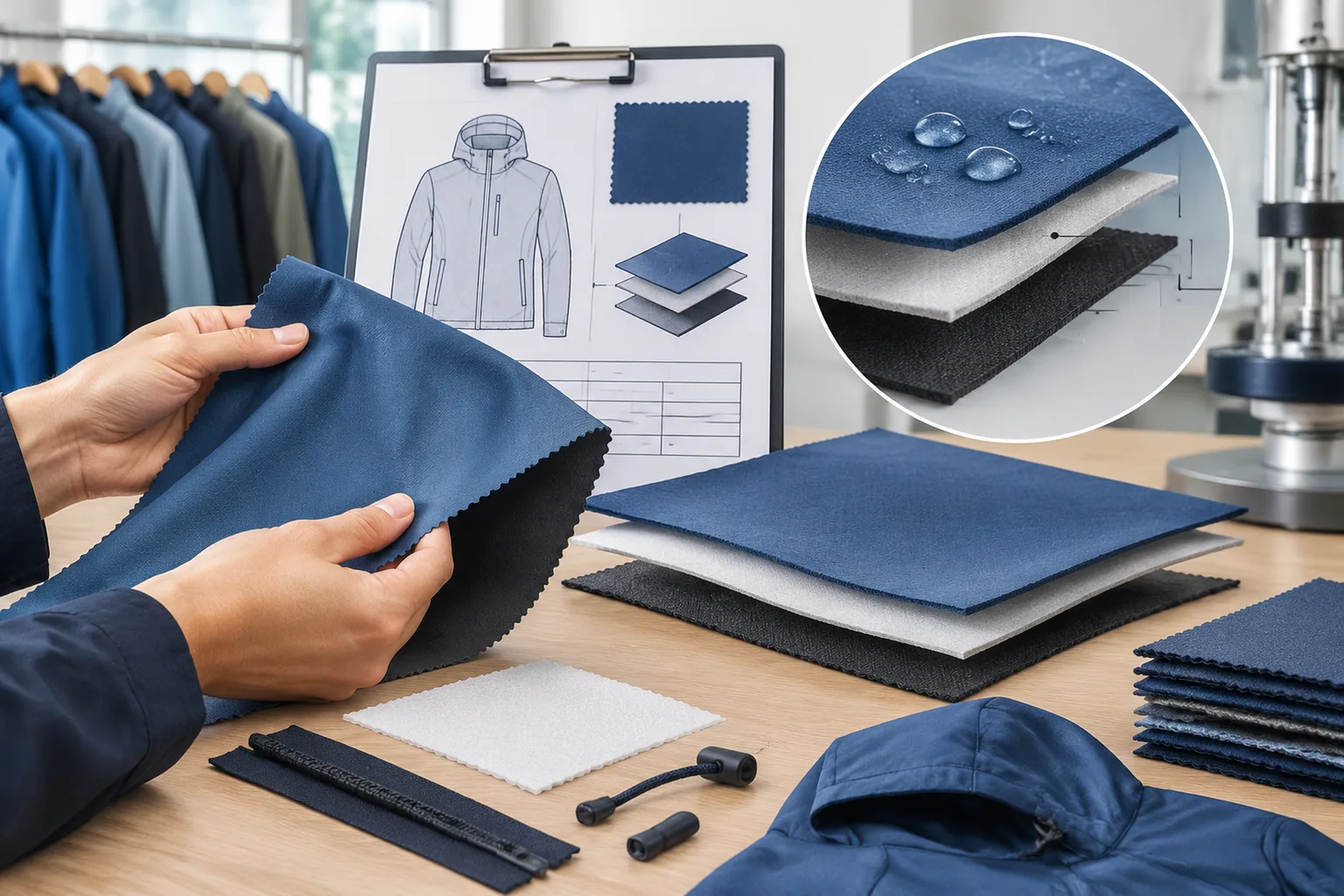
Three layer shell fabric construction commonly combines an exterior face textile, a middle membrane or functional film, and an inner backing textile in one bonded laminate. These are three components of a fabric assembly, not three separate garment layers. Exact materials and bonding details vary by product, so the layer count describes architecture rather than guaranteeing a particular result. Apparel Wiki approaches this subject as an independent educational publication; its Sponsor disclosure explains that sponsorship does not provide paid control over editorial content.
Understanding this arrangement helps product teams ask better questions. Instead of accepting “three-layer” as a complete specification, they can identify each component, examine how the components are joined, and compare the complete laminate with its intended garment use.
What Three-Layer Shell Fabric Construction Means
A three-layer shell fabric commonly has a face textile on the outside, a functional membrane or film in the middle, and a backing textile toward the garment interior. Lamination joins these components so the material can be handled and cut as one composite fabric.
Here, “layer” identifies a position and role within the assembly. It does not mean that all three components are interchangeable fabrics. The middle component may differ substantially from the textiles placed on either side. Likewise, a backing used in one product may not resemble the backing used in another.
The term also leaves many specification questions unanswered. It does not identify fiber content, yarn characteristics, woven or knitted structure, finish, fabric mass, usable width, or the exact bonding approach. A commercial fabric name may identify a product family without settling those details. Fiber, yarn, textile structure, and finishing should therefore appear as separate description fields where relevant.
A three-layer shell fabric is also different from a complete three-layer garment system. The laminate is the material supplied for garment production. The finished garment adds pattern pieces, seams, stitching, closures, edge treatments, and other construction decisions. Those elements can affect how the garment functions, even when the same laminate is used.
For this reason, layer count should be treated as the start of a construction description. A useful specification explains what occupies each position and how the assembled material is defined. It should not ask readers to infer exact properties from “three-layer” alone.
The Face, Membrane, and Backing: What Each Layer Does
The face is the exposed textile layer of the laminate. Its specification may include fiber content, yarn details, a woven or knitted structure, color, and applied finishes. These are separate attributes. For example, “woven” identifies a structural category rather than a fiber, finish, or complete performance profile.
The middle layer is a distinct membrane or functional film. Its role should be described from product-specific documentation. The general term does not reveal its polymer, physical structure, or operating mechanism. Those details should not be assumed from the three-layer label or from the identity of the face textile.
The backing faces the garment interior and supports or protects the inner side of the assembly. It may be made with a different fiber content or textile construction from the face. Its exact form is product-dependent, so “backing” describes its place and general role rather than a universal material.
| Component | Position | Useful specification questions |
|---|---|---|
| Face textile | Exterior side | What are its fiber content, textile structure, and finish? |
| Membrane or film | Middle | What material and functional description does the product documentation provide? |
| Backing textile | Interior side | What are its composition, structure, and relationship to the bonded assembly? |
These three roles provide a practical way to read a specification, but they do not prove that every shell uses identical materials. No single layer establishes the behavior of the complete laminate. Comparisons should account for the face fabric, membrane, backing, joining method, and any relevant finishing.
How the Layers Are Joined into a Shell Laminate
Lamination means joining the face, functional middle layer, and backing so they form a composite textile. The joining interfaces are part of the construction. They are not merely incidental boundaries between three independently behaving materials.
Shell fabric bonding can use different materials, application patterns, equipment, and process conditions. Without product-specific technical documentation, it is not appropriate to prescribe one adhesive, temperature, pressure, or production sequence as universal. Even fabrics with the same layer order may use different joining details.
Bonding changes the object being evaluated. A face textile considered alone does not include the constraints or interactions introduced by the membrane, backing, and joined interfaces. Its description or test result therefore cannot, by itself, establish how the finished laminate will behave. The same caution applies to information covering only the backing or middle component.
The interfaces also deserve attention when a laminate is reviewed. Separation between components, often described as delamination, is one possible concern. Other observable concerns include local lifting, bubbling, wrinkling, or changes after the material is folded, flexed, washed, or stitched. Whether a change is acceptable requires an appropriate specification and evaluation method; visual inspection alone does not establish a universal failure threshold.
Three-layer shell lamination should therefore be documented as a complete assembly. Component information remains useful, but it should sit beside information about the joined laminate rather than replace it.
Construction Choices That Change the Fabric
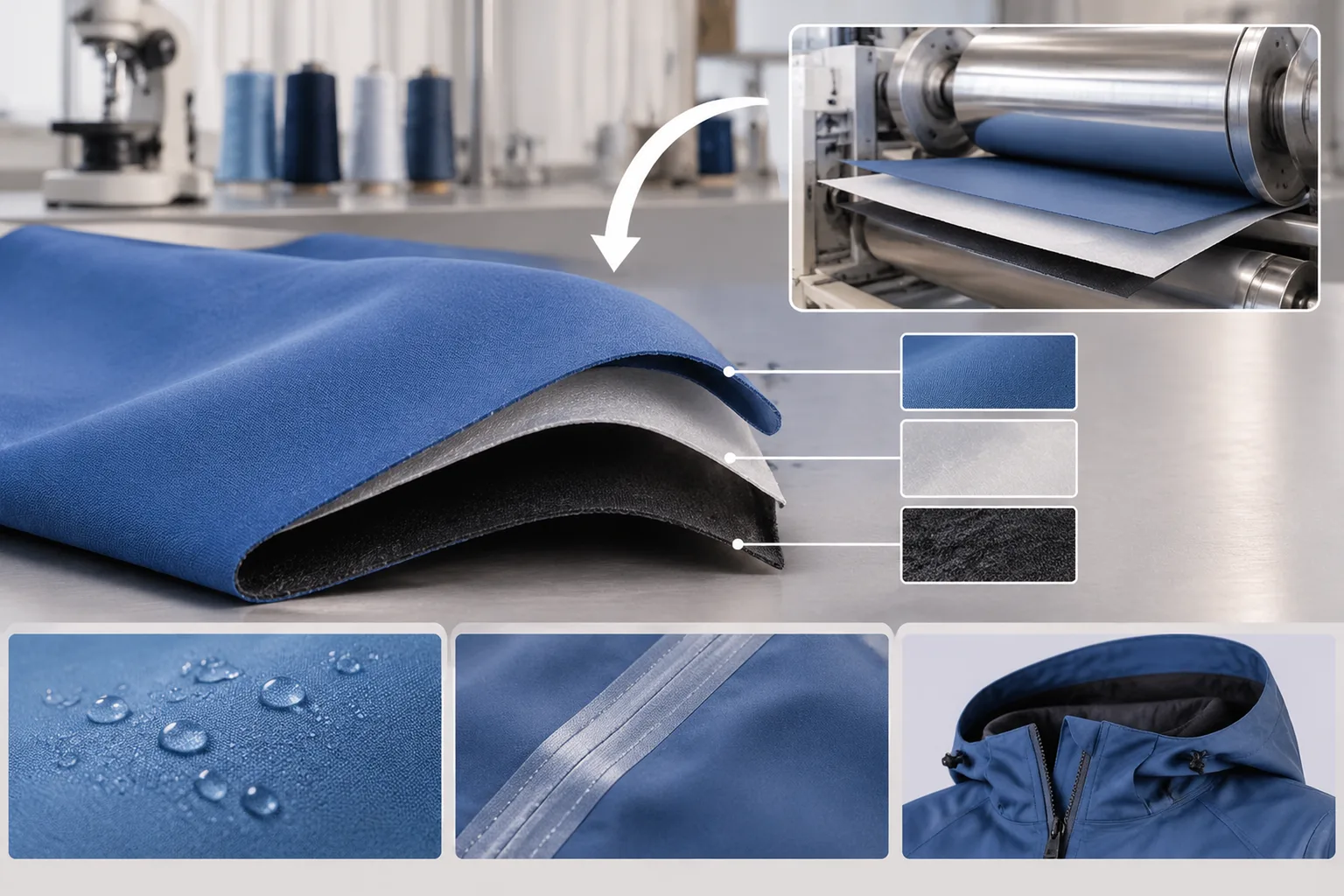
Three-layer shell fabric specifications can differ at every component. The face and backing may use different fibers, yarns, and textile structures. A knitted or woven description offers a structural clue, but neither category alone determines stretch, breathability, durability, or suitability for a garment.
Finishes add another specification level. A finish may be applied to a textile component or described for the assembled fabric, so its location and scope should be clear. A finish name should not substitute for the composition and construction of the underlying layers.
Fabric mass and usable width are also important commercial and production details. Fabric mass expresses mass per unit area; it is not the same as thickness and is not a quality grade. Usable width identifies the area available for cutting, which may differ from the total edge-to-edge width. Neither value explains the three-layer architecture or proves a performance level.
Shell laminate material choices involve project-specific trade-offs. A construction selected for one garment may not suit another pattern, sewing process, care expectation, or end use. The relevant comparison is therefore not simply whether two materials carry the same three-layer label. It is whether their component descriptions, finishing, assembled construction, and supporting evidence address the same development question.
A like-for-like comparison should separate architecture from claimed results. First compare the identity and construction of the face, membrane or film, backing, and bonded assembly. Then compare any stated result only when its sample scope, conditions, and method are sufficiently clear. If those details differ, the result may answer a different question even when both products are described as three-layer shell fabrics.
How to Read a Specification and Evaluate a Sample
A useful three-layer shell fabric specification should identify the assembled laminate and describe its components separately. Begin by checking whether the document distinguishes the face textile, middle membrane or functional film, and inner backing. For the textile layers, look for fiber composition and textile structure as separate fields. A commercial material name alone may not provide either detail.
Review the specification in a consistent sequence:
- Identify the supplied material. Determine whether each statement describes one component, the bonded laminate, or a finished garment. These are different evaluation scopes.
- Check component details. Look for the composition and construction of the face and backing, the identity of the functional middle layer, and any stated finish. If a field is missing, record it as unknown instead of inferring it from a trade name.
- Review physical information. Keep fabric mass, usable width, and other supplied dimensions distinct from the layer arrangement. These values help with comparison and production planning, but they do not prove quality or performance.
- Examine claimed results. Ask which specimen was evaluated, whether it was a component or the complete laminate, what method and conditions were used, and whether the result applies before or after any stated treatment.
- Match the evidence to the application. Compare results only when their specimen scope and evaluation conditions address the same development question. Similar labels do not make unlike evidence directly comparable.
A physical sample adds information that a specification sheet may not communicate. Handle the bonded material as a complete assembly. Observe whether its surfaces and interfaces remain consistent during ordinary folding and flexing. If the development process includes washing or stitching, review the material again afterward. Areas showing lifting, bubbling, wrinkling, separation, or changes near stitches deserve further investigation.
These observations are screening steps, not formal test results or certification. They can reveal questions that need a documented evaluation method, but they do not establish a pass threshold or predict service life. Record the sample condition, preparation, handling, and garment operation involved so later comparisons use the same context.
Garment construction also changes the question being asked. Seams, closures, pattern geometry, stitch choices, and care conditions introduce variables that a fabric-level statement may not cover. When the garment design or intended use changes, reassess which evidence is relevant. Do not transfer a result for one component, laminate sample, or construction directly to a different finished garment.
What Layer Count Does Not Tell You
The three-layer shell fabric meaning is architectural: it indicates a joined arrangement of three functional positions. The count alone does not identify the face or backing fiber content, yarn characteristics, woven or knitted structure, exact membrane material, finish, bonding process, fabric mass, usable width, or measured performance.
It also does not show whether a reported result applies to the face textile, the membrane or film, the complete laminate, or a finished garment. Each result needs a defined specimen scope, method, condition, and evaluation state. Evidence from one layer should not be generalized silently to the bonded assembly. Likewise, laminate-level evidence should not automatically become a finished-garment claim.
Two materials can therefore share a three-layer description while differing in component identity, construction, finishing, joined interfaces, and supporting evidence. Read the actual specification and relate each statement to its subject. For development decisions, use information that addresses the intended fabric, garment construction, care conditions, and end use.
A Practical Next Step for Comparing Shell Fabrics
Create a side-by-side comparison that separates the face, functional middle layer, backing, finish, laminate details, fabric mass, and usable width. Then list each stated result with its specimen scope, method, and conditions. Treat two three-layer fabrics as equivalent only where the relevant information supports that comparison. If a component description or evidence detail is absent, mark the uncertainty and request clarification instead of converting the shared layer count into a performance assumption.
Frequently Asked Questions
What are the three layers in a three-layer shell fabric?
The common arrangement is an exterior face textile, a middle membrane or functional film, and an inner backing textile. They are joined into one laminate. Exact fibers, textile structures, finishes, middle-layer materials, and bonding details vary among products.
Is three-layer shell fabric the same as a three-layer garment?
No. A three-layer shell fabric is a laminated textile architecture. A finished garment also includes its pattern, seams, stitches, closures, and other construction details. Fabric-level information does not describe or establish the behavior of the entire garment.
Does the term three-layer shell specify the face fabric or membrane material?
No. The term identifies the arrangement, not the exact materials. The specification should separately state the face textile’s composition and structure, the middle functional layer’s identity, and the backing details. A trade name may not supply all this information.
Why should a bonded shell fabric be evaluated as an assembly rather than by its face fabric alone?
Bonding creates interfaces between components, and the assembled laminate may behave differently from the face textile considered alone. Evaluation should therefore include the joined material and examine relevant changes after handling or garment operations. Face-fabric information cannot establish laminate performance by itself.
What details should a specification include when comparing three-layer shell fabrics?
Look for separate descriptions of the face, functional middle layer, backing, finish, bonded assembly, fabric mass, and usable width. For any stated result, also check the specimen, evaluation method, conditions, and treatment state. Missing details should remain documented uncertainties.