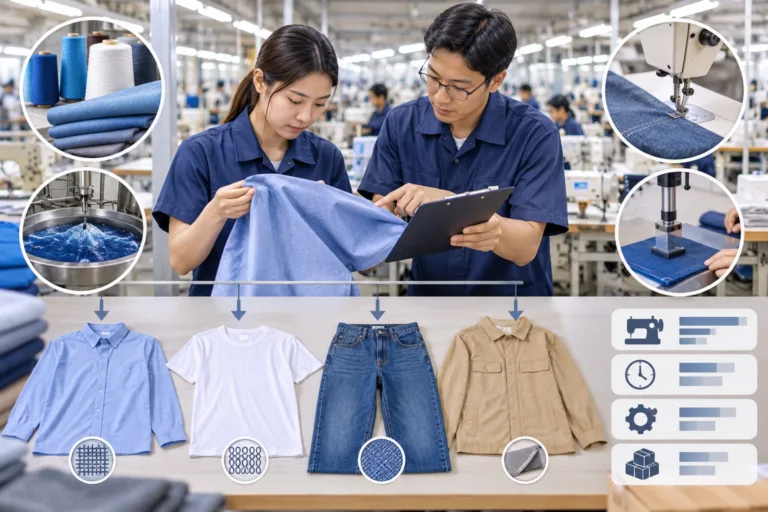
The scope of online apparel safety information is practical but limited. It can help you understand terminology, spot possible hazards, identify labeling or documentation questions, compare testing pathways, and locate the authority that may control a decision. It does not automatically prove that a specific garment meets every applicable requirement. For background on Apparel Wiki’s editorial context, see the Sponsor page.
The useful boundary depends on the product, wearer, intended use, sales market, and source status. A general article may explain what to investigate, while a direct authority may state a current rule for a defined market. A laboratory result may describe a tested sample and method. An editorial recommendation may help organize research. Apparel Wiki is an independent garment-manufacturing knowledge publication, not a regulator, laboratory, certifier, or compliance approval service.
Online Apparel Safety Information Scope: What It Can Tell You
Safety information covers more than a statement that a garment is “safe.” Depending on the product and question, it may address possible hazards, material or component concerns, labeling questions, documentation, traceability, or routes for testing. These topics are connected, but they do not necessarily come from one rule, one source, or one piece of evidence.
The first distinction is between learning about an issue and proving a result. An online explanation can alert a product team to a possible concern, define unfamiliar terminology, or suggest which authority to consult. That is useful orientation and issue-spotting. It is not proof that a particular garment satisfies an applicable requirement. Proof, where required, depends on the relevant source, product scope, market, current status, and evidence specified for that question.
The same garment description can lead to different research questions. A shirt sold as ordinary clothing may require one type of inquiry in one market, while a similar product marketed for protective use may raise a different classification question. The wearer group can also change the research boundary. A description such as “cotton children’s sweatshirt” is not enough to establish which information applies without knowing where it will be sold, how it is presented, and which claims accompany it.
When reading online material, identify what kind of statement you are seeing:
- Educational guidance: explains a concept or research path.
- Direct-source fact: states what an identified authority or responsible source says within its defined scope.
- Laboratory or test information: describes a method, sample, or result with stated boundaries.
- Editorial recommendation: suggests a prudent way to organize questions.
- Assumption or example: illustrates reasoning without establishing a product fact.
Use online material to define what must be checked, then consult the relevant current authority or qualified specialist when making an actual determination. The scope of online apparel safety information is therefore best understood as a map for disciplined research, not a universal compliance verdict.
Start With the Product, Wearer, and Market Boundaries
Before searching for apparel safety requirements by market, write a short product-boundary brief. Record the garment type, materials or components that may matter, intended wearer, intended use, sales location, and the way the product is presented. Note whether it is ordinary clothing or is described as providing protection. These details frame the research; they do not, by themselves, settle compliance.
This applicability-first step prevents a broad search result from being treated as a universal apparel rule. Children’s and adult products should not automatically be researched through the same list. Ordinary clothing and protective products may require different questions because their intended functions and claims differ. A statement useful for one sales market may not answer the question for another. Presenting a garment for a particular use can also change which product boundaries need verification.
The reader’s role matters as well. A brand, designer, importer, manufacturer, seller, and researcher may need to investigate different records or responsibilities. One person may be defining product claims; another may be assembling material information; another may be checking market-entry documentation. Do not assume that a single party, document, or online checklist answers every role-specific question.
Keep the market and product assumptions beside each source you collect. A simple research note might say which garment is being considered, who is expected to wear it, where it may be sold, what use is intended, and which statement the source appears to support. This makes it harder to carry a useful statement into a different jurisdiction or product without noticing the change.
For example, an everyday outer layer should be researched differently if its product claims or intended use position it as protective equipment. That change does not prove that a particular protective classification applies. It signals that the reader must verify the classification and applicable requirements through the responsible authority or current official guidance. The scenario is a warning about changed scope, not a global rule.
Apparel Wiki can explain this reasoning framework, but it cannot provide one worldwide pass conclusion. Start with the product boundary and operating market, then identify the authority and evidence relevant to that defined case.
Separate Educational Guidance From Authoritative Evidence
Online compliance guidance becomes easier to use when each source is assigned a limited job. Instead of ranking pages with an unsupported reliability score, ask what the source can establish, what it leaves open, and what action should follow.
| Source or statement type | What it can establish | What it cannot establish | Next action |
|---|---|---|---|
| Editorial explanation | Definitions, distinctions, and a practical research path | That a specific garment complies in a particular market | Use it to frame questions and find the relevant direct source |
| Official rule or regulator guidance | The wording or status of a requirement within its stated scope | That every product or market falls within that scope | Check jurisdiction, current version, effective date, and product fit |
| Laboratory or test-method material | The method, sample, or result described by the material | Every labeling, documentation, traceability, or market obligation | Match the evidence to the specific question and applicable source |
| Supplier or platform information | A lead about a material, component, claim, or available document | Independent proof that the finished garment meets all requirements | Request context and confirm the claim through the appropriate source |
| Assumption or example | A way to illustrate how a decision could be structured | A fact about a real product, rule, test, or market | Replace the assumption with product-specific evidence before deciding |
A direct source is stronger for establishing its own wording or status, but it still needs interpretation within its stated boundaries. Check the jurisdiction, product scope, current version, effective date, and fit with the garment under review. A page that accurately describes one requirement may still be irrelevant to another product or market.
A test report or test-method description also has defined scope. It may address a particular sample and method, but it does not automatically resolve labeling, documentation, traceability, or other procedures. One apparel safety test report is not a universal answer to every safety and compliance question. Match each evidence item to the claim it is meant to support.
Supplier pages, summaries, and search snippets are useful leads, especially when they reveal terminology to investigate. Treat them as leads requiring context and confirmation, not as automatic proof. Preserve the source link, title, publication or update date, jurisdiction, product scope, and the conclusion you believe it supports. Also record what the source does not answer.
This source-boundary approach reflects Apparel Wiki’s role as an independent knowledge publication. A source is a route to verification, not blanket support for every statement surrounding it. The more consequential the product decision, the more important it becomes to compare the online summary with the current responsible source or seek qualified professional judgment.
Evaluate an Online Safety Claim Before Using It
Begin by identifying exactly what the page claims. It may define a term, describe typical practice, state a legal requirement, report a test result, recommend an action, or provide an example. These categories are not interchangeable. An editorial explanation can improve understanding, while a direct requirement may establish a rule for a defined market. A test result describes evidence from a specified sample and method. A recommendation expresses judgment rather than proof.
Next, check the boundaries around the statement. Note the jurisdiction, product scope, wearer group, intended use, publication status, effective date, and any stated conditions. A current requirement, a proposed rule, and a historical position have different research consequences. A statement about ordinary clothing may not answer a question about a garment presented for protective use. Record these distinctions instead of treating “apparel” as one universal category.
- Locate the underlying source. Look for the issuing authority, original document, test material, or clearly identified evidence behind the summary.
- Compare the wording. Check whether the online page preserves conditions, exceptions, units, sample descriptions, and the party responsible for the action.
- Mark what remains unknown. Missing market, product, date, or evidence details are unresolved questions, not permission to fill the gap with an assumption.
- Record the source status. Save the title, link, publication or update date, jurisdiction, product scope, and the conclusion the source appears to support.
For example, a page describing a fabric or garment claim may help identify a material-safety or labeling question. That is useful issue-spotting. It does not establish that a particular finished product is compliant. The reader still needs to compare the claim with the applicable direct source and the evidence required for that product and market.
This claim-checking workflow is research literacy for apparel professionals and learners. It does not replace legal, regulatory, or laboratory judgment. Clear wording should make uncertainty visible: distinguish sourced facts from editorial guidance and assumptions rather than presenting every online statement as an established conclusion.

Turn Online Research Into a Traceable Compliance Question
Once a page identifies a possible issue, convert that information into a bounded research record. Start with a short product brief: garment type, relevant materials or components, intended wearer, intended use, target market, and the product claims being considered. Add the reader’s role, such as brand, designer, importer, manufacturer, seller, or researcher, because the next investigation may differ by role.
Then map each question to its source and evidence. A useful record can include:
- Product boundary: the garment, components, wearer group, use, and market under review.
- Claim: the specific safety, labeling, documentation, traceability, or testing question.
- Source status: editorial explanation, direct-source material, supplier information, test material, or assumption.
- Applicability details: jurisdiction, product scope, current status, and applicable date still requiring confirmation.
- Evidence sought: the record, test information, label detail, technical material, or other evidence the applicable source may call for.
- Open questions and responsibility: what remains unresolved and which person or organization must make the next check.
Do not collapse different requirements into one generic safety document. Fiber content, origin, responsible-party information, care information, safety testing, technical files, and traceability may arise from different rules or agreements. Their presence in one product workflow does not mean that one record proves all of them.
The same boundary applies to third-party reports. A report may address a defined sample and method, but it does not automatically resolve every labeling, documentation, traceability, or market procedure. Match the evidence to the question it is meant to support. If a decision depends on a named rule, test, limit, or legal obligation, verify the current requirement with the responsible authority or recognized method owner.
Use version control for labels, specifications, and research notes. Record when a garment detail, claim, source, or rule status changes. This makes it easier to identify whether an earlier conclusion still fits the product under review. A source that cannot establish applicability, current status, or the required evidence should be marked unresolved. Seek qualified judgment where necessary rather than turning an incomplete source into a product decision.
This mapping exercise reflects Apparel Wiki’s role as an independent garment-manufacturing knowledge publication. It explains how to organize questions and compare evidence, but it does not issue approvals or accept compliance responsibility for a reader’s product.

Practical Takeaway: Use Online Safety Information as a Starting Point
Online apparel safety information is a map for terminology, questions, and source-finding, not a universal compliance verdict. Before relying on a safety statement, review one garment’s market, wearer, intended use, claims, source status, and evidence gaps. Compare that product brief with current authoritative material, document unresolved questions, and check the applicable rule or method before making a product decision.
Frequently Asked Questions
Can online apparel safety information prove that a garment is compliant?
Usually, no. Online information can explain an issue or locate an applicable source. Proof depends on the product, market, current requirements, and evidence needed for the specific question. General guidance alone is not a universal compliance determination.
Why does the sales market change the scope of apparel safety research?
Requirements and responsible parties can vary by market, product presentation, and intended use. A statement relevant in one jurisdiction may not apply elsewhere. Record the target market beside each source and verify the current direct source before relying on it.
How can I tell whether an online apparel safety claim is authoritative?
Identify whether the page is editorial guidance, a direct authority source, test material, supplier information, or an example. Check its jurisdiction, product scope, date, status, and underlying source. Treat summaries and search results as leads until their support is confirmed.
Does one apparel test report resolve all safety and compliance questions?
No. A report addresses the sample and method described in that report. It may not answer labeling, documentation, traceability, or other market procedures. Match each question with the evidence required by the applicable source.
What product details should I record before researching garment safety requirements?
Record the garment type, relevant materials or components, intended wearer, ordinary or protective use, target market, product claims, and your role in the process. Add the source status, applicable date, evidence sought, and unresolved questions as research develops.