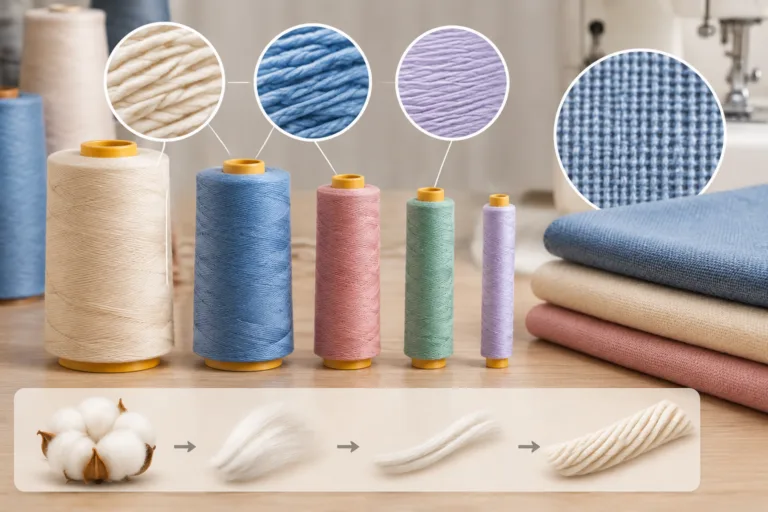
A sewing thread yarn count expresses the fineness of the yarn used in a thread, but the number on your spec means opposite things depending on which count system it comes from. In direct systems such as tex, dtex, and denier, a larger number means a heavier, thicker thread. In indirect systems such as the English cotton count, a larger number means a finer yarn. Comparing the two by size alone is one of the most common specification errors in garment development. This guide explains the systems, the safe conversions, and the notation habits that keep a thread spec unambiguous from quotation through production review. Apparel Wiki is an independent educational publication, supported in part by sponsors; see our Sponsor page for how that relationship is disclosed.
The goal is specification hygiene: knowing what to write, what each figure represents, and what to confirm with the supplier in writing before sampling begins.
What a Sewing Thread Yarn Count Actually Expresses
A yarn count is simply a way of expressing yarn fineness, and all count systems do it in one of two directions. Direct systems state linear density: the weight of a fixed length of yarn. Indirect systems state the reverse: the length of yarn produced from a fixed weight. The direction matters more than the number itself.
On sewing thread specifications, the direct-system units you will most often encounter are these:
- Tex — grams per 1,000 meters of yarn.
- Decitex (dtex) — grams per 10,000 meters, a finer-grained version of tex.
- Denier — grams per 9,000 meters.
In all three, a larger number means more weight per unit length, so the thread is heavier and generally thicker. These unit bases are standard textile terminology, which makes them a reliable first checkpoint when you read any thread spec.
Indirect counts work the other way. The English cotton count (Ne) expresses how many length units correspond to a fixed weight, so a larger Ne number means a finer yarn. This inversion is the root of most comparison mistakes. A thread described as, say, a higher Ne value is finer, not heavier — the exact opposite of what a higher tex value would mean.
One boundary applies throughout this article. The unit definitions above are standard terminology, but specific commercial thread designations — and what a given supplier’s numbers actually mean in their labeling — must be confirmed with that supplier. Conventions vary commercially, and a written figure is only as reliable as the shared understanding behind it.
That leads to the practical rule this guide returns to repeatedly: never compare a direct-system number against an indirect-system number by size alone. The two scales run in opposite directions, so a magnitude comparison is meaningless before you even check the units.
Converting Between Tex, Dtex, and Denier
Within the direct system, conversion is straightforward arithmetic because the units differ only in their reference length. The two relationships you need are:
- tex = denier ÷ 9
- dtex = tex × 10
Using these example inputs: if a thread is labeled 90 denier, then tex = 90 ÷ 9 = 10 tex, and dtex = 10 × 10 = 100 dtex. This is arithmetic on example inputs, not a measured result from a specific product — but the arithmetic itself is exact, because converting between denier, tex, and dtex only changes the reference length over which weight is measured. The underlying linear density of the yarn does not change.
That exactness does not extend beyond the direct system. Converting into or out of an indirect count such as Ne is not a simple division; it depends on the specific count system’s basis — its length and weight units and how they are defined. Without confirming that basis in an authoritative reference for the system in question, a converted Ne figure should not be trusted. Treat indirect-to-direct conversion as a separate task requiring the system’s own definition, not a shortcut from the formulas above.
A second boundary matters just as much: linear density is not yarn diameter. Two threads of equal tex can differ in physical thickness depending on fiber type, twist, and yarn structure. A converted tex value therefore does not let you predict needle fit, needle-hole appearance, or how the thread will sit in the seam. It tells you mass per length, nothing more. Thickness-dependent decisions still need to be checked on the actual thread and fabric.
Finally, keep the original unit on the specification alongside any converted value rather than replacing it. If a quote, sample, or production lot later needs to be traced back, the original designation is the reference the supplier actually used. A converted number written alone breaks that traceability and invites a new round of interpretation.
Ply Notation, Thread Tickets, and Why One Number Is Not Enough
Many threads are not single yarns but plied constructions, and this is where count specifications get quietly confusing. A two-part notation such as a 30/2-style figure typically indicates the single-yarn count and the number of plies twisted together. The key point is that the plied thread’s overall linear density differs from the single-yarn figure — combining plies changes the mass per length of the resulting thread. Because the direction of that change depends on whether the underlying count is direct or indirect, and because commercial writing conventions vary, you should ask the supplier to confirm exactly what such a notation means rather than recording a single number and assuming the rest.
Thread ticket sizing adds a second layer. A ticket number is a manufacturer’s own sizing convention for a commercial thread. It is not interchangeable with tex, dtex, denier, or Ne values, and it should never be treated as a linear-density value. Two suppliers’ ticket scales may not map onto each other, and a ticket number alone does not tell another party what linear density you expect.
The underlying reason is the same throughout: different count systems and commercial writing conventions cannot be unconditionally interchanged. The same written figure can describe different threads under different conventions, which is why a specification should always state the system explicitly.
Consider the practical failure mode. A developer specifies a thread by one number only. The supplier, reading that figure under a different convention, supplies a plied construction whose overall linear density differs from what the developer assumed. On a heavy fabric, that difference can change seam bulk and how the seam sits. The fix costs almost nothing: confirm the notation’s meaning and the count system in writing before sampling.
The table below summarizes what a count specification should record and what to confirm.
| What to record | Why it matters | What to ask the supplier to confirm |
|---|---|---|
| Count value with its system named (tex, dtex, denier, or the relevant indirect count) | Prevents direct-versus-indirect comparison errors | That the quoted figure uses the stated system |
| Ply notation, written in full | Single-yarn count and plied linear density differ | The exact meaning of the notation in their convention |
| Ticket size, if the commercial system requires it | Ticket numbers are not linear-density values | Which linear density the ticket corresponds to |
None of these rows requires an invented number. Each simply closes a gap where a single figure, read without its system or convention, has historically caused a mismatch between what was specified and what was supplied.
How Count Choices Affect Sewing Performance
A heavier linear density generally puts more thread mass into the seam. More mass typically means more seam bulk, greater stiffness along the stitch line, and a different way the thread sits against the fabric. That direction of effect is typical practice, not a guaranteed outcome for every fabric — structure and finishing can shift it.
Thread thickness never acts alone. Needle size, fabric density, and fabric stretch all interact, and a larger needle can widen damage or change the stitch’s appearance. Treat a supplier’s recommendation as a starting point: sew on the actual fabric at the target speed and layer count, then check for skipped stitches, thread breakage, and needle holes. No single thread-and-needle pairing suits every knit or woven garment, so the right combination is project-dependent and confirmed by sewing trials.
This is also where the earlier conversion work pays off. If a converted tex value is mismatched — or was read under the wrong convention — the team may test the wrong thread thickness entirely, and the performance evaluation inherits that error. Specification accuracy feeds directly into sewing results.
When judging whether a count choice performs as intended, compare sewn samples before and after washing under the same conditions. Post-wash behavior can differ from as-sewn appearance, and a thread that looks balanced on the day it is sewn may behave differently once the garment is laundered.
Writing a Thread Count Specification That Survives Production
A durable specification records four things: the count value with its system named (tex, dtex, denier, or the relevant indirect count), the ply notation with its meaning confirmed, the ticket size if the commercial system requires one, and the fiber generic name. Lead with the generic fiber name — polyester, for instance — because it is verifiable, and treat brand or process names as separate information with their own scope.
Run the conversion pitfalls as a checklist before releasing the spec:
- Comparing a direct-system number against an indirect-system number by size.
- Dropping the ply part of a notation and keeping only the single-yarn figure.
- Converting to a new unit and discarding the original, losing traceability.
- Treating a ticket number as a linear-density value.
Two brief scenarios show how the decision flexes. For a lightweight knit where seam bulk matters, a team may choose a finer linear density and then confirm the appearance on the actual fabric. For heavy seam construction, a heavier plied thread may be considered, with the plied notation confirmed first. In both cases, the variable that could change the decision is the fabric’s density and stretch.
Supplier confirmation of notation meaning is standard practice, not a formality. Different commercial conventions mean the same written figure can describe different threads. And keep the limitation in view: a written specification reduces ambiguity, but it does not replace sewing trials on the target fabric.
Key Takeaways for Specifying Sewing Thread Yarn
The core rule: name the count system explicitly, keep direct and indirect values separate, convert only within the direct system (tex = denier ÷ 9, dtex = tex × 10), and confirm ply notation and ticket meaning with the supplier.
As an educational next step, compare the linear-density units on your current thread specs against this article’s definitions, or read the related Apparel Wiki guides on fibers and yarns to build the surrounding context.
Frequently Asked Questions
Can I convert a tex value directly into an English cotton count (Ne)?
No. Direct and indirect systems run in opposite directions and are not linked by a simple division. Conversion between them requires the specific count system’s basis, so treat any direct-to-indirect shortcut with caution.
Is a thread’s ticket size the same thing as its yarn count?
No. Ticket numbers are manufacturer sizing conventions, not linear-density units. They are not interchangeable with tex, dtex, denier, or Ne values, and should be confirmed against the actual count system the supplier uses.
What does a notation like 30/2 actually mean on a thread specification?
A two-part notation generally indicates the single-yarn count and the number of plies, but conventions vary commercially. The plied thread’s overall linear density differs from the single-yarn figure, so ask the supplier to confirm exactly what the notation means in their system.
Does a higher tex value always mean a thicker thread than a lower one?
Within the direct system, a higher tex means a heavier thread per fixed length, which is generally thicker. But linear density is not diameter — fiber type, twist, and structure also affect thickness, so equal tex values can differ in apparent size.
Why should I keep the original count unit on my spec after converting?
The original unit preserves traceability. If a later question, dispute, or sampling round needs to check the figure against the supplier’s records, the original value and system make the comparison unambiguous.
How does thread count relate to needle selection for my fabric?
Thread thickness, needle size, fabric density, and fabric stretch need to be considered together. There is no fixed pairing for all knits or wovens — start from supplier guidance and confirm on the actual fabric and layers through sewing trials.