Loop length describes the yarn incorporated into a knitted loop, while stitch density describes the number of stitches within a defined fabric area. They are related through knitted structure, but they are not interchangeable. One value cannot be converted reliably into the other without a supported method and matching conditions. A useful loop length stitch density comparison must identify the construction, measurement basis, and fabric state. Apparel Wiki maintains editorial independence from sponsorship, as explained on its Sponsor page; this article provides educational terminology rather than a product specification.
Loop Length and Stitch Density Describe Different Things
In this article, loop length means the length of yarn incorporated into one knitted loop. It describes structure at the individual-loop level. The measurement therefore concerns yarn consumption within a specified loop or an average derived from a stated group of loops. The reported unit and sampling basis should accompany the value.
Stitch density describes how many stitches occur within a defined area of knitted fabric. It operates at the fabric level rather than the individual-loop level. A report might provide counts by the two fabric directions, a combined count over an area, or another declared counting basis. The basis must be stated because these formats do not communicate exactly the same information.
The concise distinction is that loop length concerns yarn incorporated into a loop, whereas stitch density concerns stitches counted within an area. Calling stitch density “loop length,” or using the terms as substitutes, removes that distinction. It can also obscure whether a number describes yarn usage, loop geometry, or a fabric count.
A bare number is not a complete knit fabric specification. For loop length, readers need at least the unit, the loops represented, and the relevant sample condition. For stitch density, they need the count, area or directional basis, units, construction, and fabric condition. Supplier documents may use shortened labels, so the label should be clarified before values are compared.
Neither variable independently establishes quality, fit, durability, comfort, or suitability for a product. Each provides one structural description. A performance conclusion requires additional information about the fabric, intended use, and property being evaluated. A higher or lower number is therefore not automatically preferable; the appropriate value is project-dependent rather than a universal requirement.
How Loop Length and Stitch Density Relate in Knitted Fabric
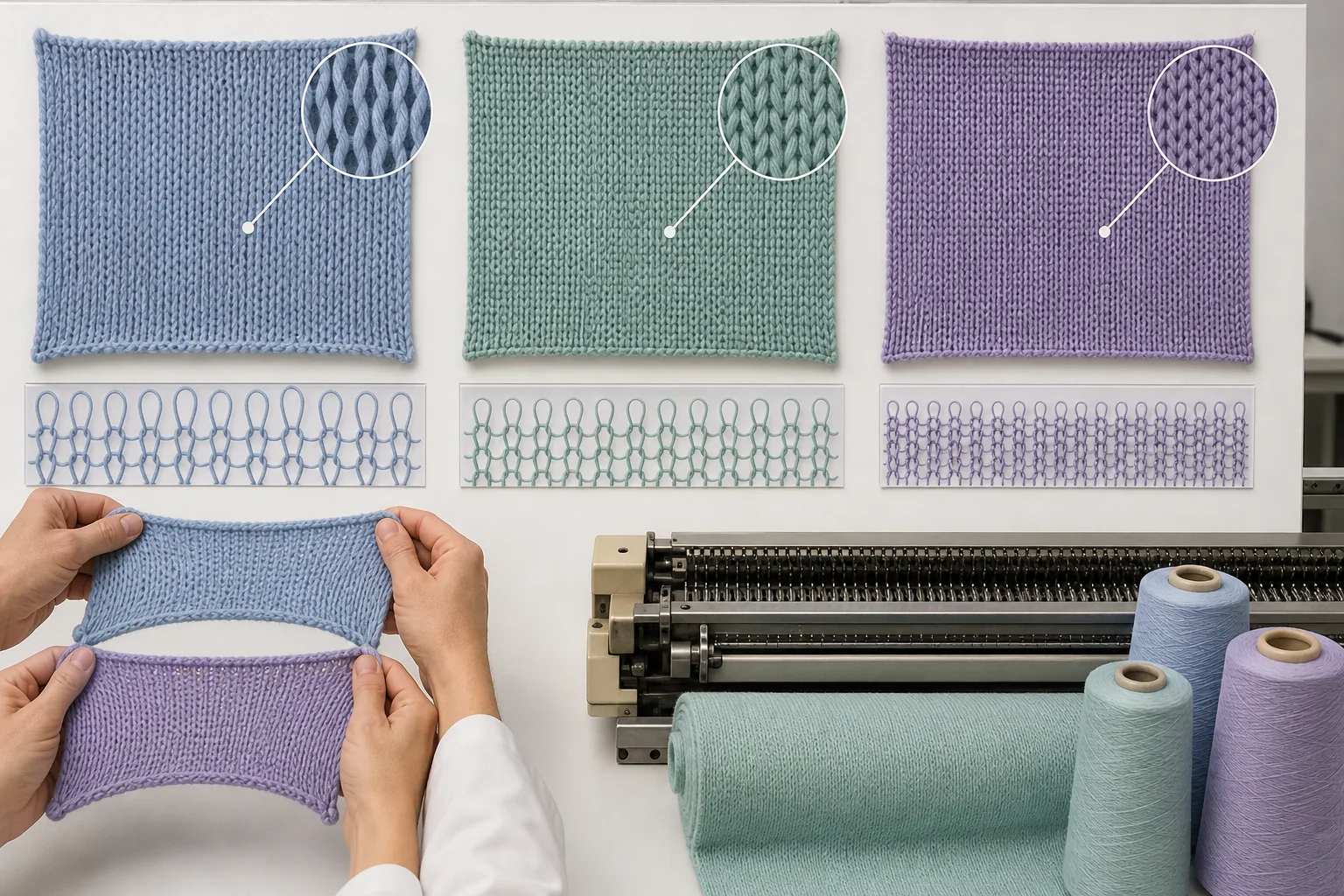
Knitted fabric is built through the formation and intermeshing of yarn loops. Loop length describes yarn at that local structural scale. Stitch density describes how many resulting stitches occupy the declared fabric area. Because both measurements concern the same knitted structure at different levels, they can be considered together when a fabric is analyzed.
The relationship is structural, not synonymous. Knit loop length helps describe how yarn is allocated within loops. Stitch density records the population of stitches in a fabric area after the sample has reached the condition in which it is counted. The measurements answer different questions even when they come from the same specimen.
A difference in loop length may accompany a difference in stitch density, but loop length alone does not establish an exact density. The fabric’s knit construction, yarn characteristics, knitting setup, and condition at measurement can all affect how reported values should be interpreted. Without controlling or documenting those variables, an apparent association does not demonstrate a universal cause-and-effect rule.
For the same reason, stitch density should not be used as a shortcut for calculating loop length. A density count does not state how much yarn forms each loop. Conversely, a loop-length value does not identify the number of stitches occupying a particular area. Deriving one from the other would require a supported model or measurement procedure applicable to the construction and conditions involved.
This distinction matters when reviewing knitted fabric structure. Two reports can show similar stitch densities while differing in other structural details, or show different densities without loop length being the only changed variable. The figures become more informative when their measurement bases, constructions, yarns, and fabric states are comparable.
These variables can help describe a fabric, but they do not by themselves predict a named product property. Any claim about dimensional behavior, appearance, comfort, durability, or another outcome requires property-specific evidence. Structural explanation should not be treated as a verified performance result.
What Can Change the Relationship
The relationship between loop length and stitch density must be interpreted in context. Several variables can distinguish one report from another, even when both documents use the same terminology. These variables are best treated as conditions to check, not as proof that a particular result must follow.
- Knit construction: Different constructions organize and connect loops differently. Values from unlike constructions should not be assumed to have the same structural meaning.
- Yarn characteristics: The yarn used is part of the structure being measured. Yarn identity and relevant characteristics should therefore be recorded before comparing samples.
- Machine or knitting setup: Production settings provide context for how the loops were formed. A comparison should establish whether the samples were made under comparable setups rather than attributing every difference to one reported variable.
- Fabric condition: The state of a sample during measurement matters. Measurements taken at different stages of relaxation, finishing, or handling may not describe equivalent fabric states.
- Measurement basis: Units, counted directions, defined area, sampling basis, and sample preparation must align for a direct numerical comparison to be meaningful.
Construction and stitch density should therefore be reviewed together with the sample record. When any contextual field is missing, the appropriate response is to request clarification rather than infer the missing detail. A value taken before finishing, for example, should not automatically be treated as equivalent to a value reported for finished fabric.
Yarn linear density is another separate concept. It describes yarn mass in relation to length; it is not loop length and does not count stitches in fabric. Converting between yarn-count systems would not resolve the structural relationship discussed here.
There is no universally correct loop length or stitch density for every knitted fabric. Selection depends on the intended construction, product brief, material system, and validated specification. Comparable conditions improve interpretation, but they do not turn either measurement into a standalone quality verdict.
How to Compare Loop Length and Stitch Density Values
Start by checking whether the reported values describe comparable samples. A numerical difference becomes useful only after the records establish what was measured, how it was expressed, and which fabric state was examined. A bare number should be treated as incomplete information rather than evidence that one fabric is preferable.
- Confirm the unit and basis. Record the unit for loop length and the declared area or counting basis for stitch density.
- Identify the construction. Determine whether both figures refer to the same knit construction and counted directions.
- Check the sample state. Establish whether the fabrics were measured at comparable stages of relaxation, finishing, and handling.
- Review the material and setup records. Differences in yarn or knitting setup can limit conclusions drawn from the two reported values.
- Return to the product brief. Interpret the figures against validated project specifications, not an assumed universal preference.
| Observable input | What it may indicate | Initial interpretation | What could change that interpretation |
|---|---|---|---|
| Values include units, basis, construction, and fabric condition | The records provide essential comparison context | Proceed to check whether the stated conditions align | Yarn, knitting setup, sampling, or product requirements |
| A value lacks its unit, area, or counting basis | The number is ambiguous | Request the missing information before comparing | The supplier’s reporting convention or sample record |
| Samples share construction and documented fabric state | The figures may support a more focused comparison | Review both variables without treating either as a quality grade | Different yarns, setups, or evaluation purposes |
| Samples have different constructions or fabric states | The figures may not describe equivalent structures | Resolve those differences before attributing meaning to the numbers | Construction details, finishing history, and measurement basis |
For a lightweight knit comparison, first establish whether both samples share the same construction and measurement conditions. If one uses a different yarn or was recorded at another finishing stage, the values may still describe each sample accurately. However, their difference cannot automatically be assigned to loop length or stitch density alone.
This framework is an interpretation aid, not a pass/fail test. The preferred specification depends on the product brief and any validated requirements established for that product.

Common Interpretation Errors and Limits
The first error is treating loop length versus stitch density as two names for the same measurement. They describe related aspects of knitted structure at different levels. Substituting one term for the other removes information and can cause specifications, sample reports, or supplier discussions to be misread.
A second error is inferring one value directly from the other. Their structural relationship does not create a universal conversion. Even when two reports appear related, a calculation needs a supported method and matching conditions. Without those elements, the inferred result is an assumption rather than a measured or validated value.
- Comparing unlike bases: Stitch counts reported for different areas, directions, or sample conditions should not be ranked as though they share one basis.
- Ignoring construction: Values from different knit constructions do not become equivalent merely because the same terminology appears in both records.
- Assigning a quality grade: Neither variable alone establishes overall fabric quality or suitability for a particular garment.
- Predicting product properties: Comfort, durability, dimensional behavior, fit, and other performance questions require relevant evidence beyond these two measurements.
- Treating common practice as a requirement: A reporting convention can improve communication, but that does not automatically make it a regulatory rule or universal specification.
Definitions explain what a term means. Typical reporting practice describes how people may communicate it. A project specification sets requirements for a particular product, while a test result reports an evaluation under stated conditions. These categories should remain separate when interpreting knit fabric measurements.
For example, two fabrics with different constructions may also show different reported loop length and stitch density values. Resolve the construction, basis, and sample-state differences first. Otherwise, attributing an observed distinction to either variable would overlook the context that separates the samples.
If the real decision concerns a product property, name that property before examining the data. Then identify the applicable authoritative measurement reference or product-specific evaluation. Loop length and stitch density can contribute structural information, but they do not replace evidence designed to assess the property in question.
A Practical Next Step
Create a measurement record with a separate field for each value. Include its unit, area or counting basis, knit construction, counted directions where relevant, yarn identification, and fabric condition. Before comparing records, mark any fields that are missing or inconsistent and request clarification rather than filling the gaps by inference.
If the decision concerns performance or product suitability, check the applicable authoritative measurement reference and the validated product specification. This keeps loop length and stitch density in their proper roles: useful structural information within a documented evaluation, not standalone verdicts.
Frequently Asked Questions
Can loop length be calculated from stitch density?
Not through a universal conversion. The variables describe different structural levels, and their relationship depends on context. A calculation would require a supported method, compatible inputs, and matching construction and measurement conditions. Stitch density alone is insufficient.
Why can two knitted fabrics with similar stitch density have different loop lengths?
Similar stitch density does not establish how much yarn is incorporated into each loop. The fabrics may differ in construction, yarn, knitting setup, or condition when measured. Those details must be examined before interpreting the difference.
What information should accompany a stitch density value?
The record should state the counting basis or defined area, relevant counted directions, knit construction, and sample condition. It should also identify the reporting unit or convention clearly enough that another reader can understand what the number represents.
Do higher stitch density or shorter loop length always mean better fabric?
No. Neither direction creates a universal quality ranking. Suitability depends on the intended construction, material system, product brief, and validated specifications. Claims about comfort, durability, fit, or dimensional behavior need evaluation appropriate to that specific property.
Can loop length and stitch density be compared across different knit constructions?
The values can be reviewed, but a direct ranking may be misleading. First identify the construction and ensure the measurement bases and fabric conditions are understood. Use the figures to describe each structure, not to assume the constructions are equivalent.