Base layers fabric recovery depends on how the material returns after extension and how the finished garment distributes strain during wear. Stretch describes how readily a fabric extends; recovery describes its tendency to return toward its intended dimensions or shape after release. This explanation remains editorially independent under Apparel Wiki’s Sponsor policy.
Both properties matter because a base layer usually maintains close contact while accommodating movement. Fiber content alone cannot predict the result. Yarn, fabric structure, finishing, pattern shape, seams, local components, and wearing conditions all affect the fit a wearer experiences. The practical approach is to compare materials and assemblies under the directions, movements, and conditions expected for the intended garment.
How base layers fabric recovery affects fit over time
Recovery is not another word for softness, compression, or general durability. A soft fabric can recover well or poorly. A garment can feel compressive because of its dimensions and construction without returning effectively after repeated extension. Likewise, a fabric may stretch easily yet retain a visible dimensional or shape change after release.
In a base layer, insufficient return can appear as looseness at an elbow or knee, a waistband that shifts, or an opening that becomes distorted. A hem may move away from its intended position. Close-body contact can also change after bending, reaching, walking, or prolonged wear. These outcomes are garment-level observations, not proof of one isolated material cause.
Extension is rarely uniform across the garment. Reaching can load shoulders and armholes differently from the torso. Bending can increase demand at knees or elbows, while stride and posture affect the crotch and seat. Pattern shape, garment ease, seam placement, and edge construction determine where that demand accumulates and how it transfers into adjoining areas.
For this reason, a swatch result cannot fully describe base layer fit. Necklines, armholes, waistbands, crotches, cuffs, and other openings behave as distinct loading zones. Each combines fabric behavior with pattern dimensions, seams, bindings, elastic parts, and movement. A category name also does not establish a fixed functional level; the relevant question is what wearing task the specific base layer must perform.
The central decision rule is to assess fabric recovery in the directions, zones, and use conditions expected in the finished garment. Do not select from a fiber label or a general impression of stretch alone. Stretch versus recovery becomes useful only when the comparison reflects where, how far, how often, and under what conditions the base layer will extend.
Stretch, recovery, and the factors that differ
Fabric stretch and recovery describe related but separate behavior. Extension concerns the change produced while a load is applied. Recovery concerns the return after that load is removed. Any remaining dimensional or shape change can be described qualitatively as residual deformation, but its significance depends on the product and observation conditions.
A result can vary with the direction of extension, the amount of loading, how long the load remains, and whether loading occurs once or repeatedly. Directional stretch is especially relevant because fabric may behave differently along its length, width, or another orientation. Comparisons should therefore keep direction and loading patterns aligned rather than treating “stretch” as one undivided property.
Timing also changes what an observation answers. Immediate return after release shows short-term behavior. A later observation, after an appropriate and consistently applied rest period, can show whether additional relaxation occurred. Neither moment is automatically more important. Product developers may need both when the garment must retain contact during movement and regain its intended shape afterward.
Fabric-level stretch recovery still does not establish garment-level retention of silhouette or coverage. A specimen has no neckline binding, waistband, seam, pattern ease, or size relationship. Sewing can constrain or redirect extension, while garment dimensions can place different demands on nominally identical fabric. Material observations are inputs to garment evaluation, not substitutes for it.
Use conditions may also matter. Temperature, moisture, laundering, friction from another layer, and the wearer’s movement pattern can influence the relevant comparison. Their importance is product-specific, so none should be assigned a predetermined effect without suitable evidence.
Material identity should consequently be recorded in layers. Fiber composition, yarn construction, fabric structure, weight or density, and finishing describe different inputs. A generic name such as “knit” or a fiber name alone is not a complete explanation of performance.
Material and fabric construction variables
A useful base layer fabric description separates composition, yarn, structure, weight or density, finishing, and current fabric condition. These variables interact. Changing one can alter the behavior attributed to another, so comparisons should not silently assume that unmatched materials are otherwise equivalent.
Elastic components may contribute to extension and return, but elastic fiber content alone does not predict finished-garment recovery. The fiber’s placement in the yarn and fabric, the surrounding fibers, the construction, processing, and garment demand all remain relevant. No ingredient or percentage should be treated as a universal performance guarantee.
Fabric construction affects how extension is distributed. In knits, loop geometry and the course and wale directions can create different behavior by orientation. Wovens and knits may also be engineered in varied ways, making “all knits stretch” and “all wovens do not” unreliable shortcuts. Structure offers a comparison clue, not a complete ranking.
| Variable observed | What it may change | Initial comparison question | Variables that could change the conclusion |
|---|---|---|---|
| Composition | Extension, return, hand, and response to processing | Are the fiber identities and proportions recorded separately? | Yarn arrangement, structure, finish, and use conditions |
| Yarn | How forces move through the fabric | How are the component fibers arranged within the yarn? | Yarn size, fabric geometry, density, and processing |
| Structure | Extension pathways and dimensional response | Which construction and orientation are being compared? | Composition, weight or density, finish, and loading direction |
| Directional behavior | Return in particular garment orientations | Does extension and return differ by direction? | Pattern placement, seam location, and local movement |
| Finishing | Hand, dimensions, and response after release | Are samples in the same relevant processing state? | Finish recipe, subsequent care, and relaxation |
| Fabric condition | Observed dimensions and apparent stability | Has the material been conditioned or relaxed consistently? | Storage, moisture, handling, laundering, and elapsed time |
Finishing and relaxation deserve separate attention because they can alter hand, dimensions, and apparent behavior. An unfinished or insufficiently relaxed sample may not represent the material delivered for cutting. Compare options after the processing state relevant to production and use, while keeping composition, construction, weight or density, and observation conditions as controlled as practical.

Garment zones and assembly that change perceived recovery
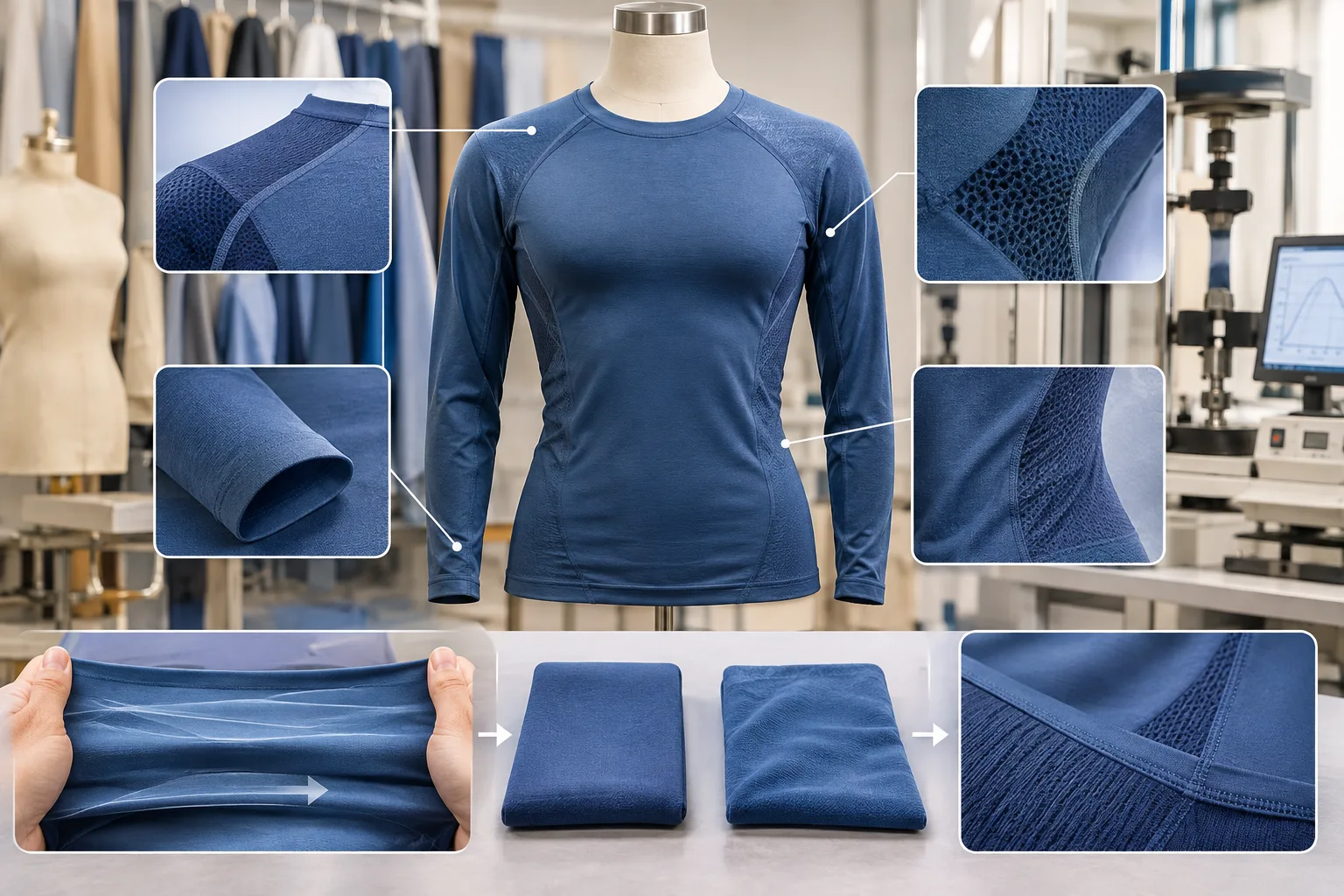
A base layer does not experience equal strain everywhere. Map the expected movement and friction zones before judging whether a fabric is suitable. Reaching can load the shoulders and armholes, while bending affects the knees or seat. Stride places a different demand on the crotch. Waistbands, necklines, cuffs, and hems must manage repeated movement at garment edges.
The pattern determines how much extension the material must accommodate in each zone. Piece shape, fabric orientation, stretch-direction placement, ease, and garment length can increase or reduce local demand. Two garments made from the same fabric may therefore retain fit differently. A longer torso, closer fit, or differently shaped armhole changes where strain accumulates.
Assembly adds another set of variables. Seams, stitch choice, seam allowances, bindings, waistbands, elastic elements, and finished openings can constrain or redirect extension. They can also concentrate strain beside a less extensible component. Favorable recovery in an unsewn specimen does not guarantee that a joined seam or bound edge will respond the same way.
For a lightweight knit intended for frequent reaching and bending, compare directional behavior with local pattern demand at the armholes, crotch, and knees. A soft, extensible hand may feel suitable in the swatch, yet it does not show whether those zones return toward their intended shape after repeated movement. The assembly must also allow the necessary extension without creating an unwanted restriction elsewhere.
Evaluate the shell fabric, elastic parts, seams, and edge treatments as one garment system. Isolated component impressions cannot be added together as proof of finished performance. Assessment with final materials, intended assembly, representative movements, and relevant sizes gives more useful evidence than a general swatch judgment. Record observations by zone because a stable waistband can coexist with distortion at a knee or neckline.
How to evaluate recovery for the intended base-layer task
Begin with a use brief rather than the category name. Record the intended activity, fit objective, expected movements, layering arrangement, coverage needs, and likely high-strain areas. Include relevant care, moisture, temperature, or friction exposures when they form part of the intended use. The term base layer alone does not establish a required performance level.
Keep comparisons aligned across material and garment options. Observe the direction and location of extension, loading pattern, repetition, release timing, and any rest period. Note visible dimensional or shape change, edge behavior, coverage, and wearer-perceived fit. Changing several conditions at once makes it difficult to identify why one option behaves differently.
| Observable inputs | Implications for recovery demand | Initial evaluation focus | What could change the choice |
|---|---|---|---|
| Low-movement use with a close fit | Contact and silhouette may matter more than large movement ranges | General shape return, comfort, and coverage after wear | Fit ease, wear duration, posture, and donning needs |
| Repeated bending and reaching | Extension accumulates in particular directions and zones | Armholes, elbows, crotch, seat, and knees during representative movement | Pattern shape, fabric orientation, activity, and repetition |
| Stable waistband or opening required | Edge retention depends on fabric, elastic elements, and assembly | Return and comfort of the completed edge | Binding, elastic, seam construction, opening size, and desired pressure |
| Layered use with friction | Other garments may resist movement or shift the base layer | Hem stability, surface interaction, coverage, and local distortion | Outer-layer fit, surface character, movement, and moisture |
After selecting an initial material and construction, evaluate assembled garments through representative movements and across the relevant size range. Record whether each zone retains contact, shifts, restricts movement, develops looseness, or changes coverage. A single pass-or-fail statement can hide meaningful differences between the waistband, torso, knees, and openings.
More return is not automatically better. A construction that pulls back strongly may conflict with comfort, donning, intended ease, seam behavior, coverage, or the desired feel. When options create different trade-offs, return to the use brief and localized demand. For people with distinct posture, mobility, or dressing needs, use their actual movement and wear feedback rather than assumptions based on a demographic label.
Turn findings into a development decision
Base layers fabric recovery is a system property expressed through the intended garment and use, not a promise supplied by a fiber label. Decide in sequence: define movement and fit, compare material and structure, identify localized garment demands, and then evaluate the finished assembly.
As the next step, create a zone map and a like-for-like comparison record. Document materials, processing state, pattern orientation, assembly, movement conditions, and observation timing. Before making a formal material claim or setting a product specification, identify and check the applicable evaluation method for that product and material context.
Frequently Asked Questions
What is the difference between stretch and recovery in a base layer?
Stretch describes how the material extends under load. Recovery describes its return toward intended dimensions or shape after release. A close-fitting base layer needs enough extension for movement, but its finished fit also depends on how the fabric and assembled garment return afterward.
Can a fabric with a high stretch amount still lose its base-layer fit?
Yes. A large extension capacity does not establish how fully or quickly the fabric returns. Fit can also change because of repeated loading, pattern demand, seams, edge treatments, processing state, or localized strain within the completed garment.
Why might recovery feel different at the waistband, knees, and neckline?
These zones experience different movements, friction, edge constructions, and loading directions. A waistband may include elastic and seams, while knees undergo repeated bending and a neckline relies on opening shape and finishing. Each zone should therefore be assessed separately.
Does fiber content alone tell me whether a base layer will recover well?
No. Fiber content is only one part of material identity. Yarn construction, fabric structure, weight or density, finishing, condition, direction of extension, and garment assembly can all affect observed behavior. Compare these variables separately rather than treating the label as a performance result.
Should fabric recovery be evaluated before or after sewing the base layer?
Both stages answer different questions. Material comparison can identify directional behavior before sewing. Finished-garment evaluation shows how patterning, seams, elastic parts, bindings, and movement interact. A favorable specimen result should not replace assessment of the final assembly.
How should I compare recovery when the base layer will be worn for a specific activity?
Translate the activity into expected movements, high-strain zones, layering, coverage, and relevant care or environmental conditions. Compare options under aligned observation conditions, then assess assembled garments through representative movement and sizes. Record zone-specific changes instead of relying on one overall rating.