
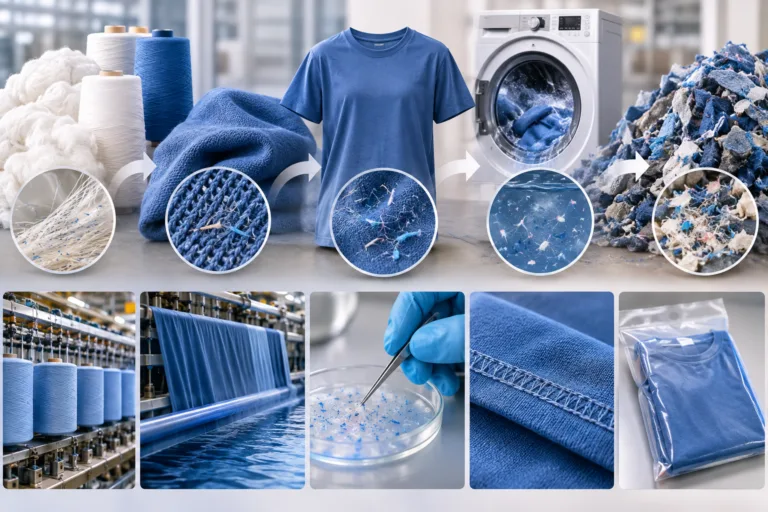
A microplastic shedding reduction framework is a repeatable process for mapping potential fiber release, choosing product-relevant interventions, and evaluating whether evidence supports a reduction claim. It begins with a specific garment, its intended use, and the life-cycle stages under review. Apparel Wiki treats this as independent educational guidance, separate from the commercial support described on its Sponsor page.
Here, shedding refers narrowly to the potential release of small, plastic-containing textile fibers from clothing during use or care. The framework organizes investigation and decision-making. It does not guarantee that shedding will be eliminated, establish a reduction percentage, or rank the overall sustainability of a garment.
A Practical Framework for Reducing Microplastic Shedding
The framework starts by defining exactly what is being assessed. Record the garment style or variant, product function, expected use, and relevant care context. A performance base layer, fashion knit, and insulated jacket present different product requirements, even when some material descriptions appear similar.
Next, identify plausible shedding points without treating them as proven causes. Product teams can then select a targeted change and decide what evidence would be needed to assess it. The sequence is:
- Define the product and context. Identify the garment, intended function, use assumptions, care assumptions, and stages included in the assessment.
- Map variables to investigate. Consider material, yarn, fabric, surface, finish, garment construction, wear, and care details.
- Select a targeted intervention. Choose a specification, construction, finishing, or care-related change that remains compatible with product needs.
- Plan the comparison. State what will be compared, which conditions must remain similar, and what kind of evidence would support the intended claim.
This sequence matters because a fiber name or material label does not describe the complete garment. Yarn specification, fabric structure, exposed surfaces, seams, finishing, use, and care may all belong within the investigation boundary. Without comparable evidence, none should be presented as a confirmed reduction lever.
The same boundary applies to results. A direct record for the product under defined conditions is different from published background research, a database average, or a model estimate. General information can help form a question, but it should not be restated as a measurement from the garment being developed.
For clothing microplastic shedding reduction, the framework therefore provides decision order rather than a universal score. A material substitution, design intention, or care statement may be worth investigating, but its label alone does not prove that the finished product sheds less.
Map Where Shedding Could Occur in a Garment’s Life
Mapping comes before intervention selection. Its purpose is to expose the assumptions surrounding a garment, not to create an unsupported ranking of textile fiber shedding factors. Use the following prompts to define what needs investigation:
- Fiber and yarn: Record the declared fiber composition, yarn specification, and any relevant differences between product variants.
- Fabric construction: Note whether the textile is knitted, woven, or otherwise constructed, along with surface characteristics relevant to the comparison.
- Surface and finishing: Identify brushed, raised, coated, printed, washed, or otherwise finished areas without assuming their effect.
- Garment construction: Map cut edges, seams, linings, trims, panels, and other components that could affect the assessment boundary.
- Intended wear: Define the garment function, expected frequency of wear, likely friction context, and required durability.
- Care context: Record the assumed cleaning, drying, and handling conditions included in the inquiry.
These are investigation prompts, not demonstrated causes. Their relevance can change with the product and comparison. For example, a surface detail may deserve attention in one garment but fall outside the boundary of another assessment. No feature should be described as increasing or decreasing shedding without suitable evidence.
Keep a short scope record for every comparison. It should identify the exact product variant, included components, use assumptions, care assumptions, and available evidence type. This prevents a team from comparing unlike products while assuming only one variable changed.
Also distinguish product observations from estimates or generalized values. If information comes from another textile, a database, or a modeled scenario, label it accordingly. Do not treat it as a direct result for the current garment. Collection and measurement procedures also require evidence of suitability; a convenient procedure is not automatically applicable to every product or claim.
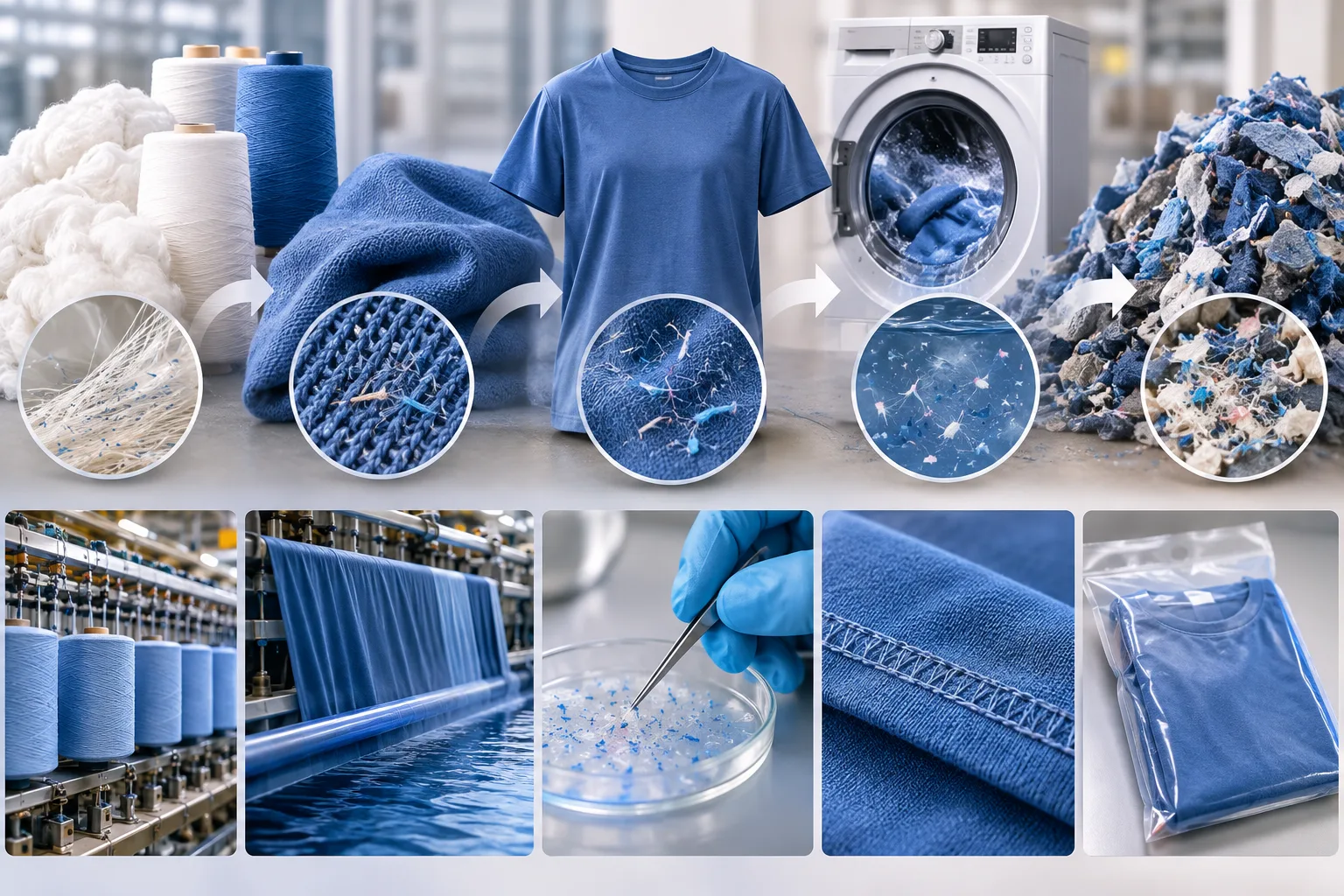
Choose Reduction Levers Without Assuming One Material Wins
After mapping the garment, compare possible interventions against its required function. The goal is not to identify a universally superior fiber. It is to find a change worth investigating while preserving necessary performance, durability, appearance, comfort, manufacturability, and care compatibility.
| Observable product or use input | Intervention to investigate | Possible garment trade-off | Initial decision question | What could change the choice |
|---|---|---|---|---|
| Material or yarn specification | Compare candidate specifications suitable for the same function | Hand feel, appearance, strength, cost, or process compatibility | Can the specification change without altering product function? | Comparable product evidence and required performance |
| Fabric or garment construction | Investigate structure, surface exposure, seams, or edge treatment | Drape, stretch, weight, fit, durability, or production complexity | Which construction details can change while keeping the intended use? | Wear demands, component interactions, and manufacturing feasibility |
| Finishing | Compare finish options or an unfinished control where appropriate | Surface character, color, comfort, care, or processing requirements | What product purpose does the finish serve? | Finish durability, application conditions, and comparable evidence |
| Care guidance | Investigate product-appropriate handling and care instructions | User convenience, hygiene needs, appearance retention, or compliance concerns | Is the proposed guidance realistic for the intended user and garment? | Actual care context and evidence under stated conditions |
Each row identifies a lever to evaluate, not a proven way to reduce microplastic shedding from clothing. A credible choice requires a defined comparison. Changing material, construction, finish, and care conditions at once makes it difficult to attribute any observed difference to one intervention.
Consider a lightweight knit intended for frequent wear. Before replacing its material, the team could compare candidate constructions against stretch, recovery, comfort, seam behavior, and durability needs. A construction that suits a casual layer may not suit an active garment. The preferred option could change with end use, manufacturing constraints, or verified shedding evidence.
Finally, keep environmental dimensions separate. Evidence supporting a shedding-related intervention would not, by itself, establish lower climate impact, water use, chemical hazard, or improved labor conditions. Those are distinct questions with different boundaries and evidence needs. A targeted shedding decision should therefore remain a specific product claim, not become a broad declaration that the garment is environmentally preferable.
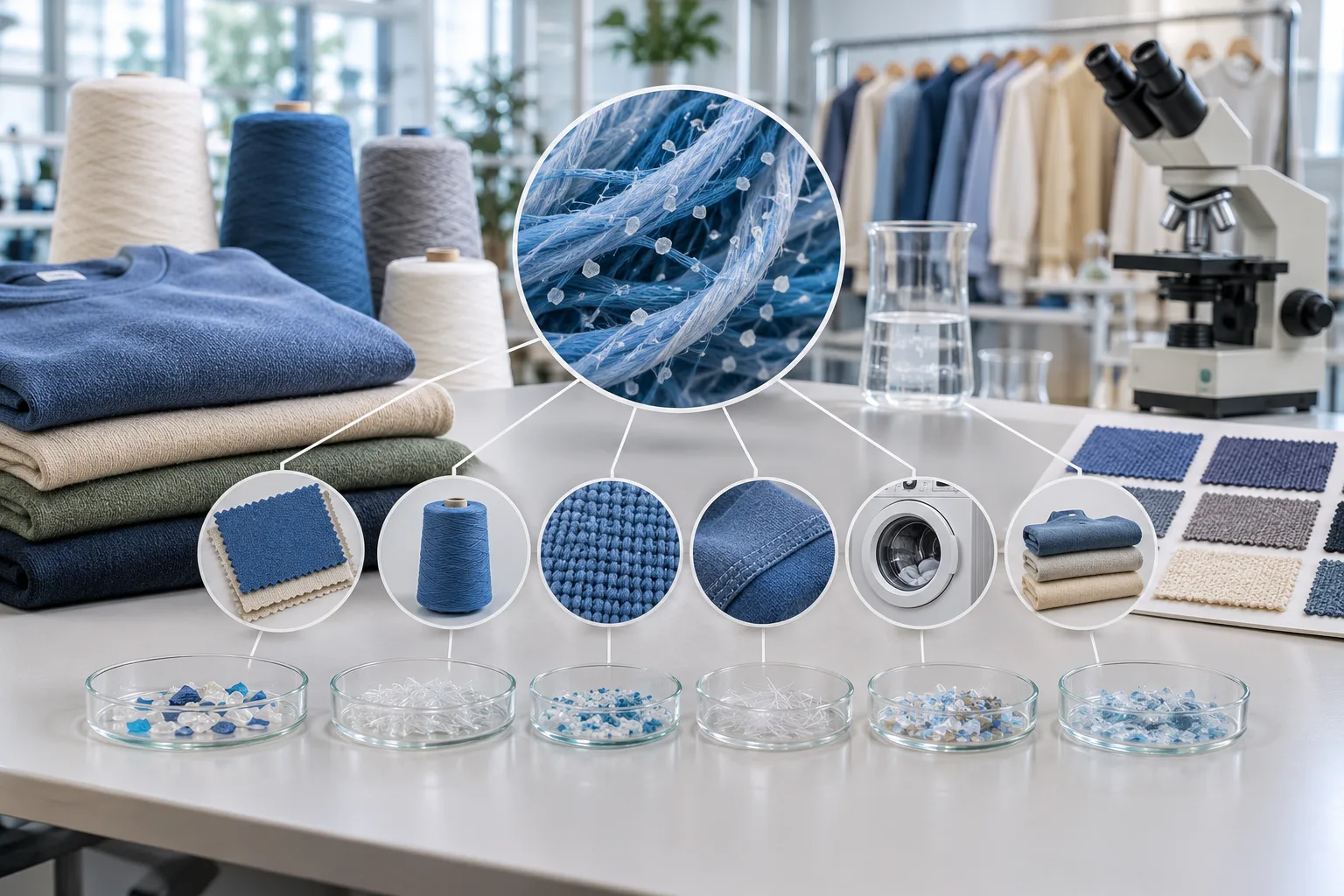
Evaluate Reduction Claims With Comparable Evidence
A reduction claim becomes useful only when its object and comparison are clear. Before interpreting a result, ask what changed, what stayed constant, and which garment or life-cycle stage the evidence covers. A comparison between unlike products, uses, or care assumptions cannot support a simple ranking without further qualification.
Start by identifying the evidence type. Direct product records, published research, database averages, and model estimates answer different questions. None should be silently substituted for another:
- Direct product records may describe the exact garment variant and stated evaluation conditions. The record should still identify how the information was obtained.
- Published research may provide relevant comparative findings, but its products, conditions, and reporting basis must match the decision closely enough to be applicable.
- Database averages describe a broader dataset. They are not measurements of the garment under review.
- Model estimates depend on selected inputs and assumptions. They should remain labeled as estimates rather than observed product results.
Next, examine comparability. Check whether the products serve the same function and whether included components, use assumptions, care conditions, and evaluation stages align. Also check the reporting basis. A result expressed for a quantity of textile answers a different question from one expressed for a finished garment used under stated conditions.
The comparison boundary should be visible. If one assessment includes repeated care while another covers only an initial condition, the results do not represent the same scope. Similar caution applies when product life, intended wear, disposal, or other relevant assumptions differ. These differences do not automatically invalidate evidence, but they limit the conclusion it can support.
Before communicating a finding, record the claim object, evidence source, conditions, uncertainty, and known limits. State whether the information is a product result, a research finding applied by analogy, an average, or an estimate. This prevents a narrow observation from becoming an unsupported general statement.
No single metric establishes overall sustainability. Likewise, an internal comparison does not by itself demonstrate legal compliance. Any named method, threshold, reporting rule, or public claim needs separate verification for the product, method, and relevant market.
Build the Framework Into Product Decisions and Communication
A practical workflow should connect the product brief, development decisions, evidence review, and later communication. The goal is not to create another sustainability label. It is to preserve the reasoning behind a targeted decision so design, sourcing, development, and quality teams work from the same assumptions.
Create a short decision record for each product or defined product family. It should include:
- product identity, variant, included components, and intended function;
- expected use and care assumptions;
- the shedding points or variables investigated;
- the proposed material, construction, finishing, or care intervention;
- the available evidence type and comparison boundary;
- important uncertainty, exclusions, and the next review question.
Use this record at decision gates. During design, define the attribute being investigated. During development, note whether other specifications changed with it. Sourcing can document the relevant material or process information, while quality teams can check whether the evaluated product matches the approved specification. A completed checklist organizes this work; it does not prove a reduction.
Communication should reflect the evidence level. A design intention can say that a feature was selected for investigation. An estimate should identify its basis and assumptions. A measured comparison should describe the products, conditions, boundary, and applicable result. Teams should not rewrite one evidence type as another or extend a narrow result to unevaluated colors, constructions, suppliers, or care conditions.
Keep each environmental statement dimension-specific. Evidence concerning shedding does not establish lower water use, climate impact, hazardous-substance performance, or improved labor conditions. Broad terms such as “green” or “sustainable” hide those distinctions and require support beyond a shedding assessment.
Before publishing a claim, review the wording against current official guidance in every relevant market. Rules and interpretations can change, so claim specificity is good editorial practice rather than a guarantee of compliance. Retain the supporting record and define when new product changes should trigger another review.
Conclusion: Use a Product-Specific, Evidence-Led Process
The microplastic shedding reduction framework turns a broad concern into a defined product decision. It helps teams map relevant variables, investigate feasible interventions, and evaluate whether evidence supports a narrow claim. It does not prove that a garment sheds less without a suitable comparison.
As an educational next step, select one product and compare its exact specification with its intended use and care context. Document what would remain constant, what intervention would change, and what evidence would be needed before making or repeating a reduction claim.
Frequently Asked Questions
What does microplastic shedding reduction mean for clothing?
It means investigating ways to reduce the potential release of small, plastic-containing textile fibers from a defined clothing product during specified use or care stages. A reduction should not be claimed until suitable comparative evidence supports it under stated conditions.
Which garment details should a team investigate when assessing potential shedding?
Investigate the exact material and yarn specification, fabric construction, surface characteristics, finishing, garment construction, intended wear, and care context. These are prompts for product analysis, not proof that any individual feature increases or decreases shedding.
Can changing a fabric or fiber be assumed to reduce clothing microplastic shedding?
No. A material change may also alter construction, durability, comfort, appearance, manufacturing feasibility, or care needs. Its effect should be evaluated through a sufficiently comparable product assessment rather than inferred from the fiber or fabric label alone.
How can teams tell whether two shedding results are comparable?
Check the product function, variants, included components, conditions, life-cycle stages, care assumptions, evaluation approach, and reporting basis. Differences should be documented. If the boundaries do not align, present the results separately instead of making a straightforward ranking.
Does evidence of lower shedding prove that a garment is more sustainable overall?
No. Shedding is one environmental dimension. It does not establish performance concerning climate impact, water use, hazardous substances, durability, labor conditions, or other topics. Each broader claim requires its own defined boundary and supporting evidence.


