
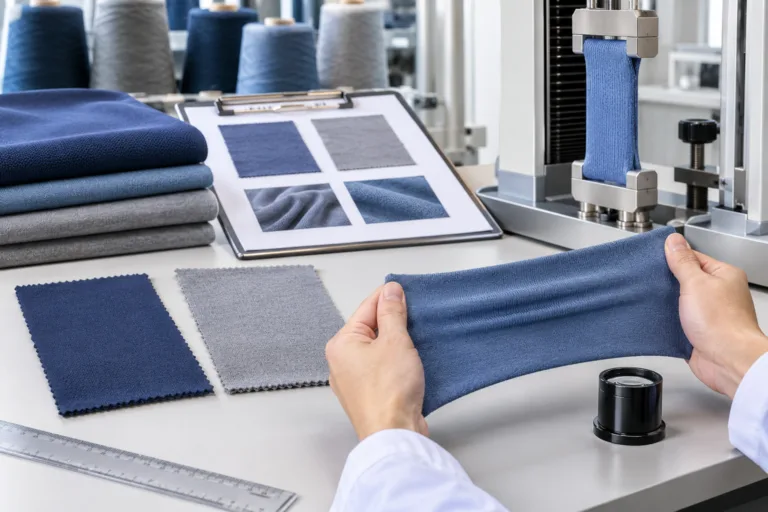
A swatch can give an early, comparative view of compression knit stretch recovery: how the material extends and returns after release under stated conditions. It can also reveal directional differences, visible distortion, edge changes, or changes between bonded layers. These observations help development teams ask better material and prototype questions. Apparel Wiki is an independent educational publication; its Sponsor page explains the separation between sponsorship and editorial control.
A swatch cannot establish how much pressure a garment will apply, how it will fit around body contours, or how seams will behave. It also cannot prove durability after repeated wear and care. Its value lies in controlled comparison, accurate documentation, and bounded interpretation—not in turning one stretch-and-release observation into a complete performance claim.
What compression knit stretch recovery can reveal from a swatch
For a practical review, stretch recovery means the material’s return after it has been extended and released under recorded conditions. That return may be assessed immediately and again after a chosen observation period. Without a validated test method, fixed extension amount, or formal calculation, the result should remain a qualitative comparison rather than a pass-or-fail finding.
Start by identifying the wale and course directions, then examine each direction separately. Use the same swatch preparation, handling sequence, and observation timing for every sample being compared. A material may extend readily in one direction yet show a different return pattern in the other. Neither direction is automatically superior; suitability depends on how the fabric will be oriented and loaded in the garment.
Keep four related observations distinct:
- Extension: how the swatch changes while force is applied.
- Return after release: how closely and evenly it moves toward its relaxed condition.
- Residual visible distortion: marks, ripples, edge changes, or altered shape that remain after release.
- Recovery over time: whether the swatch continues returning during a later recorded observation.
These observations can describe stretch recovery in knit fabric, but they do not independently prove compression performance. A swatch that appears to return cleanly once might behave differently after repeated extension, laundering, heat exposure, sewing, or use around a curved body area.
The description “compression knit” is also incomplete on its own. Knit identifies a construction family, not a fiber. Record the fiber composition, yarn construction where known, knit structure, weight, finishing, and any coating, bonding, or lamination. Each belongs to the material description and may affect the development questions that follow. Samples with the same commercial label can still differ in specification and observed behavior.
Most importantly, a flat compression knit swatch cannot determine garment pressure, long-term fit retention, seam response, or care durability. It provides evidence about that sample under the conditions used, not a universal statement about every garment made from it.
Set up a swatch comparison that produces usable observations
A useful compression fabric swatch evaluation begins with records, not pulling. Assign each sample a clear identity and note the wale and course directions. Record its relaxed dimensions, visible structure, known composition, weight, finish, and any lamination or coating. Include supplied conditioning information, if available, and describe the extension, release, and observation sequence you will use.
Use matching sample sizes whenever practical. If one swatch is cut, conditioned, held, or extended differently from another, the comparison becomes harder to interpret. Consistency does not convert an informal review into a laboratory test, but it reduces avoidable variation and makes the observations more useful for development.
A simple qualitative sequence can follow these steps:
- Place the swatch flat and inspect it in its relaxed condition. Record its shape, edges, surface, layers, and directional markings.
- Extend it consistently in one direction using the documented handling procedure. Avoid changing the procedure between samples.
- Release the swatch without adding an extra pull, snap, or smoothing action that could affect the comparison.
- Observe it at a recorded interval. Note its return, remaining distortion, and any surface or edge changes.
- Repeat the same sequence in the other direction, then apply it consistently to the remaining samples.
This process is useful for a knit fabric recovery comparison, but it should not be described as a certified result. A formal result depends on an applicable documented method, controlled specimen preparation, defined equipment or procedures, and reported calculations. An informal review instead supports screening, comparison, and decisions about what requires closer evaluation.
Use a compact checklist while observing each sample:
- Does the swatch return evenly, or do some areas remain more extended?
- Do the edges curl, flare, ripple, or shift?
- Are there permanent-looking lines, shiny areas, creases, or other marks?
- Does the surface appearance change after extension or flexing?
- Does the response differ noticeably between the wale and course directions?
- For multilayer material, do the layers appear to move, wrinkle, lift, or change differently?
Bonded and coated constructions need attention beyond surface return. Review folds and flexed areas as well as the flat face. The assembled material acts as a system, so information about one component does not automatically describe the condition of the coating, bond, backing, or completed laminate.
Read directional recovery without overinterpreting it
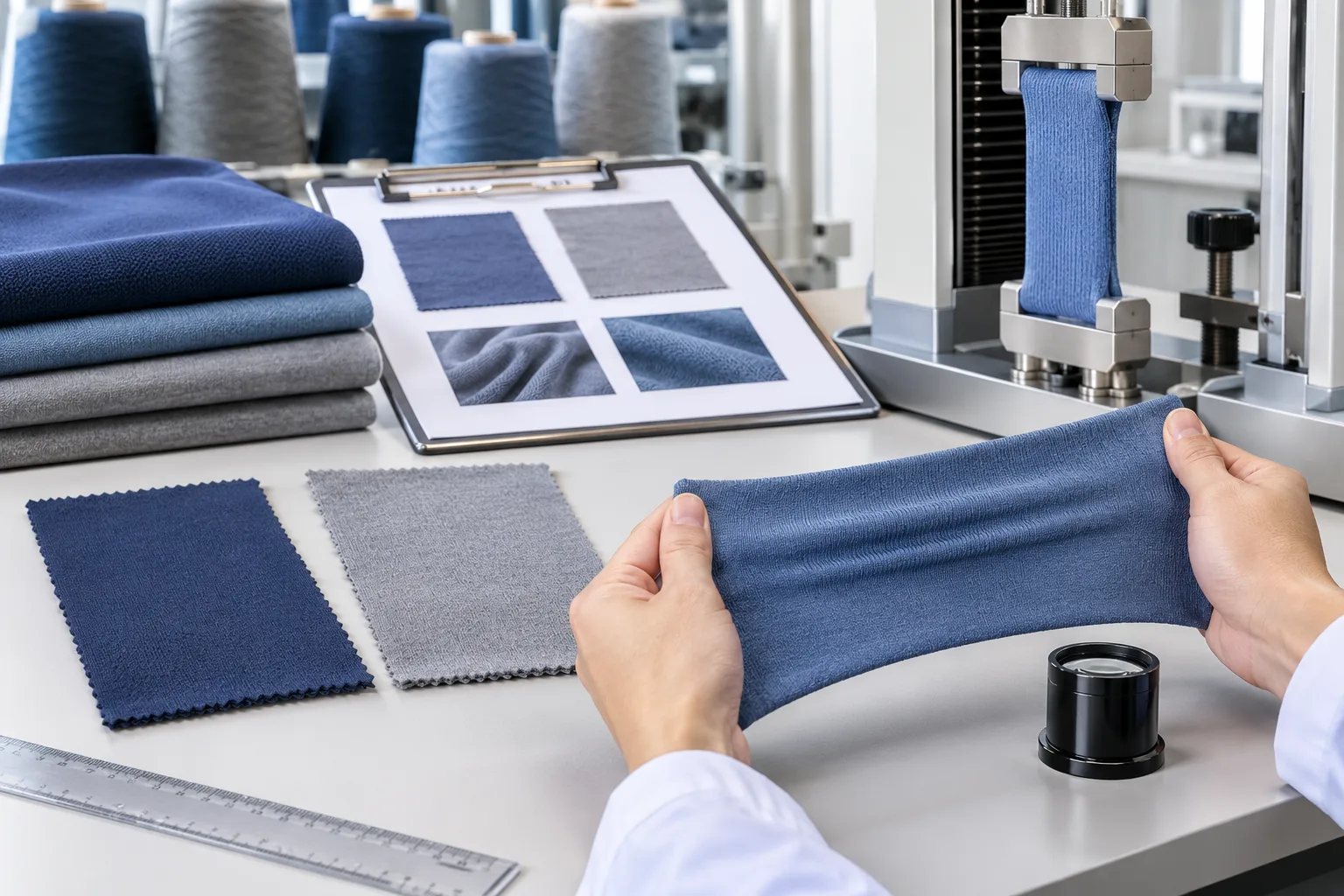
Wale and course stretch may produce visibly different extension and return. The useful question is not which direction is universally better. It is whether the observed directional stretch recovery suits the intended panel orientation, movement demand, and construction plan. Structure can guide investigation, but it should not be treated as a standalone predictor of recovery, comfort, breathability, or durability.
| Observable swatch input | Possible development implication | Sensible initial choice | Variable that could change the choice |
|---|---|---|---|
| Similar return in both directions | Panel orientation may be less constrained by directional return | Retain both orientation options for prototype review | Garment shape, loading direction, seams, and finished dimensions |
| Noticeably different directional return | Orientation may affect how a panel regains its shape | Compare the stronger observed return with the main movement demand | Pattern layout, seam placement, and material transitions |
| Visible residual distortion | The sample may require further review before use in a highly loaded area | Recheck handling and compare another sample or construction | Repeated extension, finishing, care, and prototype geometry |
| Layer or surface change after flexing | Flat-face return does not describe the full material system | Carry the affected fold or flex condition into a constructed trial | Bonding, coating, stitching, care, and location in the garment |
For a close-fitting panel expected to stretch mainly in one direction, compare that demand with the direction showing the more suitable return under the documented review. This can inform an initial orientation choice. It cannot finalize the panel, because seam position, curvature, finished dimensions, and adjacent materials still require confirmation in a prototype.
A single release observation is therefore an early signal. It can identify a promising direction or a concern worth investigating, but it does not prove repeated-use durability, stable garment compression, or wearer experience.
Separate swatch recovery from garment compression performance
A fabric returning toward its relaxed shape does not establish how much compression a finished garment will provide. Swatch recovery describes material behavior under the recorded comparison conditions. Garment compression also depends on body dimensions, pattern reduction, panel shape, finished measurements, construction, and how the garment is positioned during wear.
The same fabric can behave differently across garment zones. A flat panel does not reproduce body curvature, changing movement demands, or the loading created where panels meet. Panel orientation, seam placement, edge finishes, and transitions to another material can alter the questions that need examination in a prototype.
For example, a direction that shows suitable return in a flat sample may still create an unsuitable result when it wraps around a curved area. The finished panel may stretch in more than one direction, while a seam restricts or redirects movement. The swatch finding remains useful, but it becomes an input for pattern and construction review rather than a garment-level conclusion.
Development conditions can also change compression knit performance over time. Repeated extension, laundering, heat exposure, finishing changes, and interaction with elastic, thread, lining, bonding, or other components may require separate evaluation. Which conditions matter depends on the product, care expectations, construction, and intended use.
Keep three evidence levels distinct:
- Material observation: what the swatch did under stated preparation, extension, release, and observation conditions.
- Prototype finding: what happened after the fabric was cut, oriented, joined, shaped, and evaluated in a garment form.
- Product claim: a statement requiring evidence appropriate to the finished product and its stated use.
This separation is especially important for quantified pressure, physiological, circulation, medical, or therapeutic claims. A qualitative swatch review cannot support them. Such claims require suitable product-specific evidence beyond the scope of a fabric comparison.
Use swatch findings to choose the next development step
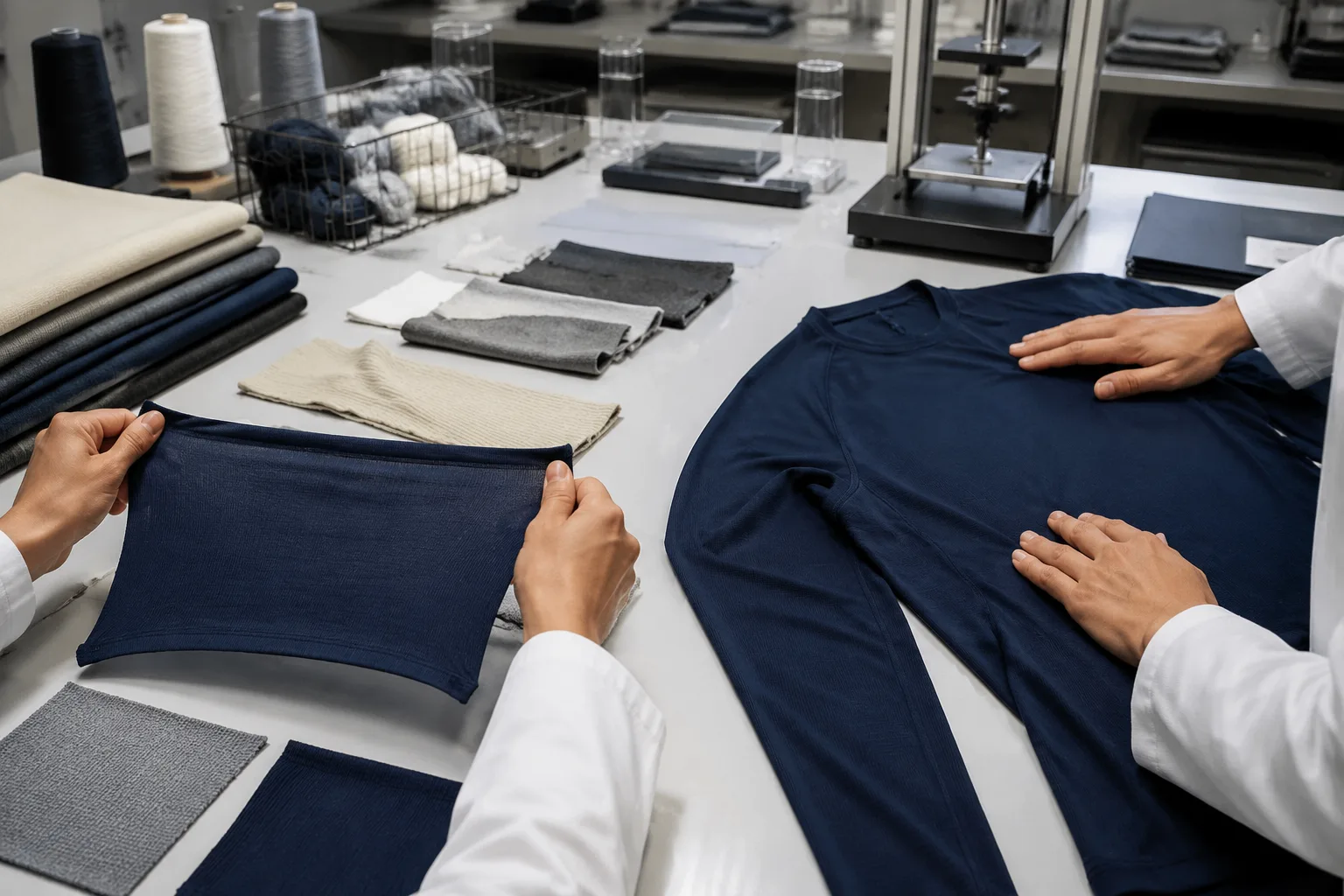
The next action should address the main uncertainty revealed by the comparison. If a sample shows appropriate return under the documented conditions, retain it as a reference and carry its identity and observation record forward. This preserves a meaningful comparison point without treating the result as a universal approval.
If directional differences, visible distortion, or surface changes conflict with the intended use, revise the development question. The next comparison might examine another material, a different panel orientation, an adjusted construction, or a changed garment zone. Avoid changing several variables at once when the goal is to understand which choice affected the result.
Advance to a compression garment prototype when garment geometry is the unresolved variable. A prototype can bring curvature, panel shape, seams, finished dimensions, and material transitions into the review. It can also show whether the direction selected from the swatch remains appropriate after cutting and assembly.
Carry the following information into the material brief:
- The complete material description, including known composition, yarn, knit structure, weight, finishing, coating, bonding, or lamination.
- The swatch condition and any preparation information supplied or recorded.
- The wale or course direction examined and the handling sequence used.
- The observed return, distortion, curl, marks, or surface and layer changes.
- The intended garment zone and expected direction of movement.
- The unanswered question that the prototype or next comparison should address.
For a multilayer compression-knit component that appears acceptable while flat but changes at a fold, reproduce that fold location in a constructed sample. Compare the area before and after the relevant flexing or care review. Examine the assembled system, because a report or observation for one component does not automatically describe bonding, stitching, or layer behavior after construction.
Laboratory testing becomes more useful when a specification, supplier agreement, compliance need, or comparable acceptance decision requires a defined method and documented result. The applicable method should determine specimen preparation, test conditions, calculations, and reporting. An informal swatch review should not be converted into a pass/fail threshold.
Also avoid using fabric weight as a shortcut for predicted recovery, thickness, or quality. GSM describes mass per unit area. It is one material-description input and should be considered with composition, yarn, structure, finishing, assembled layers, and intended use.
Make the swatch a starting point, not the final verdict
A controlled swatch comparison is most valuable when it produces a documented directional observation tied to an intended garment use. It can reveal a promising material response, identify distortion, or expose a layer-related concern. It cannot settle garment compression, durability, fit, or wearer experience.
As the next educational step, compare the swatch record with the prototype review plan. Identify which questions require garment geometry and construction, then check the applicable documented test method if the decision requires a formal, comparable result.
Frequently Asked Questions
What is the difference between stretch and stretch recovery in a compression knit?
Stretch describes extension under the stated handling or test condition. Stretch recovery describes the material’s return after release under stated conditions. Immediate return, residual distortion, and later recovery are related observations, but they should be recorded separately.
Can a fabric swatch tell me how much compression a garment will provide?
No. A swatch can reveal comparative extension and return, but garment compression also depends on body dimensions, pattern reduction, panel geometry, orientation, seams, finished measurements, component interactions, and how the garment is worn.
Why should I check stretch recovery in both knit directions?
Wale and course observations may differ. Checking both directions helps relate the material response to panel orientation and movement demand. Neither direction is automatically better; suitability depends on the intended garment zone and construction.
What should I record when comparing compression-knit swatches?
Record sample identity, known material details, relaxed dimensions, direction, sample condition, handling sequence, release interval, and visible observations. Note uneven return, curl, edge distortion, persistent marks, directional differences, and surface or layer changes.
Does a swatch that returns well once prove that it will hold up after wear and washing?
No. One release observation is an early development signal. Repeated extension, care, heat, finishing, assembly, and component interactions can introduce different conditions that require separate evaluation when relevant to the product.
When should a compression-knit recovery question move from swatch review to a formal test?
Use a formal test when a specification, supplier agreement, compliance requirement, or acceptance decision needs a defined method and documented result. Use the applicable method rather than converting an informal comparison into an unsupported threshold.


