Apparel master data governance architecture is the operating model used to define, own, control, and exchange shared apparel information. It covers entities such as styles, colors, sizes, materials, components, suppliers, facilities, and approved versions, then connects them to the people, workflows, controls, and systems that use them. In practical terms, it helps an apparel business agree on what a record means, who can change it, which version is approved, and where that information should be used.
This is a business and decision structure, not simply a software installation. Apparel Wiki is an independent educational publication, and its Sponsor information does not change that editorial position. The right governance approach depends on the company’s products, operating model, partners, existing systems, and process maturity.
What Is Apparel Master Data Governance Architecture?
Master data is relatively stable, shared information about the important entities in a business. In apparel, it may include a style identifier, a color definition, a size range, a material or trim, a supplier, a factory or other facility, and the current approved specification version. These records are reused by multiple teams and processes, so their meaning must remain clear when information moves from product development to commercial or operational work.
Apparel master data governance is the set of decisions and practices that keeps this information understandable and usable. Its architecture combines data definitions, ownership, creation and approval workflows, access controls, change rules, status values, version handling, and system responsibilities. It should answer practical questions: Who defines a material code? Who approves a production version? What happens when a color name changes? How can users identify the current record? When should an obsolete record be retired?
Master data should be distinguished from transactional data. A style, supplier, or material can be referenced by many transactions, while a purchase order, production order, shipment, or sales transaction records a particular business event. The transaction may use master data, but it is not the same thing. Confusing these layers can make it difficult to correct a shared definition without accidentally changing historical activity.
PLM, ERP, MES, WMS, and related system labels may indicate different areas of business activity, but the name of a system does not prove its exact capabilities. One product may create or manage product information, another may support purchasing or inventory, and another may record manufacturing activity. Their boundaries and overlaps must be checked against actual workflows, data structures, and documentation. No single architecture is universally correct: a brand, manufacturer, made-to-order business, and multi-partner operation may need different ownership and integration choices.
Why Data Governance Matters Across the Apparel Product Lifecycle
Apparel data management becomes difficult when the same product information is copied, renamed, reformatted, or interpreted differently as work progresses. A style may begin in design and development, then appear in costing, sourcing, purchasing, production planning, quality review, inventory, and fulfillment. Color, size, material, component, supplier, and version information can travel through each stage, even when different teams use different tools.
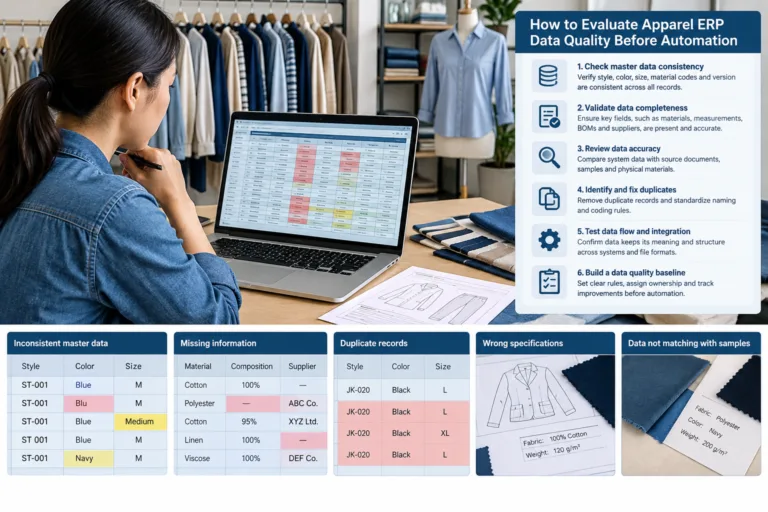
An inconsistent identifier can create a duplicate record. A unit that is not clearly defined can cause users to compare unlike values. A development specification can be mistaken for a production-approved version. A supplier or component may be selected under a familiar name even though the underlying record is different. These issues can lead to rework, approval confusion, incorrect purchasing, inventory questions, or fulfillment corrections. The exact impact depends on the process and the degree of control already in place.
Automation does not independently resolve a disagreement about meaning. It can move inconsistent names, values, and statuses more quickly across an interface. For that reason, governance should establish definitions and accountability before an organization assumes that integration will produce consistent results.
| Data domain | Typical users or decisions | Risk when meaning is inconsistent |
|---|---|---|
| Style and product identity | Design, development, merchandising, planning | Duplicate products, unclear approvals, unreliable reporting |
| Color, size, and measurements | Product teams, production, quality, fulfillment | Incorrect specifications, selection confusion, avoidable corrections |
| Materials and components | Development, costing, sourcing, purchasing | Wrong inputs, mismatched records, purchasing rework |
| Suppliers and facilities | Sourcing, procurement, production, quality | Unclear responsibility, duplicated partners, routing errors |
| Versions and approval status | All downstream users | Work based on outdated or unapproved information |
The business consequence may be operational first and strategic later. Teams may spend more time reconciling records, decisions may be delayed while people confirm which value is correct, and reports may be less reliable when records cannot be grouped consistently. These are risk pathways, not guaranteed savings or quantified losses. Responsibilities also differ: a brand may own product definitions while a manufacturer owns production records, or both parties may share responsibility through agreed interfaces.
Which Data Domains and Attributes Need Governance?
A practical apparel product master data scope can include product and style identifiers, descriptions, seasons or collections, colors, sizes, measurements, materials, trims, packaging, suppliers, factories or facilities, markets, and document or specification versions. The list is a starting point, not a universal field catalog. Each organization must decide which attributes are necessary for its products, partners, processes, and systems.
It helps to distinguish several related concepts. An entity is a business object, such as a style or supplier. An attribute describes it, such as a material composition or size label. A code is an agreed identifier or value used to represent an entity or attribute. A relationship connects records, such as a style using a component or a supplier serving a facility. A version identifies a controlled state of a record or document at a particular point in its lifecycle.
Color and size illustrate why shared definitions matter. A color name may be descriptive for a designer but insufficient for purchasing or production if different systems use similar names for different values. A size label may be reused across markets or product categories with different measurement expectations. The business must agree which definitions, codes, relationships, and effective dates are appropriate; there is no universal naming scheme that can be assumed for every apparel operation.
A bill of materials, measurement specification, tech pack, and approval record can contain or reference master data, but they are not automatically identical master records. A bill of materials may describe the components required for a particular product version. A specification may describe measurements or construction requirements. An approval record may document a decision. Governance should define how these objects relate, which one is authoritative for each question, and how changes are connected.
Start with domains that cross several teams and systems and create meaningful operational risk. A focused first effort might examine style identity, materials, supplier records, or specification versions. Governing every field at once can make ownership, training, exception handling, and maintenance harder to manage.
How to Assign Data Ownership, Approval, and Change Control
Data ownership should follow business accountability rather than defaulting automatically to the IT department. A data owner is accountable for the meaning, policy, and acceptable use of a domain. A data steward helps maintain definitions, quality checks, and day-to-day issue resolution. Creators enter or propose records, approvers authorize them, system administrators configure technical controls, and downstream users consume the information and report problems.
A controlled workflow commonly moves a record through proposal, validation, approval, publication, revision, retirement, and review. The exact steps depend on the organization, but the decision points should be visible. Users need to know which record is current, what status it has, who approved it, and how to raise an exception. Change control should also preserve enough history to explain why a style, material, supplier, or specification changed.
| Domain | Likely accountable owner | Stewardship and approval focus |
|---|---|---|
| Style and product identity | Product or merchandising leadership | Definition, uniqueness, lifecycle status |
| Material and component | Product development or sourcing leadership | Attributes, approved uses, substitutions |
| Supplier or facility | Sourcing or operations leadership | Identity, relationships, status, responsibility |
| Color and size | Product or technical leadership | Controlled values, market context, reuse |
| Specification version | Technical or quality leadership | Approval state, effective date, revision history |
This matrix is an organizational design example, not a legal or universal industry requirement. Conflicts are normal: design may prefer a descriptive name, procurement may need a structured code, and development may be working with a sample that is not approved for production. Clear escalation rules should identify who resolves the conflict, while exception rules should explain when a deviation is permitted and how it is recorded. Governance policy sets the decision principles; implementation procedures and company preferences determine how those principles operate in practice.
How Systems Should Exchange Apparel Master Data
Governance becomes practical when each system has a defined responsibility for the data it creates, approves, enriches, consumes, or reports. A product lifecycle management system may support development activities in one company, while an enterprise resource planning system may manage purchasing or inventory in another. Manufacturing execution, warehouse, and related tools can have different boundaries. These labels provide context, but they do not prove the exact capabilities of a particular product.
Before connecting systems, agree on the meaning of shared identifiers, fields, units, status values, version rules, and effective dates. A style identifier should refer to the same business object wherever it appears. A material description should not silently change meaning between product development and purchasing. Similarly, a specification marked as approved in one system should not be treated as current elsewhere unless the approval state and version have been transferred and interpreted consistently.
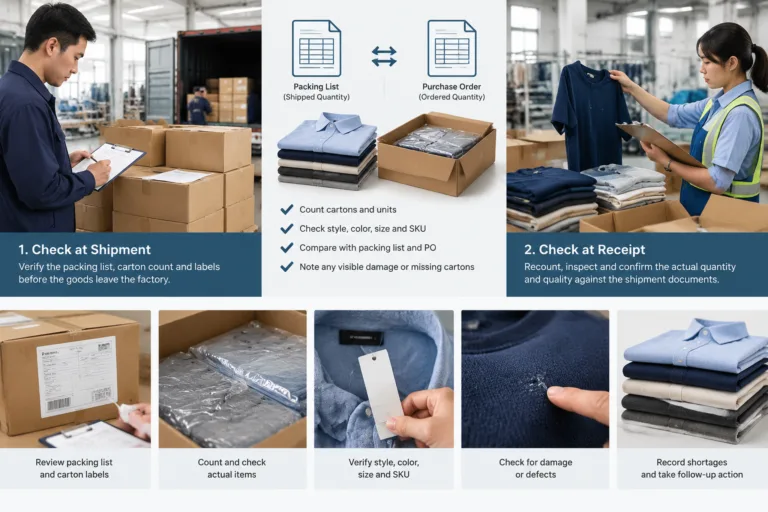
A file that imports successfully is not necessarily a successful exchange. Dimensions, material relationships, color or size values, approval status, revision history, and record identity may be altered, omitted, or reinterpreted. A useful interoperability test therefore follows a representative complex record through import, editing, export or return, exception handling, and recovery. Include records with revisions, optional attributes, substitutions, and intentionally invalid values where those situations occur in the real workflow.
Three broad architecture choices can help frame the discussion:
| Approach | Useful question | Main consideration |
|---|---|---|
| Centralized master | Can one governed source serve the required teams and systems? | Central authority may simplify definitions, but integration and ownership must be workable. |
| System of record | Which system is accountable for each domain or record type? | Different domains may have different authoritative sources, requiring clear handoffs. |
| Federated model | Can multiple owners maintain data under shared rules? | It can fit distributed organizations, but depends heavily on coordination and consistent controls. |
The appropriate choice depends on ownership, integration capability, governance maturity, and operational risk. Apparel master data architecture should be validated with representative business records and users, not inferred from a vendor demonstration or a system acronym.

How to Evaluate Governance Quality in an Apparel Project
An apparel data governance assessment should begin with the records that matter to several teams. Check whether important entities have clear definitions, unique identifiers, accountable owners, approved values, version rules, and retirement processes. Users should be able to identify the current approved style, material, supplier, or specification and understand whether an older record remains usable, has been replaced, or should no longer be selected.
Evaluate both the data and the operating behavior around it. A technically complete record may still create risk if users bypass approval, maintain local spreadsheets, or cannot resolve conflicting values. Review duplicate creation, manual reconciliation, exception handling, approval delays, downstream corrections, and the effort required to find or repair a record. Keep observed results separate from editorial recommendations and hypothetical examples.
A controlled pilot gives the organization a more useful basis for judgment than a generalized promise of efficiency. Define the current baseline, choose a representative sample, set an observation period, and document the measures that matter to the selected workflow. Depending on the project, these may include data completeness, duplicate handling, workflow adoption, user effort, integration behavior, exception recovery, and the ability to identify the approved version. Include training, integration, and maintenance work when reviewing the result.
- Definitions: Are the entity, attribute, status, and version meanings understandable to every participating team?
- Accountability: Is someone responsible for decisions, exceptions, corrections, and ongoing maintenance?
- Workflow: Can users propose, review, approve, publish, revise, retire, and audit records without creating parallel meanings?
- Integration: Do representative records retain their identity, relationships, units, and status when exchanged?
- Adoption: Do users follow the process, and can they recover from rejected or incomplete exchanges?
Exit conditions are also important. A pilot should not expand simply because a demonstration worked. The organization should know which unresolved exceptions, ownership gaps, or maintenance burdens must be addressed before adding another domain or system.

Common Limits and Practical Next Steps for Apparel Data Governance
Governance cannot compensate for an unclear product definition, unresolved business ownership, poor process design, or an unvalidated integration. It also cannot make every organization use the same data model. A brand, manufacturer, custom business, and made-to-order operation may prioritize different domains because their product flows, partners, inventory responsibilities, and approval decisions differ.
For that reason, implementation should begin with a specific business problem rather than a promise that one platform or architecture will improve the entire company. Document the current flow for one cross-functional domain, such as style identity, material information, supplier records, or specification versions. Agree on the definitions, owner, approval path, status values, and exception rules. Then test representative records across the relevant system boundary before expanding the scope.
Maintenance is part of the operating model. New employees, suppliers, systems, product categories, policy changes, and retired products can all challenge the original rules. Assign responsibility for reviewing definitions and managing exceptions after launch. A governance process that works only while a project team is present is not yet sustainable.
As an educational next step, readers can compare their current data flow with the practical guidance in Apparel Manufacturing Tools, then record one domain where inconsistent information creates repeated manual work. The decision path is straightforward: clarify the business problem, map the data, assign accountability, test the boundary, measure the result, and scale only when the operating model remains maintainable.
What is apparel master data governance architecture?
It is the combined structure of definitions, ownership, workflows, controls, and system responsibilities used to keep shared apparel data consistent. It can cover styles, colors, sizes, materials, suppliers, facilities, and approved versions.
What types of apparel data should be governed first?
Start with high-impact domains reused by multiple teams and systems. Style identity, materials, colors, sizes, suppliers, facilities, and specification versions are common candidates, but the priority should reflect the organization’s actual risks and processes.
Who should own apparel master data?
Business ownership should follow accountability for the meaning and use of the data. Product, sourcing, operations, technical, or other leaders may own different domains, while data stewards support quality and daily control.
How do PLM, ERP, MES, and WMS relate to apparel master data governance?
They may support different parts of the product, purchasing, production, or warehouse lifecycle, but their exact capabilities vary. Governance defines the boundaries and exchange rules; system names alone do not establish those responsibilities.
How can a business test apparel data interoperability before expanding a system project?
Use representative complex records and test import, editing, export or return, exception handling, and recovery. Check identity, relationships, units, materials, dimensions, status, and versions rather than only whether a file opens.
What are the limits of apparel master data governance?
Governance does not resolve unclear definitions, weak ownership, poor processes, or flawed integrations by itself. Results depend on business agreement, user adoption, technical design, maintenance, and the organization’s ability to enforce decisions.