Assortment overlap data analysis examines how assortment items share defined characteristics or coverage. The main pitfalls are inconsistent comparison units, mismatched product records, unequal selling windows, and incompatible sales or availability definitions. These errors can make products appear redundant without establishing that shoppers consider them substitutes. Apparel Wiki provides this guidance as an independent educational publication; its Sponsor page explains that sponsorship does not confer editorial control.
Start by asking whether the records represent comparable items under comparable conditions. Define what each row represents, which products belong in the review, and what the findings should inform. Similarity alone cannot establish that removing one item would shift purchases to another.
How to Frame Assortment Overlap Data Analysis
A useful assortment overlap definition identifies both the comparison unit and the characteristic being compared. Styles can overlap in category, colorways in appearance, and SKUs in specific color-size coverage. Those comparisons answer different questions. Combining them under one label makes the result difficult to interpret.
Before summarizing overlap, state whether the review operates at style, colorway, size, category, fabric, construction, or SKU level. Also distinguish the record unit from the matching attribute. A dataset can contain one row per style while comparing those styles by fabric or intended use.
For this review, style count describes assortment breadth. Depth concerns the stock planned within that assortment, especially units allocated to each style-color-size combination. Record the number of combinations separately: variant coverage and stocking quantity both affect inventory exposure, but they describe different features of the plan.
Break the plan down to SKU level before judging inventory or choice implications. This reveals where stock and variants sit within a style total. Then summarize at the level needed for the decision. A category coverage question may need style-level results, while size availability requires finer detail.
Keep descriptive similarity separate from commercial substitution. Shared fabric, silhouette, or construction can identify items for closer inspection. These attributes do not establish that customers would choose one garment instead of another. That interpretation requires evidence about customer choice and the conditions under which products were offered.
Record a short analysis brief before reviewing results: the purpose, included population, exclusions, comparison unit, and intended decision. Specify whether the population covers planned products, launched products, or available stock. A product assortment comparison prepared to inspect category coverage should not silently become evidence for cutting inventory. Preserve these boundaries beside the findings so another reader can understand what the result describes and where its relevance ends.
Match Product Identity and Data Grain Before Comparing Items
Data grain means what one record represents. A style summary, a color-size SKU, and a channel-specific stock record are different grains. Mixing them can make one product appear repeatedly, while aggregating everything to style level can hide differences in color or size coverage.
Write an explicit identity rule using the fields needed for the review. Treat style ID, color code, size code, season, channel, and revision status consistently. Decide which fields identify the product and which describe its context. A channel field, for example, may distinguish selling records without identifying a different garment.
Check the relationships behind apparent matches before merging records:
- Duplicate records: establish that rows repeat the same underlying record, rather than separate transactions, locations, or reporting periods.
- Renamed styles: preserve the connection between old and new identifiers when product documentation supports continuity.
- Revised styles: retain revision information when fit, fabric, or construction has changed; decide whether that change matters to the comparison.
- Shared parent styles: keep child colorways and sizes traceable. A common parent does not make every variant an identical choice.
Document each matching rule and retain the original identifiers. Otherwise, later reviewers cannot tell whether a match came from product evidence or an undocumented cleanup choice. Genuinely separate products should remain separate even when their descriptions are similar.
Check attribute vocabularies as part of product data quality. Category, silhouette, fabric description, construction detail, and intended use need comparable meanings. Convert measurement units consistently where relevant. A blank field does not establish a match, and a generic description such as “knit” does not establish equivalent fabric.
SKU matching also needs a clear counting rule. Counting each size as an independent alternative can inflate the apparent number of choices when the question concerns distinct designs. Inspect a small sample of matched and unmatched records against product documentation before trusting the full comparison. Include records with missing fields or revisions. Use discrepancies to correct the rules, then reassess affected matches rather than assuming the remaining records are reliable.
Check Time, Availability, and Sales Definitions
Assortment sales data needs a defined observation window. Align season, channel, launch timing, and markdown status before interpreting parallel or divergent sales. An item launched late has less selling time within the same reporting period. Matching report dates alone does not equalize its opportunity to sell.
Choose whether the question concerns performance over shared calendar dates or comparable periods after launch. Document that choice. Earlier receipts can increase inventory exposure before selling begins, while delayed receipts can restrict availability. These are planning considerations, not proof that receipt timing determines customer preference.
Use this field-definition checklist beside the results:
- Observation period: record start and end dates, launch dates, and markdown exposure. Unequal selling windows limit direct comparisons of totals.
- Sales measure: specify gross units, net units, or another agreed measure. State how cancellations are handled; booked orders and completed sales represent different events.
- Available-to-sell denominator: define eligible stock and receipts for the chosen rate. Stock unavailable to the reviewed channel should not silently count as customer-accessible inventory.
- Replenishment: state whether and when additional receipts enter the denominator. A replenished item and an unreplenished item may have different opportunities to record sales.
- Returns: document whether returns reduce sales and whether returned units reenter available stock. Posting dates can affect the period being compared.
- Channel scope: identify included channels and transfer treatment. Inventory transfers should not be confused with customer sales or counted twice as available stock.
A sell-through data definition is incomplete without its period, numerator, denominator, and treatment of returns and replenishment. Use an explicit project convention, and align it across compared items before interpreting differences.
Availability is not demand. Stockouts, missing sizes, or delayed receipts can constrain recorded sales without demonstrating weaker customer interest. Preserve those limitations beside the affected comparison. A low sales total from an intermittently available garment cannot, by itself, establish that another item displaced its sales.
Separate Apparent Overlap from Meaningful Assortment Risk
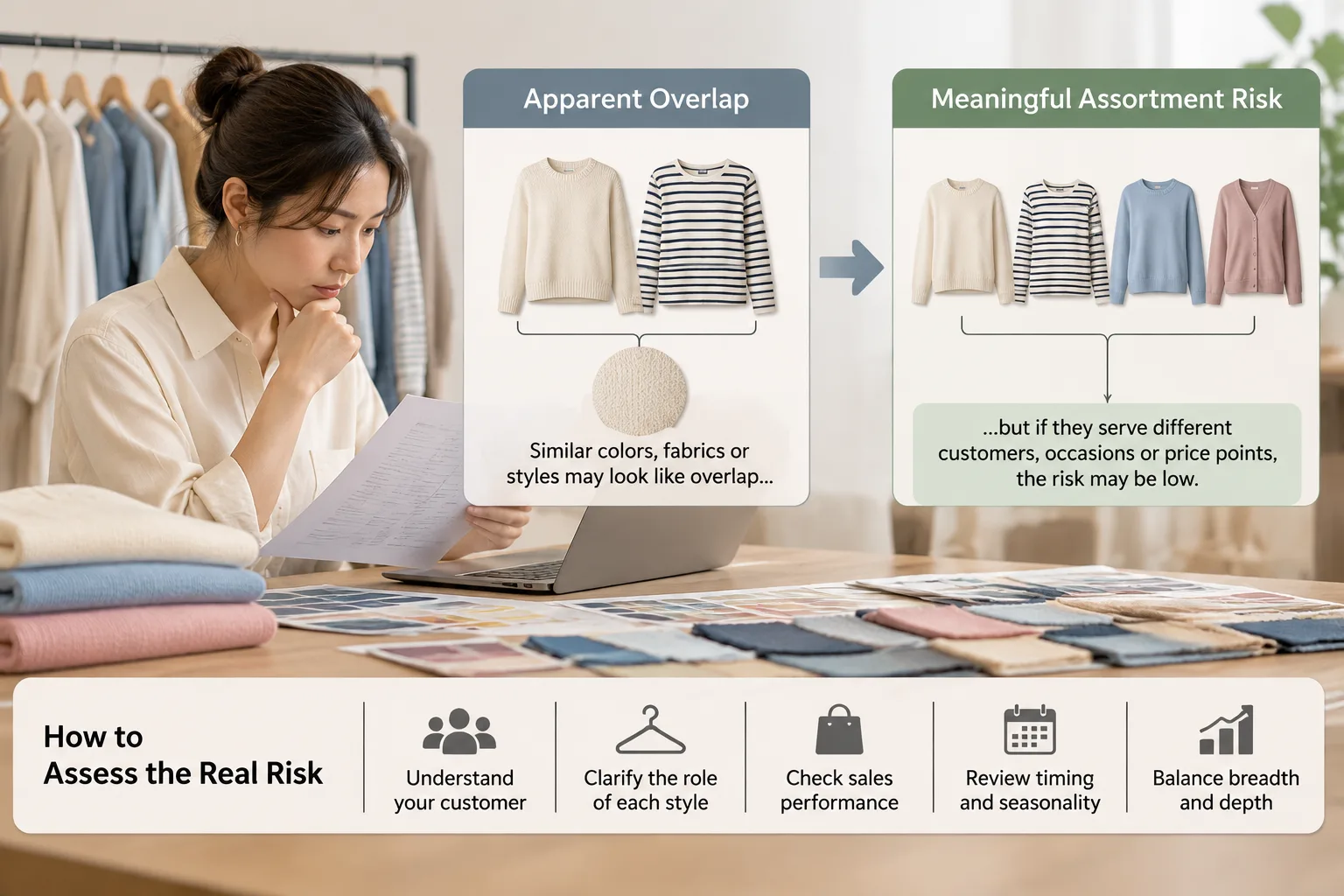
An overlap finding can describe several different relationships. Attribute overlap asks whether items share features such as category, fabric, silhouette, color, or construction. Customer-choice overlap asks whether they may serve a similar shopping need. Sales-pattern overlap compares movement over an aligned period. Inventory-risk overlap considers whether similar items create added stock, presentation, or replenishment pressure.
These relationships should not be compressed into one undifferentiated overlap score. Shared attributes can justify a closer product review, but they do not establish that customers would choose one item instead of another. Parallel sales movement also does not prove that one item displaced the other. Observational assortment relationships require cautious interpretation because the records may reflect several commercial conditions at once.
Review the context around any apparent match. Price architecture, use occasion, fit, fabric, construction, color, size availability, channel placement, launch timing, and promotional exposure can change how two products function in the assortment. Two similar-looking tops may serve different uses or price positions. Two items with different descriptions may still address a similar shopper need.
A high apparent overlap may result from a broad category definition, duplicated records, or a parent style being compared with its own variants. Conversely, low attribute overlap may conceal substitution when products solve a similar use problem. Check the data identity and grain before treating either pattern as a commercial conclusion.
Item role also matters. A core item, image item, and experimental item may have different purposes, observation periods, and review conditions. This role distinction is an editorial planning lens, not a fixed industry taxonomy. An overlap finding may be acceptable when the items support different assortment objectives. More styles also do not necessarily produce higher total sales, so choice should be considered alongside inventory and presentation burden. No universal threshold establishes when overlap becomes harmful.
A Practical Review Workflow for Overlap Findings
A repeatable review begins with the decision question. State whether the analysis will inform product cleanup, a future assortment plan, inventory review, or a closer product comparison. Then set the comparison unit, freeze the dataset scope, and record inclusion and exclusion rules. This prevents a result from being reused for a decision it was not designed to answer.
Next, inspect identity and field consistency. Check style IDs, color and size codes, season, channel, revision status, category, fabric description, construction details, and intended use. Audit the time window, sales measure, markdown status, availability, returns, replenishment, transfers, and cancellations. Flag missing or non-comparable records rather than silently filling them or treating blank fields as matches.
Use the following table to keep an observed pattern separate from the action it may justify:
| Observable inputs | What the pattern may indicate | Initial review choice | Variables that could change the choice |
|---|---|---|---|
| Duplicate IDs, renamed styles, or conflicting parent records | A data-identity problem rather than product overlap | Clean or reconcile records before making an assortment decision | Revision history, intended replacement status, and the comparison unit |
| Shared attributes but different use roles | Descriptive similarity without direct substitution | Review role, use occasion, and price position qualitatively | Fit, channel placement, presentation, and customer need |
| Comparable items with different selling windows | A sales-pattern difference affected by timing | Align the observation period or qualify the comparison | Launch date, markdown exposure, season, and promotional support |
| Similar items with constrained stock or missing sizes | Observed sales affected by availability rather than demand | Separate availability review from substitution review | Receipts, replenishment, size coverage, stockouts, and channel access |
Rank findings by confidence and decision relevance. A clear duplicate record may support a data-cleaning action, while a sales difference affected by stock constraints may only support further review. Keep those actions separate. When the data cannot distinguish substitution from availability or timing effects, require a qualitative product review before changing the assortment.
For a lightweight knit offered in several colorways, compare the same style and selling window first. Then inspect color and size availability. The review may change if the products serve different use occasions or received different channel exposure. This sequence uses observable garment and data inputs without treating the result as a measured customer response.

Use the Results as a Qualified Input to Assortment Decisions
Reliable assortment overlap review depends on comparable identities, aligned time windows, clear availability definitions, and a stated decision context, not on a single overlap number. Before changing an assortment, compare the dataset specifications and applicable measurement definitions, then revisit flagged records with the relevant merchandising or product team. Keep an audit note recording assumptions, unresolved fields, confidence, and the variable that could change each initial choice.
Frequently Asked Questions
What is assortment overlap data analysis?
Assortment overlap data analysis compares defined assortment units, such as styles, colorways, sizes, categories, or SKUs, to identify shared attributes or related sales and inventory patterns. Its meaning depends on the comparison unit, population, field definitions, and decision the review is intended to inform.
Why can two similar apparel products not be treated as direct substitutes?
Similarity does not prove that customers would choose one product instead of the other. Use occasion, fit, price position, fabric, construction, channel, size availability, promotion, and item role can distinguish products that appear similar in a dataset.
How should sales and availability data be aligned before reviewing assortment overlap?
Align the observation period, launch timing, channel, sales measure, available-to-sell definition, replenishment treatment, returns, transfers, and cancellations. Record each convention beside the comparison. Availability is not demand, so stock constraints should not be interpreted as weaker customer interest without supporting evidence.
Should assortment overlap be measured at style level or SKU level?
Use the level that matches the decision. Style-level analysis can summarize a product family but hide color and size differences. SKU-level analysis supports inventory and choice review but can multiply apparent alternatives. The selected level and its limitations should be documented.
How can stockouts and late launches distort an overlap review?
A stockout, missing size, delayed receipt, or late launch can reduce the time or opportunity to record sales. A lower sales total under those conditions does not by itself show that another item displaced demand. Review timing and availability before interpreting the sales pattern.