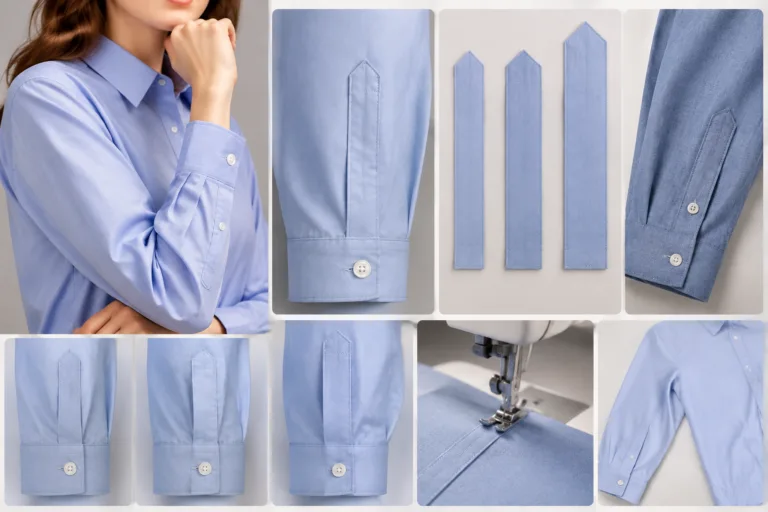
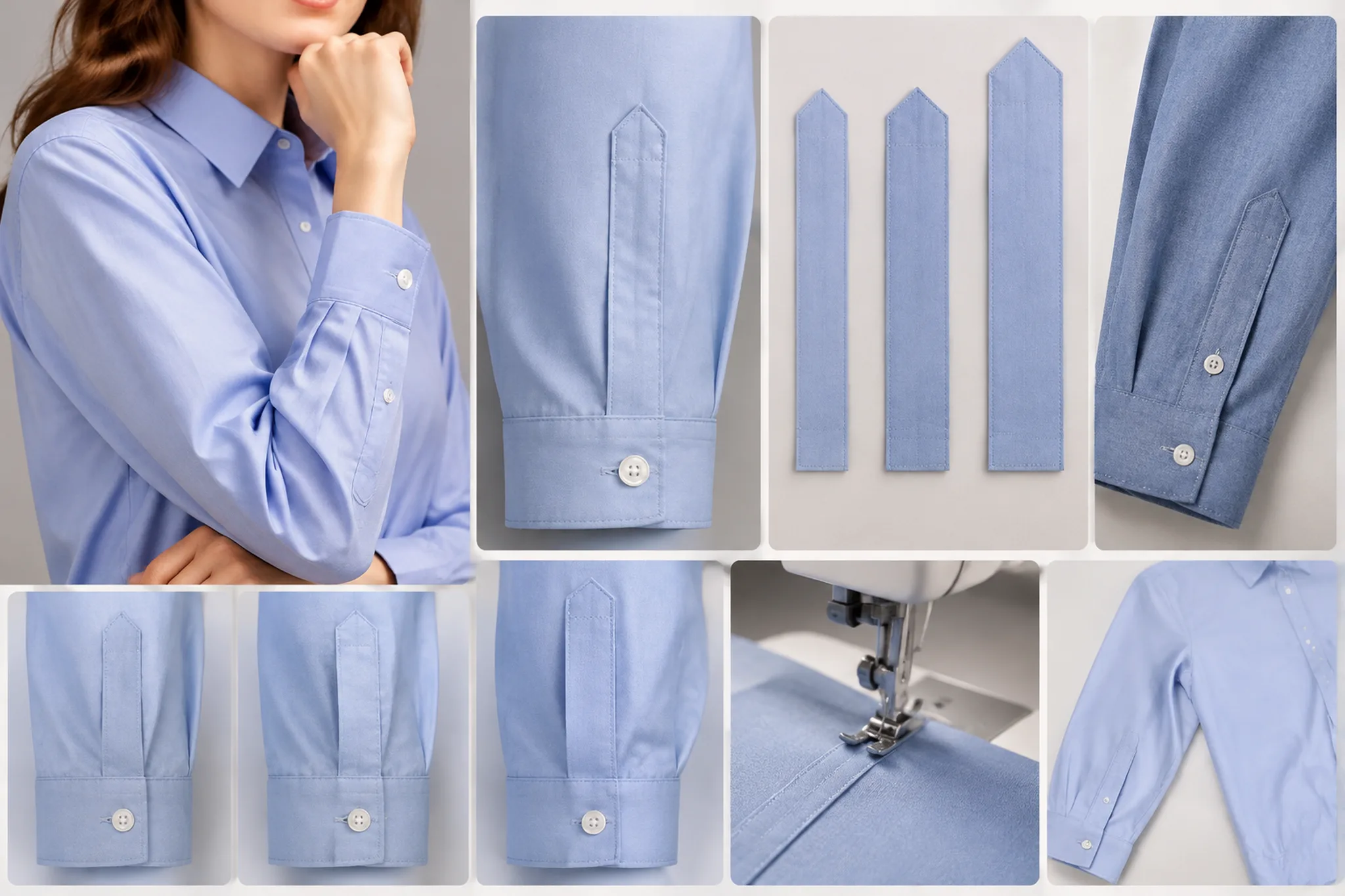
Sleeve plackets design proportions are a coordinated choice, not a universal measurement: the opening must work with the cuff, while the visible detail should suit the sleeve, material, and garment style. A sleeve placket is the constructed detail that creates or controls access at a sleeve opening; its edges and overlap also form a visible line on the garment. For a construction reference, see New Mexico State University’s guide to sleeve plackets and bands. Begin by checking how the opening and cuff interact in use. Then judge whether the placket’s visual weight fits the sleeve and surrounding design. An opening can function correctly and still look oversized, underscaled, or disconnected.
What Sleeve Placket Proportion Has to Balance
Proportion brings together two questions: does the placket provide the access the wearer needs, and does its visible scale make sense on this garment? The first concerns how the opening is controlled and how it meets the cuff. The second concerns the lines, edges, overlap, and closure details visible on the sleeve. A positive answer to one does not settle the other.
Start with the intended opening action and the cuff. The placket must work as part of that opening system; judging appearance before checking this relationship can lead to changes that interfere with use. Once the function is understood, compare the detail with the sleeve’s width and shape, the cuff’s size and closure, and the material’s behavior. Fabric weight, drape, and structure can affect how layers sit and how clearly edges read, so the same design may not look or handle alike across materials.
The garment’s design language matters too. A prominent placket may be an intentional visual feature in workwear or a directional design. On a fine, narrow sleeve, that same emphasis may dominate. A lightweight narrow sleeve and a fuller structured sleeve therefore offer different visual contexts, but neither dictates one correct proportion: fabric behavior and cuff construction can change the balance.
For design review, separate the visible detail from its construction: the fabric layers, seams, and opening components joined beneath the surface. This is an evaluation framework, not a fixed specification. Ask first whether the sleeve opening functions as intended with the cuff; then decide whether the visible scale supports the garment.
The Inputs That Set Visual Scale
Read the sleeve, cuff, material, and nearby details together before changing the placket. A narrow sleeve leaves less surrounding area, so the same visible feature may command more attention. A fuller sleeve can give a stronger detail more context. These are starting observations, not rules: sleeve shape and styling also affect the comparison.
| Observable input | Likely implication | Initial proportion direction | What could change the choice |
|---|---|---|---|
| Sleeve width and shape | A narrow sleeve can make the placket feel dominant; a fuller sleeve gives it more surrounding area. | Consider reducing emphasis on a narrow sleeve or allowing more on a fuller one. | Intended styling, sleeve shape, and cuff construction. |
| Cuff scale | Width, height, and closure treatment affect whether the opening details read as one system. | Relate the placket’s visual weight to the cuff rather than matching dimensions automatically. | Cuff shape, closure, and design emphasis. |
| Material behavior | Thickness, drape, stretch, texture, and stability are useful clues when assessing folds, edges, and visible bulk. | Compare the assembled detail on the material before settling its scale. | Layering, construction, and how the fabric behaves in use. |
| Contrast and nearby details | Contrast, buttons, topstitching, seam lines, and pocket details can draw attention or create visual repetition. | Adjust emphasis in relation to the surrounding details. | Color, placement, and the garment’s overall design language. |
Inspect the construction as well as the front view. Stitches describe how thread forms the line; seams describe how fabric layers connect. Seam allowances and layer arrangement also affect what the finished detail presents. Recording these separately helps distinguish a visible proportion concern from an underlying construction choice.
Treat the table’s directions as questions for review, not guaranteed material effects. Fabric category alone cannot settle how a particular placket will look. Compare the actual sleeve and cuff, including their closure and nearby details, before choosing which input to adjust.
How to Check Function Before Judging Appearance
Start by stating what the sleeve opening needs to do: open, close, allow passage over the hand, support rolling, or permit adjustment. Check how the placket and cuff cooperate during that action. Look for forcing, catching, or distortion as inspection cues; do not infer performance from appearance alone.
Next, inspect the assembled detail from both sides. Note whether the placket edges and overlap align, how the placket joins the cuff, and where the closure components sit. Separate what you see at the surface from the underlying build: identify the stitch, seam, seam allowance, and joined layers rather than treating those terms as interchangeable. This can clarify whether a concern is visual, positional, or related to construction.
Then examine areas involved in opening and movement. Ask whether there is visible distortion, loose stitching, fabric damage, or seam displacement, and where force appears to be concentrated. Thread, stitch, fabric, and stress location are all relevant observations; changing thread alone does not explain what is happening at the material or seam. Treat these as prompts for inspection, not a diagnosis or a claim about durability.
Review the sleeve at rest and while performing the relevant movement. A flat view may not show how the placket sits when opened, closed, or manipulated. Note whether the visible balance changes along with any observed strain or misalignment. Keep those findings distinct: visual scale and functional behavior are related, but one does not prove the other.
This is an editorial fit-and-construction review, not a validated performance test. It can help identify what to investigate and what change to compare, but it does not establish strength, durability, or compliance with a test method. Any such claim requires its own appropriate evidence. For this review, record the movement checked, the visible construction, and the specific concern before judging whether proportion should change.
Adjusting Visual Weight Without Losing the Opening
Once the sleeve opening and cuff work as intended, adjust the placket’s visual weight with coordinated design choices. Consider its visible width and length in relation to the cuff, the edge treatment, contrast, topstitching, closure size, and nearby details. A change to one feature can affect how the whole sleeve reads, so compare the assembled garment rather than judging an isolated piece.
More contrast or a stronger edge can make the opening easier to see or give it deliberate emphasis. Extra layers or reinforcement may also change thickness, stiffness, and the feel against the wearer. Check how the detail folds, moves over the hand, and sits against the skin; a balanced front view does not settle those questions.
For a lightweight knit sleeve with a restrained cuff, a high-contrast or heavily layered placket might dominate the sleeve. Reducing contrast or visible detailing could be a useful first comparison, but stretch behavior, closure needs, and intended styling may point elsewhere. Treat reinforcement as a response to a specific construction concern, not an automatic improvement. Compare the load path, appearance, hand feel, and bulk before choosing added interlining, a bar tack, or another layer.
A Repeatable Review Workflow for Design Development
A concise record makes a sleeve placket design review easier to revisit when the material, cuff, use, or construction changes. Separate what you observe from what you assume, and record:
- The intended opening action and relevant sleeve movement.
- The cuff relationship and the placket’s intended visual role.
- Material behavior observed in the garment, plus any unresolved assumptions.
- The construction details, including stitch, seam cross-section, seam allowance, layers, closure, and reinforcement.
Inspect the technical build separately from its visual scale. Note whether the edges and cuff connection align, then view the assembled detail on the full sleeve. A seam describes how fabric layers join; a stitch describes how thread forms within that construction. Recording these separately helps distinguish a visual concern from a construction or positional one.
For each proposed change, compare the current detail with an annotated specification or sample view. Record the reason for the change, the expected functional effect, the expected visual effect, and the variable that could reverse the decision. Review relevant states, such as relaxed, opened, closed, and manipulated. These observations document a sample review; they are not a measured performance or durability result.
Map the construction order before locking the change. Internal work may need to happen before an area is closed, and later access can affect repair and consistency. There is no single best sequence for every style or equipment setup. When relevant, note appearance, hand feel, load behavior, and post-care condition as review dimensions without treating an informal observation as a test finding.
Retain the proportion when the opening works, the detail reads as connected to the cuff and sleeve, and added structure has no unresolved bulk or comfort concern. Otherwise, revise one influential variable at a time and compare again.
Make the Next Proportion Decision Deliberately
Begin with the required opening and cuff interaction, then judge visual scale against the sleeve, material, construction, and surrounding details. Before approving a change, record the functional requirement, visual intent, observed construction, and unresolved variable. Compare annotated specifications or sample views, and consult the applicable construction or evaluation reference when a decision depends on a named method or measured claim. These steps support a reasoned design decision; they do not certify performance.
Frequently Asked Questions
How do I know whether a sleeve placket is visually too large for the sleeve?
Judge it in relation to the complete sleeve, cuff, and surrounding details, not by itself. If it dominates unintentionally or feels disconnected from the cuff, compare a less prominent treatment while preserving the opening function.
Should the sleeve placket match the cuff width exactly?
Not necessarily. The placket and cuff should work together as an opening system, but their visible widths do not have to match. Sleeve shape, closure, material, and design intent all affect the relationship.
Which fabric characteristics most affect sleeve placket proportions?
Consider thickness, drape, stretch, surface texture, and stability. These are variables to inspect in the actual construction; fabric category alone does not determine how the finished placket will look or handle.
How can I check sleeve placket function before changing its appearance?
Open and close it as intended, check its connection and alignment with the cuff, and observe it during relevant sleeve movement. Record visible distortion or strain as inspection findings, not as a formal durability result.
Can reinforcement improve a sleeve placket without making it bulky?
That depends on the construction and the specific concern being addressed. Compare the reinforced and current versions for appearance, thickness, hand feel, movement, and the area where load is transferred before deciding whether the added structure is suitable.