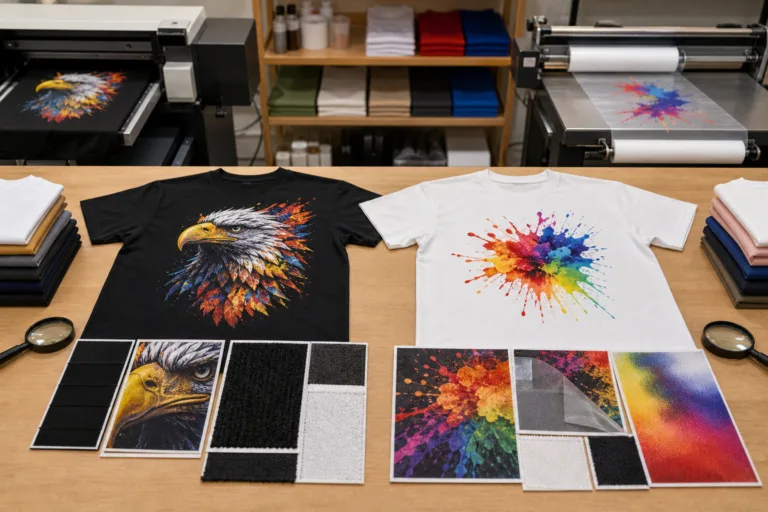
DTG and DTF are two digital apparel-printing methods with different paths from artwork to garment. DTG, or direct-to-garment printing, places ink directly onto a prepared garment. DTF, or direct-to-film printing, prints the image onto a coated film, applies a compatible adhesive system, and transfers the resulting print to the garment with heat and pressure. That process difference affects fabric compatibility, coverage, hand feel, artwork handling, and quality control.
Neither method is universally better. The practical choice depends on the actual garment, color, fabric construction, artwork, intended use, and process materials supplied by the printer. Apparel Wiki is an independent apparel knowledge publication, not a manufacturer, testing laboratory, factory, or printing service. Readers should also distinguish editorial guidance from any commercial relationship described on our Sponsor page.
What Is the Difference Between DTG and DTF Printing?
In a typical DTG printing process, the garment is positioned on a printer platen, prepared according to the selected ink system, printed directly, and cured or otherwise finished. The image becomes part of the garment surface through the interaction of ink, pretreatment, fabric, and curing conditions. The precise preparation and finishing sequence varies by equipment, ink, garment, and supplier instructions.
In a typical DTF printing process, the artwork is printed in reverse or in the required orientation onto a transfer film. A powder or other adhesive system is applied and prepared, after which the transfer is placed on the garment and applied with heat and pressure. The film is then removed according to the system instructions. This adds media handling and a transfer stage before the garment reaches final inspection.
The distinction is more important than the names alone suggest. DTG places greater emphasis on garment preparation and direct print conditions. DTF places greater emphasis on film, adhesive, transfer alignment, pressure, heat, and peeling or finishing conditions. Both routes still require controlled artwork, accurate placement, suitable curing, and inspection. A result that looks acceptable on one garment or color cannot automatically be expected on another.
The same artwork can also behave differently between methods. Fine details, gradients, solid areas, and large opaque designs may require different preparation or produce different surface characteristics. A supplier’s statement that a particular DTF or DTG system supports a fabric should be understood as system-specific evidence, not a universal claim about every ink, film, pretreatment, powder, garment, or finish sold under the same process name.
How Do Fabric and Garment Conditions Affect DTG and DTF Compatibility?
DTG fabric compatibility and DTF fabric compatibility depend on interactions among the print materials and the garment. Fiber content matters, but it is not the only variable. Dye behavior, fabric color, knit or woven construction, stretch, surface texture, coatings, softeners, and other finishing chemistry can influence ink acceptance, adhesive bonding, color appearance, and dimensional stability.
Light and dark garments may require different coverage decisions or process routes within a specific system. Dark grounds can change the perceived color and may require an opaque base or another controlled approach. On some fabrics, dye migration can shift the print color after heating or during use. Other risks include weak adhesion, uneven coverage, color change, distortion on stretch fabric, and poor contact over a textured or heavily finished surface. These are material-system risks, not automatic defects of one named method.
The relevant sample should match the intended production garment as closely as possible: same fabric type, color, construction, finish, and preferably the same style or a materially equivalent style. Sampling on a generic cotton shirt does not prove that the same route will behave identically on a polyester blend, coated panel, ribbed section, or garment with a different dye and finish.
Hypothetical scenario 1: light cotton jersey
Context: A brand is developing a detailed front graphic on a light, relatively stable cotton jersey. Evidence to gather: The printer should identify the ink and pretreatment system, show a sample on the actual garment or an equivalent approved fabric, and explain the proposed curing and inspection process. Trade-off: DTG may be attractive when direct surface integration and detailed color work are priorities, while DTF may offer a different route for handling the artwork and garment. Practical conclusion: Compare identical artwork and print dimensions on the actual garment, then judge coverage, color, flexibility, and hand feel rather than choosing from the fiber label alone.
Hypothetical scenario 2: dark stretch polyester blend
Context: A performance-style garment has a dark color, stretch construction, and a finish that may affect bonding or color stability. Evidence to gather: Request system-specific compatibility documentation and a sample using the intended color, stretch, and finish. Review whether heating, stretching, and handling produce migration, lifting, distortion, or unacceptable color change. Trade-off: A transferred print may provide a practical coverage route in one system, but the resulting layer and stretch behavior must be assessed; direct printing may involve different preparation and compatibility constraints. Practical conclusion: Approve only the route that passes project-defined tests on the actual garment. Do not extend the result to every polyester blend or stretch finish.
How Does DTG vs DTF Hand Feel Differ on the Finished Garment?
DTG hand feel and DTF hand feel should not be reduced to “soft” versus “plastic.” Tactile results depend on print coverage, ink or film thickness, artwork density, garment surface, curing, and wash history. An open graphic with substantial unprinted garment showing may feel different from a large solid block, even when both are produced by the same method.
As a general process distinction, DTG can integrate more directly with the garment surface, while DTF introduces a transferred print layer. That does not establish an automatic quality ranking. A thin, well-controlled transfer may feel more acceptable than a poorly prepared direct print, and a dense DTG design may feel more noticeable than a small DTF logo. Film, ink, adhesive, opacity requirements, and finishing conditions all affect the result.
Evaluate hand feel under the intended use conditions. Compare the same artwork, print size, garment, color, and placement wherever possible. Handle the fresh sample, flex the printed area appropriately, and assess it again after the relevant care or use simulation. Comfort is partly subjective, so record the intended wearer’s preference separately from objective observations such as visible cracking, lifting, color change, or altered flexibility.
What Changes in the DTG and DTF Production Workflow?
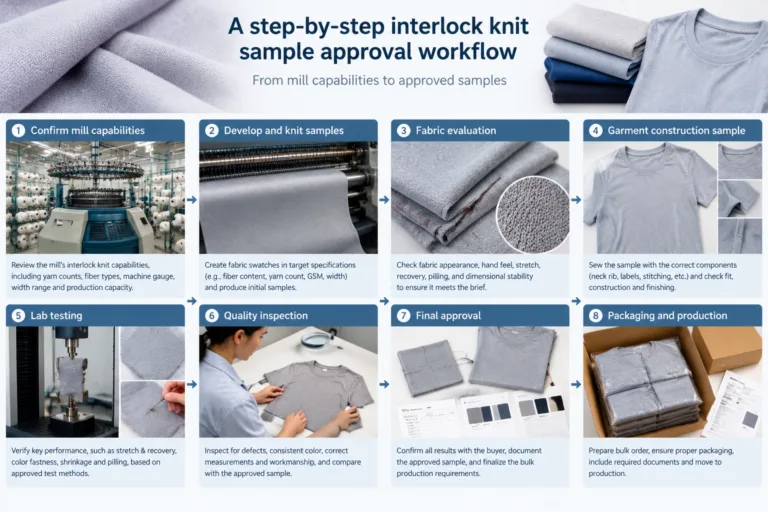
The following is a representative comparison, not a machine-operating instruction. Exact sequence, materials, and settings vary by equipment and supplier. The production record should identify the artwork version, print dimensions, placement reference, garment color, process materials, and approval status.
| Workflow stage | Typical DTG route | Typical DTF route |
|---|---|---|
| Artwork review | Check artwork, scale, color references, and direct-print requirements. | Check artwork, scale, orientation, transparency, and transfer-film requirements. |
| Material preparation | Prepare and position the garment according to the ink system. | Prepare the film, ink, adhesive or powder system, and garment-transfer setup. |
| Image application | Print directly onto the prepared garment. | Print the image onto film, prepare the adhesive layer, and transfer it to the garment. |
| Finishing | Cure or finish the direct print as specified for the system. | Cure or prepare the transfer, apply heat and pressure, remove the film as instructed, and finish the garment. |
| Inspection | Check coverage, placement, color, surface defects, and curing-related results. | Check registration, placement, coverage, adhesion, film or edge defects, and transfer-related results. |
DTF therefore adds transfer-media handling and a heat-transfer stage, while DTG concentrates more of the process risk in garment preparation and direct print conditions. In either workflow, inconsistent placement, artwork changes, unsuitable materials, or incomplete process records can reduce repeatability. A production approval should preserve the sample identity and the conditions that produced it, so a later garment or process change triggers a new compatibility review.
Which Method Handles Artwork, Coverage, and Garment Color Better?
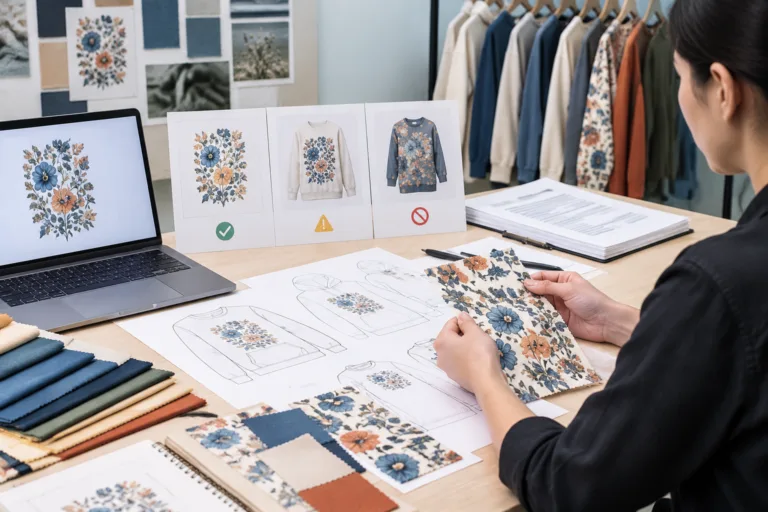
Artwork suitability depends on more than whether an image looks good on screen. Fine details, gradients, photographic imagery, solid coverage, print size, garment color, and the required opacity all interact with the selected ink, film, adhesive, garment, and production settings. A design that reproduces clearly may still be unsuitable for the chosen fabric, while a simple logo may require careful placement and coverage control.
DTG and DTF should therefore be compared using the actual artwork at its intended size. Review the artwork version, transparent areas, color references, separations where relevant, and the distance from seams or other placement points. Screen color is useful for design review, but it is not physical color approval. A printed sample or controlled proof is needed when color, opacity, or brand consistency matters.
| Project condition | Questions for sampling |
|---|---|
| Fine details or small logos | Are edges, narrow elements, and open spaces still clear at the intended print size? |
| Gradients or photographic artwork | Does the tonal transition remain acceptable on the actual garment color and surface? |
| Large solid coverage | Is the coverage even, and does the finished print create an acceptable tactile change? |
| Dark garment | Does the selected system provide the required visual contrast and opacity without unacceptable surface effects? |
| Stretchy or textured garment | Does the print remain visually stable and suitably flexible during normal handling? |
This matrix is a screening tool, not a universal ranking. Garment compatibility must be evaluated separately from artwork performance, because the two questions can produce different conclusions.
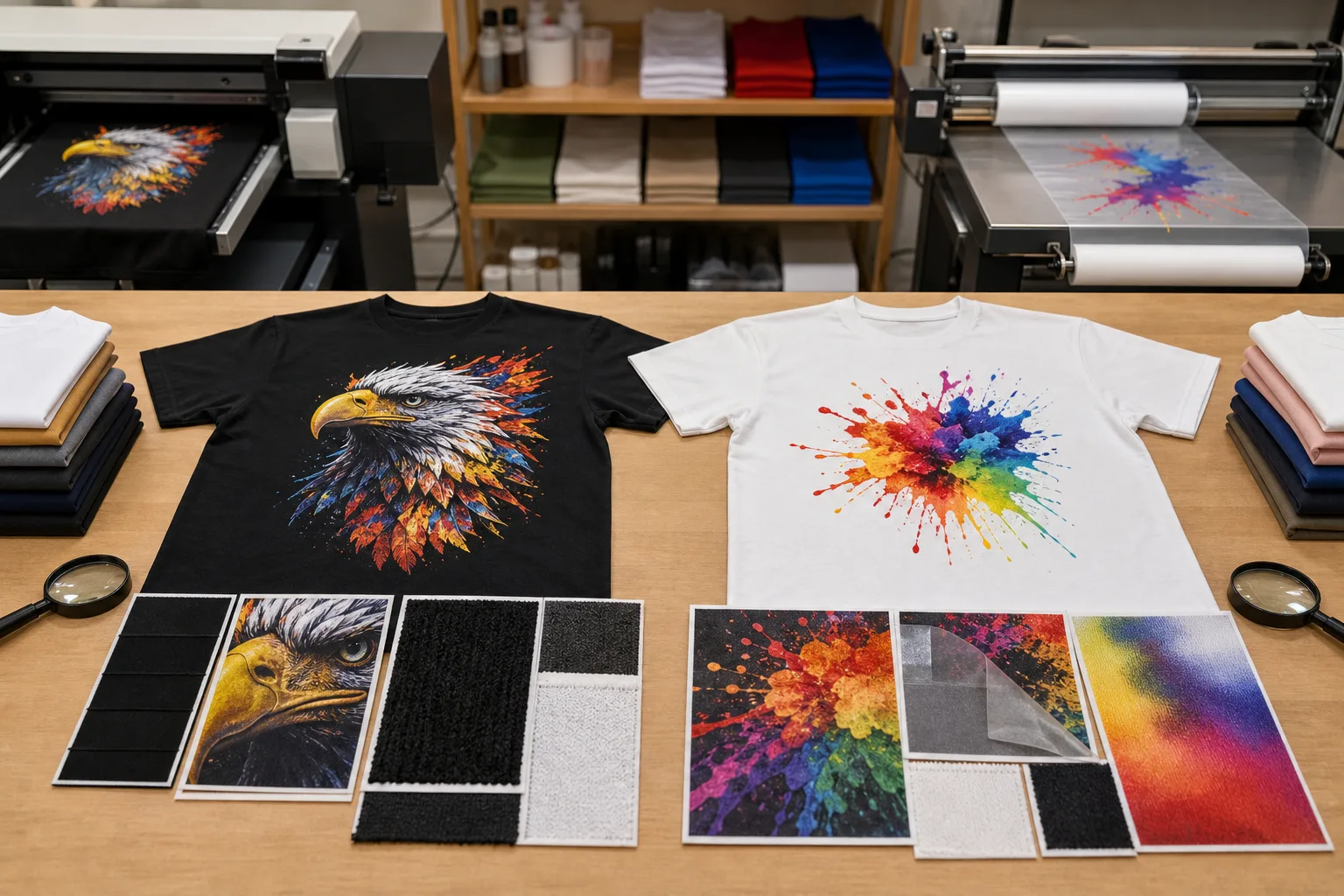
How Should You Evaluate DTG and DTF Samples Before Production?
Begin with a representative sample rather than a generic demonstration piece. Use the intended garment style, fiber composition, color, construction, finish, artwork, print dimensions, placement, and process route. A sample made on a different blank or with a different artwork scale can reveal useful information, but it cannot confirm that the planned production combination will behave identically.
Inspect the sample under consistent lighting and record the observations. Check coverage, edge definition, registration, placement, color appearance, surface defects, garment distortion, and any visible interaction between the print and the fabric. For DTF, also review transfer edges and signs of incomplete or uneven adhesion. For DTG, pay close attention to direct-print coverage and the effect of garment preparation on the finished appearance.
Assess hand feel and flexibility before and after the relevant care or use simulation. The appropriate evaluation depends on the garment’s intended use and the criteria agreed with the printer. Look for cracking, lifting, peeling, migration, color change, or an unacceptable tactile change only against pre-agreed acceptance criteria. A fresh sample can look convincing while later handling, laundering, stretching, or friction exposes a problem.
Keep a sample record that identifies the garment, color, artwork version, print size, placement reference, process route, materials, supplier-provided settings, date, observations, and approval status. Visual inspection, user handling, supplier testing, and formal laboratory evaluation are different levels of evidence and should not be described as interchangeable. Apparel Wiki offers practical production guidance, not a substitute for a certified laboratory program.
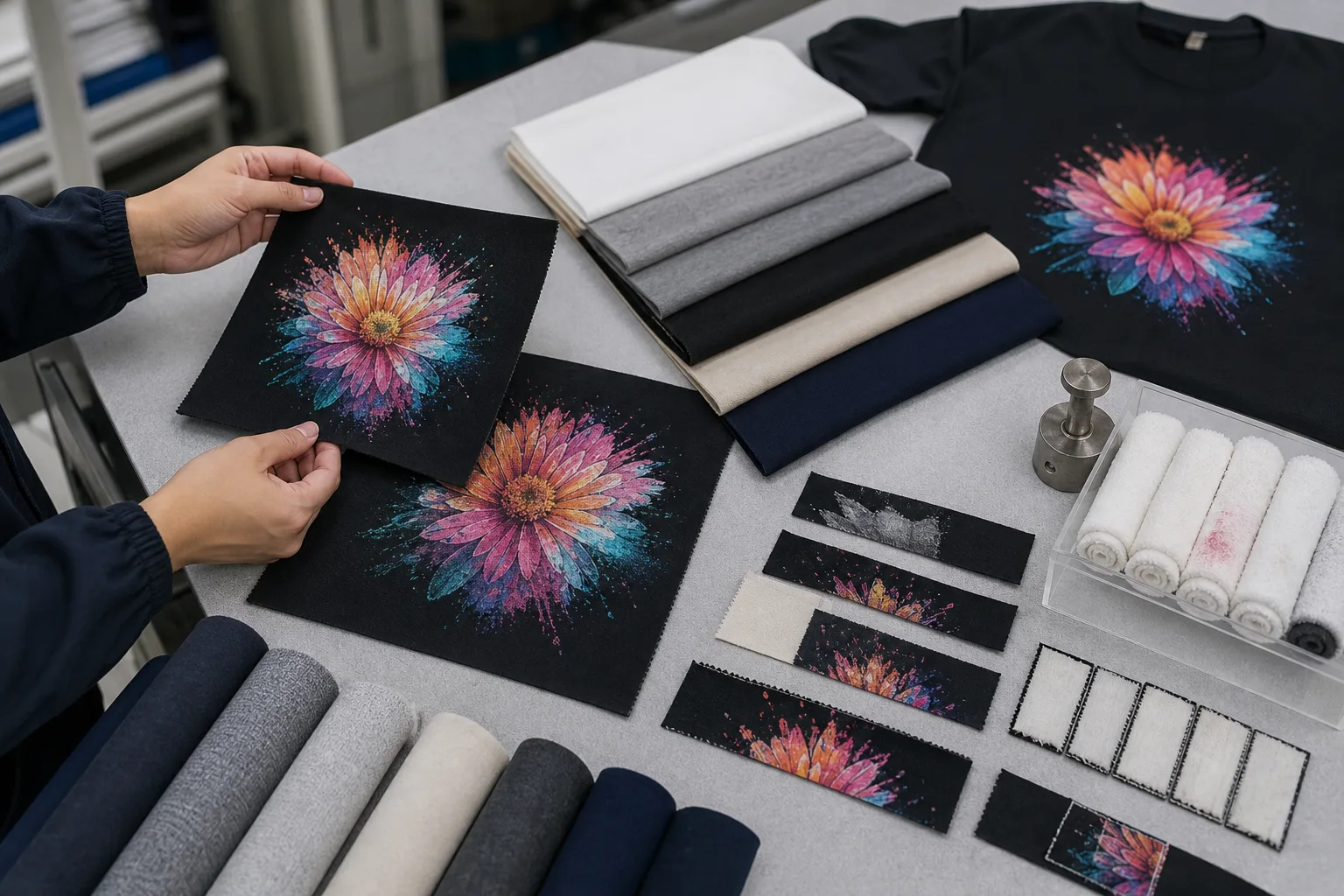
DTG or DTF: A Practical Decision Framework for Apparel Projects
Choose the method by working from the complete project rather than from a general reputation. First document the garment: fiber composition, color, construction, stretch, surface texture, dye behavior, and finish. Then review the artwork’s detail, tonal range, coverage, size, placement, and expected hand feel. Finally, define the use case, including expected wear, care conditions, visual priority, and the level of variation the project can accept.
Compare the operational consequences as well. DTG typically concentrates attention on garment preparation and direct-print conditions. DTF adds film, adhesive or powder, transfer handling, and a heat-transfer stage. Both routes require controlled artwork, accurate placement, suitable materials, finishing, inspection, and records. The practical choice is the route that passes representative sampling and the agreed evaluation criteria, not automatically the route associated with a softer feel, broader compatibility, or stronger general reputation.
Before approving a printer, ask:
- Has the exact garment color, construction, and finish been tested with this process system?
- Which ink, pretreatment, film, adhesive or powder, and curing route will be used?
- Can the supplier provide a sample record linked to the approved artwork and placement?
- What changes require a new sample, such as a garment substitution, dye change, artwork scale change, or process-material change?
- Which visual, tactile, care, or use evaluations are included, and what criteria determine approval?
- How will artwork version, print dimensions, placement, and production status be controlled?
The next useful step is to prepare one controlled comparison using the same artwork, print size, garment, color, and placement for both routes where practical. Record the visual result, hand feel, workflow requirements, and post-use observations, then select the method that fits the project’s evidence and tolerance. Apparel Wiki is an independent apparel knowledge publication, not a manufacturer, factory, certifier, or OEM/ODM service provider.
Is DTG or DTF better for cotton garments?
Neither is universally better. Cotton content, garment color, construction, finish, artwork, and the specific process materials all affect the result. Test the intended garment rather than relying on the process name alone.
Can DTG and DTF both be used on dark garments?
Both may be considered for dark garments, but the required opacity, coverage, color appearance, and fabric interaction depend on the complete system. Approve the result from a representative sample.
Which usually has a softer hand feel, DTG or DTF?
Hand feel depends on coverage, print thickness, artwork density, garment surface, curing, and wash history. A controlled comparison with identical artwork and garment conditions is more useful than a universal claim.
Is DTF suitable for stretchy or polyester garments?
It may be suitable for some systems, but stretch, dye behavior, finish, and adhesion must be checked together. Confirm compatibility on the actual fabric, color, construction, and process materials.
Does artwork size affect the choice between DTG and DTF?
Yes. Size changes coverage, detail visibility, placement risk, tactile impact, and the amount of material applied. Evaluate the artwork at its final production dimensions.
How should I test a DTG or DTF sample before placing a production order?
Use the intended garment and artwork, inspect visual and placement quality, assess hand feel and flexibility, conduct the relevant care or use simulation, and compare the results with written acceptance criteria.