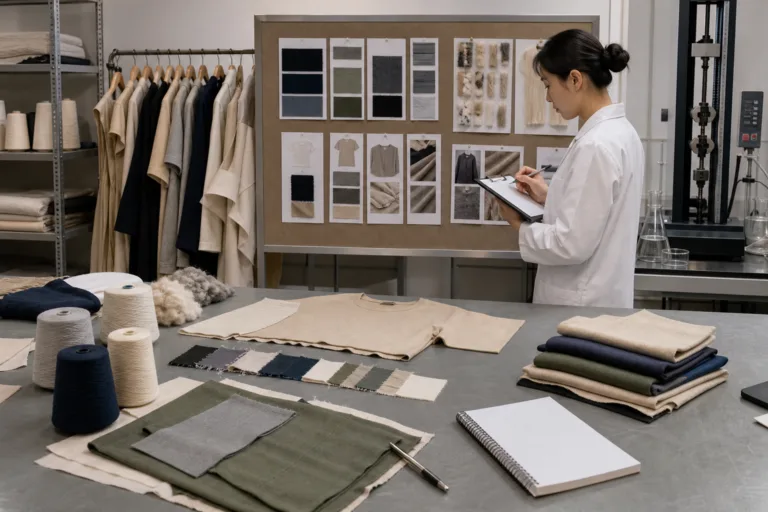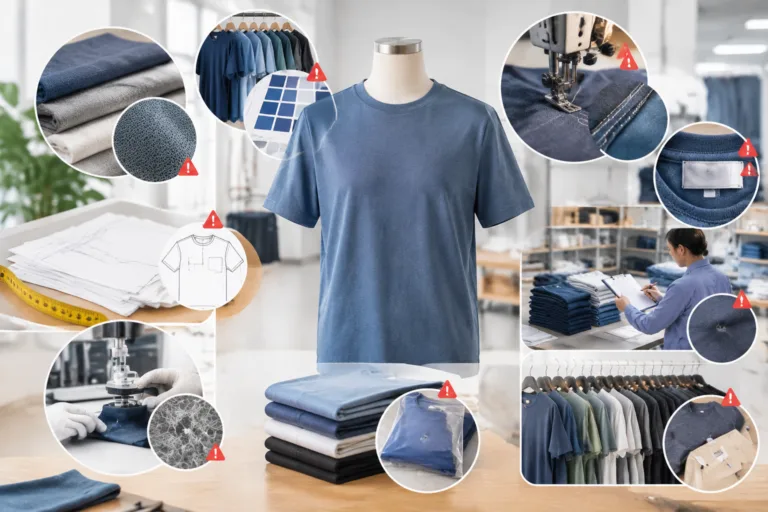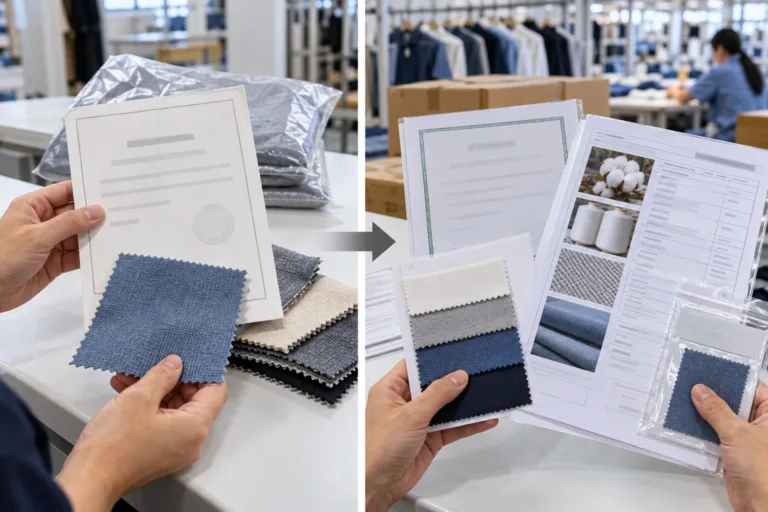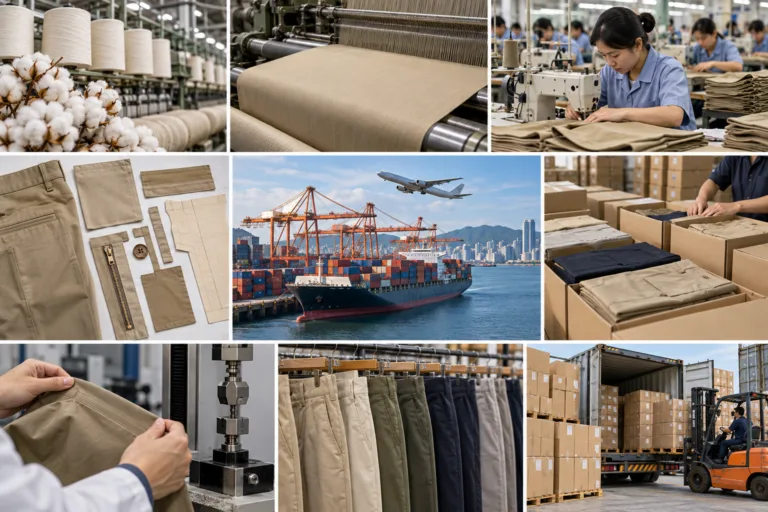

A private label clothing manufacturer produces garments that are sold under a buyer’s own brand name rather than the factory’s brand. In apparel sourcing, this model sits between simple ready-made buying and fully original product development. It can be a practical option for startups, retailers, clubs, and growing brands that want branded products, some level of customization, and a clearer path to repeat production without building a factory themselves.
For readers who are still mapping the full path from idea to production, this startup guide to clothing development and production is a useful companion resource. It helps connect early sourcing decisions with product development steps such as sampling, specification planning, factory communication, costing, and production readiness, which are all important when deciding whether private label is the right model.
Many new buyers use terms like private label, OEM, ODM, and white label as if they mean the same thing. In practice, they describe different levels of customization, design ownership, development work, and factory involvement. Choosing the wrong model can lead to unrealistic expectations about price, MOQ, lead time, or how much you can actually change in a garment.
This guide explains the terminology in simple language, then moves into real sourcing logic: what you can customize, what usually stays fixed, what factories need from you, and how to evaluate whether a private label clothing manufacturer fits your brand stage and budget.
What Is a Private Label Clothing Manufacturer?
A private label clothing manufacturer makes apparel that is branded for the buyer. The factory may use existing patterns, standard blocks, proven fabric programs, or partially developed house styles, but the final product is presented under the customer’s label, hangtag, and packaging.
From an apparel development perspective, private label usually means you are not starting from zero like a highly customized cut-and-sew program. Instead, you are often adapting a factory’s base product or production capability. That may include changing fabric color, adding embroidery or screen printing, switching trims, adjusting fit within limits, or replacing the factory’s brand identity with your own.
This is why private label can be attractive to small and mid-sized brands. It often reduces development complexity compared with fully custom manufacturing, while still giving enough brand control to create a differentiated market offer.
What private label clothing means in the apparel industry
In apparel sourcing practice, private label typically includes three core elements:
- Brand substitution: your neck label, size label, care label, hangtag, and packaging replace the factory’s generic branding.
- Product adaptation: some design and specification changes may be possible, depending on the factory’s base style and production setup.
- Factory manufacturing: the supplier handles cutting, sewing, finishing, and packaging, and sometimes fabric sourcing and trim sourcing as well.
The exact scope varies widely. One factory may call a color change and custom neck label private label. Another may allow fabric substitutions, fit revisions, pocket changes, and decoration options under the same term. That is why buyers need written confirmation of what “private label” includes before sampling begins.
Private Label vs OEM vs ODM vs White Label

These models overlap, but they are not identical. The differences matter because they affect design control, technical workload, costing, and risk.
| Model | Typical Product Source | Customization Level | Design Ownership | Best Fit |
|---|---|---|---|---|
| Private Label | Factory base style or adapted product | Low to medium | Usually buyer brand, mixed design ownership | Brands wanting branded products without full development |
| OEM | Buyer-developed product | High | Buyer-led | Brands with clear specs and custom requirements |
| ODM | Factory-developed product | Medium | Factory-origin design adapted for buyer | Buyers needing speed and development support |
| White Label | Standard ready-made product | Very low | Factory standard product | Fast market entry with minimal changes |
Private label vs OEM
OEM usually means the buyer provides the product direction more precisely. That can include measurements, construction details, fabric requirements, artwork, wash requirements, and trim specifications. In a stricter OEM setup, the factory manufactures to the buyer’s specifications.
Private label is often less custom than OEM. The factory may already have the pattern, fit block, sewing method, and material library. You apply your brand and request selected changes rather than building a completely original garment package. If you are unsure how detailed factory instructions should be, understanding the difference between a tech pack and spec sheet helps clarify how much product information is needed for each model.
Private label vs ODM
ODM means the manufacturer develops the product concept or already owns the product design, then offers it to buyers for branding and adaptation. This can look similar to private label, but the key difference is that ODM is more explicitly factory-designed. If a supplier shows a catalog of ready-to-develop activewear sets, fleece hoodies, or uniforms and then lets you modify details, that often falls closer to ODM.
Private label may include ODM-type situations, but not always. Sometimes private label is simply branded production of a common garment shape with your chosen trims and decoration. This is why the commercial label alone is not enough; you need to ask who owns the pattern, who developed the fit, and what can be changed.
Private label vs white label
White label is the least customized path. The product is already established, and changes are usually limited to branding and perhaps color assortment or packaging. In simple terms, white label is closer to “take this finished product and sell it under your label.”
Private label usually implies more room for identity than white label, especially in apparel where labels, fit, fabric hand feel, and decoration strongly affect brand positioning. Still, some suppliers use the two terms loosely, so it is safer to define the allowed changes in writing.
Which Model Is Best for a New Brand?
There is no single correct model for every beginner. The right path depends on budget, product complexity, speed requirement, and how distinct the brand needs the garment to be.
A new brand may prefer private label when it wants a practical middle ground: more brand ownership than white label, but less technical burden than full OEM. This is especially common for T-shirts, hoodies, sweatshirts, polos, leggings, and basic uniforms, where the market already accepts familiar silhouettes.
OEM becomes more suitable when your selling point depends on specific pattern engineering, unusual fit proportions, custom fabric development, or construction details that cannot be achieved by adapting a standard factory style. ODM is useful when the buyer needs factory development support and is comfortable starting from the supplier’s design base.
For readers comparing suppliers across regions and business models, a practical step-by-step sourcing guide can help organize the search process before you request samples or quotations.
Is private label suitable for beginners?
Often, yes. A private label clothing manufacturer can be suitable for beginners because the model usually lowers technical and financial barriers. The factory may already know the sewing sequence, pattern grading logic, shrinkage behavior, and decoration limitations of its existing styles. That reduces the number of unknowns compared with a fully original garment.
However, “beginner-friendly” does not mean risk-free. Buyers still need to confirm measurements, fabric composition, GSM, wash performance, labeling content, decoration placement, and packing details. A startup that skips these details can still receive goods that are technically acceptable to the factory but commercially wrong for the brand.
What You Can Customize in Private Label Clothing
One of the biggest misconceptions is that private label always means minimal change. In reality, the customization range depends on the factory’s capability, MOQ logic, and sourcing network.
Common customization areas include:
- brand labels and printed neck labels
- care labels and size labels
- hangtags and barcode stickers
- polybags, cartons, and packing method
- fabric color and dye lot
- print, embroidery, patches, and transfers
- small fit adjustments
- trim substitutions such as drawcords, zippers, buttons, snaps, and elastic
- surface finishes such as garment wash, peaching, brushing, or enzyme wash
The most important sourcing question is not “Can you customize this?” but “Which changes are included, which require new development, and which trigger new MOQ or lead time?”
Custom labels: neck labels, care labels, and size labels
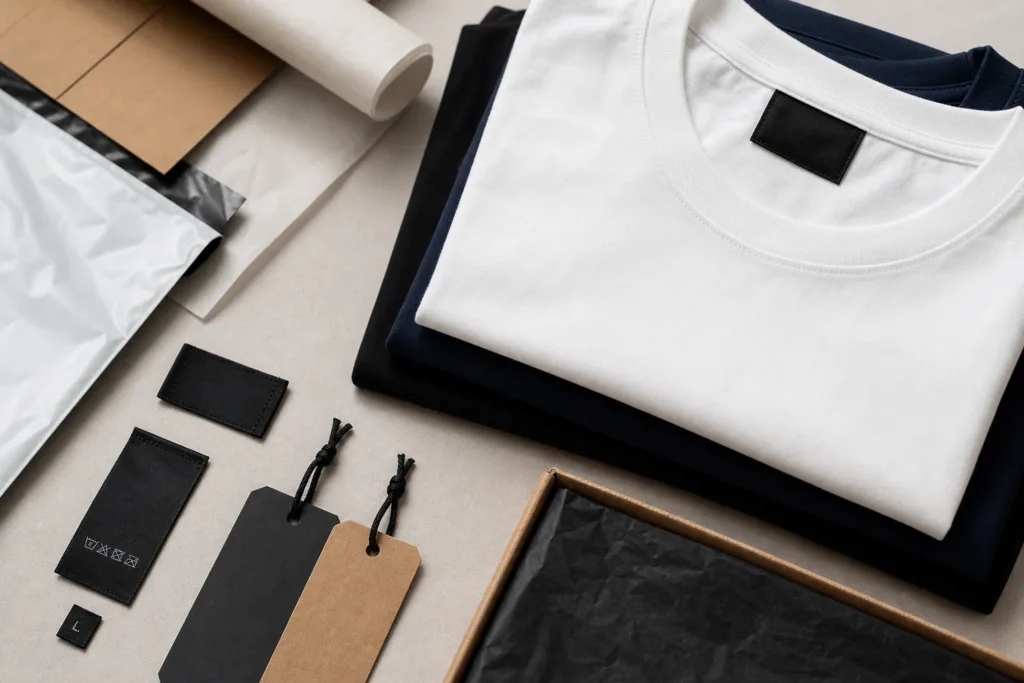
Labels are one of the clearest forms of private label identity. A factory can replace a main label with a woven brand label, satin label, heat-transfer neck print, or tear-away format, depending on the garment type and target market.
Care labels matter for both branding and product information. They typically include fiber content, country of origin where required, care instructions, and size or supplier reference information depending on market needs. Because labeling rules vary by destination market, buyers should confirm compliance obligations rather than copying another brand’s label format. When reviewing sample approval, it is also useful to consider sample testing and pre-production quality checks related to post-wash appearance, since label placement, seam behavior, puckering, and overall look can change after laundering.
Size labels should also be checked carefully. A factory may use S, M, L, XL by habit, but your brand’s target body measurements may not match that naming structure. The printed size must align with the actual garment measurement spec, not just the market convention the factory is used to.
Hangtags, packaging, and brand presentation options
Hangtags and packaging do not change garment function, but they strongly affect perceived organization and retail readiness. In apparel sourcing practice, these details are often forgotten until late in production, which creates avoidable delays.
Typical private label packaging options include custom hangtags, string seals, folded insert cards, printed barcode stickers, custom polybags, carton marks, and pack-ratio instructions. If your business sells to retailers or marketplaces, packaging accuracy may be as important as the garment itself because receiving teams depend on size stickers, carton labels, and quantity consistency.
Brands should also confirm whether the factory sources packaging internally or through external vendors, because that affects lead time coordination and minimums.
Style customization: colors, fabrics, fit, and design changes
Style customization in private label usually falls on a spectrum. At the simplest end, you choose colors and add a chest print. At the more developed end, you may request a heavier fleece GSM, a dropped shoulder, wider rib, contrast taping, a custom zipper puller, or a revised inseam length.
Apparel Wiki recommends separating changes into four groups during supplier discussion:
- Cosmetic changes: branding, color, print, embroidery, packaging
- Material changes: fabric composition, GSM, lining, trim quality
- Fit changes: chest width, body length, sleeve opening, rise, inseam
- Construction changes: seam type, pocket design, placket shape, cuff structure
This separation helps the factory quote more accurately. A cosmetic change is usually simpler than a new fabric, and a new fabric is usually simpler than a pattern or construction change. If you mix all requests into one vague message, the supplier may underquote, overquote, or misunderstand the development level you expect.
Minimum Order Quantities, Lead Times, and Cost Considerations
MOQ is one of the first commercial filters when choosing a private label manufacturer. The quantity may be based on total order, style, color, fabric, or size ratio. For example, a factory may accept 300 pieces per style but require 100 pieces per color. Another may accept lower sewing MOQs but impose higher fabric minimums from the mill.
Lead time depends on several stages: material sourcing, lab dip or color approval, sample revision, trim confirmation, bulk cutting, sewing, finishing, inspection, and packing. Private label is often faster than custom OEM development, but not always. A “simple” hoodie program can still be delayed by custom dyed rib, special packaging, or artwork approval.
Costing also needs careful interpretation. A lower quoted unit price may exclude labels, packaging, decoration, testing, or pattern adjustment. That is why buyers should ask whether the quote is trim-included, packaging-included, decoration-included, and based on which incoterm. Understanding CMT vs. FPP pricing in garment manufacturing is especially useful here because it clarifies whether the factory is charging only for cut-make-trim labor or for a fuller finished-product package.
In beginner projects, the biggest hidden cost is often revision. Every time the sample changes, fabric is replaced, trim is upgraded, or labeling is corrected, the commercial picture shifts. Early precision saves money.
How to Choose the Right Private Label Clothing Manufacturer
Choosing the right factory is not just about finding one that says yes to your design. It is about matching your product type, order volume, quality expectation, and communication style with the factory’s real operating strength.
Start by narrowing the supplier profile. A knitwear-focused factory may be right for jersey T-shirts, fleece hoodies, and joggers, but not for tailored woven shirts. A supplier strong in performance activewear may understand stretch recovery, flatlock, moisture-management fabrics, and panel sewing better than a general casualwear factory.
At a broader knowledge level, Apparel Wiki explains why supplier fit matters as much as price: the factory’s category experience, quality control habits, and ability to interpret specifications often determine whether bulk goods match the approved sample.
Factory evaluation checklist: capabilities, samples, communication, and quality control
Use a structured checklist when screening factories:
- Product capability: What garment types do they regularly make?
- Material capability: Can they source the required fabric composition, GSM, and finish?
- Customization range: Which private label changes are standard, and which require development?
- MOQ logic: Is the minimum based on style, color, or fabric?
- Sampling process: Do they provide development samples, fit samples, pre-production samples, and revision control?
- Communication quality: Are answers clear, complete, and technically informed?
- Quality system: Do they have documented checkpoints, measurement control, defect handling, and approval records?
- Inspection support: Are they open to inline and final inspections?
- Lead time realism: Do they explain critical path timing, not just promise speed?
- Past category evidence: Can they show similar product workmanship?
When evaluating process discipline, look beyond verbal assurance. A supplier with traceable procedures, documentation, corrective-action habits, and controlled workflows is generally more reliable than one competing only on price. That is the core logic behind How to evaluate a factory’s quality management system, which emphasizes documented process control and continual improvement rather than informal promises.
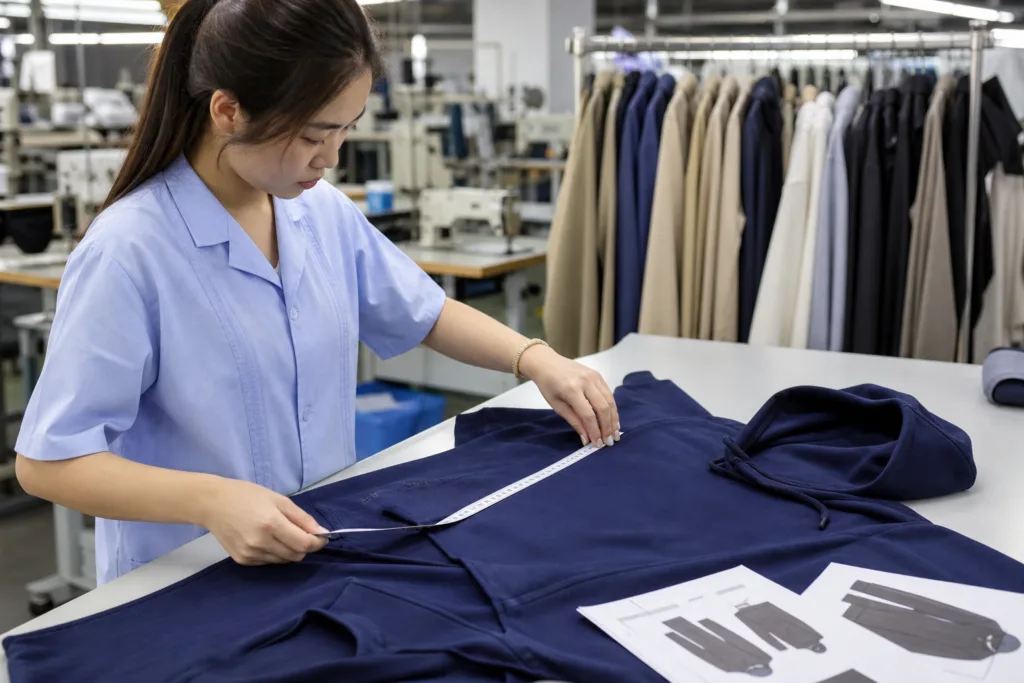
Sample review is one of the strongest decision tools. A sample tells you more than a price sheet because it reveals stitching consistency, fabric hand feel, shrinkage risk, neckline recovery, label application, print quality, and overall workmanship. If the factory cannot execute a clean sample, bulk production is unlikely to improve.
Communication quality is equally important. Many production issues begin not with bad sewing, but with unclear instructions. Buyers should document artwork size, label placement, fold method, measurement tolerances, and packaging details in writing. If you want to reduce misunderstanding, study how to write clear factory comments and callouts so sample corrections are specific and actionable.
Common Mistakes to Avoid When Starting Private Label Clothing
The most common mistake is assuming the phrase “private label” guarantees deep customization. Some suppliers mean branding only. Others mean moderate style adaptation. Always define the allowed changes and their costs before ordering.
Another mistake is relying on photos rather than specifications. Two hoodies can look nearly identical in photos but differ significantly in GSM, shrinkage, rib quality, shoulder fit, pocket construction, and print durability.
New buyers also often skip tolerance discussion. In garment production, measurements are rarely exact to the millimeter across all sizes and all pieces. You need agreed tolerances for chest, body length, sleeve length, inseam, and other critical points.
A further mistake is underestimating lead time for trims and packaging. Custom woven labels, zipper pulls, printed bags, and hangtags can become the critical path even when sewing is straightforward.
Finally, many startups do not separate “good for sample” from “good for bulk.” A garment sample may look attractive, but approval should also consider repeatability. Ask whether the same fabric, trim, print method, and sewing standard can be maintained at bulk volume and within your budget.
Decision cues for choosing private label or another model
Private label is often the right path when you want faster entry, manageable complexity, and a branded product line built on proven factory capability. It is less suitable when your brand identity depends on highly original pattern engineering or specialized fabric development that the supplier does not already support.
Use private label when:
- you want your own branding on an existing or semi-custom product
- you can accept some design limits
- you want lower development burden than full OEM
- your first goal is market testing, not maximum originality
Move toward OEM when:
- fit and construction are central to your brand promise
- you have clear technical specifications
- you need more control over materials and pattern details
- you are prepared for more development time and cost
From a sourcing risk perspective, the right answer is usually the model that matches your current operational maturity, not the model that sounds most advanced.
Conclusion
A private label clothing manufacturer can be a practical solution for brands that want branded apparel without taking on the full complexity of original product engineering. The model works best when buyers understand its real boundaries: what is customizable, what is standardized, how MOQ works, and how factory capability affects final quality.
The key is not choosing private label by name alone. It is choosing a supplier whose category experience, communication quality, sampling discipline, and quality control system fit your product and growth stage. When those basics are clear, private label can be an efficient bridge between concept and scalable production.
FAQs
What does a private label clothing manufacturer actually do?
A private label clothing manufacturer produces garments that are sold under your brand name, usually by adapting existing factory styles or proven production programs. The factory may handle sourcing, cutting, sewing, labeling, finishing, and packaging, while you control the branding and selected product details such as color, trim, print, or fit adjustments.
Is private label the same as white label in clothing?
No. White label usually refers to a more standardized product with very limited changes beyond branding, while private label often allows a broader range of customization such as labels, packaging, fabric options, decoration, and some style modifications. The exact difference depends on how the supplier defines each program, so buyers should confirm the scope in writing.
Can beginners work with a private label clothing manufacturer?
Yes, many beginners start with private label because it is often simpler than full custom OEM development. The factory may already have working patterns, material options, and production routines, which reduces development complexity. Even so, beginners still need to review samples carefully, confirm measurements, approve labels, and document all production details clearly.
What can usually be customized in private label apparel?
Common customizations include main labels, care labels, size labels, hangtags, packaging, color choices, prints, embroidery, patches, and selected trim changes. Some factories also allow fit adjustments, fabric substitutions, or construction changes, but those requests may increase MOQ, sampling cost, and lead time depending on how far the product moves from the factory’s base style.
How do I know if a factory is right for my brand?
You should check whether the factory regularly makes your garment category, can source the right fabric and trim quality, communicates clearly, provides usable samples, explains MOQ logic, and maintains consistent quality procedures. A factory is a better fit when its real capability matches your product requirements, rather than simply offering the lowest price.
What is the main risk when choosing private label clothing production?
The main risk is assuming you will get more customization or control than the factory actually offers. Many problems come from unclear expectations about design ownership, fabric quality, fit changes, packaging, or production consistency. The best way to reduce risk is to confirm the development scope, approve samples carefully, and put all key requirements in writing before bulk production starts.