Tie-dye and dip-dye are often treated as simple visual effects, but in mass-produced apparel they are process decisions with real consequences for fiber selection, color consistency, costing, lead time, and quality control. A hand-made look can be commercially successful, but only when the brand and factory agree early on what level of variation is acceptable, how the effect will be achieved, and which fabric construction can support the result. In many projects, the challenge is not creating a colorful sample. The challenge is repeating that look across sizes, colorways, and bulk production without causing wash problems, crocking, shade mismatch, or rejected pieces.
For readers who also need broader context on how coloration methods differ across apparel categories, this overview of modern textile coloration systems is useful because it helps connect dye effects with other production routes such as fabric printing, garment coloration, and roll-based processes. That wider comparison matters when a team is deciding whether a tie-dye or dip-dye look should be achieved through actual wet processing, simulated printing, or another lower-risk commercial method.
What tie-dye and dip-dye mean in apparel production
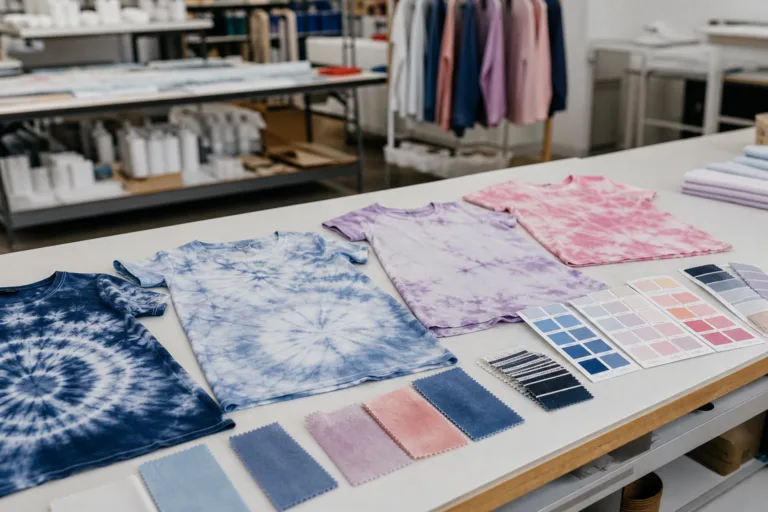
In apparel production, tie-dye usually refers to a resist-dye effect created by folding, twisting, bunching, binding, or compressing fabric or garments so that dye penetration becomes uneven by design. The result may look radial, striped, clouded, marbled, crumpled, or panel-based depending on how the substrate is prepared before dye application.
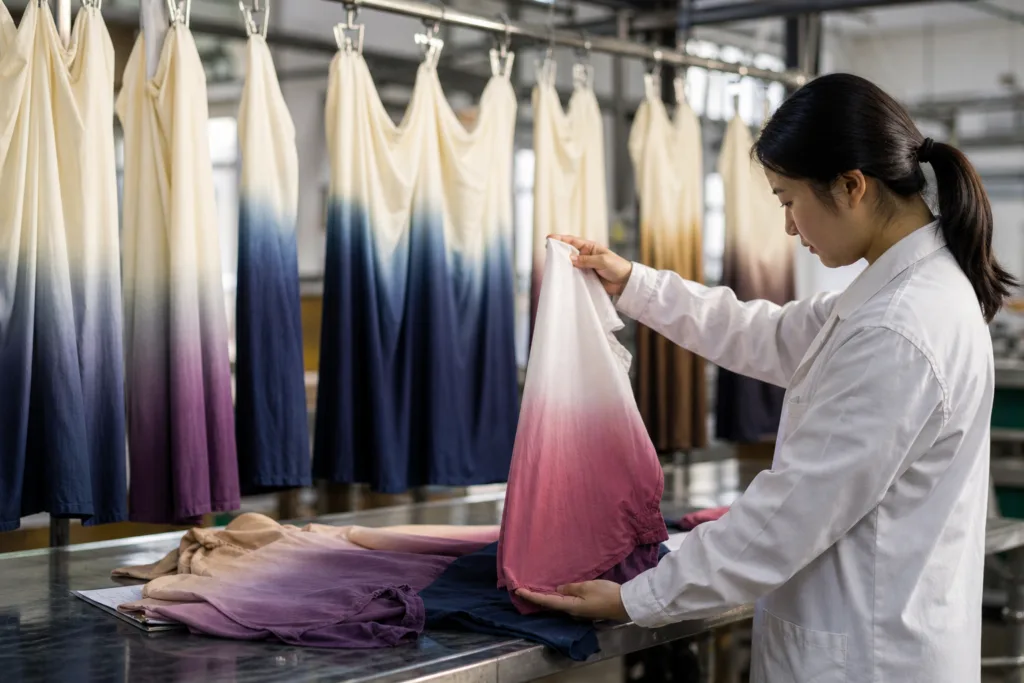
Dip-dye is different. It usually refers to a partial immersion effect where one area of the fabric or garment is dyed more deeply than another, creating a gradient, directional fade, or clearly separated tonal zone. In commercial use, dip-dye may range from a hard horizontal line to a soft ombre transition.
From a product development perspective, the key difference is control logic. Tie-dye builds pattern through resist and irregular penetration. Dip-dye builds pattern through immersion depth, dwell time, bath movement, and capillary spread. Both can look casual and artistic, but both still need measurable specifications if the style is going into bulk production.
That is why tech packs should define more than “tie-dye wash” or “dip-dye effect.” Teams should clarify visual reference, placement tolerance, acceptable shade variation, fabric base color, garment panel effect, wash standard, and defect thresholds. Without that, the sample may look exciting while the bulk run becomes impossible to approve consistently.
How these dye effects evolved from handcrafted roots to fashion mainstays
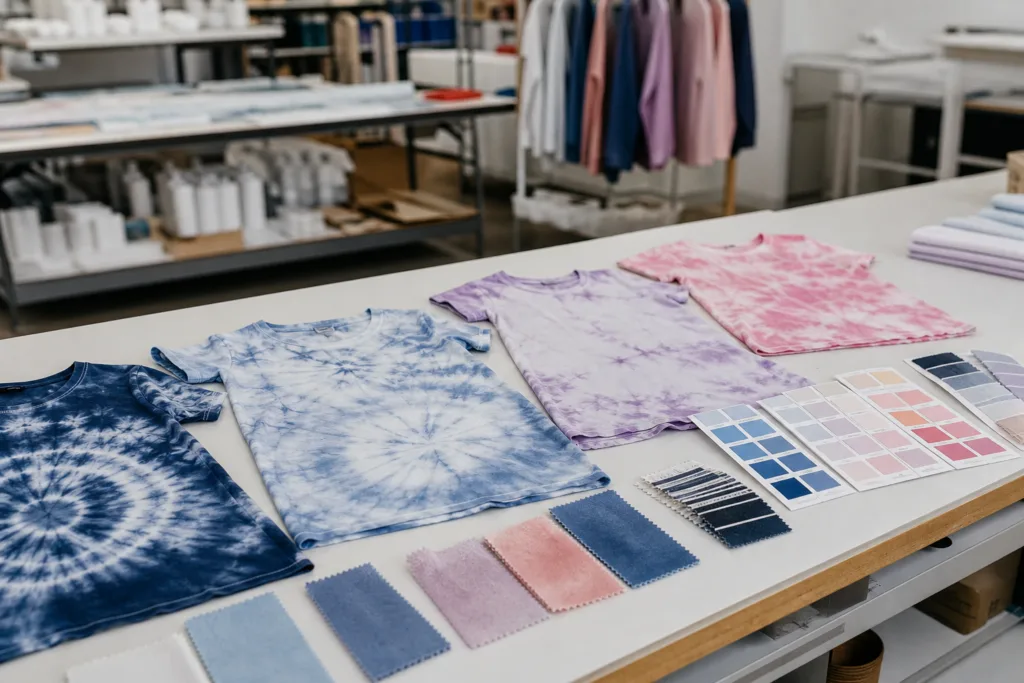
Tie-resist and partial immersion dyeing have deep craft histories across multiple regions and textile traditions. What matters for apparel teams today is not claiming one single origin, but understanding that these techniques were historically valued because they created controlled variation. That same idea still drives modern commercial use. The look feels less flat than a solid dye and less engineered than a repeated print.
As the fashion and casualwear market expanded, brands started adapting handcrafted color effects for larger runs in T-shirts, fleece, jersey dresses, beachwear, and youth-oriented collections. Over time, what began as artisanal surface treatment became part of mainstream seasonal merchandising. Some brands use actual wet-process tie-dye or dip-dye. Others simulate the look through printing to improve repeatability.
The reason these effects keep returning is simple: they create visual interest without requiring complex garment construction changes. A standard T-shirt block, sweatshirt pattern, or lounge short can feel new when coloration changes. For buyers, this can be commercially useful because the dye effect becomes the main story while base fit and pattern remain stable.
Why tie-dye and dip-dye keep returning in commercial collections
These looks return because they solve both creative and merchandising problems. They add movement to simple silhouettes, help separate a collection from flat basics, and work across adults, kids, resort, streetwear, sleepwear, and promotional fashion programs. They also support seasonal storytelling. A soft dip-dye may feel cleaner and more premium, while an aggressive tie-dye can feel youthful or vintage-inspired.
From a cost-performance angle, tie-dye and dip-dye can be attractive because the visual update happens mainly through coloration rather than major block redevelopment. That said, the savings are not automatic. If the process is highly manual, if yield loss is high, or if the approval standard is unrealistic, the style can become more expensive than a printed alternative.
For smaller collections, the decision also connects with SKU strategy. Brands exploring test capsules should think carefully about color count, size depth, and process complexity. The practical issue is not only appearance but whether the planned order size can absorb setup and sampling work. This is where understanding small-batch production tradeoffs helps teams avoid decorative ideas that do not scale well at low volume.
How tie-dye and dip-dye are adapted for mass production
Mass production does not mean every piece becomes identical. In this category, controlled variation is part of the product. The real objective is repeatable variation within an approved range. That is a different quality standard from a solid-dyed polo or a placement print.
Factories usually adapt these effects in one of three ways: true manual or semi-manual garment dyeing, fabric-stage dyeing before cutting, or printed simulation of tie-dye and ombre visuals. The right route depends on order size, substrate, cost target, and consistency requirement.
Garment-stage processing is common for tees, fleece tops, and relaxed casual items because it creates a natural effect after assembly. But garment dyeing also adds risks such as seam puckering, thread shade contrast, panel distortion, and size movement after wet processing. Fabric-stage processing may offer better control before cutting, but pattern placement can shift when the fabric is spread and cut. Printed simulation offers strong repeatability and often lower defect risk, but the hand feel and depth can differ from actual dye penetration.
In practice, brands should decide early whether “authenticity of process” or “consistency of appearance” matters more. That one decision changes factory selection, MOQ, timeline, and acceptable defect logic.
Common industrial methods, equipment, and process flow
Commercial tie-dye and dip-dye are not always done with purely hand-crafted methods, even when the final look appears spontaneous. Development often starts with lab dips, trial folds, strike-off samples, and pilot runs. Brands and mills use pilot-scale production equipment to test how immersion, liquor ratio, mechanical movement, and substrate behavior affect the final result before scaling into larger orders.
A simplified industrial process flow often looks like this:
- confirm fabric composition and construction
- decide whether processing will happen on fabric panels or finished garments
- develop visual standards and tolerance range
- run lab dip or sample trials
- test wash, crocking, and size stability
- approve production method and packaging precautions
- run bulk with in-line shade and appearance checks
- perform final inspection based on agreed variation standard
Common methods include hand-binding with batch dyeing, rotary immersion for dip lines, spray-assisted tonal effects, clamp resist methods, enzyme or bleach-assisted fading, and overdyed garment washes. Some factories also combine pigment effects with reactive or disperse dye systems to create layered visuals.
Equipment choice matters. Open vats, garment dye machines, padding equipment, tumble dryers, hydro extractors, and finishing units all affect final handle and shade. A process that looks simple on a sample table may become difficult when hundreds or thousands of units must flow through wet processing, drying, sorting, and packing without mixing shade groups.
| Method | Typical Use | Main Strength | Main Risk |
|---|---|---|---|
| Garment tie-dye | T-shirts, hoodies, fleece | Natural handmade effect | high variation and sizing movement |
| Garment dip-dye | Dresses, tees, beachwear | Clear directional gradient | uneven line or inconsistent depth |
| Fabric-stage resist dyeing | Cut-and-sew programs | Better batch planning | pattern placement shifts after cutting |
| Printed simulation | High-repeat retail runs | strong visual consistency | less authentic dye character |
Fiber and fabric considerations for tie-dye and dip-dye
The substrate matters more than many buyers expect. Tie-dye and dip-dye do not behave the same on cotton jersey, cotton fleece, polyester interlock, rayon woven, or cotton-poly blends. Dye uptake depends on fiber chemistry, yarn structure, surface finish, and fabric density. In other words, the visual idea cannot be separated from the material decision.
For cotton programs, absorbency usually supports rich dye effects and soft transitions, especially with reactive dye systems. But even within cotton, fabric construction changes the outcome. Lightweight jersey may show faster penetration and softer edges, while brushed fleece may hold color differently across face and back. Teams comparing substrates should understand cotton fabric types and dye behavior before approving color development on only one sample base.
Blends create extra complexity. If the style uses cotton-poly fabric and the dye class mainly colors one fiber type, the result may look heathered, muted, or uneven in a way that is either attractive or unacceptable depending on the intended look. From a technical perspective, fiber-specific dye selection and shade control is critical because cotton, polyester, wool, and blends require different wet-processing logic to achieve stable results.
Knits and wovens also respond differently. Knits stretch, absorb, and recover in ways that can soften or distort lines, while wovens may produce crisper boundaries but can show seam grin, panel mismatch, or tension marks more clearly. If a brand wants a clean dip line on a woven shirt, cutting and sewing sequence becomes important. If the same effect is placed on a loose knit dress, drape may visually blur the transition after hanging.
Common substrate effects to confirm before bulk
- how quickly the fabric wets out
- whether the base shade is optic white, natural, or pre-tinted
- how much shrinkage occurs after dyeing and drying
- whether sewing thread matches or contrasts after processing
- whether rib, body, and hood fabric take color differently
- whether elastane content is affected by chemistry or heat
Color control, repeatability, and quality challenges at scale
This is where many programs become difficult. A buyer may approve a sample because it looks artistic, then reject bulk because no two pieces are exactly the same. That is a mismatch between product concept and quality standard. Tie-dye and dip-dye need a realistic approval framework.
Good bulk control starts with a control sample and a range sample. Instead of one perfect piece, the factory should submit an approved window showing acceptable light, medium, and dark expression, plus acceptable placement shift if relevant. This reduces argument later.
Common quality problems include harsh lines where a gradient should be soft, muddy shades caused by poor liquor control, white voids in unwanted areas, excessive back staining, skew after processing, and color transfer during first washes. Size instability is also common when garments are processed after sewing.
Commercial collections should verify wash durability, rubbing resistance, and dimensional stability through recognized colorfastness and shrinkage testing. This matters especially when dark-to-light transitions are used, because rubbing or bleeding can change the intended visual balance and create customer complaints.
Operationally, brands should also separate true defects from designed irregularity. A random cloud effect is not automatically a defect. But an off-center dip line on half the size set may be. The inspection team needs a style-specific QC sheet, not only a general standard. For teams building that process, an apparel quality control checklist is a practical starting point, but tie-dye and dip-dye styles usually need extra points added for line placement, shade grouping, and wash-down consistency.
| QC Checkpoint | Why It Matters | Typical Risk |
|---|---|---|
| shade band approval | defines acceptable variation | bulk rejection for natural differences |
| dip line position | controls visual balance | inconsistent placement by size |
| crocking test | checks rub-off | consumer staining complaints |
| wash test | checks durability and migration | bleeding or major appearance shift |
| measurement after wash | checks fit stability | garment shrinkage out of tolerance |
Sustainability considerations in wet-processed dye effects
Sustainability claims in this area should be handled carefully. Tie-dye and dip-dye are not automatically more sustainable just because they look artisanal. Wet processing can involve significant water use, chemical inputs, energy, rework, and wastewater treatment challenges if the process is not well controlled.
For brands, the practical question is not whether the effect is fashionable. It is whether the chosen mill or dye house can manage liquor ratio, dosing accuracy, color bath reuse where appropriate, segregation of effluent streams, and correction rates. The U.S. EPA guidance on water use and wastewater treatment is relevant here because lower-impact production depends heavily on process control, pollution prevention, and proper handling of dyehouse outputs.
Lower-impact options may include better right-first-time development, low-liquor machinery, fewer re-dyes, using fabrics that dye efficiently for the intended chemistry, and selecting visual effects that tolerate small natural variation instead of forcing repeated corrections. Sometimes the more sustainable choice is not actual tie-dye at all. It may be a printed simulation that achieves the same aesthetic with lower wet-processing load, depending on substrate and scale.
Brands should also be realistic about waste. Complex handmade looks can create sorting losses, second-quality units, or packaging separation by shade family. If those losses are ignored at costing stage, the program may look efficient on paper but perform poorly in real production.
Brand-level use cases and commercial value
Mass-produced tie-dye and dip-dye work best when the coloration matches the product story. On jersey basics, the effect can add energy without changing fit. On fleece, it can support a washed casual mood. On beachwear, ombre dip-dye often aligns with summer color palettes. On kidswear, tie-dye can support playful assortment planning. The method should fit the product, not be applied because the look is trending again.
Merchandising value comes from visual differentiation, but only if the product remains wearable and easy to assort. A dip-dyed tee with a usable neutral base may work across more retailers than a highly saturated spiral tie-dye with no matching bottom options. This detail may look small, but it affects sell-through and replenishment potential.
In apparel sourcing practice, brands also need to decide whether they want a core repeatable program or a short seasonal capsule. Repeatable programs require stronger standardization and mill discipline. Seasonal capsules can accept more irregularity, but they still need commercial planning. Readers comparing broader apparel concepts and terminology can also use Apparel Wiki as a structured reference point when aligning design language with production reality.
Common production mistakes and how brands reduce risk
The first common mistake is approving only one showroom sample and assuming bulk will match it. A better approach is approving a process standard plus a visual range. The second mistake is choosing the base fabric too late. If the same tie-dye recipe is moved from one cotton jersey to another with different absorbency or finish, the result can change significantly.
Another issue is ignoring MOQ and line efficiency. Some factories are happy to sample these effects but do not want fragmented small runs in multiple colorways. If a brand wants experimental coloration with limited quantity, it may need stronger planning and lower MOQ negotiation strategies before development starts.
Other avoidable mistakes include failing to pretest sewing thread, mixing lots during packing, not defining whether front and back must align visually, and forgetting that rib trims may dye differently from body fabric. Teams also overlook packaging risk. If garments are packed before fully stabilized, residual moisture or unfixed color can create migration or odor issues in transit.
Risk-reduction checklist for development teams
- approve base fabric before color effect development
- define placement and shade tolerance clearly
- request wash-tested size specs after processing
- confirm thread, rib, and label reaction to dye process
- separate approved variation from true defect language
- review packing method for dark-to-light contact areas
- cost for yield loss and second-quality risk honestly
Key takeaways for planning a tie-dye or dip-dye program

Tie-dye and dip-dye can be commercially strong when the team treats them as engineered dye programs, not just creative finishes. The main decisions are process route, substrate choice, variation tolerance, and QC logic. Once those are clear, the look becomes easier to scale.
For buyers, the key is not only whether the style looks good in sampling. The key is whether the material, dye chemistry, garment construction, and acceptance standard all support the same commercial objective. A premium ombre on a woven resort dress may need very different controls from a casual tie-dye jersey tee sold as an intentionally irregular item.
In many projects, the best outcome comes from simplifying early. Fewer color zones, better fabric matching, realistic tolerance windows, and honest testing often produce a stronger bulk result than an overdesigned effect that cannot be repeated. That is the practical way to use tie-dye or dip-dye in mass-produced apparel without turning a visually attractive concept into a sourcing problem.
FAQs
Is tie-dye harder to mass produce than dip-dye?
Usually yes, because tie-dye often depends on more variables such as fold method, binding pressure, dye penetration, and random resist areas. Dip-dye can also be difficult, but the visual control is often more directional and easier to standardize when immersion depth, dwell time, and drying conditions are tightly managed.
Can polyester garments be used for tie-dye or dip-dye programs?
They can, but the process logic changes because polyester needs different dye chemistry than cotton. On blends, one fiber may take color more strongly than the other, which can create a heathered or muted look. That can be desirable, but it should be tested early because the final effect may differ a lot from cotton-based development.
What is the biggest quality risk in dip-dye apparel?
The biggest risk is inconsistent transition control. That may show up as an uneven dip line, one side climbing higher than the other, excessive back staining, or a gradient that looks too sharp in some pieces and too soft in others. Size movement after wet processing can also shift the visual balance, especially on lightweight knits.
Should brands use actual dyeing or printed simulation for these looks?
It depends on the commercial goal. Actual dyeing usually gives more depth and authenticity, while printed simulation often gives better repeatability and lower production risk. If the style needs a very exact look across large volume, printing may be the safer route. If natural variation is part of the concept, true dye processing may be worth the extra control work.
How should MOQ be handled for tie-dye and dip-dye styles?
MOQ should be discussed together with color count, process complexity, and acceptable variation. Some factories can handle these effects efficiently only above certain batch sizes, while others may accept smaller runs with a higher unit cost. It is better to confirm this before sampling than to approve a style that the production line cannot support profitably.
What should be included in a tech pack for tie-dye or dip-dye?
A good tech pack should include clear visual references, base fabric details, garment stage or fabric stage processing notes, placement expectations, shade tolerance, size spec after wash, thread and trim requirements, test requirements, and defect definitions. Without these details, the buyer and factory may both think they approved the same look while expecting very different bulk results.