Chinos are a recognizable form of trousers commonly associated with cotton twill, practical construction, and relatively simple styling. Their social history is more complicated than a single origin story: work requirements, institutional dress, military and occupational use, commercial production, and civilian adoption all helped shape what chinos came to mean. Apparel Wiki is an independent educational publication; its Sponsor page explains the separation between support and editorial control.
In short, chinos became socially important because a practical trouser form moved across settings. A pair could represent utility in one context, conformity or institutional belonging in another, and relaxed respectability in civilian life. The history of chinos therefore concerns not only fabric and cut, but also who supplied clothing, who was expected to wear it, and how later observers interpreted it.
What Are Chinos, and Why Does Their History Matter?
In practical garment terms, chinos are trousers generally made from cotton twill or a related woven fabric. They are commonly associated with a clean, adaptable appearance rather than one fixed construction: color, weight, pocket arrangement, rise, leg shape, finishing, and details can vary by period, region, maker, and use. “Chinos” is therefore a useful garment category, not a universal technical specification.
The term also overlaps with, but is not identical to, “khaki.” Khaki may describe a color or a broader family of uniform and work-clothing associations, while chinos usually identifies a trouser form. Historical records may describe an early garment as khaki, cotton drill, uniform trousers, or workwear without using the later category name. Reading those terms carefully prevents a modern label from being projected backward onto every similar-looking garment.
This distinction matters because the history of chinos cannot be reduced to one inventor, military event, or country. The earliest surviving garment, a dated photograph, a uniform regulation, a commercial launch, and widespread civilian use are different kinds of milestones. A museum specimen can show how one garment was made and used; a catalog can document commercial availability; neither alone proves worldwide adoption or a single origin.
The most useful approach separates documented fact from interpretation. A dated record may establish that a garment existed in a particular setting. Historical interpretation then asks how institutional clothing influenced civilian dress, or how a practical style acquired associations with reliability, education, class, or informality. Those interpretations can be well supported, but they remain different from direct evidence. This evidence-led distinction is central to understanding chinos as both trousers and a changing social symbol.
From Uniform and Work Clothing to a Recognizable Trouser Form
Early forms related to chinos may appear in records under several descriptions rather than under one stable name. Terms such as khaki, cotton drill, uniform trousers, and occupational clothing can point to related materials or uses, but they do not automatically establish that the garments were called chinos at the time. Color, fabric, function, and category name should be treated as separate pieces of evidence.
Institutional clothing can influence later civilian dress through several channels. Surplus garments may circulate beyond their original users. People may imitate a uniform seen through travel, education, employment, or popular imagery. Manufacturers and retailers may also adapt a practical form for a broader customer base. These pathways are historically distinct, and evidence for one should not be treated as proof of all the others.
For that reason, invention, commercial availability, institutional adoption, and broad public use should be recorded as separate milestones. A garment may exist before a recognizable product category develops. A retailer may offer a style before it becomes common. An institution may require similar trousers without having invented them. A period photograph may show an individual wearing them without demonstrating that the practice was widespread.
Regional military histories and naming practices add further complexity. Similar trousers may have been developed, specified, or popularized through different systems in different places. Military adoption can explain visibility and later influence, but it does not by itself prove that a garment was invented for one army or nation. A reliable chino trousers history therefore compares regulations, procurement documents, photographs, catalogs, and examined garments rather than relying on a memorable origin anecdote.
How Work Gave Chinos Their Practical Meaning
Work helped give chinos meaning because clothing used in repeated, organized activity is judged through practical demands. Durability, ease of laundering, freedom of movement, consistent appearance, and suitability for regular wear may all have mattered in particular occupations or institutions. These are design and use considerations, not universal performance claims: the actual experience depended on fabric, construction, maintenance, working conditions, and the wearer.
Institutional or occupational clothing can also communicate more than utility. A standardized trouser may signal discipline, reliability, rank, membership, or readiness when worn under explicit rules. In another setting, similar trousers may simply reflect an employer’s preferred appearance or a worker’s limited clothing choices. Labor history is therefore important because it shows how garments were assigned, obtained, maintained, and experienced—not merely how they looked in photographs.
The intended function of workwear should also be separated from meanings assigned later. Civilians, retailers, and fashion media may reinterpret a practical garment as dependable, understated, masculine, professional, or relaxed. Those associations are not inherent in cotton twill. They emerge from the relationship between garment, wearer, setting, and audience, and they may differ according to class, gender, race, region, and institutional access.
How Chinos Became Connected to Class, Education, and Everyday Identity
Once a trouser form appears beyond its original occupational or institutional setting, its social meaning can multiply. Uniforms, campuses, offices, leisure spaces, and mainstream retail may each give similar trousers different rules and expectations. A pair worn under a dress policy is not communicating in exactly the same way as a pair selected for weekend clothing, even when the silhouette and fabric look similar.
In one context, chinos may suggest conformity or affiliation; in another, they may communicate respectability, informality, professionalism, or an attempt to appear approachable. These meanings are produced socially rather than built permanently into the garment. The wearer’s position, the surrounding dress code, the cut and styling, and the observer’s expectations all affect how the trousers are read.
Advertising and visual culture can help explain these associations, but they must not be confused with proof of everyday adoption. A catalog or advertisement presents an intended consumer image. A dated photograph, school or workplace policy, oral history, or retail record may provide different evidence about actual use. Comparing those sources helps reveal who could access chinos, who was encouraged to wear them, and whose experience was left out of the dominant fashion narrative.
This is why chinos and identity should be studied without treating one country, class, gender, or institution as representative of everyone. The same garment form can move between work and leisure, authority and personal choice, or conformity and self-presentation. Its social history is not a fixed meaning attached to a trouser, but an ongoing record of how people and institutions gave that trouser meaning.
The Role of Manufacturing, Trade, and Mass Distribution
A garment does not become widely available simply because a fabric, color, or trouser shape exists. Its spread usually depends on several connected stages: textile production, garment cutting and sewing, institutional procurement, wholesale distribution, retail presentation, and consumer access. In the history of chinos, these stages should be treated separately rather than compressed into one story of invention.
Textile histories can show how cotton cultivation and processing, twill weaving, and fabric finishing supported particular types of clothing in specific periods and regions. Production records may also reveal changes in cloth weight, color, construction, or sizing. Such evidence can explain what manufacturers were able to produce, but it does not automatically show what every wearer received or preferred. A technical change becomes socially important only when institutions, retailers, or consumers adopt it.
Military and institutional procurement could create demand for repeatable garments, while regional manufacturing capacity affected where those garments could be made and distributed. Later, commercial clothing systems connected similar trouser forms with department stores, catalogs, specialty retailers, and mainstream apparel markets. Standardized sizing, where adopted, made distribution more practical, but a catalog or store listing proves availability rather than widespread everyday use.
Trade arrangements also shaped access to fibers, cloth, machinery, and finished garments. Their effects varied by time and place, and historical trade systems should not be used as evidence of current tariffs, sourcing conditions, labor practices, or compliance status. For apparel professionals, the useful lesson is that mass production changes both the material supply of a garment and the number of social settings in which people can encounter it.

Comparing Chinos Across Work, Uniform, and Civilian Contexts
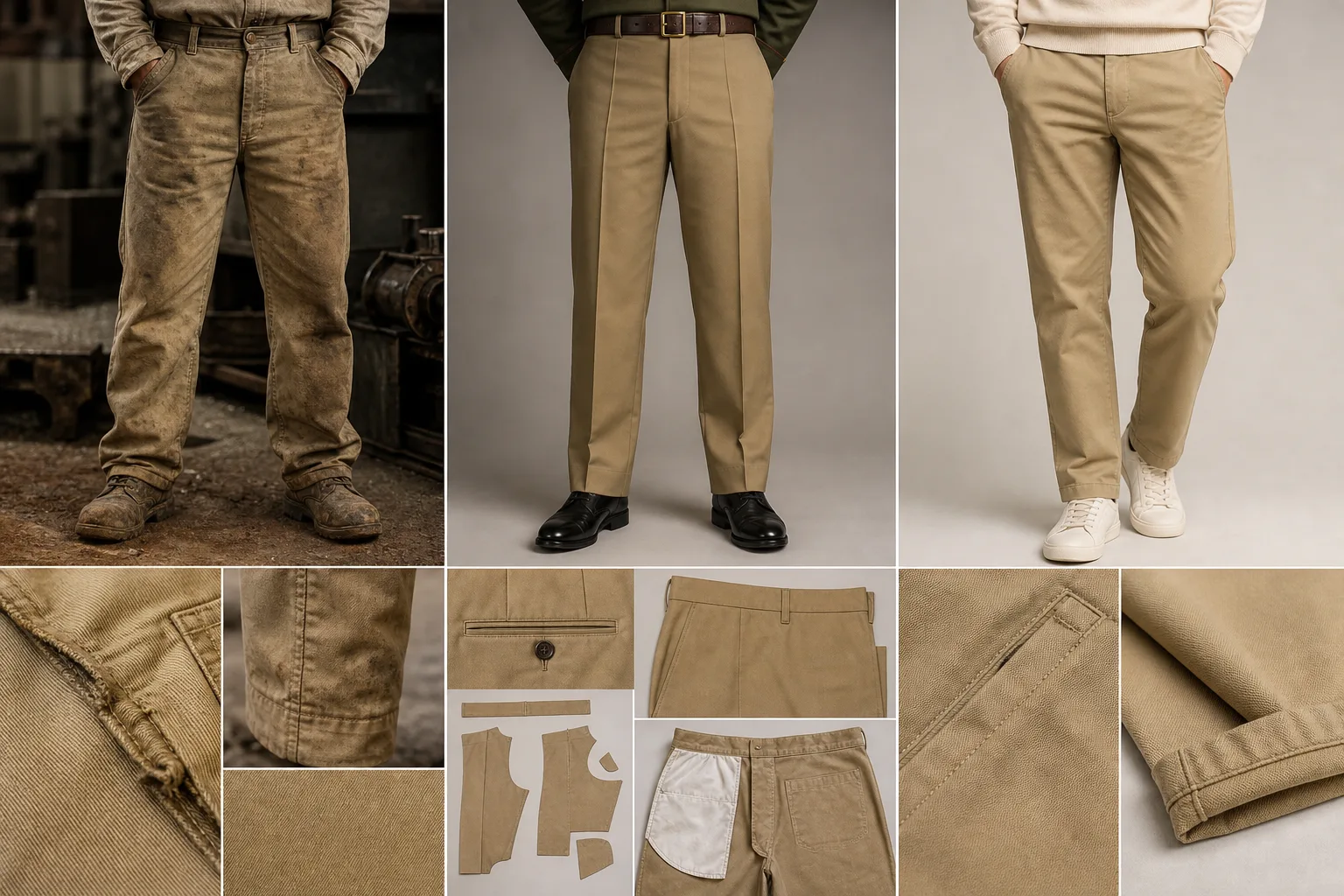
Similar-looking trousers can communicate very different things. The relevant context includes who requires or chooses the garment, how it is styled, what rules govern its use, and how observers interpret it. The following framework is a historical organizing device, not a claim that every wearer fits neatly into one category.
| Context | Primary purpose and authority | Typical presentation | Possible social message |
|---|---|---|---|
| Occupational workwear | Repeated activity, practical movement, or workplace requirements | Functional styling shaped by the job and available garments | Reliability, occupation, discipline, or belonging |
| Military or institutional uniform | Organizational identity and rules established by an authority | More controlled details, presentation, and permitted combinations | Rank, service, conformity, or institutional affiliation |
| Educational or office dress | Expected appearance within a school, professional, or administrative setting | Combined with dressier or more conventional separates | Respectability, competence, affiliation, or approachability |
| Casual civilian clothing | Personal choice, leisure, and retail availability | More variation in cut, styling, footwear, and coordination | Informality, personal taste, familiarity, or understated status |
These categories overlap. A former uniform detail may become a retail design reference, while a trouser sold as casual clothing may still draw on the visual authority of work or institutional dress. Cut, color, fabric, and styling can alter the reading even when the basic garment form remains similar. Historical evidence should therefore identify the setting and date before assigning a social meaning.
What the History of Chinos Can and Cannot Tell Us Today
The social history of chinos is best understood as an interaction between work, institutional authority, manufacturing, trade, retail, and changing norms. No single force explains the garment’s entire development. The same historical reference may remain visible in a contemporary design while its practical use, wearer, and cultural meaning have changed substantially.
When evaluating a claim about chinos, readers can use a simple evidence checklist:
- Identify the garment: Determine whether the source describes chinos, khaki, cotton drill, a uniform trouser, or a related form.
- Date the evidence: Separate the date of a surviving garment, image, advertisement, regulation, commercial launch, and later popularity.
- Check provenance: Give greater weight to records that explain an object’s ownership, location, construction, and dating.
- Distinguish image from use: Treat advertising and visual culture as evidence of presentation, not automatic proof of widespread adoption.
- Limit the geography: Do not turn a regional military, labor, retail, or education history into a universal global timeline.
Historical association also has clear limits. A connection with work or military clothing does not by itself prove the current performance, sustainability, labor conditions, legal status, or quality of a particular pair of chinos. Those questions require contemporary product, production, and policy evidence. For designers, students, and apparel teams, the value of chinos social history is not a final origin verdict; it is a more careful way to interpret how garments acquire meaning.
Next step: To connect this historical framework with apparel production vocabulary, explore Apparel Manufacturing Tools. Use it as an educational reference alongside dated garment records, technical documentation, and regional history—not as evidence that Apparel Wiki is a factory, laboratory, or sourcing provider.
Are chinos the same as khakis?
Not always. The terms overlap in everyday use, but khaki can describe a color or historical uniform and workwear context, while chinos generally refers to a trouser category commonly associated with cotton twill. Usage varies by period, region, and retailer.
Where did chinos originally come from?
There is no single universally accepted origin point. Early garments, terminology, military or occupational adoption, commercial availability, and broad civilian use may belong to different dates and places.
Why were chinos associated with work and military clothing?
Institutional and occupational clothing could value repeatable appearance, mobility, practical maintenance, and organized presentation. Later civilian markets and wearers reinterpreted those associations, giving the trousers additional meanings.
How did chinos move from uniforms into civilian fashion?
The movement could involve procurement, surplus, imitation, travel, education, popular imagery, retail promotion, and changing dress norms. The relative importance of each pathway depends on the region and period being studied.
What do chinos communicate about identity or social status?
They do not communicate one fixed message. Depending on setting, styling, wearer, and observer, chinos may suggest conformity, professionalism, informality, affiliation, respectability, or personal choice.
Why is there no single definitive history of chinos?
Different evidence types record different milestones. A surviving garment shows one object, an image shows representation, a regulation shows institutional intention, and a retail record shows availability. None alone proves a complete global history.