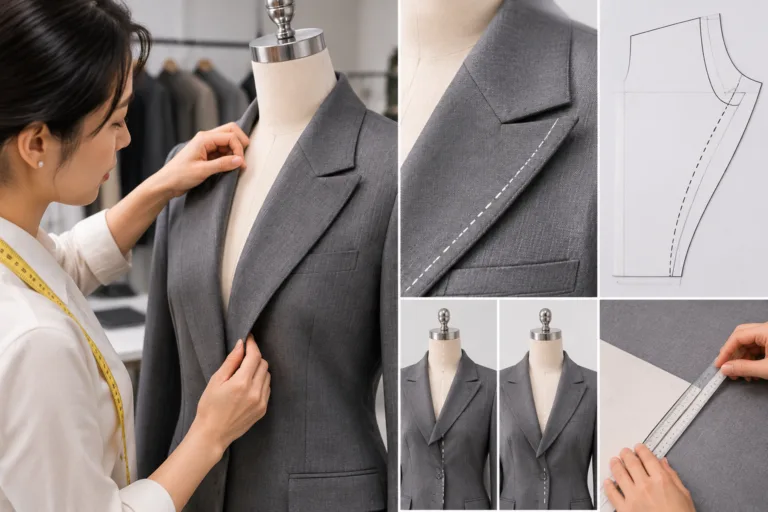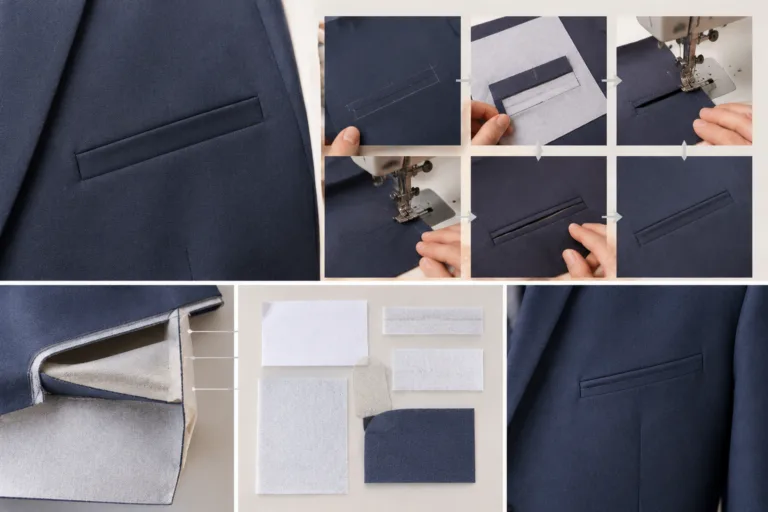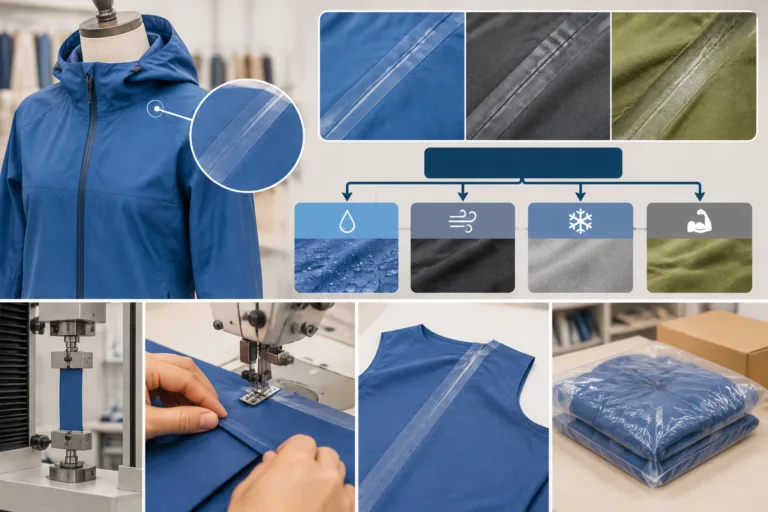
Consider taped seams when the seam itself presents a moisture pathway, an exposed edge, or localized rubbing that a compatible tape treatment could address. The garment must also accommodate the added material and application process. Apparel Wiki evaluates taped seams applications as an independent educational publication; its Sponsor page explains its editorial independence.
A taped seam has a strip of material applied along or over the joined area for a defined purpose. That purpose might involve sealing, coverage, or stabilization. The label alone establishes neither waterproof performance nor improved comfort or strength.
Taped seams applications: what they solve in garment construction
Start by separating the stitch from the seam. A stitch describes how thread forms loops or interlaces; a seam describes how fabric layers join. Tape is an additional construction treatment, rather than a stitch type. Identifying each element separately makes a specification easier to interpret.
On a sewn seam, the stitch line follows the needle penetrations. The seam allowance is the fabric between that line and the cut edge. A tape treatment may cover the stitched area, the allowances, or another specified part of the join. A cross-section should show exactly what it covers.
Terminology needs care because tape-like materials serve different purposes. Ordinary seam allowance finishing manages cut edges. Binding generally wraps an edge or allowance with a separate strip. An adhesive film may join surfaces between layers, rather than form an exposed covering over a completed seam.
A strip intended only to cover or stabilize an edge should be described by that function. Its presence does not establish that the stitch line is sealed. Similarly, a bound seam should not be treated as equivalent to a seam-sealing construction merely because both use a narrow strip.
The practical decision starts with the problem: where could moisture pass, which edge remains exposed, or what part of the seam contacts another surface? Consider taping when that location matters in use and the proposed treatment can address it without undermining movement, softness, or appearance.
Keep the intended function separate from the result. Fabric, seam geometry, tape compatibility, application conditions, handling, and end use all belong in the decision. Tape cannot compensate for an unsuitable fabric, a poorly chosen seam design, or an incompatible application process.
For a seam with little relevant exposure, an ordinary finish may be sufficient. Where softness or extension is essential, added thickness or stiffness can weigh against taping. More material is useful only when it serves the identified construction need.
Where taped seams make sense: garment zones, materials, and use conditions
Location helps identify where to investigate, but it does not dictate a treatment. Outerwear panel seams, hood or collar joins, pockets, and leg openings can have different exposures within one garment. High-contact areas also deserve attention when a seam edge sits against skin, equipment, or another garment.
Use the following table as an initial sorting tool. Each choice remains conditional on the actual fabric, seam construction, and intended use.
| Observable inputs | Likely implication | Initial construction choice | Variables that could change the choice |
|---|---|---|---|
| Outer seam exposed to rain | The join warrants attention as a possible moisture pathway | Investigate a compatible seam-sealing treatment | Coating, finish, junction shape, application access |
| Seam edge against skin or repeated rubbing | Edge profile and contact feel matter | Compare soft coverage with a simpler edge finish | Tape thickness, edge position, required hand feel |
| Lightweight stretch fabric in a moving zone | Extension and recovery are selection priorities | Favor a flexible seam; assess tape before adding coverage | Stretch direction, tape flexibility, allowance width |
| Relaxed interior seam in dry use | No clear exposure-driven reason for tape | Start with an ordinary allowance finish | Skin contact, care exposure, appearance requirements |
For a lightweight stretch garment, consider a close-fitting leg seam that extends during movement. If the proposed tape makes that area noticeably firmer, maximum coverage is a poor selection priority. Compare extension and contact feel with the untaped construction before deciding whether coverage serves the design.
For a structured outer layer, exposed panel junctions may justify investigating tape when moisture control is an intended function. That initial choice can change if the coating is incompatible, the junction is difficult to cover, or the selected application conditions do not suit the fabric.
Curvature, seam allowance width, tape width, washing or other care exposure, and the required hand feel can reverse either decision. Judge each zone by its specific exposure and construction, rather than assigning one treatment to every seam in the garment.
How to choose a taped-seam approach
Begin seam tape selection with the complete material system: base fabric, coating or finish, tape, bonding system, and intended care. Ask whether the relevant supplier documentation supports that combination. A tape description alone cannot establish suitability for a particular garment.
For an adhesive-backed or heat-activated option, ask what surface it is intended to bond to and which application conditions it requires. Can the available equipment control those conditions? What heat-sensitive limits does the fabric supplier identify? Resolve these questions before choosing mainly by width, color, or appearance.
Next, rank the requirements at the seam’s location. Skin-adjacent areas call for attention to softness, thickness, and edge feel. Moving or stretch zones require attention to extension and recovery. Visible areas need assessment of both the inside finish and any change apparent on the outside.
Review a cross-section showing the joined layers, stitch line, allowances, and proposed tape placement. Identify the area that needs coverage. Insufficient width may leave part of that intended area untreated; excessive coverage adds material beyond it. Compare the resulting bulk and flexibility rather than assuming wider is better.
For stretch construction, ask whether the taped area follows the required movement and returns appropriately afterward. For care exposure, ask what evaluation supports the proposed combination. Treat these as material-system questions, without assuming that a flexible-looking tape or a neat sample establishes suitability.
Appearance inspection and performance evaluation answer different questions. A clean-looking application does not prove adhesion, moisture control, laundering resistance, or durability. Likewise, a thicker or stronger added layer does not establish a stronger overall seam; the construction still needs to suit actual loads and movement.
Before comparing samples, document the intended use, fabric construction and finish, seam type, tape system, proposed application conditions, and care exposure. State the acceptance criteria for coverage, appearance, hand feel, movement, and the intended seam function. This gives each sample a consistent basis for comparison.
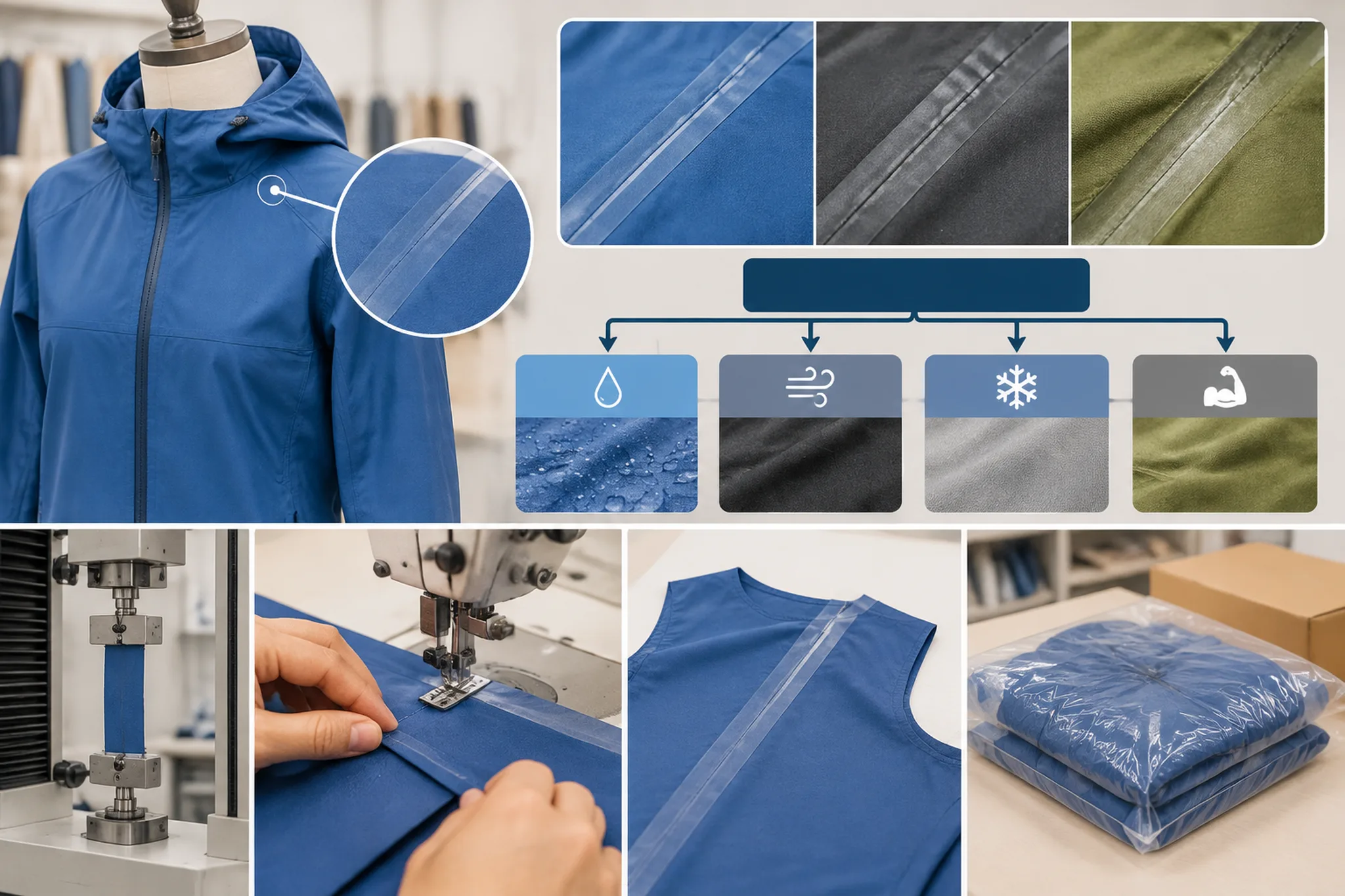
Application sequence and workmanship factors
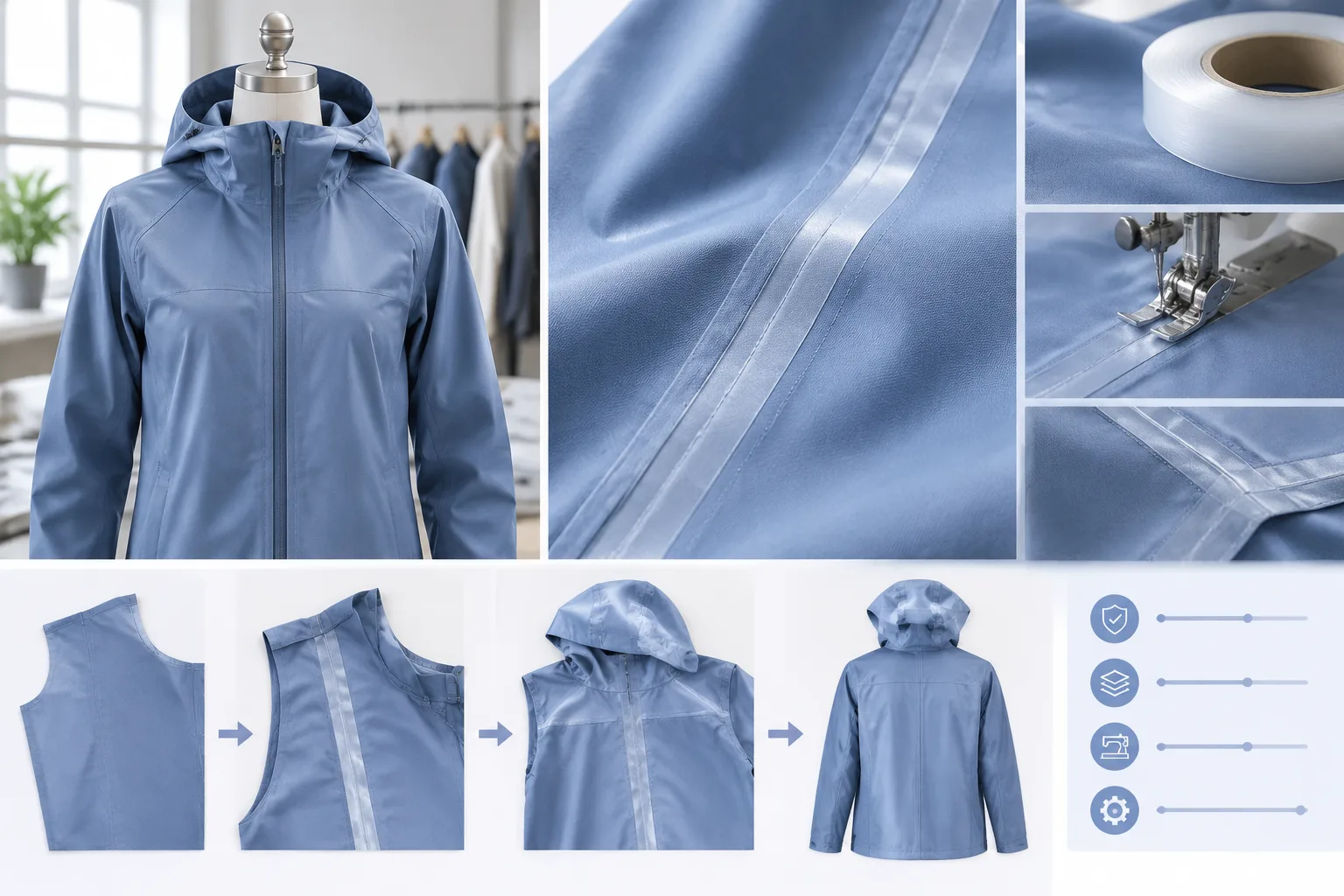
Once the proposed construction is documented, map when each seam remains accessible for taping and inspection. Decide where the tape will sit before closing surrounding components. An enclosed area may leave insufficient access to position the material, operate the selected equipment, or correct an unsatisfactory application.
Use a process sketch to mark access points and operations that would be difficult to undo. Show which layers are joined at each stage and which surface must remain reachable. Include inspection before enclosure so a visible problem does not become hidden behind a lining or another component.
The following sequence provides a planning framework. Adapt the exact operations to the selected tape system, fabric, seam shape, and equipment:
- Establish the join. Identify the seam construction, allowance arrangement, and intended tape path. Check that the assembly order leaves room for application.
- Prepare the joined layers. Arrange and stabilize them as required by the construction and applicable material-system instructions. Resolve folds or alignment problems before covering the area.
- Apply under documented conditions. Follow the selected system’s requirements for equipment and any heat or pressure controls. Do not transfer settings from an unrelated fabric-and-tape combination.
- Inspect while access remains available. Examine the intended coverage, tape alignment, edges, and surrounding fabric before continuing with enclosure.
At curved seams and junctions, inspect how the tape follows the actual assembly. Look for wrinkles, gaps, lifting edges, inconsistent placement, scorching, or distortion. Record their locations rather than relying on an overall impression that the seam looks tidy. These observations identify areas requiring investigation; they do not establish a performance rating.
Keep workmanship inspection separate from evaluation of adhesion, care durability, or the intended moisture-control function. Those questions need an appropriate evaluation method for the proposed construction. A photograph or surface inspection cannot settle them.
If a problem appears, record the assembly stage and application conditions before changing the procedure. This preserves a useful basis for comparison. There is no universal best sequence or machine setting: the workable procedure must suit both the material system and access within the garment.
Trade-offs, failure modes, and how to evaluate the decision
Evaluate the taped seam against the problem it was intended to address. If the concern is rubbing, examine the contact area during relevant movement. If the concern is seam-related leakage, identify an evaluation method that addresses that function. A satisfactory appearance answers only the appearance question.
Inspect the whole join when investigating a problem. Record whether the observation involves broken thread, fabric tearing, yarn slippage, tape lifting, distortion, or restricted movement. These are different findings and should guide different questions. Do not assume that changing the tape addresses damage elsewhere in the construction.
Thread strength alone does not establish whole-seam suitability. Consider the expected load, fabric extension, movement direction, and location of stress. When comparing constructions, look for whether an apparent improvement at one point coincides with a new problem nearby. Added material should be judged by the resulting assembly.
Use a consistent comparison checklist for taped and non-taped constructions where that comparison is relevant:
- Appearance and alignment: Note puckering, displaced layers, uneven coverage, and changes visible from the garment exterior.
- Bulk and hand feel: Compare thickness, bending, and localized hard areas, especially at overlapping allowances or seam junctions.
- Movement and contact: Examine the required extension and the feel of the seam against the body during relevant movement.
- Care exposure: Compare observations before and after the intended care exposure using an applicable procedure. Record what was evaluated and under which conditions.
- Intended function: Assess the defined seam risk with the relevant method; keep this result distinct from visual observations.
This checklist supplies comparison categories, not universal pass/fail limits. Record the suspected failure mechanism, sample identification, tape system, construction variables, application conditions, and evaluation method alongside the findings.
Keep the taped treatment when evaluation supports its intended purpose and its stiffness, bulk, appearance, and process demands remain acceptable for the garment. Otherwise, reconsider the seam design, a simpler finish, or reinforcement limited to the problem area. An unresolved result calls for further evaluation before adoption; it does not justify assuming either success or failure.
A practical next step for deciding on taped seams
Choose one seam and write down its function, exposure, movement, comfort requirement, fabric, and finish. Identify the specific problem the proposed treatment should address. Then compare taped and non-taped construction samples or specifications where relevant, using the same evaluation questions.
Check the applicable material-system documentation and evaluation method before drawing a performance conclusion. Record missing information as an open question. The useful outcome is a traceable construction decision: why tape is being considered, what evidence would support it, and which trade-offs are acceptable. The appropriate choice remains project-dependent; this framework supplies neither a universal specification nor a performance guarantee.
Frequently Asked Questions
Are taped seams necessary for every waterproof or weather-exposed garment?
No universal requirement follows from weather exposure alone. Examine the intended garment function, seam construction, exposure, and material system. A waterproof fabric description does not establish the completed garment’s performance. Any claim about the assembled garment needs relevant supporting evaluation.
What is the difference between a taped seam and a bound seam?
In practical construction terms, taping places a tape treatment over a defined seam area. Binding generally wraps an edge or seam allowance with a strip of material. Specify the actual construction: neither label alone establishes moisture control, durability, or comfort.
Can taped seams be used on stretch fabrics?
Consider them only after evaluating the proposed fabric, seam, and tape combination. Ask whether the treated area accommodates the required extension and returns appropriately afterward. Assess appearance and comfort through movement; tape that looks flexible does not establish compatibility with a stretch garment.
What garment areas are most likely to need seam taping?
Start with exposed panel joins, hood or collar joins, pocket constructions, leg openings, and areas of repeated contact. These are inspection locations, not mandatory taping zones. The priority is whichever seam presents a defined exposure or contact problem that the proposed treatment can address.
How can a team evaluate whether a taped seam is working as intended?
Define the intended function and acceptance criteria first. Record workmanship observations separately from function-specific evaluation, and include relevant movement and care exposure. Keep the construction and application details with the results so the team can identify what the evidence supports and what remains unresolved.