
Many new founders spend most of their energy on logos, social media, and launch ideas, but the real reasons why clothing brands fail usually show up earlier and deeper than that. In apparel, failure often starts with product planning that is too wide, budgets that are too thin, supplier decisions made too quickly, demand assumptions that were never tested, and inventory levels that turn cash into dead stock. The first 12 to 24 months are difficult because every early mistake affects the next one. A bad product plan creates higher sampling cost. Weak budgeting pushes the founder toward the wrong factory. Poor factory choice creates quality issues. Quality issues weaken sales, and slow sales make inventory harder to move.
If you are still shaping your launch plan, a pre-launch brand validation framework can help you pressure-test the basics before money gets tied up in samples and production. That is especially useful when you need to narrow your first collection, define a realistic price level, check whether your target customer is clear enough, and understand what should be validated before placing bulk orders.
The real meaning of failure in a clothing startup is not always a formal shutdown. In many cases, the brand is still online, but the business is already under pressure. Cash is locked in slow-moving stock. Repeat orders are weak. The founder is discounting too early. Product quality is inconsistent. New styles are launched before older ones have proven anything. From an apparel sourcing perspective, that is already a failure pattern, even if the business technically still exists.
This article looks at what actually causes those outcomes. The goal is not generic startup advice. The goal is to help clothing founders make better product, sourcing, and inventory decisions before the expensive mistakes happen.
What clothing brand failure really looks like
When people ask why clothing brands fail, they often imagine one final event: the website closes, the company stops posting, and the founder walks away. In practice, failure is usually a sequence of weaker signals.
- Cash loss: too much money spent before revenue is proven
- Unsold inventory: units remain in stock too long and need discounting
- Low repeat orders: first customers do not come back because fit, quality, or value did not hold up
- Margin erosion: hidden costs reduce profit even when orders come in
- Operational fatigue: the founder is stuck solving preventable production and stock issues
In apparel development, these are connected. If your first delivery arrives late, the seasonal sales window shrinks. If the fit is inconsistent, returns increase. If the collection has too many colorways and too many silhouettes, the size run becomes fragmented. Each problem may look manageable by itself, but together they drain time and cash very quickly.
Launching too many products too early

One of the most common startup mistakes is trying to launch like an established brand. A new label with limited cash may attempt T-shirts, hoodies, sweatpants, jackets, caps, bags, and multiple graphics all in the first release. On paper that looks exciting. In production, it usually weakens focus.
Each new style creates work: pattern review, sample revisions, fabric approvals, trim decisions, grading, size spec checks, decoration placement, costing, and quality control standards. If you launch ten styles instead of three, you are not just multiplying units. You are multiplying decisions, risks, and opportunities for error.
Founders comparing options should review how many designs to launch with because SKU count is one of the earliest pressure points in a startup collection. A broad launch can make a brand look bigger, but it also makes it harder to identify what customers actually want.
Why product overload hurts early-stage brands
Too many products create five practical problems. First, sampling cost rises fast. Second, the founder has less time to refine each garment. Third, minimum order quantities spread across too many items. Fourth, inventory becomes harder to manage by size and color. Fifth, brand identity gets blurry because there is no clear hero product.
Let’s look at a simple example. A founder with a limited budget can produce either three strong styles with clear fit and fabric decisions, or eight styles with minimal testing and mixed quality. The second option may create a wider storefront, but it often reduces confidence in the overall range. Customers do not always need more choices. They need a reason to trust the product.
How to choose a tighter first collection
A tighter first collection usually works better when it follows one clear use case. That might be heavyweight streetwear basics, fitted women’s active tops, uniform-friendly polos, or washed casual knitwear. The point is to make the first drop easy to understand.
| Approach | Lower-Risk Option | Higher-Risk Option |
|---|---|---|
| Number of styles | 1 to 3 hero SKUs | 6 to 12 mixed styles |
| Color count | Core neutrals or one signature palette | Many colors with unclear demand |
| Fabric base | Shared fabric across several items | Different fabric for every style |
| Fit direction | One fit concept | Loose, fitted, cropped, oversized all together |
| Inventory control | Simpler size planning | Fragmented stock across many variants |
For many startups, one strong T-shirt body and one strong fleece body can do more than a large first collection. This detail may look small, but it can create problems later if it is not confirmed early. A limited collection makes it easier to improve fit, control quality, repeat what sells, and explain the brand clearly.
Starting without enough budget or cash buffer
Another major reason why clothing brands fail is that the founder calculates only the production invoice and ignores everything around it. Apparel projects rarely fail because the quoted unit price was shocking. They fail because the total project cost was never mapped properly.
A practical budget should include development, production, logistics, launch support, and a cash buffer for mistakes. That means samples, pattern revisions, fabric tests when relevant, labels, packaging, freight, duties, storage, content creation, returns, and possible reorder timing. Many founders assume that if they can pay for bulk production, they are ready. In reality, they may be underfunded before the goods even arrive.
A more realistic startup cost breakdown for new brands helps founders see the difference between product cost and launch cost. That distinction matters because clothing businesses often run short of cash after manufacturing, not before it.
Hidden costs founders often underestimate
- Sampling rounds: first sample, fit sample, salesman sample, or pre-production sample
- Freight and duties: which may materially change landed cost
- Branding components: woven labels, care labels, hangtags, polybags, stickers, cartons
- Photography and content: needed to sell the product properly
- Returns and exchanges: especially when fit is unproven
- Reorders: a good seller still creates a cash need if stock runs out
From a sourcing point of view, underbudgeting also causes weaker decisions. Founders with no buffer may approve poor samples, skip quality checks, choose cheaper fabric than intended, or accept unrealistic lead times. In many projects, the problem is not that the buyer chose the wrong category. The problem is that some production details were not clarified before sampling or bulk production.
How to budget more realistically
Start from your target retail price and work backward. Estimate the landed cost, not only the factory price. Then check whether your gross margin can absorb discounts, returns, and marketing spend. After that, test whether your budget still works with a lower-than-expected sell-through rate.
A conservative startup budget normally asks three blunt questions. If only 50 to 60 percent of the first drop sells in the planned time window, can the business continue? If one style fails completely, is the company still stable? If a reorder opportunity appears, is there enough cash to support it? If the answer to all three is no, the launch plan is too fragile.
Choosing the wrong factory or supplier
Factory selection is not only about price. It is about fit between your product, your order size, your communication style, and the supplier’s real operating level. New founders often choose factories based on quick promises, low quotes, or attractive sample photos. That is risky because the real production result depends on process control, not presentation.
For startup teams, some of the most useful warning signs of risky factories show up before the first order is placed. Delayed replies, vague answers, shifting prices, incomplete spec confirmation, and unrealistic promises on MOQ or lead time often indicate bigger execution issues later.
Common supplier problems that damage new brands
The first issue is poor communication. If the factory does not clearly confirm fabric composition, GSM tolerance, print method, measurement points, shrinkage allowance, or sample comments, mistakes are likely. The second issue is weak quality control. If there is no stable process for in-line checks, measurement review, or packing verification, bulk inconsistency becomes more likely. The third issue is mismatch in order scale. A large factory may not care about a very small order, while a tiny workshop may not manage structured QC for a growing brand.
Founders also need to understand MOQ logic. A factory may accept a low MOQ on paper but compensate with higher unit cost, limited customization, fewer fabric choices, or less attention during production. That is not always wrong, but it needs to be understood before committing.
How to evaluate a factory more realistically
Ask specific questions, not general ones. Instead of asking whether they can make hoodies, ask what fabric weights they commonly use, what shrinkage they expect after washing, how they control print registration, how they handle measurement tolerance, and what sample stages they recommend. A capable supplier usually answers with process detail.
It also helps to compare supplier answers against broader technical guidance available on Apparel Wiki, especially when you are still learning garment terminology, quality checkpoints, and sourcing logic. The more precisely you understand your own product, the harder it is for vague supplier communication to slip through.
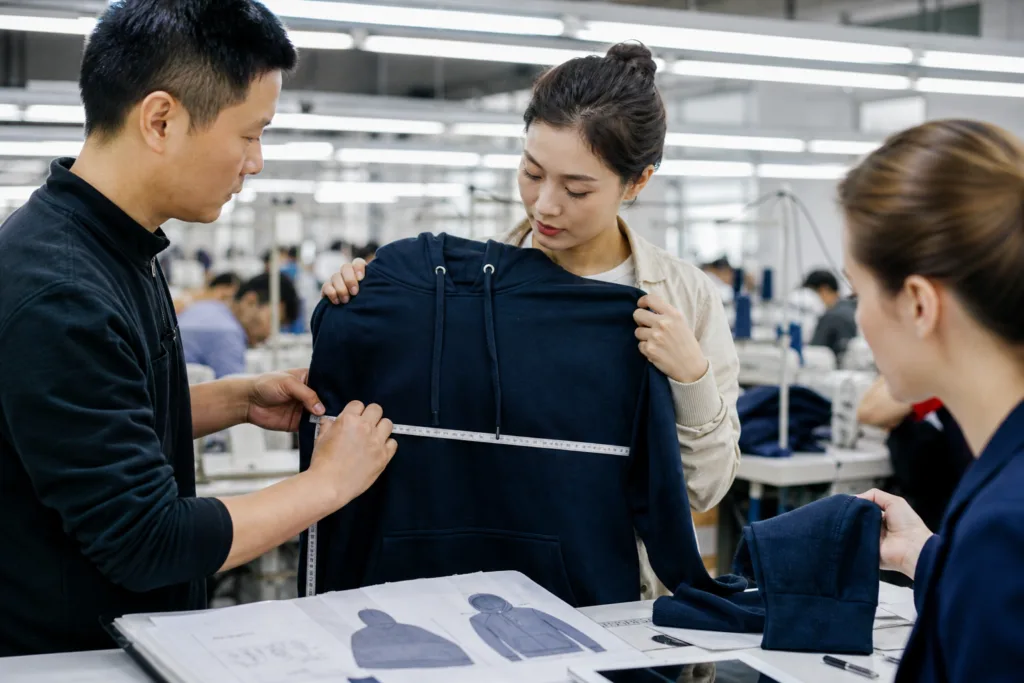
Before bulk production, confirm at least these points in writing: approved sample reference, bill of materials, fabric composition, GSM target, measurement chart with tolerances, print or embroidery specs, wash or finishing instructions, packing method, production lead time, and defect handling expectations. These are not administrative details. They are control points.
Skipping market testing before bulk production
Many clothing startups fail because they assume demand instead of testing it. The founder likes the design, friends respond positively, a few social posts perform well, and bulk production starts. But apparel buying decisions depend on more than visual reaction. Fit, hand feel, price, color choice, season timing, and customer trust all affect real demand.
Low-risk founders usually use some form of validation before placing a full order. Practical methods for testing designs before bulk production can expose weak assumptions early, while the cost of changing direction is still manageable.
What should be tested
Test more than the artwork or style concept. Test whether the fit works on the intended customer body type. Test whether the fabric feels right for the price. Test whether customers understand the product’s use case. Test whether the color range is too broad. Test whether your sizing language is clear enough to reduce returns.
For example, a startup may design a premium heavyweight T-shirt and price it above common blanks. If the target customer values fabric density, washed hand feel, and fit shape, that can work. If the audience mainly wants a cheap graphic tee, the same product may fail even if manufacturing quality is good. The issue is not the garment itself. The issue is product-market mismatch.
Low-risk ways to test demand
- Sample content testing: show actual samples instead of digital mockups when possible
- Small batch launch: produce a controlled first quantity
- Pre-orders: useful when lead times and communication are managed carefully
- Limited drops: test a narrow range before expanding
- Direct fit feedback: collect comments from target users, not only friends
Market testing is not a guarantee of success, but it changes the type of risk you take. Instead of guessing at scale, you learn with smaller exposure. In apparel sourcing practice, that is often the difference between a course correction and a cash-flow problem.
Overbuying inventory and creating stock pressure
Inventory is where several earlier mistakes become visible at the same time. If the collection is too wide, inventory spreads thinly across many variants. If the budget is weak, the founder may order more than needed to chase a lower unit price. If market testing was skipped, the size ratio may be wrong. If the factory had quality issues, some stock may be unsellable. That is how inventory turns into pressure.
Unsold stock is not just a storage problem. It is a margin problem, a cash problem, and often a brand problem. Heavy discounting teaches customers to wait. Inconsistent availability damages trust. Pushing weak products just to clear inventory distracts from what the brand should improve next.
How overstock usually starts
It often begins with a reasonable-sounding decision. The factory quote drops if the order increases. The founder wants to look fully stocked. The brand launches multiple sizes in equal quantities without checking expected demand by size. Extra colorways are added because they look good in mockups. None of these decisions seems fatal alone, but together they create stock pressure very quickly.
How to reduce inventory risk
| Inventory Decision | Lower-Risk Practice | Higher-Risk Practice |
|---|---|---|
| Size run | Use conservative size ratios based on target market | Order equal quantities in every size |
| Color planning | Start with proven core colors | Launch many fashion colors immediately |
| Order volume | Plan around realistic sell-through | Buy extra to reduce unit price |
| Reorder strategy | Keep room for repeat buys on winners | Lock most cash into first order |
| SKU review | Track performance by style and size | Review only total sales |
A simple discipline helps here: do not order for the brand image you want to project. Order for the demand you have evidence to support. Smaller initial runs can look less impressive from the outside, but they preserve flexibility, and flexibility is one of the most valuable assets a new brand has.
Other reasons clothing brands fail beyond the main five
The five mistakes above explain a large share of early failure patterns, but there are other common issues. Weak positioning is one. If the brand cannot clearly answer who the product is for, what problem or taste it serves, and why it deserves its price, customer acquisition becomes expensive and inconsistent.
Poor product-market fit is another. A well-made garment can still fail if it misses the buyer’s expectation on style, fit, or value. Inconsistent quality also damages growth. One strong order followed by one weak order can be enough to reduce trust, especially for startups that rely heavily on word of mouth and repeat purchase.
Timing matters too. Seasonal products launched late may miss their main sales period. A fleece-heavy collection delivered after warm weather starts will not behave like the original sales projection, even if the garments are good. In apparel, product timing is part of product planning.
How these failure points connect in a real launch cycle
These mistakes are not separate boxes. They usually connect in sequence. A founder launches too many products, which increases sampling cost. Because the budget was too tight, the founder chooses a factory mainly on price. Because the factory is not well matched, sample revisions are weak and lead times slip. Because the founder still wants to hit the launch date, bulk production starts without enough market validation. Because the initial order was large, the brand now holds inventory that is difficult to sell. That is a common early-cycle breakdown.
For buyers, the key is not only the product name or price, but whether the material, structure, marking method, and application requirements match the real use case. Startups sometimes treat brand building and apparel production as separate activities. They are not separate. Your brand promise is carried by the actual garment, and the actual garment is shaped by technical decisions.
A practical pre-launch checklist for reducing failure risk
- Can you describe your target customer in concrete product terms, not only demographic terms?
- Have you limited the first collection to a manageable number of SKUs?
- Do you know your landed cost, not only your factory quote?
- Do you have a buffer for delays, resampling, and slower sell-through?
- Has the supplier confirmed fabric, GSM, trim, measurements, and decoration specs clearly?
- Have you tested demand with real samples, limited drops, or pre-orders?
- Do your size ratios reflect likely demand instead of guesswork?
- Do you know which products are intended as hero styles and which are secondary?
- Is there a reorder plan for winners and an exit plan for weak sellers?
- Have you defined minimum quality checkpoints before shipment?
Apparel Wiki explains these checkpoints because early-stage brands often do not fail from lack of effort. They fail from unclear assumptions that move forward unchecked.
When a clothing brand should slow down, pivot, or stop
Not every problem means the brand should quit. Some problems mean the brand should reduce speed. If fit feedback is mixed, pause expansion and fix the base block. If one product sells while four others do not, narrow the range and build around the winner. If manufacturing communication is unstable, do not scale volume until control improves. Growth without control is usually expensive.
There are also moments when stopping is the rational decision. If the unit economics do not work even after honest revision, if returns remain high because the product itself is weak, or if the founder cannot finance sensible reorder cycles without damaging cash flow, continuing with larger orders usually increases losses. Slowing down early is often cheaper than forcing momentum.
Conclusion

The short answer to why clothing brands fail is that too many early decisions are made on optimism instead of proof. New founders often launch too broadly, underbudget the real cost, trust the wrong supplier, skip market testing, and buy too much inventory. Those are operational mistakes, not just branding mistakes, and they can be reduced with tighter product planning and more disciplined sourcing logic.
A more realistic launch strategy usually looks smaller and less dramatic than founders first imagine. Fewer styles. Better sampling. Clearer fit decisions. Stronger cost planning. More testing. Lower opening inventory. That approach may feel slower, but in apparel startups, slower and clearer often leads to a much more stable business.
FAQs
Why do most clothing brands fail?
Most clothing brands fail because they commit cash before they have enough proof. Common triggers include launching too many SKUs, underestimating total startup cost, choosing factories on price alone, skipping demand testing, and overbuying inventory that sells slower than expected.
How much budget does a new clothing brand need?
There is no single number that fits every brand because fabric type, MOQ, decoration method, and order size change the total. A useful answer is that the budget must cover development, bulk production, logistics, packaging, launch expenses, and a cash buffer for delays, returns, or reorders, not just the factory invoice.
What is the safest first product strategy for a startup clothing brand?
The safest first strategy is usually a small collection built around one to three hero SKUs with clear customer use, limited color options, and manageable size ratios. This makes it easier to test fit, control quality, understand demand, and reorder winners without carrying unnecessary stock.
Should a new brand use one factory for everything?
Not always. One factory can simplify communication if that supplier is genuinely capable across your product range, but many startups get better results by starting with fewer product categories instead of forcing one supplier to make items outside its real strength. The key is capability match, not convenience alone.
Is small batch production always better for new brands?
Small batch production usually reduces early inventory risk, but it is not automatically better in every case. Unit costs may be higher, fabric choices may be narrower, and customization options may be limited. It works best when the brand values learning speed, lower stock pressure, and demand testing over immediate scale.
When should a founder stop reordering and rethink the brand?
If sell-through is repeatedly weak, returns stay high, fit complaints continue, or discounting becomes the only way to move stock, it is time to pause and reassess before placing more orders. Reordering should follow evidence that the product, pricing, and customer response are working, not just hope that the next batch will fix the problem.