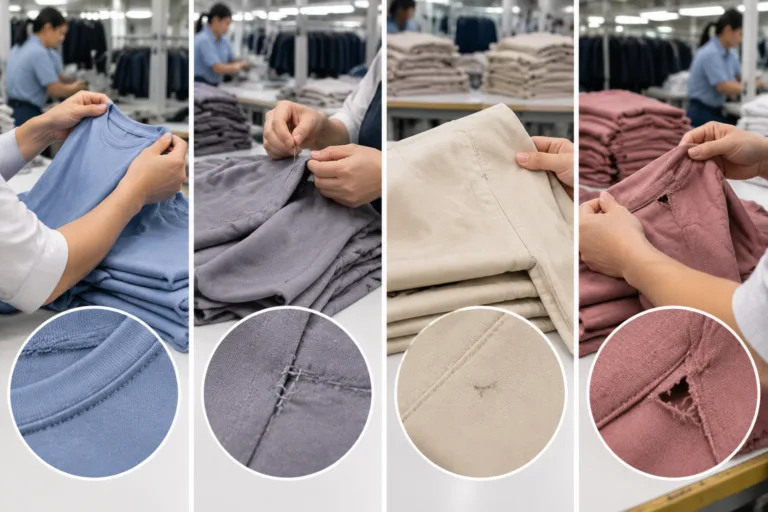
Minor defect handling decision criteria should be agreed before inspection, not improvised when a questionable garment is already on the table. A minor garment defect is an issue judged to have limited impact on the product’s intended use and on the requirements agreed for that product. The classification is project-specific: an issue that is acceptable in one garment, location, or use case may be unacceptable in another.
Apparel Wiki is an independent educational publication; its editorial work is separate from manufacturing and commercial inspection services. For more information about the site’s publishing relationship, see the Sponsor page. In practical quality control, teams should treat “minor” as a decision category supported by documented requirements, technical judgment, and authorized review, not as a universal list of harmless faults.
What counts as a minor garment defect?
A defect is a departure from an expected condition, such as an appearance, construction, measurement, or workmanship issue. A garment is nonconforming when it does not meet an applicable requirement. These concepts are related but are not identical. One garment may contain several defects, while the final decision about that garment may depend on the combined effect of those findings and the requirements that apply.
For example, a small cosmetic irregularity in a concealed area might have limited effect on a basic product’s intended use. The same irregularity could be unacceptable on a visible design feature, a high-visibility uniform, or a location where it affects fit, movement, closure, or durability. This is a hypothetical illustration, not a default acceptance rule.
Classification should begin with the product specification, approved sample, order terms, and any applicable safety or legal requirements. A general minor-defect category cannot make a safety-related, legally restricted, or contractually prohibited condition acceptable. When the documents conflict or the impact is uncertain, the finding needs escalation rather than an automatic minor classification.
Which factors should determine whether a defect is minor?
Teams can use the following factors as a decision aid. They are not a universal scoring system, and they do not replace the authority of a product requirement or an authorized decision-maker.
Safety and binding requirements
Assess possible safety and regulatory implications first. Consider whether the issue affects a component, closure, drawcord, labeling element, care instruction, or other feature subject to a specific requirement. Contract terms and buyer-approved specifications also take precedence over internal preferences. If a requirement is binding, a cosmetic description does not override it.
Intended function and durability
Ask whether the garment still performs its intended function. Review fit, movement, closure operation, seam or component integrity, and the likely effect of the issue during normal use and care. A visible flaw may be minor in one context, while a similar flaw that weakens construction or interferes with use may require repair, rejection, or further technical review.
Appearance and customer expectations
Evaluate visibility under normal wear, the location of the issue, and its relationship to the garment’s design. A finding on an interior area may be judged differently from one on a front panel, prominent trim, or branded feature. Customer expectations should be grounded in the approved sample and written product requirements, not in an inspector’s personal preference or an informal industry habit.
Extent and repeatability
Record the issue’s size or measurable condition when the specification provides a method and tolerance. Also consider how often it occurs, how many garments are affected, and whether the pattern suggests a broader process problem. Frequency alone does not determine severity, but repeated findings can change the commercial or quality significance of an otherwise limited issue.
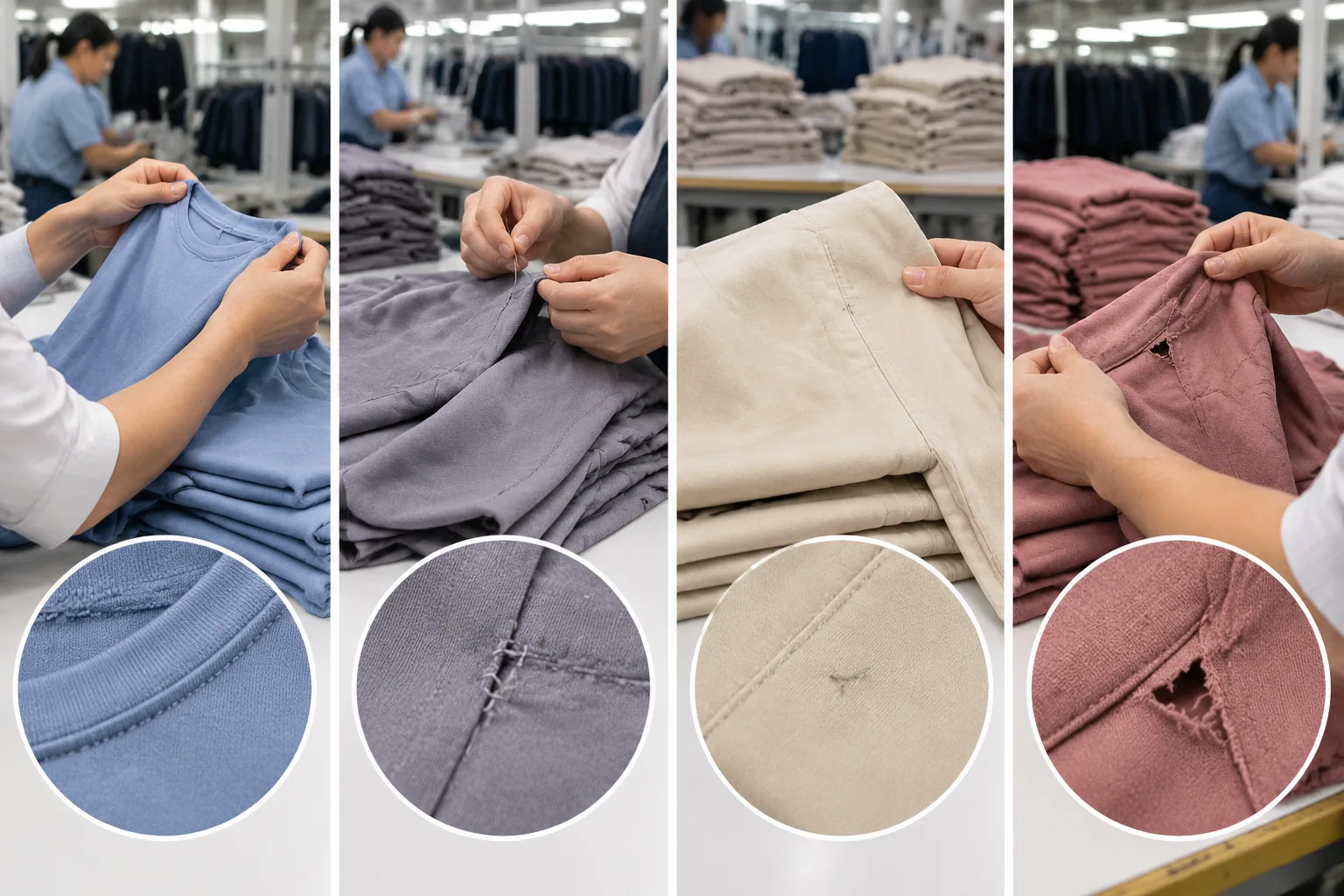
Use approved samples, defined measurement points, tolerances, and reference images where relevant. Pictures can improve consistency, especially for appearance judgments, but they do not replace written requirements or technical judgment. Keep project-specific criteria separate from general preferences so that inspectors know which decisions are documented and which require authorization.
How should teams define criteria before inspection?
Before inspection begins, prepare a short decision reference that connects each likely defect category to an observable condition and an authorized response. The reference should match the current approved sample and product specification. If either has changed, confirm which version controls the inspection.
- Define the finding: Describe the defect, affected component or location, observable condition, and any applicable measurement method or tolerance.
- Set the context: Note whether the location is visible during normal wear and whether the issue could affect fit, function, durability, labeling, care information, or safety.
- Set authority: Identify who may classify the finding, approve repair or rework, authorize a permitted concession, or reject the product.
- Set the record: Decide whether records will distinguish individual defects from garments affected by one or more defects, and use those denominators consistently.
- Set escalation triggers: Identify unclear requirements, conflicting documents, recurring findings, and uncertain functional or safety impact as issues requiring review.
Brief inspectors, production personnel, and responsible reviewers on this reference before the work starts. Defect images, sample garments, and measurement tools can support a shared interpretation, but they should be controlled and traceable to the applicable requirement. A checklist makes preparation easier; it does not turn editorial guidance into a mandatory standard or certification method.
What should an inspector do when a minor defect is found?
The first step is to identify and describe the finding clearly. Record the affected garment or lot, the defect location, the observed condition, and any relevant measurement or reference image. Avoid vague descriptions such as “poor quality” when a factual description is possible. Clear records allow another authorized person to understand what was actually observed.
When the scope or risk is uncertain, contain or segregate the affected product. This prevents questionable items from being mixed back into conforming stock before a decision is made. Containment is a temporary control; it is not the same as rejection, repair approval, or corrective action.
Next, compare the finding with the agreed criteria. If it fits the documented minor category and no higher requirement is affected, route it according to the approved process. If the criteria are unclear, the documents conflict, or the issue may affect safety, function, or contractual compliance, escalate it to the responsible authority.
The authorized disposition may be repair or rework, a documented concession where such a departure is permitted, or rejection under the applicable process. Rework changes the product and therefore requires verification against the relevant requirement after completion. Retain the decision, approver, and verification result in the inspection record. This preserves the distinction between discovering a defect, controlling affected product, deciding its disposition, and investigating why it occurred.
How do acceptance, repair, concession, and rejection differ?
These outcomes describe different decisions, authorities, and follow-up actions. A minor finding should not automatically produce either a pass or a rejection. The correct route depends on the applicable product requirements, the condition of the garment, the scope of the issue, and the person authorized to make the decision.
| Outcome | Meaning | Required follow-up |
|---|---|---|
| Acceptance | The item or lot meets the agreed criteria for the relevant decision. | Record the basis and applicable inspection result. |
| Repair or rework | The product is changed to address the defect. | Verify the completed work against the relevant requirement. |
| Concession | An authorized departure from a requirement, where such a departure is permitted. | Document the scope, reason, authority, and affected product. |
| Rejection | The product does not proceed under the current acceptance decision. | Follow the agreed sorting, return, replacement, or other disposition process. |
Acceptance does not mean that every garment is defect-free. It means that the item or defined lot has met the criteria used for that decision. Where sampling is used, the result applies to the defined lot and inspection plan. It should not be presented as proof that every unit in the lot has identical condition.
A concession is also not an informal agreement between an inspector and a production worker. It should come from the responsible authority and identify what requirement is being departed from, which products are covered, and whether any limits or additional controls apply. A concession cannot override a safety, legal, or binding contractual requirement.
How should teams review decisions and prevent repeat defects?
Good garment defect records make decisions traceable. At a minimum, record the defect description, location, observed condition, affected garment or lot, classification rationale, disposition, approver, and verification result. A factual description such as “open seam at the side panel” is more useful than a general phrase such as “poor workmanship.”
Keep the number of defects separate from the number of garments affected. One garment may have several findings, while several garments may share one defect type. These measures answer different questions and should not be combined or compared without explaining the counting basis. Consistent records also help teams see whether a problem is isolated or appears across a wider group of products.
Review recurring findings by defect type, product location, process step, material, equipment, or workmanship instruction when that information is available. A repeated issue may justify checking the specification, approved sample, construction method, material condition, operator guidance, or training. The appropriate investigation depends on evidence from the specific production context; repeated inspection alone does not explain or prevent the cause.
Reference images can help inspectors recognize the same condition, but images should be controlled alongside written criteria. If an approved sample, measurement point, tolerance, or defect image changes, the responsible parties should agree to the revision and communicate which version applies. Uncontrolled updates can create conflicting expectations between inspection stages, suppliers, and buyers.

What are the limits of a minor-defect decision?
A minor classification is a project-specific quality judgment. It cannot make a safety, legal, labeling, or contractual nonconformity acceptable. The same visible issue may receive a different decision depending on the garment’s intended use, location, visibility during normal wear, functional role, approved reference, and documented requirements.
Escalation is appropriate when the classification is uncertain, the documents conflict, the defect recurs, or the possible effect on function or safety is not understood. The inspector should also escalate when a requirement is missing rather than silently substituting personal preference or general industry practice.
Inspection conditions matter as well. A finding made under one lighting condition, measurement method, or reference sample may not be directly comparable with a finding made under another. Teams should identify the applicable conditions before inspection and preserve enough information for an authorized reviewer to understand how the decision was reached.
Repeated sampling until a lot happens to pass is not a substitute for an agreed sampling plan, containment, or investigation. Likewise, a checklist cannot resolve every technical or commercial disagreement. When the criteria are incomplete or contradictory, obtain written clarification from the responsible authority before repair, concession, acceptance, or rejection is finalized.
The practical next step is to agree the criteria and decision authority before the next inspection. A short reference sheet can identify observable defect examples, affected locations, measurement methods, escalation triggers, permitted dispositions, and the records required. Teams can also use relevant Apparel Manufacturing Tools to support consistent documentation and review, while keeping product-specific approval with the responsible parties.
Can a minor garment defect still make a product unacceptable?
Yes. “Minor” is context-dependent and does not override safety, legal, labeling, functional, or contractual requirements. A defect that appears limited in one location or product may be unacceptable when it affects intended use, required information, or an agreed specification.
Who should approve a concession for a minor defect?
The person or organization authorized by the applicable quality or commercial process should approve it. The record should identify the requirement affected, the products covered, the reason for the decision, and any required follow-up. An informal verbal agreement may not provide adequate traceability.
Should inspectors count defects or garments with defects?
They should record both when the inspection plan requires them. Defect counts measure findings, while affected-garment counts measure units containing one or more findings. Because the denominators and meanings differ, the two measures should remain clearly separated.
Does an accepted sample mean every garment in the lot is defect-free?
No. An accepted sample supports a decision for the defined lot under the applicable inspection plan and criteria. It does not establish that every garment was individually inspected or that every unit is free of defects.
What should a team do when the defect criteria are unclear?
Contain or segregate the affected product when appropriate, document the observed condition, and request clarification from the responsible authority. Do not make an irreversible disposition based only on an inspector’s assumption when requirements conflict or the potential impact is uncertain.