A strong convertible clothing concepts design brief explains more than how a garment looks. It identifies the wearer problem, the situations involved, the garment’s approved configurations, the action that changes one state into another, and the requirements that must remain acceptable during use. This gives pattern makers, developers, and reviewers a shared direction before detailed technical documents are prepared. Apparel Wiki is an independent educational publication; it is not a manufacturer, factory, testing laboratory, certification body, or service provider. Its content is supported independently, including through Sponsor relationships.
In this article, “convertible clothing concept brief” is used as a practical editorial term for that structured description. It is not presented as a universal industry template. The brief establishes product direction; a later technical package adds production-level measurements, materials, construction information, component details, and revision control.
What a Convertible Clothing Concept Brief Must Define
Begin with the practical question the garment should solve, not with novelty alone. A jacket that can become a vest, a skirt that can change length, or a shirt with detachable sections may look compelling in a sketch, but visual inspiration does not tell a team which parts must move, how the wearer performs the change, or what the garment must still do afterward. Without those decisions, pattern making, sampling, costing, and production review are left to interpretation.
A useful convertible clothing design brief should identify the intended wearer and use context. Describe the activity, setting, likely clothing layers, movement demands, weather exposure, storage situation, and reason the wearer needs more than one state. Then name the original garment state, each alternate state, and the action that connects them. “A versatile travel jacket” is broad. “A lightweight outer layer that changes from long sleeve to short sleeve when the wearer enters a warmer indoor setting” gives the team a task to investigate.
Separate what is confirmed from what remains open. A confirmed requirement might be that a detachable component must remain with the garment during a specified use. A project-dependent choice might be whether that component is folded, rolled, stored in a pocket, or carried separately. An editorial recommendation is guidance from the writer, while a hypothetical example is an illustration rather than evidence of demand or performance. Keeping these categories visible prevents preferences from being mistaken for tested facts.
The brief should also state what success means at a suitable level for the concept stage. Possible outcomes include easier movement, adjustable coverage, reduced carrying, or a faster transition. These are candidate outcomes, not universal wearer needs. The team must later decide which ones apply, how they will be observed or measured, and which trade-offs are acceptable.
Translate the Wearer Problem Into Convertible Garment Tasks
Broad ideas become useful when they are rewritten as observable use cases. For each case, record what the wearer is doing, where the garment is being used, what layers are underneath, how the body moves, what environmental exposure occurs, where detached parts go, and what triggers the transition. The trigger could be a change in temperature, activity, coverage, storage needs, or access. The brief should describe the situation before selecting a zipper, snap, strap, panel, or other construction solution.
Record the wearer’s words and actions before interpreting their cause. If someone repeatedly pulls at a sleeve while reaching, the observation is that the person pulls at the sleeve during that movement. “The sleeve is too long” is a hypothesis. Other explanations could involve layering, fabric friction, cuff design, activity, or the wearer’s preferred fit. A useful problem definition keeps these explanations separate until a sample or further observation provides better evidence.
A small interview or observation exercise can help a team discover questions, but it should not be presented as proof of market-wide demand. Note the participant’s wording, the action observed, the surrounding context, and competing explanations. Then convert the findings into a short list of prioritized user outcomes. For example, a concept might prioritize easier arm movement first, adjustable coverage second, and compact storage third. The order belongs to the project and should be revisited when new evidence appears.
Use a task statement before a construction statement
A task statement describes what the wearer needs to accomplish: “Move from outdoor travel to indoor work without carrying a separate layer.” A construction statement describes one possible response: “Remove the sleeves and store them in an interior pocket.” Starting with the task preserves room to compare alternatives. It also makes it easier to reject a visually attractive mechanism if it creates excessive effort, poor access, loose components, or an awkward transition.
Specify Configurations, Transformations, and User Interactions
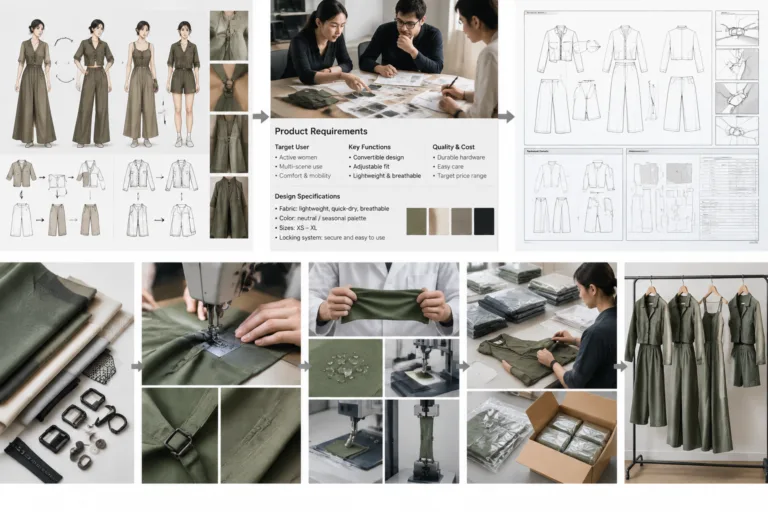
List every approved configuration and give it a functional name that can be used in sketches, samples, review notes, and later documents. Names such as “full-length outer layer,” “shortened layer,” and “stored-component state” are more useful than relying on changing descriptions such as “look one” or “alternate look.” Keep the number of promised states aligned with what the team can explain, sample, wear, maintain, and inspect.
Describe the transformation as a sequence of user tasks. State whether parts are removed, folded, detached, reversed, extended, cinched, or reattached. Identify what the wearer must see, hold, align, reach, or remember. Treat force, dexterity, visibility, access, storage of detached components, and prevention of incorrect assembly as questions to validate for the specific design. Do not claim that a transformation is easy, secure, comfortable, or durable without product-specific observation or testing.
Some qualities should remain acceptable across all intended states. These invariants may include secure attachment, adequate coverage, mobility, balance, appearance, and access to closures or pockets. The exact priorities depend on the garment and use context. For example, a component that is acceptable in a relaxed indoor state may not be acceptable if it interferes with movement during an outdoor activity.
| Configuration detail | Question to record |
|---|---|
| Intended activity | What is the wearer doing in this state? |
| Garment state | Which parts are present, absent, folded, or reversed? |
| Transformation action | What exact sequence changes the garment? |
| Required components | Which attachments, closures, panels, or storage features are involved? |
| Acceptance questions | What must be observed, checked, or tested before approval? |
Use the matrix as a communication tool, not as proof that the concept works. Each state still needs review through samples and, where relevant, wear observations or other product-specific evaluation. A fashion sketch can communicate silhouette, but it rarely captures the complete interaction sequence. Describing the transformation as a user task exposes missing steps early and helps the team decide whether the proposed versatility earns its added complexity.
Turn the Concept Into Product Requirements and a Technical Handoff
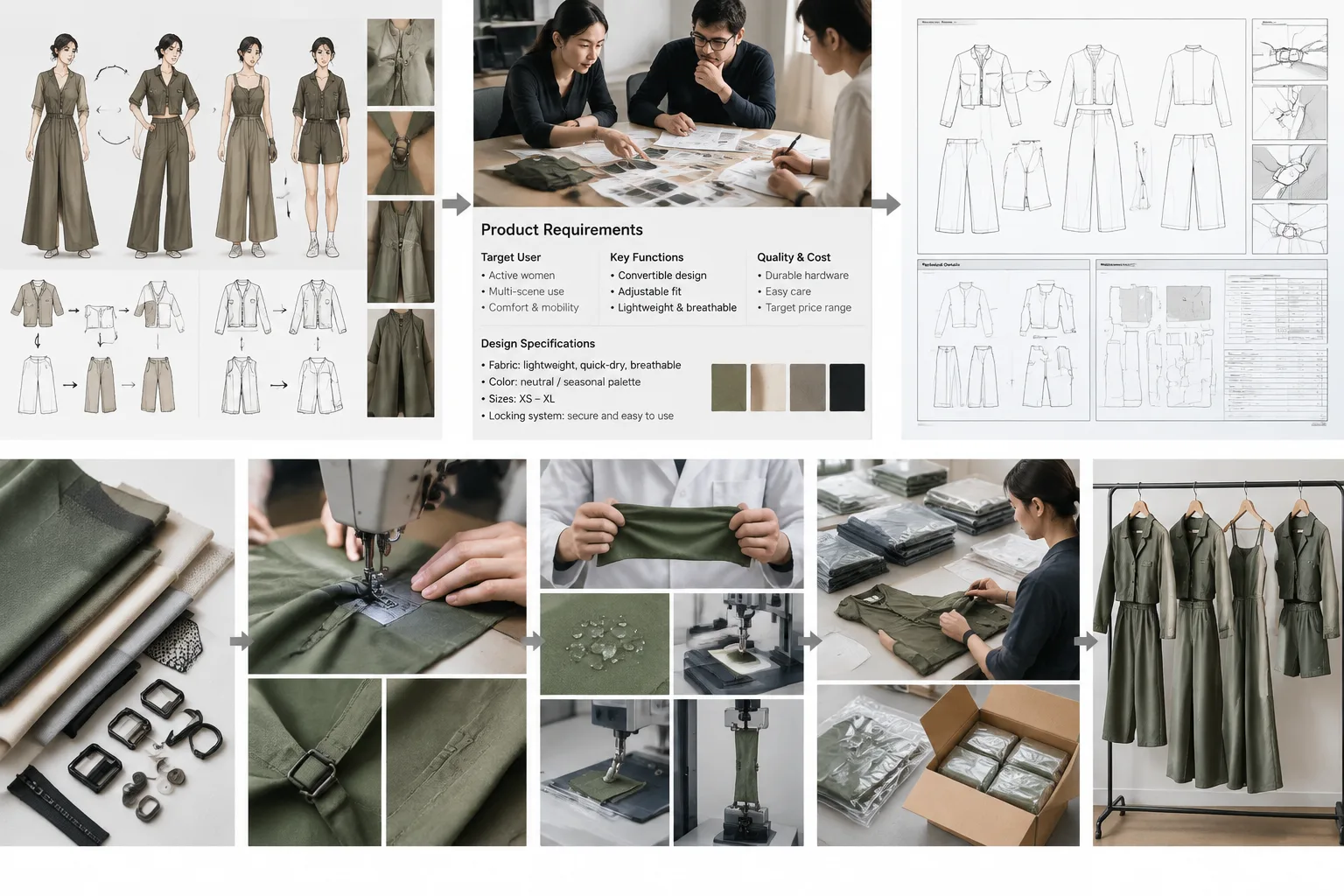
Once the intended configurations and wearer tasks are approved, the convertible clothing concept needs to become information that another person can interpret consistently. A useful requirement identifies the object, the condition, and how the result will be reviewed. For example, a requirement might identify a detachable sleeve, state when it must be attached, and specify whether approval depends on measurement, visual review, movement observation, or another agreed evaluation.
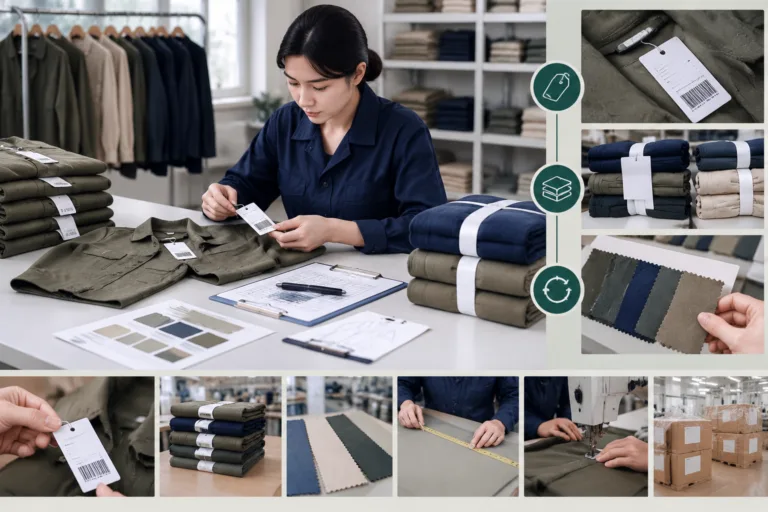
The handoff should cover the parts that matter to this garment rather than follow a supposedly universal template. Depending on the design, that may include garment measurements, transformation points, attachment hardware, seam and reinforcement areas, materials, trims, labels, care instructions, packaging, and identification of detachable components. A pocket, strap, panel, or closure that changes function between states deserves the same clarity as the main silhouette.
Drawings, written instructions, measurement points, units, material descriptions, and revision numbers must agree. An illustration may show a component in one position while the written instruction describes another. A pattern maker, sample room, supplier, or quality reviewer should not have to infer which version controls. A checklist or handoff table can expose these conflicts before sampling and can be maintained alongside the relevant Apparel Manufacturing Tools.
A bill of materials and a cost sheet serve different purposes. The bill of materials describes what the product uses and, where applicable, the quantity or unit of each component. The cost sheet assigns values to those inputs and may include other project-defined cost categories. Document material specifications, units, supplier options, allowances, waste assumptions, substitution permissions, and approval authority clearly so one loss or quantity assumption is not counted twice.
A technical package develops from the brief; it does not replace the brief. The brief explains the problem, intended states, and design direction. The later package supplies production-level detail as decisions become settled. Any supplier alternative should therefore be treated as a controlled decision when it could change weight, strength, appearance, care, fit, or transformation behavior.
Balance User Benefit Against Construction and Maintenance Trade-Offs
Convertible features should earn their complexity. Review each concept against the intended user benefit, technical feasibility, appearance in every state, comfort and mobility, component security, maintenance complexity, repairability, material impact, and expected cost. These categories are prompts for project discussion, not a universal scoring system or a promise of commercial success.
A zipper, snap, magnet, strap, panel, or other hardware may enable a useful transformation while also adding bulk, weight, snag risks, failure points, assembly operations, or laundering questions. A detached part may improve flexibility but create storage, labeling, replacement, or loss concerns. A hidden attachment may preserve appearance but make inspection or repair more difficult. The relevant question is whether the added construction solves a documented task well enough to justify its consequences.
For two or three hypothetical concepts, a comparison matrix can make the decision visible. Use rows such as primary wearer benefit, transformation steps, component count, appearance across states, maintenance questions, and unresolved risks. Any scores should be labeled hypothetical, and the project team should define its own weights. A sample result, supplier statement, observed user action, and editorial recommendation should remain clearly separated in the record.
The strongest option is not necessarily the one with the most configurations. Keeping a feature may be reasonable when it solves an important task and can be explained, sampled, worn, maintained, and inspected. Removing it may be better when its visual novelty introduces complexity without a sufficiently clear benefit.
Prototype, Review, and Update the Requirements
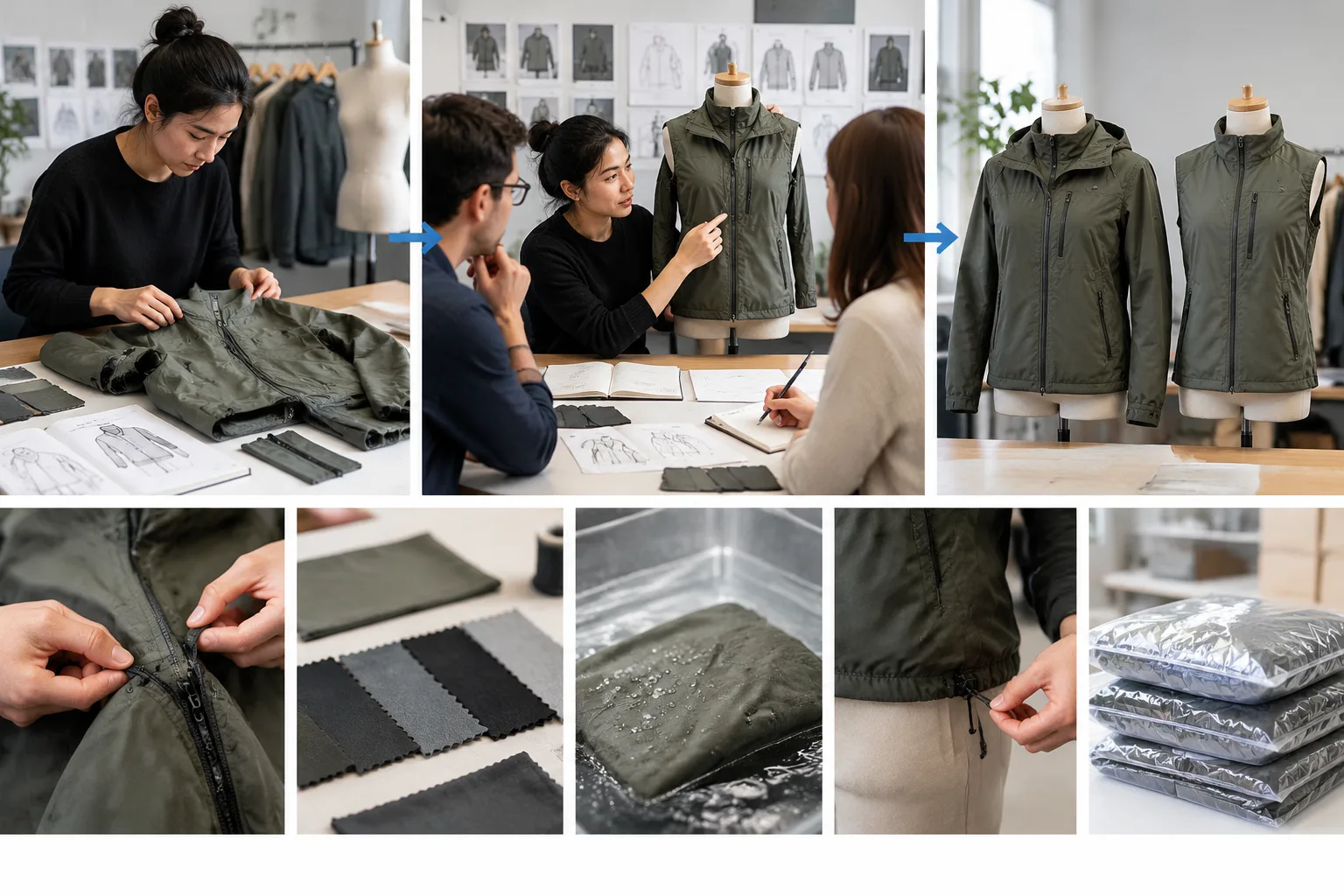
Before making a detailed sample, review the brief for missing configurations, ambiguous terms, conflicting drawings, unspecified units, and requirements that cannot yet be measured or reviewed. The first prototype can then focus on the highest-risk question: perhaps the attachment sequence, a reversed panel, a change in balance, a movement issue, or the storage of a detached component. It does not need to represent every polished detail at once.
Observe the stated tasks in each intended configuration and record what happened. Useful notes may include the wearer’s actions, comments, errors, skipped steps, and visible difficulties. Time or effort observations can be included only when the project has defined how they will be measured. Do not describe a transformation as easy, secure, comfortable, or durable based solely on the concept sketch or one unstructured impression.
Review fit, balance, access, component security, appearance, movement, care implications, and transition reliability. Then log each finding as an observed result, interpretation, proposed change, owner, and revision status. This format keeps an observation such as “the wearer searched for the attachment point” separate from an interpretation such as “the marking or visibility may be insufficient.”
After an approved change, update the brief, drawings, measurements, component information, and other technical documents that it affects. Keep visible distinctions between what the sample demonstrated, what remains unknown, and what is simply a project preference. The next decision may be to revise the concept, proceed to a fuller sample, request targeted material or component testing, or stop the feature.
Next step: Build one working requirements sheet from the approved configuration matrix. Give every major outcome an owner, a review method, and a revision status, then use the first prototype to test the highest-risk interaction before expanding the document into a fuller technical handoff.
FAQ
What should a convertible clothing design brief include?
It should identify the wearer problem, use context, intended configurations, transformation sequence, required components, performance expectations, constraints, and open questions. It establishes development direction; it is not automatically a complete production specification.
How do you describe multiple configurations in a convertible garment brief?
Give every approved state a functional name and record its intended activity, garment state, transformation action, required components, and acceptance questions. Describe the user sequence in words as well as showing it in sketches.
What is the difference between a convertible clothing concept brief and a tech pack?
The brief defines the problem, concept, configurations, and direction. A tech pack or comparable technical handoff develops the production details, such as measurements, materials, construction information, component identification, revisions, and review requirements.
How can a designer test whether a transformation is practical for the wearer?
Ask users to complete the intended transformation in the relevant context and observe actions, errors, comments, access, movement, and component handling. Record the method and findings, because ease, security, comfort, and durability require product-specific evaluation.
Which requirements should be measured, and which should remain project-dependent?
Measure or formally review requirements that affect fit, configuration, attachment, access, materials, construction, or approval decisions. Project preferences such as weighting trade-offs or visual priorities should be identified as choices rather than universal apparel rules.
How should materials, trims, care, and detached components be documented?
List applicable materials and trims with their relevant descriptions, units, component identity, supplier or substitution status, and approval authority. Document care and packaging decisions for the actual design and target market, including how detached parts are identified, stored, or handled.