

A cold spot in a puffer jacket is an area that feels less warm than nearby areas. That sensation does not, by itself, show that insulation has shifted or that the garment has a defect. Improving puffer jackets cold spots starts with identifying where and when the feeling occurs, then considering fit, coverage, construction, insulation distribution, and use conditions.
Apparel Wiki approaches the question as a garment-development problem, not a diagnosis from the category name alone. A puffer jacket’s intended task and the conditions in which someone wears it matter. The observations below can help narrow what to inspect before choosing a design change.
What a Cold Spot in a Puffer Jacket Means
A cold spot is a localized difference in perceived warmth: one area feels colder than the surrounding jacket while worn. It is a practical description, not a standardized technical classification. The report describes a wearer’s experience; it does not establish a cause or quantify a loss of warmth.
Several factors can shape that experience. A jacket may sit differently as the wearer moves, leave an area more exposed, or interact with the wearer’s layers and posture. Activity and surrounding conditions can also affect how warmth is perceived. Insulation distribution or assembly could be relevant, but the sensation alone cannot confirm either.
Start by recording the reported location and the circumstances: when it occurs, how the jacket is being worn, and whether the garment’s condition has changed. Note whether the sensation recurs under similar conditions. A repeatable complaint gives a more useful starting point for inspection than a single impression, but it remains an observation rather than a test result.
The word “puffer” does not establish how warm a particular jacket will feel or whether it suits every use. The wearer’s task, garment design, materials, fit, and conditions all matter. Treat the complaint as a question to investigate, not proof of a particular construction or material problem.
Where Cold Spots Appear and What to Inspect First
Begin with a simple garment map. Mark or describe the area the wearer identifies, then compare it with nearby sections. Note whether the location aligns with a seam, closure, panel boundary, or a body area that moves. This turns a broad comfort complaint into a specific place to inspect.
Check the jacket in its normal worn configuration. Look at how it fits, whether it covers the reported area, and whether an opening or the garment’s position changes with posture. Consider whether the sensation shifts when the wearer moves or changes layers. These observations can point toward fit or exposure without establishing either as the cause.
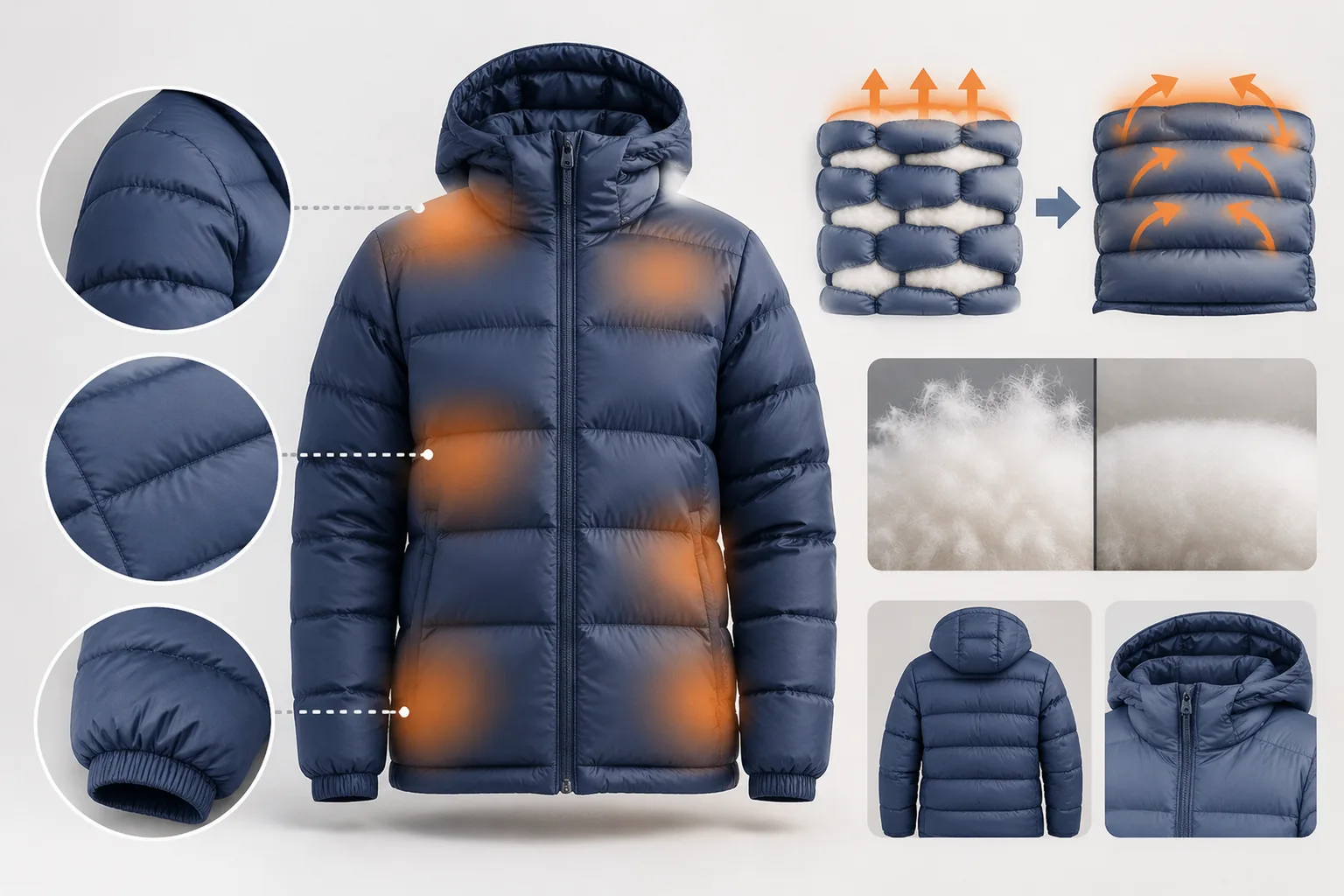
Next, inspect the garment without disturbing its construction. Look for visible differences in loft, bunching, gaps, or apparent unevenness in the insulation. Compare the suspect area with adjacent panels and note its relation to the compartment layout. A visual clue can guide further investigation, but appearance alone cannot confirm insulation quantity or finished-jacket performance.
Keep the notes tied to conditions: location, posture or movement, layers, garment state, and whether the sensation repeats. Comparing observations across relevant wear conditions can help distinguish a consistent pattern from a one-time impression. This is a practical inspection, not a measurement or a formal test-method result.
Why Puffer Jackets Can Feel Cold in Local Areas
Insulation distribution is one possible contributor. If a reported area also appears to have less loft or a change in how insulation sits within a compartment, that is a clue to investigate. It is not proof that insulation has moved or that the area performs differently. The panel and compartment design, along with how the insulation is retained, may be relevant to the question.
Seams, closures, and panel transitions can create local differences in the garment’s construction. If a cold sensation repeatedly lines up with one of these features, inspect that area and its surrounding coverage. The alignment may help focus the review, but the feature’s presence alone does not establish a defect or quantify warmth loss.
Fit and movement offer a separate line of inquiry. A jacket that shifts during activity, leaves a body area uncovered, or sits differently with another layer may change where the wearer feels exposed. Compare the garment’s position and coverage in the conditions associated with the complaint. If the reported location changes with posture or movement, that variation is useful context, not a diagnosis.
The finished jacket combines shell, lining, insulation, elastic elements, and attachments. Their interaction matters, so an impression about one component cannot establish how the assembled garment performs. Connect each possible explanation to an observable clue and the intended wearing task. Until the garment is evaluated in that context, keep the cause open rather than treating one clue as a confirmed finding.
How to Improve Puffer Jackets Cold Spots
Improving puffer jacket cold spots starts with matching a design response to a repeatable observation. A visible change in loft or a recurring complaint within one compartment can direct attention to that panel, its compartment layout, and how the insulation is retained. Review those details together, then evaluate any proposed adjustment on the assembled jacket; changing one component does not establish the finished result.
If the reported area aligns with a seam, closure, or panel transition, examine that local construction and the coverage around it. The goal is to understand whether the feature, its placement, or how the jacket sits in use is relevant, not to remove or alter construction details automatically. When the complaint varies with movement or posture, consider pattern, sizing, opening behavior, and coverage for the intended wearer and task.
| Observed input | Possible implication | Initial design question or response | Variables that could change the decision |
|---|---|---|---|
| Repeated complaint near a visible change in loft or compartment appearance | Insulation distribution or retention may warrant review | Examine the relevant panel and compartment design; check the revised assembled garment | Garment condition, panel location, size, and intended use |
| Complaint repeatedly aligns with a seam, closure, or panel boundary | Local construction or surrounding coverage may be relevant | Review the feature and adjacent coverage before changing other areas | Jacket position, posture, movement, and layering |
| Complaint shifts with movement, fit, or body coverage | Pattern, sizing, or opening behavior may affect exposure | Review fit and coverage in the relevant wearing conditions | Wearer, size, activity, layers, and posture |
For a lightweight jacket worn during active movement, check whether shifting fit or coverage changes where the wearer reports feeling cold. For a jacket intended for less active use, compare the complaint with the expected layers and postures. These are ways to frame a design review, not evidence that either condition explains a particular garment.
These cause-matched questions help prioritize puffer jacket design changes, but they do not establish a universal fix. Assess the final combination of shell, lining, insulation, elastic elements, and attachments in the assembled garment.
How to Evaluate Changes in the Finished Jacket
Compare the original and revised jackets under relevant, consistent wearing conditions. Record the reported location, garment state, fit, layers, posture, movement, and wearer feedback. Keep the observations distinct from inspection findings: a wearer’s impression can help identify a pattern, but it is not by itself a laboratory result or a formal performance claim.
Evaluate the completed material combination and assembly. A change to insulation, lining, shell, elastic elements, or attachments can interact with the rest of the garment, so a component-level judgment cannot establish the finished jacket’s performance. Include the sizes and use scenarios that matter to the intended wearer, and state clearly which conditions were and were not assessed.
If the complaint becomes less noticeable in a comparison, record that as an observation under those conditions rather than a guarantee across wearers or uses. If it persists or moves, revisit the suspected cause or broaden the review to other relevant fit, coverage, and construction factors. Document what changed so the comparison remains interpretable.
When a formal performance claim is needed, identify an applicable evaluation method and seek authoritative technical guidance on its scope. Do not substitute informal wear feedback for a test result, certification, or universal threshold. A qualitative comparison can inform development decisions, but it does not establish those claims.
A Practical Review Before the Next Design Iteration
For the next design review, record the repeatable complaint and its conditions, inspect the relevant clues, choose a cause-matched change, and compare the assembled jacket in the intended use context. Keeping those observations and variables together helps the team decide what to revisit and makes later comparisons more useful.
Frequently Asked Questions
Can a seam or panel boundary cause a cold spot in a puffer jacket?
It may be relevant if the reported area repeatedly aligns with that feature, but alignment alone does not prove a defect or quantify warmth loss. Inspect the surrounding construction and coverage, then consider fit and use conditions.
How can I tell whether a cold spot is related to fit or insulation distribution?
Compare the complaint across relevant postures, movement, layers, and garment states. A location that shifts with fit or coverage suggests questions about exposure; a repeatable location near a visible loft or compartment change directs inspection there. Neither clue confirms the cause on its own.
Can changing the insulation alone fix puffer jacket cold spots?
Not necessarily. Insulation may be one factor, but fit, construction, coverage, and use conditions can also matter. Evaluate a proposed insulation change as part of the assembled jacket before drawing conclusions.
Should I evaluate a revised jacket on its own or as part of the complete garment?
Assess the complete garment under relevant conditions. Components interact in the finished jacket, so evaluating insulation or another material alone cannot establish how the assembled garment addresses the reported issue.
Why might a cold spot feel different when the jacket is worn with other layers?
Layers can change how the jacket fits and sits on the body, which may affect coverage or where the wearer feels exposed. Compare the jacket in the layering conditions relevant to its intended use and record what changes.


