Seated rise in wheelchair trousers is the front-to-back rise relationship evaluated while the wearer is seated, rather than only against a standing trouser block. It helps a product team judge whether the garment maintains intended coverage, keeps the waistband and crotch in workable positions, and permits the required movement without unacceptable pulling, bunching, or displacement. The first step is to define the garment task and intended use context; Apparel Wiki is an independent educational publication, and readers can Sponsor its continued work without that support controlling editorial content.
There is no single seated-rise shape that fits every wheelchair user. Posture, body shape, pelvic position, support needs, transfer method, chair configuration, time spent seated, dressing method, and personal preference can all change the result. A design feature is therefore an intention to test, not proof of a verified fit outcome.
What Is Seated Rise in Wheelchair Trousers?
In conventional trouser development, rise is commonly considered through the relationship between the waist, crotch, and seat. For wheelchair trousers, that relationship must be examined in the posture in which the trousers are primarily used. The seated body changes the angle and position of the pelvis, hips, thighs, and lower back, so a pattern that appears acceptable when standing may not provide the same coverage or comfort after the wearer sits.
The phrase “seated rise” is best treated as a fit-evaluation concept rather than a universal measurement. It connects several observations: whether the front rise pulls or exposes the waist area, whether the back rise maintains coverage, where the waistband rests, how the crotch and upper thigh feel, and whether the garment moves with the wearer. Guidance on measuring the seated body in adaptive apparel design is useful when developing a block, but the completed garment still needs evaluation in its intended material and use conditions.
These elements should be read as one connected wheelchair trouser fit problem. A higher back rise may improve coverage for one wearer but create excess fabric or pressure for another. A stable waistband may reduce migration during a defined task while making dressing more difficult. Similarly, additional ease at the seat may support movement in one posture but produce bunching when the wearer leans back.
Designers should involve representative seated users in evaluation rather than treating “wheelchair user” as a uniform category. The user’s own description of pressure, exposure, restriction, instability, and dressing difficulty is important evidence for development, but it should remain distinct from clinical conclusions or laboratory measurements. A fit review can identify garment issues; it does not by itself establish medical suitability or pressure-management performance.
How Seated Posture Changes Trouser Rise and Coverage
When a person sits, hip flexion brings the thighs forward relative to the torso. Pelvic position, lumbar posture, thigh angle, knee position, cushion height, and postural supports can all influence where the trouser waist, crotch, and seat settle. The result is not one universal seated posture. A wearer may sit upright, lean against a back support, reach forward, reposition, self-propel, or transfer, depending on the product’s intended use.
For that reason, a seated trouser fit check should begin with the target posture and tasks. In an upright position, inspect whether the front rise pulls across the lower abdomen or causes the waistband to migrate. Check whether the back rise maintains the intended coverage without excessive tension. Then examine the crotch, seat, waist opening, and upper thigh together. A problem that appears to be a rise issue may instead be related to seat ease, crotch curvature, waistband stability, or the interaction between the garment and the cushion.
Front and back coverage deserve separate attention. The front rise may become restrictive when the wearer leans forward or reaches, while the waistband can shift if the garment lacks sufficient stability for the movement. At the back, insufficient length may reduce coverage, whereas excessive length or poorly controlled ease may create bunching. Bunching is not automatically a defect, because some ease may be necessary for movement, but its location and effect should be recorded.
Observe the garment during the movements that match the brief. A design intended for long periods of seated wear may need review during upright sitting, leaning, and repositioning. A garment intended to support independent dressing may also require checks during transfers or fastening. Do not add movements simply to create a broader test; each movement should answer a defined use question.
Which Design Variables Affect Seated Rise?
Rise shape and crotch curve are only part of an adaptive trouser pattern. Seat ease, waistband height, waistband stability, leg shape, and hem position can change how the garment behaves when seated. The same nominal pattern can produce different results after changes to fabric stretch, recovery, weight, lining, insulation, seam placement, seam bulk, closures, or reinforcement.
Material and construction must therefore be considered together. A stretch panel may assist movement, but its recovery and attachment method affect whether the garment remains stable. A side opening may improve dressing access without solving back coverage. A shaped waistband may support a particular posture but may not suit every body shape or dressing method. These are project-specific hypotheses, not guaranteed solutions.
The seating system is part of the use context as well. Cushion thickness and shape, posture supports, footrests, chair features, footwear, and other clothing layers can affect garment position. Transfer technique and time spent seated may also change which areas experience repeated movement, friction, or local loading. A final-material, final-trim, and final-assembly sample should be assessed as a complete garment before a design conclusion is made.
A Practical Procedure for Evaluating Seated Rise
Begin by defining the intended wearer group, seating context, dressing method, expected wear duration, and priority tasks. Record the posture and movements that matter for the brief, along with relevant chair, cushion, support, footwear, and layering conditions. This converts a general concern about wheelchair pants front rise or back rise into an evaluation with observable conditions.
Prepare representative samples using the intended fabric, trims, closures, seam construction, and relevant size range. Review the garment first in the target seated posture for front and back coverage, waistband position, crotch tension, restriction, wrinkling, seam bulk, and unwanted exposure. Then observe only the defined movements, such as reaching, leaning, self-propelling, transferring, or repositioning.
Record direct observations separately from wearer comments. For example, note waistband displacement as an observed garment behavior, then record the wearer’s description of discomfort or instability as participant feedback. Classify each issue as likely related to pattern geometry, material behavior, construction, or the seating context. This makes revisions more precise and helps teams use resources such as Apparel Manufacturing Tools appropriately during development.
After revision, repeat the same tasks, sizes, materials, and conditions where possible. Comparing like with like makes it easier to determine whether a change improved coverage, mobility, comfort, or access, and whether it introduced a new trade-off. Direct user participation is valuable, but one session or one participant cannot establish universal fit.
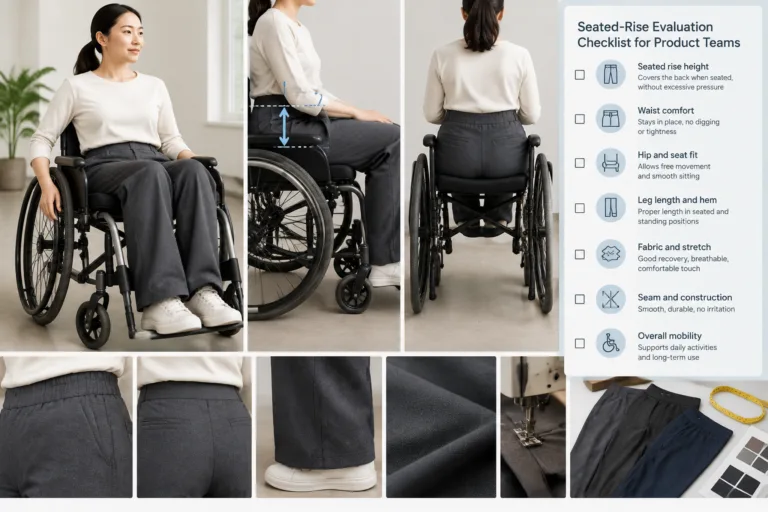
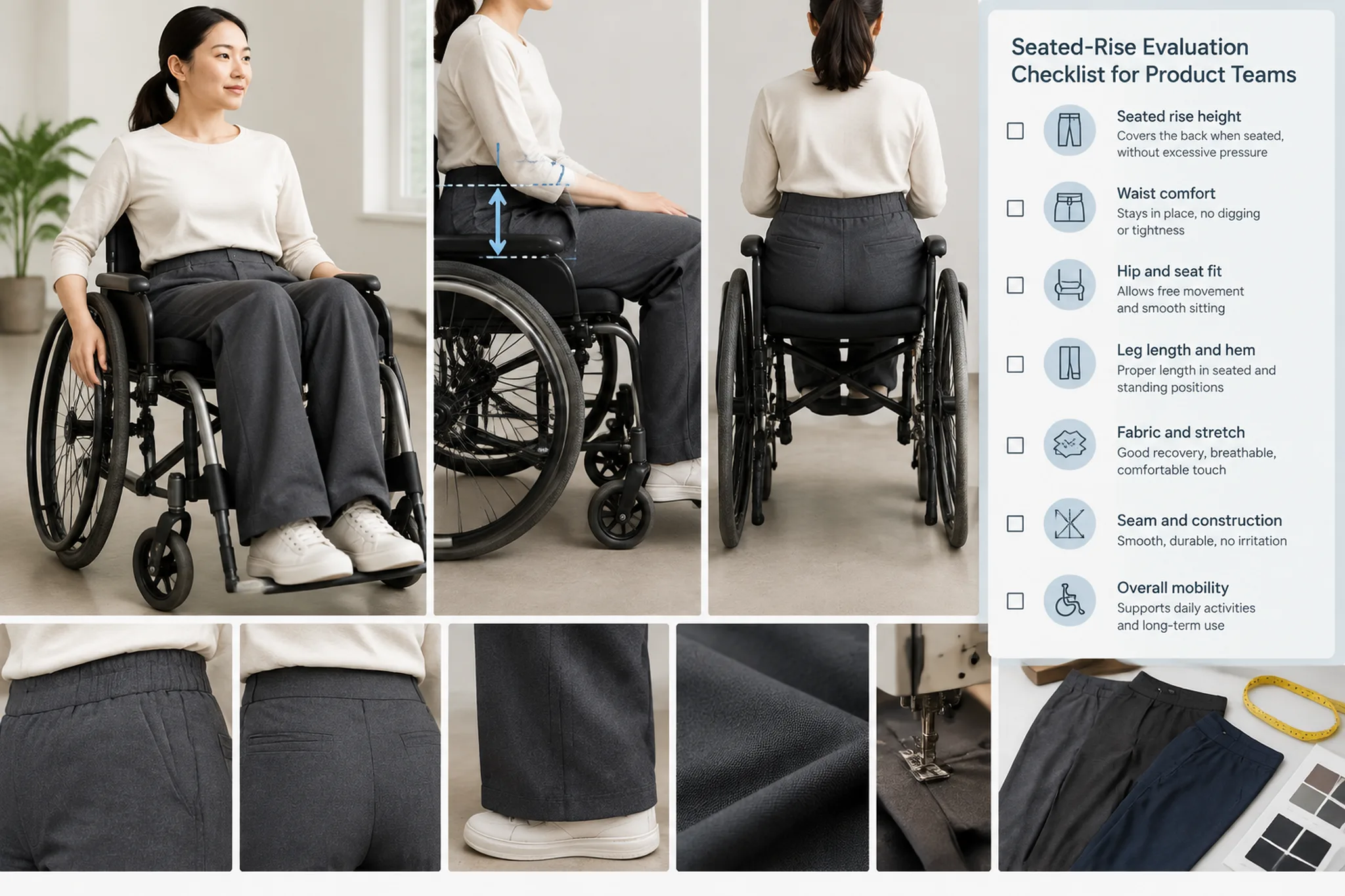
Seated-Rise Evaluation Checklist for Product Teams
A checklist helps a product team turn general impressions into findings that can be compared across samples and revisions. It should describe the intended wearer, seating context, dressing method, wear duration, and priority tasks before anyone decides whether a wheelchair trouser pattern fits well. These conditions are part of the evaluation, not background details.
- Coverage: Does the garment maintain the intended front and back coverage in the target seated posture and during the defined movements? Check whether the waistband migrates, the front pulls down, or the back becomes exposed when the wearer reaches or changes position.
- Comfort: Are the waistband, crotch, seat, and seams acceptable for the intended wear period? Record rubbing, bunching, seam bulk, instability, or local discomfort without turning one person’s preference into a universal requirement.
- Mobility: Does the seated rise allow the required movements without excessive pulling or garment displacement? Assess only the tasks relevant to the product brief, such as reaching, repositioning, self-propelling, or transferring.
- Access: Can the wearer or caregiver put on, remove, fasten, and adjust the garment using the intended method? A design may improve seated coverage while making dressing more difficult, so access should be reviewed separately.
- Compatibility: Does the garment work with the stated wheelchair, cushion, posture supports, footrests, footwear, and other clothing layers? A change that performs well in one seating setup may behave differently in another.
- Consistency: Are observations recorded by size, body shape, material, posture, task, and participant feedback? Separate what the reviewer sees from what the wearer reports, rather than reducing the result to a single pass-or-fail label.
- Validation: Have revisions been checked in the complete garment, using the intended materials and construction, with participants who represent the product’s intended user group?
Any numeric tolerance, acceptance threshold, or safety conclusion belongs in a defined product requirement supported by an appropriate method. A fit checklist can reveal missing assumptions, but it does not make a garment certified, clinically suitable, or compliant by itself.
How to Compare Seated-Rise Options Without Assuming a Universal Best Fit
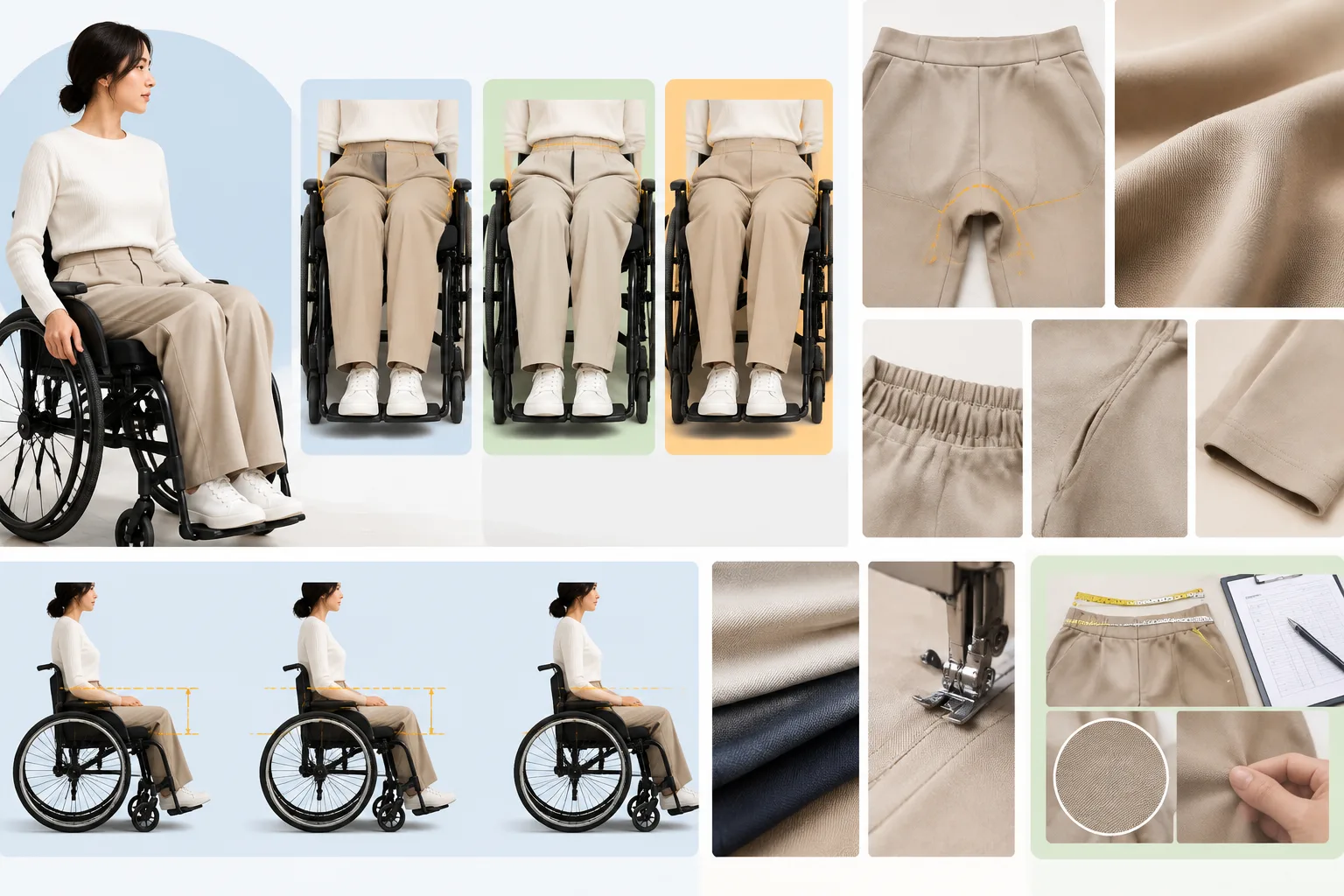
Comparing seated-rise options is most useful when every option is reviewed against the same users, tasks, sizes, materials, and seating conditions. A decision matrix can include seated coverage, movement freedom, waistband stability, dressing access, material behavior, appearance, and manufacturing complexity. The purpose is to make trade-offs visible, not to produce a universal ranking.
A higher back rise may improve coverage for one posture, while creating unwanted bulk or pressure for another. A shaped waistband may improve stability but change the way the garment opens or adjusts. A stretch panel may support movement, yet its recovery and interaction with the rest of the garment still need to be assessed. Side openings, modified closures, and other adaptive details should likewise be treated as design hypotheses to test.
Consider three hypothetical priorities. A wearer who remains seated for long periods may place greater emphasis on stable coverage and low seam bulk. A wearer who transfers frequently may prioritize movement, access, and resistance to garment displacement. A wearer focused on independent dressing may give greater weight to reachable fastenings and simple adjustment. These examples illustrate different evaluation priorities; they do not define categories of people or prescribe one construction.
Document which criteria are product requirements and which are design preferences. Review changes in the final garment because fabric stretch, recovery, lining, closures, reinforcement, and seam construction can alter the result of the pattern. Claims about durability, laundering, or closure performance also need evidence from relevant materials or garment testing rather than assumptions based on a feature name.
Limits of Seated-Rise Evaluation and Recommended Next Steps
A seated-rise review can identify garment-fit and usability findings, but it cannot by itself establish medical suitability, pressure-management performance, wheelchair compatibility, durability, or regulatory compliance. Different users may require different blocks, sizes, posture assumptions, or garment features. A label describing a user group does not determine an individual’s fit requirements.
After an initial review, create a development brief that records the intended users, seating and movement conditions, dressing method, materials, construction, evaluation observations, participant feedback, revisions, and unresolved risks. Plan additional checks for laundering, wear durability, closures, transfer conditions, and a wider range of body shapes or seating setups when those factors are relevant.
When the product brief touches clinical, ergonomic, accessibility, safety, or regulatory questions, involve appropriately qualified specialists and verify current requirements directly. Apparel Wiki is an independent clothing-industry knowledge publication, not a manufacturer, factory, laboratory, certifier, or clinical authority. The responsible next step is to use this garment-fit framework as a starting point for documented, project-specific validation.
Frequently Asked Questions
What does seated rise mean in wheelchair trousers?
Seated rise is the front-to-back rise relationship evaluated while the wearer is seated in the intended use posture. It considers waistband position, front and back coverage, crotch comfort, garment movement, and the relationship between the trousers and the seat or support system.
Why can standing trouser measurements fail when evaluating wheelchair trousers?
Standing measurements do not show how hip flexion, pelvis position, thigh angle, lumbar posture, and seating equipment affect the garment. Trousers that appear acceptable while standing may pull at the front, lose back coverage, bunch at the seat, or shift at the waistband when worn seated.
Should wheelchair trousers have a higher back rise?
Not automatically. A higher back rise may support coverage in one use context, but the result depends on posture, body shape, cushion, waistband design, material, movement, and dressing needs. It should be evaluated as one possible design response rather than a universal rule.
How can a product team test seated rise with real users?
Define the intended users, seating setup, garment materials, dressing method, wear period, and priority tasks first. Use representative samples, observe agreed movements, record garment behavior separately from participant comments, and repeat the same conditions after revisions. One session cannot establish universal fit.
Which parts of wheelchair trousers should be checked besides the rise?
Review the waistband, crotch curve, seat, upper thigh, seams, closures, leg shape, hem position, and any lining or reinforcement. Also check dressing access, compatibility with seating equipment, material recovery, and how the complete garment behaves during relevant movements.
Can one seated-rise pattern fit every wheelchair user?
No. Wheelchair users have varied postures, body shapes, transfer methods, support needs, movement patterns, and preferences. A useful pattern is linked to a defined product brief and validated with representative users, rather than assumed to suit everyone based on identity or garment category.