Mass balance accounting measurement is a method for tracking eligible material quantities through a defined operation or supply chain and assigning part of that balance to outputs. It does not prove that every molecule in a finished garment came from the claimed source. Instead, it connects documented inputs, processing movements, inventory, losses, and attributed outputs within a stated period and boundary. For broader apparel-production context, see the Sponsor page and its disclosure about editorial independence.
In textile supply chains, eligible and conventional materials may be physically processed together while their corresponding quantities are tracked through bookkeeping. Textile Exchange describes this basic mass balance model as an accounting of volume ratios as materials move through the supply chain. The meaning of a claim, however, depends on the applicable certification scheme, customer requirement, contract, or regulatory framework. Mass balance is an accounting method, not a blanket statement that a product is sustainable.
What Mass Balance Accounting Measures in Apparel Supply Chains
A mass balance system measures quantities rather than molecule-by-molecule identity. The organization defines which materials qualify as eligible inputs, records how those materials enter and move through the system, and assigns an attributed output according to a documented allocation rule. The claimed output must remain within the available eligible balance under the relevant accounting logic.
Several terms make the method easier to interpret:
- Eligible input: material that meets the basis for inclusion in the accounting system, such as a documented supplier status or material characteristic under the applicable claim framework.
- Attributed output: material or product quantity assigned an eligible claim through the accounting system. It is not automatically proof that the physical output contains the specific source material.
- Conversion or process loss: material that is consumed, discarded, rejected, or otherwise removed during a documented transformation. Its treatment must follow the chosen accounting basis.
- Stock: eligible material held at the beginning or end of an accounting period, including inventory carried under the applicable rules.
- Allocation: the documented decision that connects eligible input quantities to particular outputs.
- Accounting period: the defined time interval over which inputs, outputs, losses, transfers, and inventory are reconciled.
- Claim scope: the specific material, product, facility, market, and wording covered by the claim.
The distinction from other chain-of-custody approaches matters. Under physical segregation, eligible material is kept separate from non-eligible material through defined handling stages. Identity preservation aims to maintain the identity of a particular source or batch. Mass balance permits physical mixing within the approved system while maintaining a quantity-based record. A book-and-claim arrangement generally separates the purchase or retirement of an attribute from the physical flow of the product. Exact definitions and permitted claims vary, so these labels should be checked against the governing program rather than treated as interchangeable.
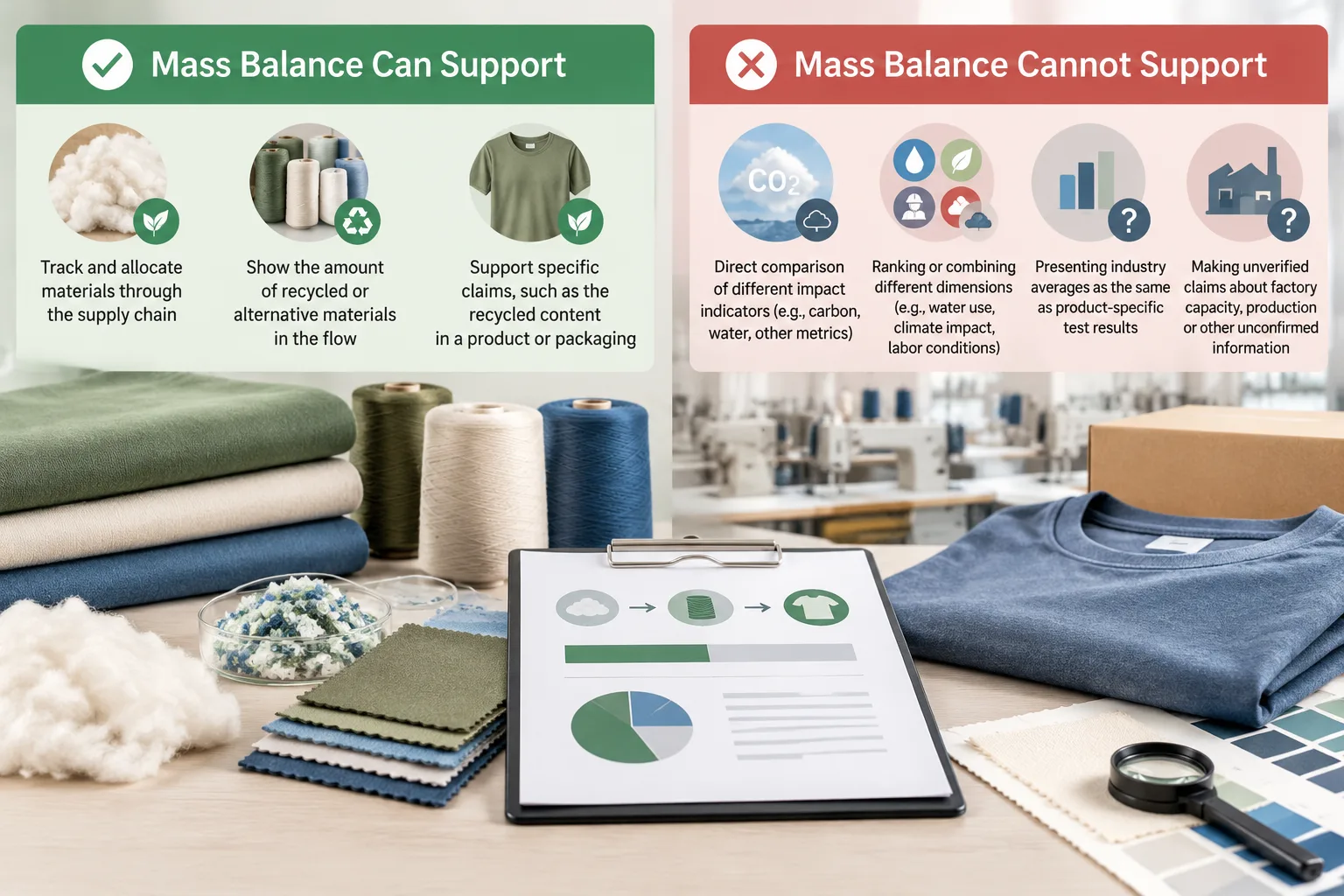
A mass balance record can support a controlled claim about material accounting within its defined system. By itself, it does not establish recycled content in every garment, lower carbon emissions, lower water use, safer chemistry, good labor conditions, or overall environmental performance. Those are separate questions requiring separate evidence.
Set the Boundary Before Measuring Any Material
Boundary definition is the first control decision in a mass balance material accounting system. Before collecting figures, write down the material being measured, its physical form, the facilities and legal entities included, the supply-chain stages covered, the accounting period, and the units used. A narrow boundary with reliable records is more useful than a broad boundary filled with unsupported assumptions.
State whether the boundary begins at purchase, goods receipt, or an earlier supplier transaction. Then specify whether it ends at processing output, intermediate stock, finished goods, shipment, or another defined event. Note how waste, rework, rejected material, returns, transfers, and closing inventory are treated. An omitted stage may prevent the reader or reviewer from understanding where a quantity changed or whether an output can legitimately be connected to an input.
Material form must remain explicit. Fiber, polymer, yarn, fabric, and garment quantities are not automatically interchangeable. A weight recorded at one stage cannot be compared directly with a count recorded at another stage without a documented conversion basis. The same principle applies to yield and process loss: any conversion factor should identify its source, assumptions, owner, and validation status.
Record the timing and coverage of the data as well. Useful boundary notes identify the geographic scope, supplier scope, production sites, data cutoff, estimated flows, excluded transactions, and treatment of material carried from an earlier period. Separate measured company records from supplier declarations, database averages, and modeled estimates. These sources may all be useful, but they do not have the same evidentiary status.
Build the Mass Balance Ledger From Inputs to Outputs
The ledger should let a sourcing, procurement, production, or quality team follow each material movement from source document to attributed output. Start with eligible incoming quantities and record the supplier, material description, transaction date, quantity, unit, supporting document, and reason the input qualifies. Keep ordinary and eligible material distinguishable in the records even when both are processed together.
At minimum, organize the accounting around opening stock, eligible additions, transfers, processing outputs, documented losses, rejected material, attributed outputs, and closing stock. The same unit and material basis should be used wherever possible. If conversion is necessary, show the original quantity, converted quantity, factor, and assumptions rather than hiding the calculation in a spreadsheet cell.
Link ledger entries to the records that make them reviewable. Depending on the operation and claim, this may include purchase orders, goods receipts, production records, inventory records, shipment documents, invoices, test reports, and supplier declarations. Assign a responsible owner to each material movement and record the source-document identifier. This creates a practical chain between the accounting record and the underlying transaction.
A recommended working format, rather than a universal external requirement, is a ledger with these fields:
- transaction or stock reference;
- date and accounting period;
- supplier, facility, or legal entity;
- material form and description;
- quantity, unit, and conversion basis;
- eligible or ordinary status;
- supporting document and data owner;
- processing movement, loss, transfer, or output status;
- exception note and approval status.
ISCC guidance describes mass balance bookkeeping through incoming materials, outgoing materials, and remaining inventory. Its guidance also illustrates the central control: an entity cannot claim more certified output than the eligible material it sourced under the relevant system. That principle should be applied only within the applicable scheme and its specific rules.
Allocate Eligible Inputs Without Exceeding the Available Balance
Allocation is the accounting decision that assigns eligible input quantities to outputs within the stated boundary and period. The organization should document the rule before issuing or communicating a claim, including the denominator and claim unit. For example, the basis might be mass of material or quantity of product, but the choice must be explicit and consistent with the applicable framework.
A simple hypothetical illustration can clarify the control. Suppose an accounting period begins with 100 kg of eligible stock, receives 500 kg of eligible input, records 50 kg of documented process loss, and attributes 400 kg to qualifying outputs. The remaining 150 kg must be explained through closing stock, transfers, or another documented treatment. This example is illustrative only; it does not establish a permitted loss rate or satisfy any particular certification scheme.
Allocation becomes more complex when the system includes mixed inputs, co-products, by-products, reprocessing, returns, or inventory carried into another period. These flows can change which quantities are available and how they may be assigned. The organization should prevent double counting, avoid unsupported carryover, and retain enough ledger detail for another reviewer to reproduce the allocation from the stated assumptions.
Document the Evidence Reviewers and Customers May Need
A mass balance ledger becomes useful when another person can follow each material movement from source record to attributed output. Organize the documentation by material purchase, supplier eligibility, inventory movement, production transformation, output shipment, claim issuance, and internal approval. This structure helps sourcing, production, quality, and sustainability teams work from the same accounting record.
Use transaction-level identifiers wherever possible. A purchase order, goods receipt, batch reference, production record, inventory entry, shipment document, or invoice can provide a link between an incoming quantity and the output to which it is allocated. The exact documents required depend on the governing scheme, customer request, contract, or market. A useful ledger should make those links visible without presenting an internal file as certification or legal compliance.
As a practical working checklist, record the scope statement, data owner, accounting period, material form, units, source records, conversion assumptions, allocation rule, reconciliation result, exceptions, and approval. Identify whether each figure is measured company data, verified supplier data, an estimate, or an unresolved gap. This distinction matters because a supplier declaration, database average, and production weighing do not carry the same level of direct evidence.
Corrections should remain visible. Record duplicate entries, late documents, amended quantities, missing data, returns, and unresolved discrepancies with a date, responsible owner, and explanation. Do not silently replace an uncertain value with a convenient estimate. Customer-requested evidence, internal controls, certification audits, and legal obligations are separate categories, so confirm the applicable requirements before describing a document package as complete. Textile Exchange provides a useful definition of mass balance, while scheme-specific guidance may use more detailed terminology.

Test the Ledger With Reconciliation and Exception Checks
Reconciliation tests whether the quantities recorded in the ledger are internally coherent. Compare opening eligible stock and eligible inputs with attributed outputs, documented losses, transfers, and closing stock, using the same material basis, units, and conversion logic established at the boundary stage. The purpose is to explain the balance, not to force every period to match through unsupported adjustments.
Review the records for duplicate invoices, missing goods receipts, inconsistent material descriptions, unexplained quantity changes, negative balances, and output claims that exceed available eligible input. Compare procurement and inventory records with production and shipment records. A mismatch may result from timing, a unit conversion, a return, a transfer, or an incorrect entry, but the reason should be investigated and recorded rather than hidden.
Each review should identify the review date, reviewer, exception status, corrective action, and treatment of unresolved information. Where estimates are necessary, state their source, timing, geographic relevance, and intended use. A documented estimate is easier to challenge and improve than an unexplained number. Scheme-specific guidance can add requirements for reconciliation, corrective action, or verification; there is no universal discrepancy threshold that applies to every mass balance system.
Reconciliation is an accounting control, not a complete sustainability assessment. A numerically consistent ledger does not independently establish material quality, fiber composition, environmental benefit, labor conditions, or compliance with every claim rule. The ISCC mass balance guidance illustrates the importance of recording incoming and outgoing quantities together with remaining inventory, but its rules should not be treated as universal requirements for every apparel claim.
Know What Mass Balance Can and Cannot Support
Mass balance can support a controlled accounting claim within a defined system, period, and material boundary. It may allow eligible and conventional materials to be physically processed together while their corresponding quantities are tracked in the books. It does not necessarily show that the claimed source material is physically present in every individual garment. That distinction should be clear in product records and customer communication.
Traceability and environmental performance are different evidence questions. A mass balance record does not by itself prove lower carbon emissions, lower water use, the absence of hazardous substances, or good labor conditions. Recycled content, renewable feedstock, chemical inputs, product composition, and environmental impact are separate claim subjects, each requiring evidence suited to the specific statement.
Environmental comparisons also need consistent assumptions. Comparing one kilogram of fiber with one garment used many times can answer different questions. Before ranking results, align the functional unit, system boundary, use and care assumptions, and end-of-life assumptions. A single accounting record should not be used to imply an overall “sustainable” product without addressing the other relevant dimensions.
The appropriate chain-of-custody approach depends on the claim and available controls. Physical segregation may be more suitable when the product claim requires separated material, while identity preservation may be needed when the source of a specific input must remain distinct. Mass balance can be appropriate where controlled quantity accounting is allowed, but the governing scheme, customer requirement, and target market must be checked before wording the claim.
Recommended next step: Define the exact claim first, then identify the governing scheme or market, map the material boundary, appoint a ledger owner, collect source records, document allocation and exceptions, reconcile the period, and obtain appropriate external review. The Apparel Manufacturing Tools collection can help organize related production and documentation work, but it does not replace scheme-specific verification.
Frequently Asked Questions
Does mass balance accounting prove that every garment contains the claimed material?
No. It tracks eligible quantities within a defined system and period. Unless the applicable approach requires physical segregation or another stronger control, it does not prove that every molecule or fiber in each garment came from the claimed source.
What information should be included in a mass balance ledger?
Include the boundary, period, material form, units, supplier and transaction details, opening and closing stock, inputs, outputs, transfers, losses, allocation rule, source documents, assumptions, exceptions, reconciliation, and approval.
How are eligible inputs allocated to attributed outputs?
An organization applies a documented allocation rule within the stated boundary and period. Attributed output must remain consistent with eligible input after considering stock, transfers, losses, conversion logic, and any applicable scheme requirements.
What is the difference between mass balance and physical segregation?
Physical segregation keeps eligible material separated through relevant operations. Mass balance may permit physical mixing while tracking eligible quantities through bookkeeping. The permitted claim wording depends on the applicable system and requirement.
Can a mass balance record prove that a product has lower environmental impact?
No. Mass balance documents a quantity and chain-of-custody relationship. Environmental impact requires separate evidence and a comparable assessment with a defined functional unit, boundary, and relevant use and end-of-life assumptions.
How should missing data, losses, returns, or closing inventory be documented?
Record each item in the ledger with its quantity, date, basis, source or estimate, responsible owner, and treatment in the reconciliation. Keep corrections and unresolved discrepancies visible instead of adjusting them without explanation.