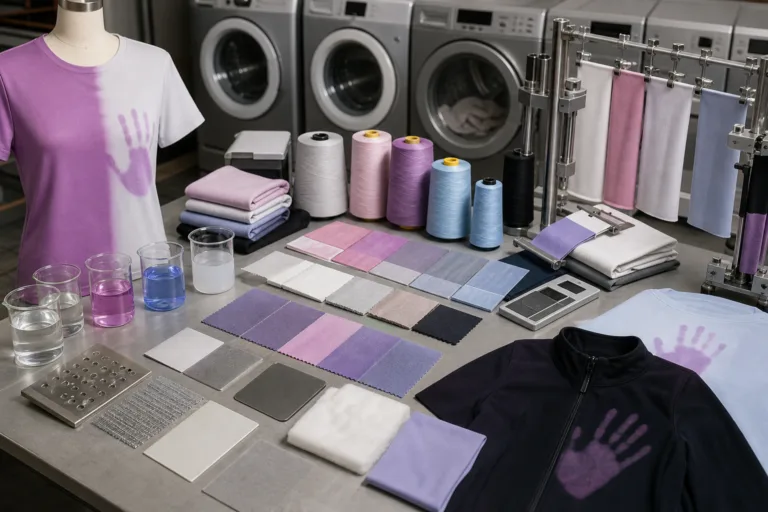
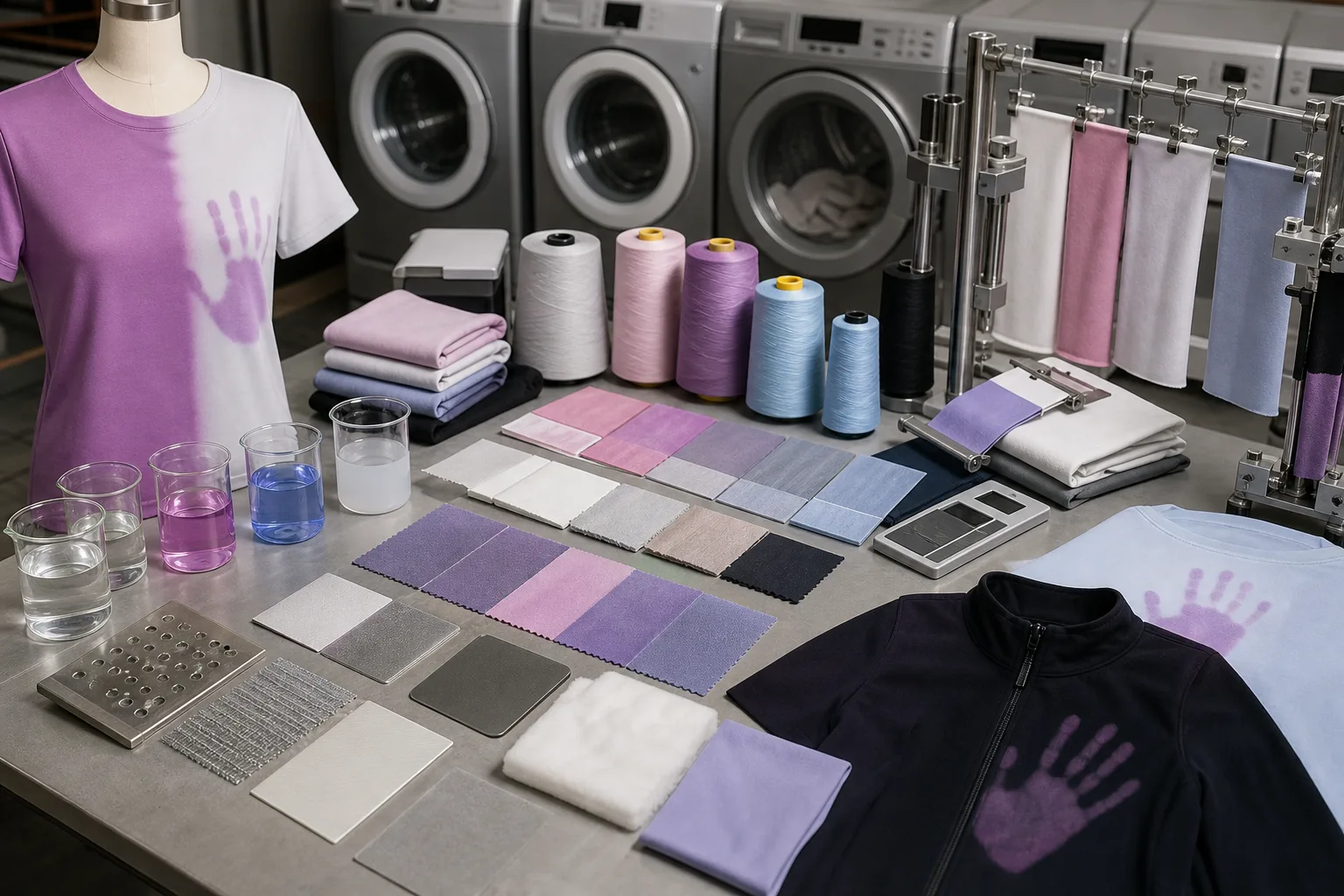
Thermochromic textile durability means retaining a usable, repeatable temperature-related color change while the surrounding fabric, print, coating, and finished garment remain fit for their intended use. A thermochromic textile contains or uses a material that changes appearance as temperature changes; some systems move back toward their original appearance when conditions return, while others may involve a less reversible change. In clothing development, durability therefore includes more than physical survival. It includes color-change response, switching appearance, reversibility, activation behavior, and acceptable visual quality after expected care and wear.
This guide treats thermochromic textiles as a product-development question, not as a guaranteed sensing or safety solution. Apparel Wiki is an independent educational publication; its Sponsor information does not turn editorial discussion into a supplier, laboratory, or manufacturing service. The practical question is whether a defined material-and-garment construction can retain its intended behavior under defined conditions.
What Does Thermochromic Textile Durability Mean?
A useful working definition separates several durability layers. The thermochromic formulation must continue to respond as intended. The application must remain attached and visually coherent. The base fiber, yarn, fabric structure, seams, and garment components must tolerate the same use and care environment. A failure in any one layer can change the user experience, even when the other layers remain intact.
For example, a fabric may retain its original strength while its thermochromic print becomes faint, uneven, slow to switch, or unable to recover its earlier appearance. Conversely, the color-changing layer may still respond in a small swatch while the garment develops distortion, cracking, seam stress, or surface damage. These are different observations and should be recorded separately during thermochromic textile durability testing.
Durability also depends on the formulation, application method, substrate, garment design, and intended care conditions. A short laboratory response confirms that the material can show a current temperature-related behavior under those conditions. It does not, by itself, establish reliable long-term clothing performance. Nor does visible color change prove accurate temperature measurement, protective performance, or suitability for a medical or safety-related claim.
How Thermochromic Materials Are Applied to Clothing
The material identity should be described in layers: fiber content, yarn, fabric structure, and finish or coating. Thermochromic behavior may be introduced through a pigment-containing print or coating, an embedded or laminated construction, or another textile-compatible system documented for the particular product. These pathways are development choices, not interchangeable categories. A thermochromic pigment textile coating should not be assumed to have the same durability profile as a system integrated throughout the textile.
In a printed or coated construction, the thermochromic layer supplies the color response, while a binder or carrier helps hold the material on the surface. The fabric substrate provides the underlying structure, and any protective finish may affect handling, appearance, moisture exposure, or resistance to wear. Curing or fixation conditions can also influence the final result. The garment then adds seams, panels, closures, embroidery, and areas that bend or stretch differently from a flat fabric specimen.
Fiber content and fabric structure affect how the applied layer looks and behaves, but neither one determines the result alone. A woven or knitted substrate, for example, can differ in stretch, surface texture, movement, and moisture behavior depending on its yarns, construction, weight, and finish. Coverage and application uniformity matter as well: thin, uneven, or poorly bonded areas may switch differently from heavily covered regions or may reveal damage sooner.
The intended activation range and switching direction must be project requirements supported by the selected material documentation. They are not universal textile specifications. Before testing, teams should identify the expected temperature conditions, whether the visual change should occur during warming or cooling, the acceptable appearance, and the care pathway for the proposed garment.
Which Exposure Conditions Create the Main Durability Challenges?
Each exposure should be connected to a possible failure mode. Repeated laundering, water, detergent, perspiration, and body heat can affect the thermochromic layer, the binder, the substrate, or the contrast between them. Washing may reveal loss of coverage, transfer, peeling, altered switching, or damage to the base fabric. Perspiration and moisture can produce a different chemical and physical environment from ordinary water exposure, so they should not automatically be treated as equivalent.
Friction and abrasion may reduce surface coverage or make a printed area look patchy. Bending, stretching, and compression can stress a coating or laminate, producing cracking, delamination, distortion, or uneven switching. These effects may be more visible at elbows, knees, cuffs, seams, and other high-movement locations than in a flat swatch. A garment’s close-to-skin placement can also combine heat, moisture, pressure, and repeated movement.
Light and heat exposure may alter appearance or response for some formulations, but the effect must be evaluated for the actual material and intended market. The relevant question is not whether every thermochromic garment needs an identical exposure sequence. It is whether the planned sequence represents the product’s likely use, care instructions, storage, and risk profile. Laboratory exposure is a controlled model; it cannot reproduce every combination encountered in daily wear.
Inspectors should distinguish visible fading from functional degradation. A surface may look lighter while still switching, or it may retain its apparent color while switching slowly, incompletely, or at a changed activation condition. If the garment also includes conductive paths, sensors, connectors, power, or data services, material failure must be assessed separately from electronic or system failure. A textile layer that looks intact does not establish that the complete smart garment still operates correctly.
How Should Thermochromic Textile Durability Be Tested?
Begin by defining the intended garment use, proposed care assumptions, temperature-response requirement, relevant exposures, inspection points, and project-specific acceptance criteria. Do not treat an example criterion as an industry-wide pass-or-fail rule. The test plan should state what counts as retained color change, unacceptable appearance, incomplete recovery, physical damage, or another meaningful failure for that product.
Record the baseline condition before exposure. At minimum, document the specimen identity and construction, general appearance, color-change behavior, response consistency, dimensions, stretch, surface defects, and any relevant system output. Retain untreated control specimens so that exposed samples can be compared with material from the same development set rather than with memory or an unrelated commercial sample.
Use staged exposures that match the project risk. Depending on the garment, these may include care, moisture or perspiration, rubbing or abrasion, flexing or stretching, heat, and light. After each stage, inspect the exposed and control specimens under consistent observation conditions. Record both visual change and functional response, including whether the effect is reversible. Critical exposures may warrant repetition when the intended use or consequence of failure justifies it.
- Baseline: identify the material, application, garment location, and starting appearance.
- Exposure: document the selected care, moisture, mechanical, thermal, or light condition.
- Evaluation: compare appearance, switching behavior, recovery, dimensions, and surface integrity.
- Failure record: note the mode, severity, location, reversibility, and unresolved uncertainty.
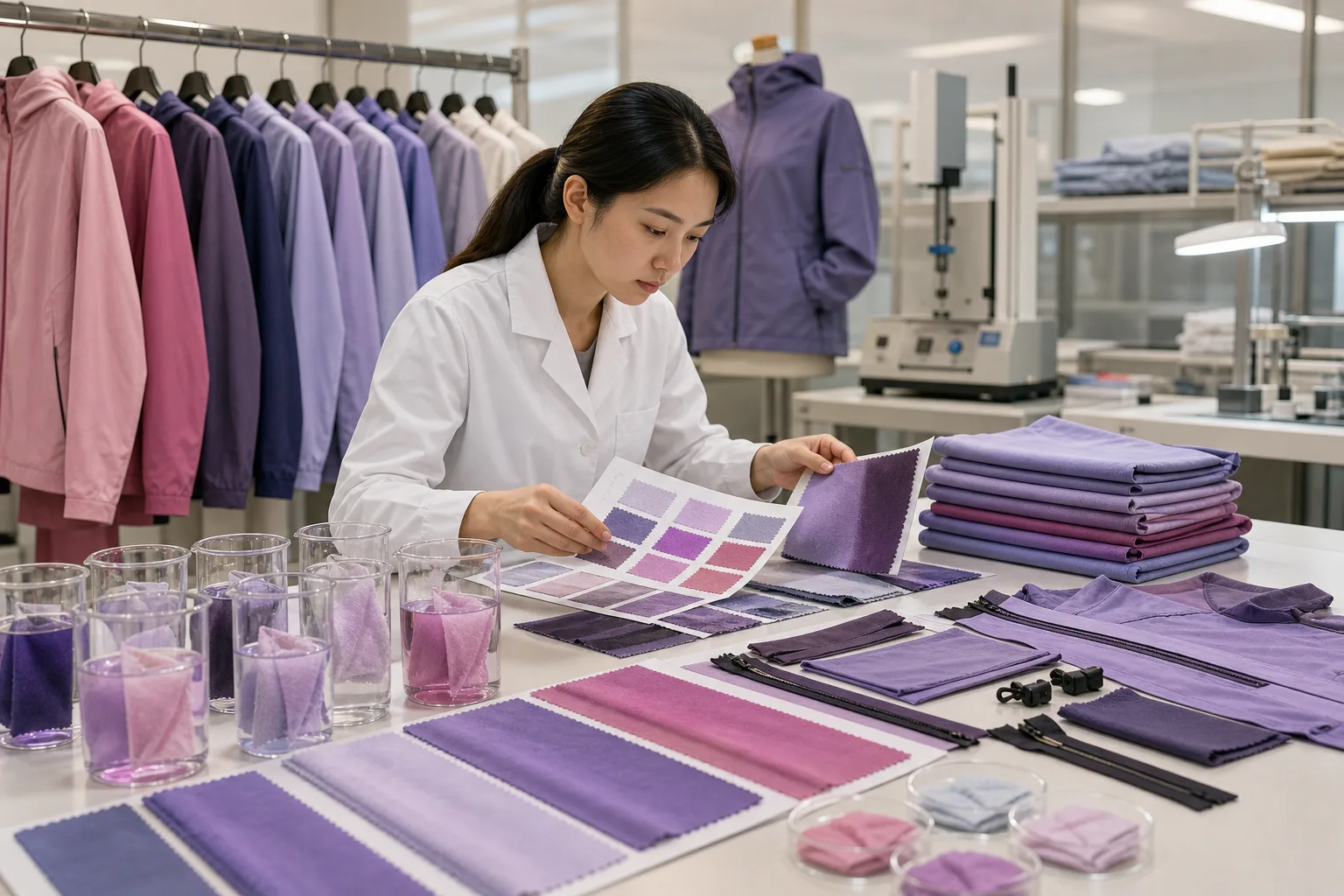
Test both material swatches and representative garment constructions when seams, curved panels, embroidery, closures, stretch zones, or body placement may influence performance. A swatch is useful for controlled comparison, but the finished garment reveals interfaces and stresses that a flat specimen may not capture. The resulting report should connect every observation to the tested construction and exposure sequence, keeping the conclusion specific to that configuration.
Which Variables Can Change the Test Result?
A durability result belongs to a defined material-and-test configuration, not to a commercial product name alone. Two fabrics described as thermochromic may use different formulations, layer structures, binders, curing or fixation processes, protective finishes, and application thicknesses. Distribution of the color-changing material also matters: uneven coverage can produce inconsistent switching before any laundering or wear exposure occurs.
The base textile introduces another group of variables. Fiber content, yarn arrangement, knit or woven structure, fabric weight, stretch, surface texture, color contrast, and moisture behavior can influence both physical damage and what an observer sees. Structure provides useful clues, but it does not independently determine durability. A comparison should therefore identify the fiber, construction, finish, and thermochromic application rather than relying on a broad fabric label.
Activation conditions must be controlled or recorded carefully. Heating or cooling rate, contact method, ambient conditions, observation angle, lighting, and the time allowed for recovery can all affect the apparent result. An observer may report a different visual impression from an instrument, while an instrument reading may not capture an uneven or localized effect that matters to a wearer. The method should state how the response was produced and how it was judged.
Garment placement can change the exposure profile as well. Elbows, knees, cuffs, seams, curved panels, close-to-skin areas, and high-friction zones may experience different combinations of bending, pressure, perspiration, heat, and rubbing. A flat swatch may be appropriate for early comparison, but it cannot automatically represent every interface in a finished garment.
- Material variables: formulation, layer distribution, binder, fixation, finish, thickness, and substrate.
- Use variables: body location, movement, moisture, temperature, friction, and expected care.
- Test variables: conditioning, exposure sequence, controls, activation method, and recovery time.
- Reporting variables: observation method, failure classification, sample identity, and acceptance rationale.
Samples should be compared only when their materials, construction, exposure history, measurement or observation method, and acceptance criteria are sufficiently aligned. Without that alignment, a difference between results may reflect the test design rather than a meaningful difference in thermochromic fabric performance.
How Can Product Teams Evaluate Results Before Making Claims?
After testing, product teams should classify what changed instead of reducing the outcome to “passed” or “failed.” Useful categories include retained color change, reduced intensity, incomplete recovery, visible fading, delayed switching, cracking or peeling, dimensional change, staining or transfer, and complete loss of the intended response. The location of each change is important because a small defect in a decorative area may have a different consequence from failure across a required design panel.
Review appearance and intended function separately. A fabric may still change color while looking less even, or it may retain an attractive appearance while switching incompletely. For ordinary fashion use, the visual effect may be the main product purpose. For a design that presents the color change as an indicator, however, the team must define what the effect is intended to communicate and avoid treating visual response as proof of accurate measurement, safety, or medical performance.
The tested care pathway should match the proposed garment. Check whether the exposure reflects the care instruction, retail market, garment category, expected frequency of use, and likely body placement. Results from a short swatch exposure should be described as evidence about that swatch and exposure sequence. They should not be expanded into a general lifetime statement without additional support.
A pre-approval record can keep decisions traceable. Record the sample identity, fiber and construction, thermochromic application, garment location, exposure conditions, controls, inspection method, observed change, severity, reversibility, acceptance rationale, and unresolved risks. Supplier information and laboratory reports can inform the review, but critical claims should be checked on the final fabric or representative garment construction.
Use conditional wording when evidence is limited. Phrases such as “retained the observed color response under the tested conditions” are more precise than “permanent” or “washproof” unless those stronger claims are supported by appropriate evidence and applicable requirements. Apparel Wiki is an independent educational publication, so this framework supports development decisions; it does not replace a qualified laboratory, compliance review, or the product team’s own technical documentation.
What Durability Testing Cannot Prove
A single wash, abrasion, light, or temperature exposure cannot establish full intended-use lifetime unless its relevance and correlation have been demonstrated. Laboratory conditions model selected risks; they do not reproduce every combination of consumer care, body movement, storage, climate, production variation, and repeated exposure. Even repeated testing remains specific to the chosen material, construction, and method.
Swatch results may not predict behavior at seams, curved panels, stretch zones, layered areas, closures, embroidery, or other finished-garment interfaces. Scale-up can also introduce differences in application uniformity, curing or fixation, print quality, batch consistency, and inspection control. These are reasons to test representative production-intent samples when the garment design makes them relevant.
Retention of a color effect does not prove accurate temperature measurement, user safety, care-label compliance, or suitability for medical, protective, electronic, or data-related claims. Those conclusions require separate evidence and, where applicable, specialist assessment for the intended market and product type. Material durability should also be distinguished from failure of conductive paths, connectors, power sources, sensors, or software in a smart garment.
The responsible next step is to align the proposed claim with the tested construction, exposure sequence, production sample, care instruction, and market-specific review. Document what the evidence supports, what remains uncertain, and which additional exposure or garment-level check would reduce the uncertainty. This produces a narrower but more defensible durability statement.
What is thermochromic textile durability testing?
It is the evaluation of whether a thermochromic textile retains acceptable physical condition and temperature-related visual response after selected care, wear, environmental, or mechanical exposures. The exact procedure depends on the material, garment, intended use, and claim.
Why can a thermochromic fabric lose its color-changing effect?
The formulation or applied layer may be affected by laundering, chemicals, perspiration, light, heat, friction, bending, stretching, cracking, peeling, or uneven application. The base textile can also change how the response appears.
Which washing and wear conditions should be included in a thermochromic textile test plan?
Include conditions that represent the proposed care and use, such as laundering, moisture or perspiration, rubbing, abrasion, flexing, stretching, heat, and light when relevant. Do not assume every project needs the same sequence or severity.
Should thermochromic textiles be tested as fabric swatches or finished garments?
Use swatches for controlled material comparisons and finished garments when placement, seams, curvature, stretch, closures, or body contact may affect performance. Testing both is appropriate when the construction creates risks that a flat swatch cannot show.
How can teams distinguish color fading from loss of thermochromic response?
Inspect appearance and switching behavior as separate observations under consistent conditions. Record color intensity, coverage, activation, recovery, timing, uniformity, and surface damage rather than treating every visual change as the same failure.
Can one durability test prove that a thermochromic garment will last for its full intended use?
No. A test supports a conclusion about its defined specimen and exposure conditions. Broader durability claims require evidence that the test is relevant to the intended care, use, garment construction, production consistency, and market claim.