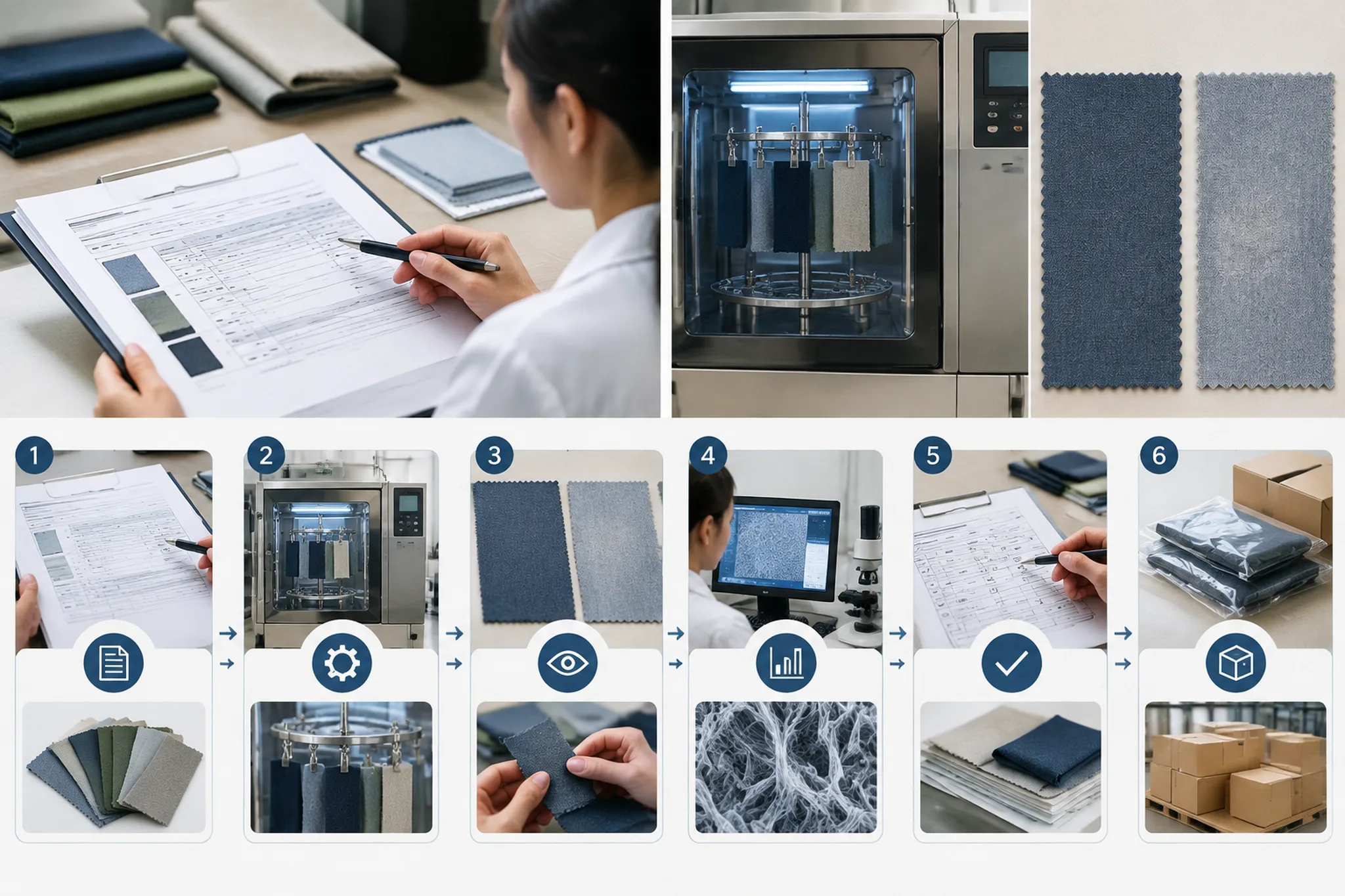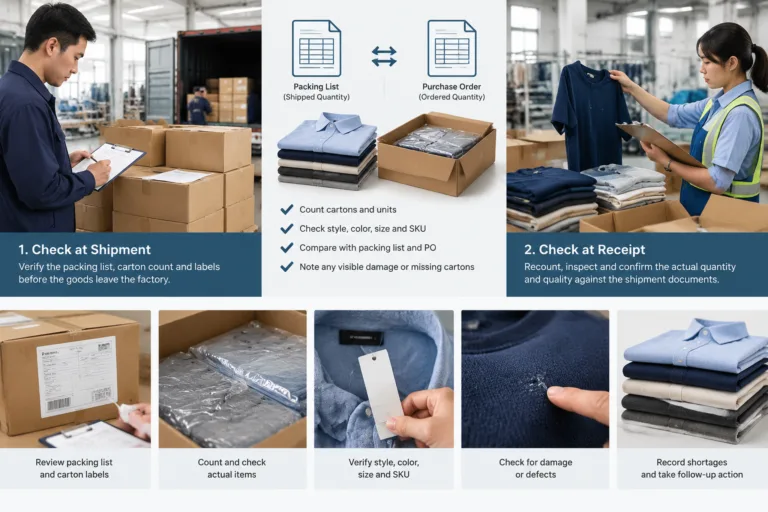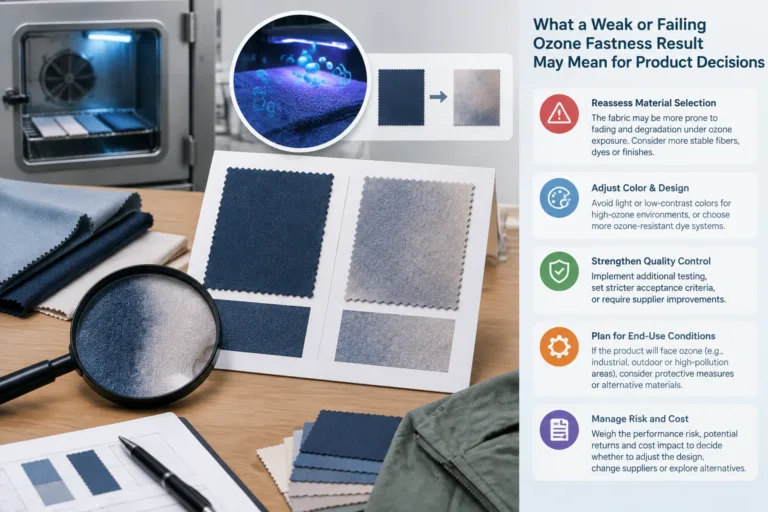
An ozone fastness testing report records how a specific submitted textile or garment sample responded to ozone exposure under identified test conditions. Ozone fastness describes resistance to color change or another reported appearance change caused by that specified exposure. To interpret the report, confirm what was tested, confirm how it was tested, identify the result, and compare it with the correct product or customer requirement. This practical guidance is independent editorial content; Apparel Wiki is not a testing laboratory, manufacturer, or certification body. Its Sponsor information does not change that editorial role.
What an Ozone Fastness Testing Report Actually Tells You
The report is evidence about a defined specimen, not a universal statement about an entire collection. It may identify a fabric, yarn, printed panel, finished garment, or another submitted item and describe the result produced by the cited ozone fastness method. The report’s facts include the sample description, method, conditions, observations, rating, and any laboratory conclusion. Those facts should remain separate from assumptions about other products or production lots.
A test result and a pass requirement are related but different. The result is what the laboratory observed or calculated using the stated method. The requirement is the outcome that a buyer, brand, product brief, internal quality standard, contract, or other applicable document says is acceptable. The existence of a test method does not create one shared acceptance threshold for every textile product, color, end use, or project.
For that reason, a favorable-looking ozone fastness test result does not automatically mean that the garment passes. The reader must first establish whether the reported method and rating scale match the requirement being applied. The report also normally covers the identified sample only. It does not automatically extend to every color, size, fiber blend, finish, batch, or future production lot.
A useful reading sequence is:
- Confirm the item, material, colorway, lot, and production stage that were tested.
- Confirm the cited method, revision, preparation, exposure conditions, and evaluation approach.
- Identify exactly what the result means, including its unit, rating scale, direction of preference, and notes.
- Locate the governing requirement and compare it with the result without filling gaps through assumption.
How to Identify the Sample, Method, and Exposure Conditions
Start with the report identity and sample traceability. Check the report number, issue date, client, sample description, material or garment identification, colorway, construction, and any batch or lot reference. Where provided, verify the sample submission date, laboratory receipt information, and the production stage. A report that cannot be confidently matched to the item under review is weak evidence for a sourcing, development, or inspection decision.
Next, look for preparation details. The report may state whether the specimen was tested as received or after laundering, finishing, conditioning, or another preparation step. Do not assume that an unmentioned treatment occurred, or that a test on fabric represents a finished garment. If the report is silent about a detail that matters to the decision, record it as an open question for the laboratory or the party that submitted the sample.
Locate the method name and its edition or revision, then review the listed exposure conditions and evaluation procedure. Also note the result unit or rating scale. Method version, specimen direction, conditioning, equipment, and evaluation conditions can affect whether two results are meaningfully comparable. These details are not merely administrative: they define the context in which the reported appearance change was assessed.
Use the original report together with any test request or sample submission record when available. If the method abbreviation, rating scale, or conclusion is unfamiliar, consult the authoritative method text or ask the laboratory for clarification. Apparel Wiki can explain how to read the evidence, but it should not reproduce a complete operating procedure without reviewing the applicable method. Laboratory competence or scope documentation may also matter when a buyer requires that verification.
How to Read the Result, Rating Scale, and Requirement Together
First determine the form of the reported outcome. It may be a numerical value, a visual rating, a descriptive observation, or an explicit pass/fail conclusion. Then check the scale, unit, direction of preference, and any footnotes. A number cannot be interpreted responsibly until the reader knows whether a larger or smaller value is considered more favorable and what the method says that value represents.
After identifying the result, find the requirement’s source. It may be a customer specification, internal quality standard, product brief, contract, or applicable regulatory document. Confirm that the requirement refers to the same test method or an accepted equivalent and that its wording is clear. If the report gives a result but the applicable threshold is supplied separately, the interpretation should remain conditional until both documents are reviewed together.
| Report result | Requirement source | Required threshold or wording | Comparison outcome | Unresolved questions |
|---|---|---|---|---|
| Recorded value, rating, observation, or conclusion | Specification, brief, contract, or other governing document | Required rating, range, or pass wording | Meets, does not meet, or cannot yet be determined | Missing method, scale, sample identity, or requirement detail |
This comparison keeps the method-defined result separate from the buyer-defined acceptance decision. If the report does not state a requirement, do not infer compliance from a favorable-looking result. If the requirement uses an unfamiliar abbreviation or scale, obtain a validated explanation from the laboratory or the document owner before treating the result as a pass or fail.
When Two Ozone Fastness Reports Can and Cannot Be Compared
Before comparing two ozone fastness reports, compare the samples. Check the material or fiber description, color, construction, finish, garment or fabric status, production stage, and batch. A difference may reflect the samples themselves rather than a meaningful difference in laboratory performance. A development comparison can be useful when the project deliberately controls these variables, but it should not automatically become a compliance decision.
Then compare the test contexts. Verify the method and edition, exposure conditions, pre-treatment, conditioning, specimen direction, equipment, and evaluation approach. The reports may use different rating systems or methods, even when their headings appear similar. Numbers from incompatible systems should not be ranked simply because one displayed number is larger than the other.
- Are the two reports linked to comparable samples and production stages?
- Do the method names, revisions, preparation steps, and exposure conditions match closely enough for the intended comparison?
- Are the result units, rating scales, and evaluation language equivalent?
- Could conditioning, equipment, specimen direction, or evaluator practice affect the apparent difference?
- Is the comparison for material development, supplier review, or a fixed acceptance requirement?
If important details are missing, describe the reports as not yet comparable rather than ranking one laboratory as better or worse. Differences in preparation or evaluation may explain different results, but they do not prove a specific cause. Use the original reports and applicable method guidance, and seek laboratory or qualified technical clarification when the comparison affects approval or rejection.
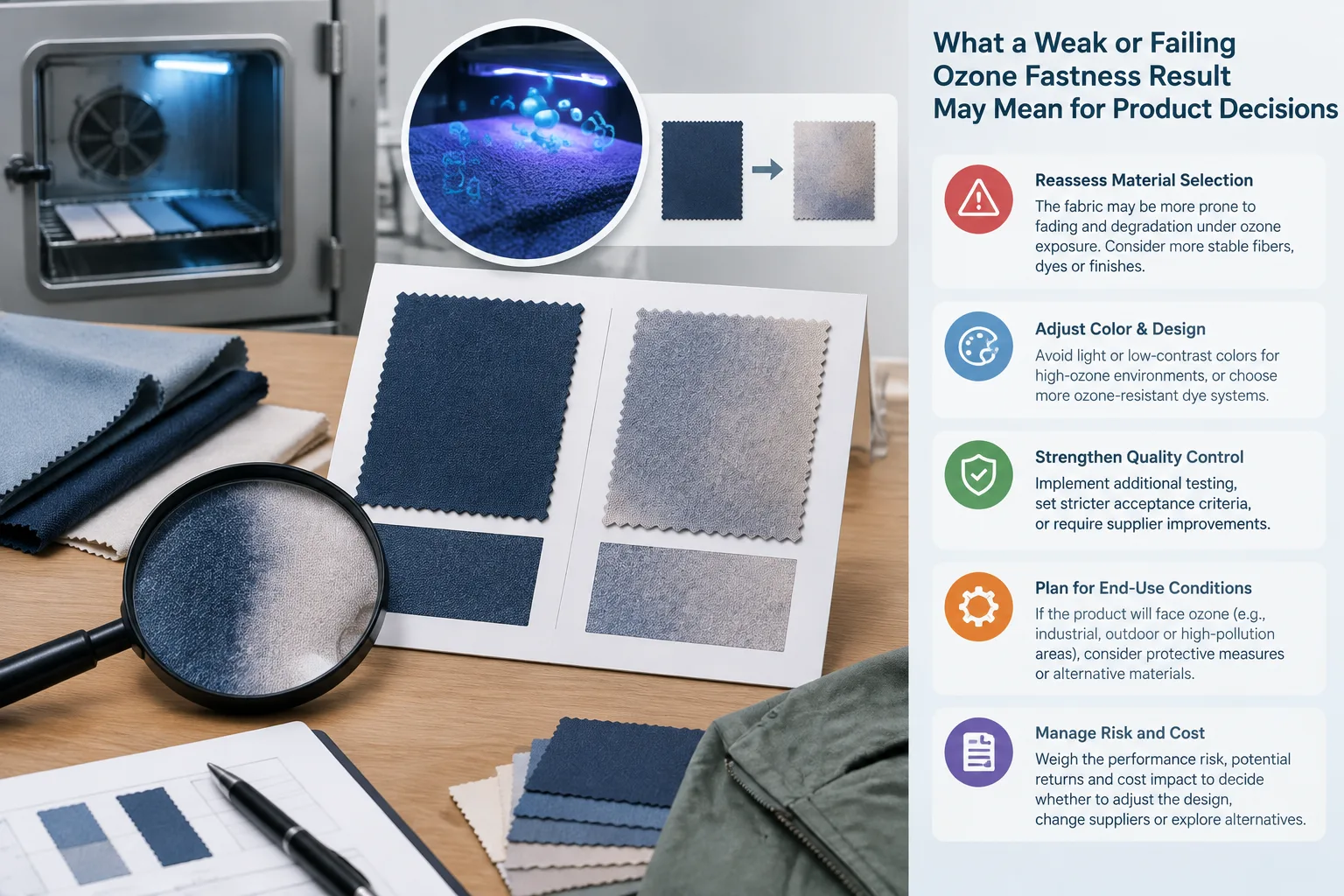
What a Weak or Failing Ozone Fastness Result May Mean for Product Decisions
A weak or failing ozone fastness result records an observed change under the stated test conditions. It does not, by itself, identify why the change occurred. The report may show a color or appearance outcome, while the underlying reason could require review of the material, colorant system, finishing history, preparation, or production conditions. Treat these as investigation paths rather than as a diagnosis.
First check whether the specimen represents the product decision under consideration. Confirm the material, colorway, construction, finished state, production stage, and batch or lot reference. A development swatch, retained fabric sample, finished garment, and production lot may answer different questions. The closer the sample is to the intended product and use, the more directly the result may inform that decision, subject to the applicable requirement.
Useful follow-up can include reviewing dyeing and finishing records, checking retained samples, comparing an approved lot with the affected lot, and repeating the test under the approved method when the original evidence is incomplete or disputed. These actions should be controlled and documented. A corrective action should follow evidence from the material and process review, not an assumption that one named chemical, finish, or supplier caused the result.
Escalate the question when the result affects approval, rejection, or a significant product claim. The appropriate contact may be the laboratory that issued the report, a qualified laboratory, a dyeing or finishing specialist, a chemical supplier, or a quality engineer. Apparel Wiki can explain the review logic, but it is an independent educational publication and does not diagnose failures or provide laboratory, manufacturing, or certification services. A test result below a buyer requirement may be a product-quality issue; it is not automatically a legal or regulatory finding.
What the Report Does Not Prove About the Whole Product
An ozone fastness report generally applies to the received sample and the listed test item. It should not automatically be extended to every color, size, fiber blend, trim, print, coating, garment panel, later production lot, or changed finish. Even closely related colors can differ in material composition or processing history, so a result for one colorway is evidence for that defined sample unless the governing specification or technical program supports a broader conclusion.
Material-level evidence and garment-level evidence also need to be separated. A fabric test may help answer a fabric performance question, but it may not answer a question about a complete garment containing seams, closures, panels, prints, coatings, or several materials. The relevant claim determines whether the specimen is representative. One ozone exposure test also does not replace other evaluations that may be relevant to colorfastness, appearance, care, durability, or the intended end use.
Use a simple three-part decision framework:
- Evidence supports the claim: the sample, method, result, and requirement align with the limited claim being reviewed.
- Evidence supports only a limited claim: the report is useful for the listed specimen, color, lot, or test item, but does not justify a broader product statement.
- Further evidence is needed: the sample identity, method, requirement, or production relevance is unclear, or the proposed claim extends beyond what was tested.
This distinction matters in internal approvals and public product language. “The submitted sample produced the reported result under the cited method” is narrower and more defensible than presenting the report as proof that an entire collection or future production will perform identically.
A Practical Workflow for Reviewing an Ozone Fastness Report
Use the following ozone fastness report review checklist when examining a document during development, sourcing, inspection, or supplier-document review:
- Match the document. Confirm the report number, style or product reference, material, colorway, lot, and production stage. Check that the report belongs to the sample being discussed.
- Record the test context. Note the cited method and revision, sample preparation, exposure conditions, conditioning information, evaluation approach, result unit or rating scale, and any laboratory conclusion.
- Locate the requirement. Identify whether the acceptance wording comes from a customer specification, internal quality standard, product brief, contract, or another applicable document. Do not assume that the method itself supplies a universal pass threshold.
- Compare like with like. Check whether the requirement uses the same method, result scale, and interpretation language. If the method or scale differs, ask whether the comparison is technically valid before ranking the outcomes.
- Test the claim boundary. Decide whether the specimen supports a material, color, lot, garment, or broader product claim. Record what remains untested rather than silently extending the result.
- Document open questions. List missing fields, inconsistent sample descriptions, unclear abbreviations, unusual conclusions, and discrepancies between the report and the specification. Send those questions to the laboratory or responsible supplier.
- Choose the next action. Accept the evidence for its limited purpose, request clarification, review related production records, or commission additional testing under the applicable method.
Keep the completed review with the report and associated sample records so another reviewer can trace the decision. Where an unresolved discrepancy could affect approval or a product claim, consult the authoritative method, the applicable specification, the issuing laboratory, or a qualified quality professional before reaching a conclusion.
The most useful next step is to review one real report line by line using this sequence: sample identity, method, conditions, result, requirement, scope, and open questions. That approach keeps direct report facts separate from interpretation and makes it easier to decide whether clarification or additional evidence is justified.
What is ozone fastness testing?
Ozone fastness testing evaluates how a defined textile or garment specimen responds to the specified ozone exposure and evaluation procedure, commonly in relation to color or appearance change. The exact result meaning depends on the cited method and its rating or reporting system.
Does an ozone fastness test report automatically mean the garment passes?
No. A report records a result for a defined sample under defined conditions. Passing depends on the applicable product, customer, or internal requirement, including its method and acceptance wording. The report alone does not establish a universal pass threshold.
Which parts of an ozone fastness report should I check first?
Start with the sample identity, colorway, lot or batch reference, test item, method and revision, exposure conditions, preparation, result scale, and stated conclusion. Then compare those details with the requirement that governs the product decision.
Can I compare ozone fastness results from two different laboratories?
Only when the samples, methods, revisions, exposure conditions, preparation, conditioning, equipment, and evaluation approach are sufficiently comparable for the intended purpose. Different rating systems or methods should not be ranked by number alone.
Does a report for one fabric color apply to all colors in the collection?
Usually not automatically. The report generally covers the identified sample and tested color. Other colors, materials, finishes, lots, or garments may require separate evidence depending on the product specification and the claim being considered.
What should I do if the ozone fastness result is below the required level?
Confirm the requirement, sample identity, method, and report details first. Then review relevant material and production records, seek clarification from the laboratory or supplier, and consider controlled follow-up testing. Do not assume the report alone proves a particular failure cause.