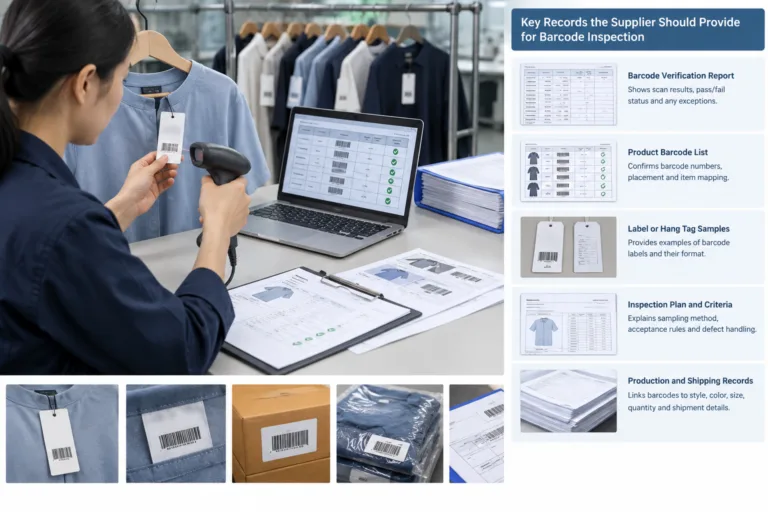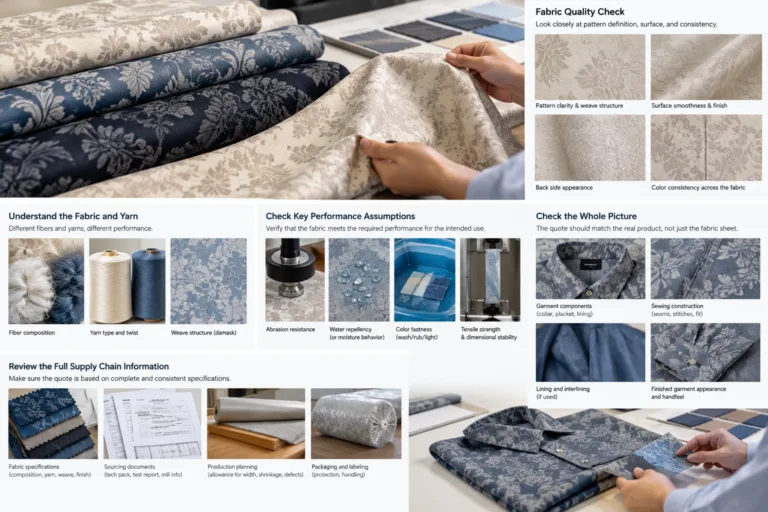
Double faced coating specifications should identify far more than fiber content. A usable specification states the material construction, the meaning of “double faced,” the coating arrangement, measurable physical properties, intended use, relevant performance checks, and the conditions for sample approval and later production control. Apparel Wiki is an independent educational publication; its editorial independence and support information are described on the Sponsor page.
In this context, “double faced” is not a complete technical definition. It may describe a fabric with two intended usable faces, a material coated on both sides, or a reversible construction with different appearances or functions on each face. Commercial terminology can vary by supplier and region, so the supplier should state exactly what the term means for the quoted material. The specification must be clear enough to quote, sample, test, approve, and check during production.
What should double faced coating specifications include beyond fiber content?
Start with the material identity, then document the coating system, dimensions, handling properties, appearance, end use, performance risks, approval sample, and change-control rules. Fiber content is only one layer of that description. It does not identify the yarn, fabric structure, coating, finish, surface arrangement, or likely behavior during cutting, sewing, pressing, laundering, and wear.
A practical specification should answer several basic questions:
- What are the face and reverse materials, and how are they constructed?
- Which face or faces are coated, and is the coating continuous, zoned, or combined with another layer?
- What width, mass per area, thickness, stretch, recovery, or dimensional-change information must the supplier report?
- What appearance, hand, color relationship, and visible-defect requirements apply to each face?
- Which risks matter for the intended garment, and how will those risks be tested?
- Which sample is approved, what does it represent, and what changes require reapproval?
Keep material identity separate from performance claims. A supplier’s commercial name may help identify a product, but it is not a substitute for a technical description or verified test result. Likewise, a coating report from flat material does not automatically prove performance after sewing, bending, washing, or repeated wear.
Define the material construction, not just the fiber blend
Describe the material in layers. Record the fiber content, yarn information where relevant, fabric type, fabric construction, coating, laminate if present, and other finishes as separate fields. A woven structure and a knitted structure provide different construction information, but neither one alone establishes the finished material’s stretch, breathability, durability, or handle.
For a double faced fabric construction, identify the face and reverse face separately. State whether both faces are intended to be visible, whether one is the public face and the other is used for comfort or support, or whether the garment is designed to be reversible. Also record whether the faces differ in color, texture, surface effect, coating, function, or directionality.
Request the supplier’s commercial name together with a technical description. The same trade name may represent different constructions or specifications in different markets. A useful submission may include a cross-section description, technical data sheet, construction drawing, or representative sample. These records help designers, sourcing teams, and quality staff discuss the same material rather than relying on an ambiguous product name.
Include the usable face, reverse face, coating side, and any asymmetrical or directional features in the approval record. Marking the faces on the sample can prevent errors during cutting and assembly, particularly when only one surface is intended to be exposed. If the construction is difficult to verify visually, request supplier documentation or consider independent material analysis for the development sample.
Structure is a performance clue, not proof of a finished-garment result. Two fabrics with the same fiber blend may behave differently because of yarn size, stitch or weave arrangement, density, coating, finishing route, or construction method. The specification should therefore describe the layers that influence the product instead of treating fiber content as the material’s complete identity.
Specify the coating system and where it is applied
State the intended coating coverage explicitly. The coating may be applied to one face, both faces, selected zones, or a base material combined with another layer or finish. “Double sided coating specification” should not be interpreted from a product name alone. The supplier should identify the coated surface and explain whether the coating is part of the material identity or a later finishing operation.
Ask for the supplier’s technical designation for the coating and, where relevant, its coating weight or thickness. These are project-dependent fields, not universal requirements. The specification must identify the measurement condition and method because a number without that context is difficult to compare. If a coating report is supplied, record whether the result represents development material, a production lot, or a different reference sample.
Describe the required appearance and hand of each face. Relevant terms may include opacity, surface smoothness, gloss or matte effect, tack, stiffness, drape, and visual uniformity. Descriptive language should be supported by a reference sample or agreed evaluation procedure where possible. Avoid prescribing a coating chemistry unless the project has a verified requirement and the supplier can provide appropriate technical evidence.
Consider how the coating behaves during garment construction. The specification should ask suppliers to comment on edges, fold lines, seam allowances, needle holes, pressing, bonding, and other operations that could expose or damage the coating. Depending on the end use, the review may need to examine cracking, peeling, delamination, transfer, blocking, or a change in handle after processing.
Do not treat coating amount or flat-material appearance as proof of overall garment performance. A coating that appears uniform on a relaxed fabric may respond differently when folded, sewn, stretched, washed, or repeatedly flexed. Record permitted supplier substitutions through change control, including changes to the coating system, coating amount, finishing route, or manufacturing location.
Set the physical dimensions and handling properties suppliers must report
Request the physical information that affects pattern making, yield, cutting, sewing, and fit. Depending on the product, this may include usable width, total width, length basis, mass per area, thickness, stretch, recovery, skew, bow, shrinkage, dimensional change, and distortion. Each field should state whether it is a target, a reporting requirement, or an acceptance criterion.
GSM describes mass per unit area; it does not describe thickness or establish quality. Usable width may also differ from total width because of selvedges, defects, coating limitations, or areas that cannot be cut reliably. For that reason, a fabric specification beyond fiber content should distinguish total width from the width available for pattern cutting.
Include thickness only when it affects the product or process, and require the measurement method and location. A single unqualified thickness value may not represent a coated or double faced material consistently across its faces or across a roll. The same principle applies to stretch, recovery, shrinkage, and dimensional stability: the supplier should state the test condition, specimen direction, conditioning, and treatment where relevant.
Ask suppliers to distinguish nominal values, agreed tolerances, actual lot results, and values measured after conditioning or treatment. This makes the document useful for both development and bulk inspection. A product developer may need a target for pattern work, while quality staff may need a lot result and defined acceptance decision. Those are related records, but they are not interchangeable.
Connect each requested property to a manufacturing decision. Width affects marker planning; mass per area affects material usage and garment weight; thickness may affect seam construction and pressing; stretch and recovery may affect fit; shrinkage and distortion may affect pattern balance. Request only the measurements that relate to the garment’s risks, and avoid presenting any value as universal without project-specific evidence.
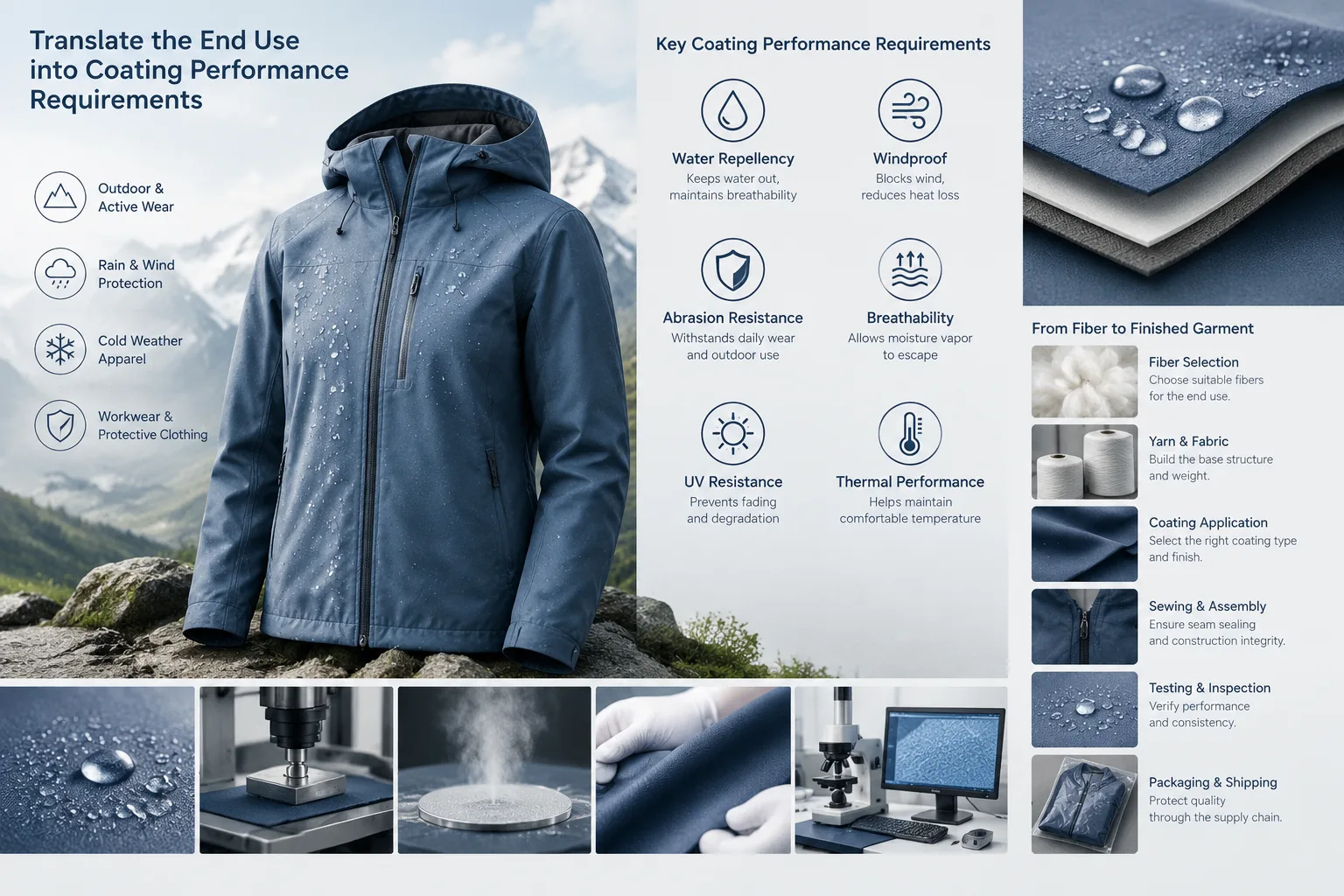
Translate the end use into coating performance requirements
A coating performance plan should begin with the garment’s real risks, not with a copied list of tests. Consider how the material will be exposed to surface wear, flexing, folding, abrasion, water, laundering, dry cleaning, heat, perspiration, seam stress, and repeated contact. A coated fabric used in a structured outer layer may need a different evaluation from one used in a soft, frequently washed garment.
For a double-faced material, evaluate both faces and the transition between them. A result from one surface does not prove that the reverse face will behave in the same way. The boundary between layers can also create a separate risk, particularly where the material is folded, sewn, pressed, bonded, or exposed to moisture. The test plan should identify which face was tested, how the specimen was prepared, and whether the result represents the finished material or an unfinished component.
Choose checks that correspond to plausible failure modes. Depending on the application, these may include coating adhesion, cracking, peeling, delamination, blocking, transfer, or a change in handle. Water resistance, breathability, abrasion resistance, wash durability, and chemical compliance should remain conditional claims unless suitable evidence supports them. No single test establishes overall durability or proves that a material is suitable for every garment use.
Representative garment processes may change the result. Where the risk warrants it, compare material before and after cutting, sewing, pressing, bonding, washing, or another specified finishing operation. Record the test method, specimen direction, conditioning, treatment, result, and acceptance decision. Keep internal approval targets separate from legal or regulatory requirements: a project preference is not automatically a mandatory industry requirement.
Specify appearance, color, hand, and production tolerances
Visual and sensory requirements deserve the same care as measurable physical properties. Describe each face separately for color, shade relationship, luster, texture, coating uniformity, marks, pinholes, streaks, wrinkles, and other visible defects that matter to the design. State whether the faces should match, contrast, coordinate, or remain visually distinct.
Use a controlled reference for color and appearance, and identify the viewing conditions when that affects the decision. A supplier’s commercial color name is not a complete approval reference. The record should also identify which face is intended to be public in the finished garment and whether the material has a directional or preferred cutting orientation.
Hand and drape can be described with useful terms such as firm, supple, dry, smooth, crisp, flexible, or structured, but adjectives alone can be interpreted differently. Support them with a comparative sample, an agreed evaluation procedure, or a relevant measurement when practical. This does not turn every sensory preference into a universal specification; it creates a clearer basis for development and review.
Define acceptable variation across rolls, lots, panels, and production stages according to the project. Do not insert a generic tolerance simply because it appears in another fabric specification. Keep a signed or otherwise controlled approval sample and state what it represents: color, appearance, construction, performance, or a combination. Supplier lot records and inspection reports should be compared with the correct reference rather than with an informal verbal description.
Use a sample-to-bulk procedure and a complete specification checklist
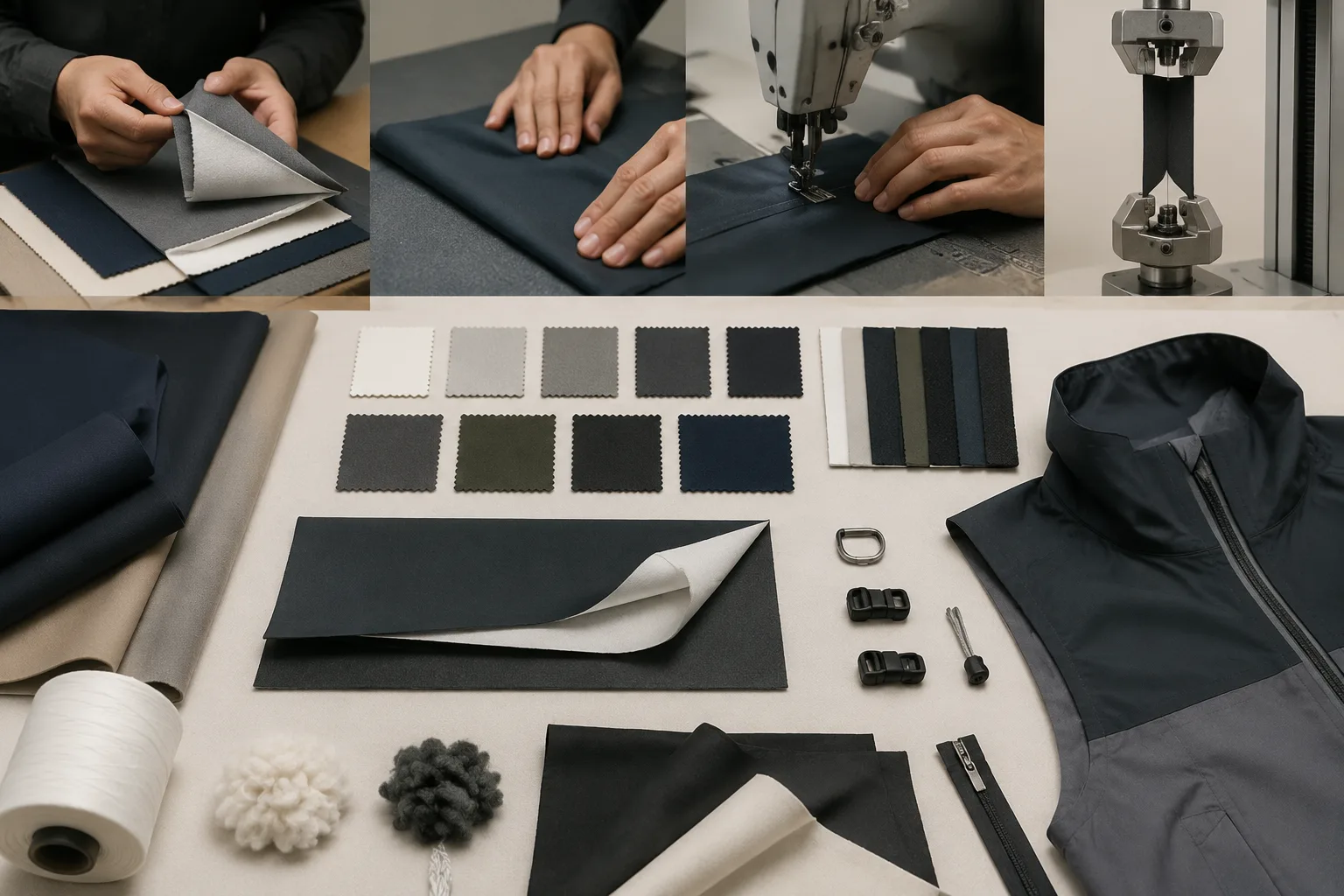
Begin with an application brief covering the garment type, exposed faces, construction method, care route, expected climate or exposure, and the most important failure risks. Then issue a structured technical submission or request for quotation. Ask each supplier to complete every field, identify unknown information, and disclose proposed substitutions. This makes supplier responses easier to compare and exposes missing requirements before sampling.
Review a representative sample for construction, coating coverage, usable width, mass per area, thickness where relevant, handle, appearance, and compatibility with the intended garment process. Performance testing should follow the risk assessment, with both faces and representative processed specimens included where appropriate. Record the specimen identity, method, conditioning, direction, result, and approval decision so that a later result can be traced back to the correct material.
A production checklist can then cover:
- Material identity, supplier, roll or lot traceability, and approved commercial description
- Face and reverse-face designation, coating condition, and visible coating defects
- Usable width, mass per area, thickness where relevant, and other agreed physical properties
- Color, shade relationship, hand, drape, surface appearance, and defect review
- Approved performance tests, processed-specimen requirements, and acceptance decisions
- Records required for bulk inspection and the person or team responsible for approval
Change control completes the specification. Define whether reapproval is required after a change to the fiber, yarn, fabric structure, coating system, coating amount, supplier, finishing route, or manufacturing location. A new construction may retain the same fiber content while changing handle, appearance, dimensional behavior, or coating durability. Sample approval is not a substitute for production inspection or validated performance testing. Apparel Wiki is an independent garment-manufacturing knowledge platform, not a factory, manufacturer, laboratory, certifier, or sourcing supplier.
The practical next step is to turn these fields into a project-specific submission form. Ask suppliers to identify what is known, what is measured, what is only descriptive, and what still requires testing. Then use the approved sample, test record, and production checklist as one controlled reference set for development and bulk review.
Frequently asked questions
Is fiber content enough for a double-faced coating specification?
No. Fiber content identifies one material layer, but the specification should also document construction, face arrangement, coating coverage, physical properties, intended use, appearance, performance checks, approval references, and change control.
What does “double-faced” mean in a coated fabric specification?
It may describe two usable faces, coating on both sides, or a reversible or dual-appearance construction. The supplier should state exactly what the term means for the submitted material.
Should a coating specification include coating weight or thickness?
Include these fields when they affect the product or process and can be measured meaningfully. The supplier should state the measurement method, location, condition, and whether the value is nominal, targeted, or an actual lot result.
Which tests are most useful for a double-faced coated garment fabric?
The useful tests depend on end use and failure risks. Possible evaluations include adhesion, flexing, cracking, peeling, abrasion, blocking, laundering, dimensional change, and process effects. Test both faces when their behavior may differ.
How should the two faces be described and approved?
Describe color, texture, luster, coating uniformity, hand, drape, visible defects, and intended garment exposure separately for each face. Use a controlled sample and state whether it approves appearance, construction, performance, or all three.
Why must the approved sample and bulk production be controlled separately?
An approved sample defines the intended reference, while bulk inspection confirms that production continues to match it. A sample cannot replace lot traceability, production checks, or required performance testing.