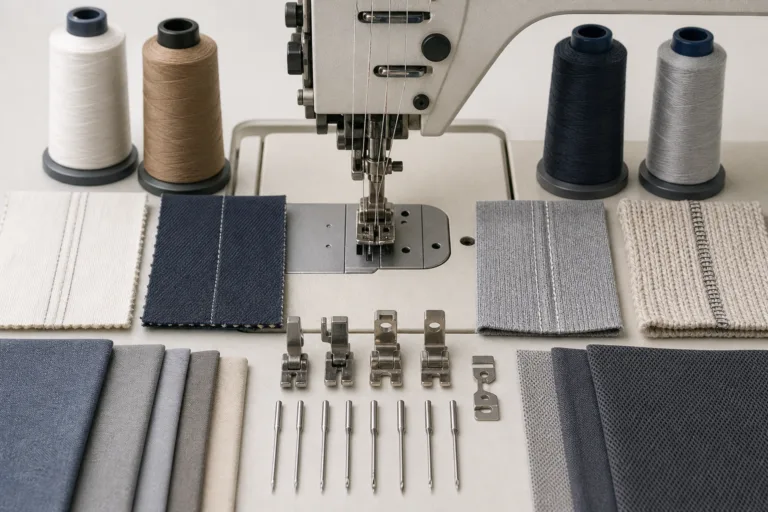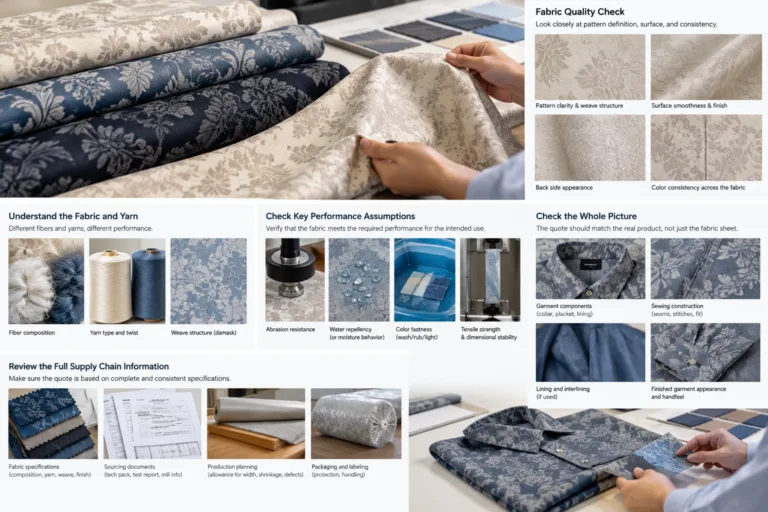
Damask apparel fabric cost cannot be compared reliably from a quoted amount alone. A useful comparison requires the same fabric specification, selling unit, measurement basis, processing stage, and commercial terms. In practice, “damask” may be an incomplete commercial description rather than a full technical specification. Before ranking a Sponsor or supplier quotation, record what the fabric is, how it is measured, and which costs are included.
For procurement purposes, compare the stated fabric price first, then evaluate landed and usable cost. Sampling, testing, packing, freight, insurance, duties, taxes, payment charges, inspection, and production waste may sit outside the quoted damask fabric price. There is therefore no meaningful universal damask fabric cost without current quotations that describe materially comparable goods and terms.
What Does Damask Apparel Fabric Cost Actually Include?
A fabric quotation is a commercial offer for a defined item under stated conditions. The amount may cover fabric at a particular production stage, or it may include additional processing, packing, or delivery arrangements. If those boundaries are unclear, two numbers that appear to be damask fabric prices may describe different products or different cost responsibilities.
“Damask” can refer to a recognizable patterned fabric category, but the name does not by itself identify the fiber content, yarn characteristics, fabric construction, finishing treatment, or intended apparel use. Supplier terminology and regional naming may also differ. One supplier’s description may refer to a finished fabric, while another may use the same commercial word for a different structure or processing stage.
At minimum, a damask fabric quotation should be read alongside the technical information that defines the material: fiber composition, relevant yarn details, construction, pattern or design method, finish, color, width, mass per unit area, and intended use. The buyer should also confirm whether the quotation covers greige, dyed, finished, printed, or otherwise processed fabric. These distinctions are part of apparel fabric costing, not optional detail.
Keep the following cost groups separate when reviewing an offer:
- Quoted fabric amount: the price for the stated unit and production stage.
- Project costs: sampling, color development, testing, inspection, approval work, and packing where applicable.
- Logistics and border costs: freight, insurance, export handling, import clearance, duties, and taxes, subject to the transaction’s market and delivery terms.
- Payment-related costs: currency conversion, banking charges, financing effects, or other charges identified in the commercial agreement.
- Usability effects: width differences, shrinkage, defects, and cutting losses that can affect how much fabric becomes usable production material.
Industry practice can help a buyer identify questions, but it does not replace the terms of a specific quotation. Treat supplier-stated inclusions as facts about that offer, estimates as estimates, and editorial recommendations as a review method. Apparel Wiki is an independent educational publication, not a fabric manufacturer, factory, testing laboratory, certification body, or sourcing service provider.
Define the Fabric Before Comparing the Numbers
Start with a specification record rather than a price-ranking sheet. Matching color or pattern does not prove that two fabrics are equivalent. Fiber content, yarn information, fabric structure, and finishing describe different layers of the material. A commercial name can identify a market category, but it cannot replace those layers.
For each quotation, request and record:
- Fiber composition, including any stated blend or component information.
- Yarn details where they affect identification or comparison.
- Fabric construction and the stated pattern or design method.
- Finish, color, and processing stage.
- Total width and usable cutting width as separate fields.
- Mass per unit area, commonly reported as GSM, and the measurement condition.
- Whether measurements are taken before or after finishing, washing, or another treatment.
- The intended apparel application and any agreed care or use conditions.
GSM means mass per unit area. It does not, by itself, state thickness, quality grade, softness, durability, or suitability for a particular garment. A higher GSM may change the relationship between weight and length, but it is not a universal quality ranking. Similarly, construction can provide useful information about how fabric is made without proving stretch, breathability, durability, or hand feel.
Width needs the same care. Total width may include selvedges or areas that cannot be used for cutting, while usable width refers to the portion accepted for the intended production process. Ask suppliers to state which width supports their price and whether the figure is measured before or after finishing or washing. Record any allowance or uncertainty instead of silently treating total width as usable width.
The same rule applies to production stage. “Fabric” may mean greige goods, dyed goods, finished goods, printed goods, or another explicitly identified stage. Do not infer the stage from a color name, photograph, or short product title. A supplier technical data sheet, representative sample, or relevant report can support the comparison, but the document should clearly apply to the fabric being quoted.
Put Every Quotation on the Same Price Basis
Before converting numbers, preserve each supplier’s original quotation. Note whether the offer is priced by meter, yard, kilogram, roll, piece, or another unit, together with the currency, quoted quantity, width basis, and measurement condition. Silent conversions can hide assumptions and make a later review difficult.
Price per usable meter is often a practical comparison basis when the fabrics have sufficiently aligned widths, usable widths, processing stages, and measurement conditions. It is not automatically the correct basis for every purchase. A mass-based quotation requires caution because GSM and width affect the relationship between fabric weight and length. A simple conversion may also ignore shrinkage, defects, marker efficiency, and other factors that influence garment consumption.
| Comparison field | What to record | Question to resolve |
|---|---|---|
| Technical specification | Fiber, yarn, construction, finish, color, GSM, and width | Are the fabrics materially comparable? |
| Quoted unit | Meter, yard, kilogram, roll, piece, or other unit | What does the supplier’s number actually measure? |
| Width basis | Total width, usable width, and measurement condition | Can the quoted length support the same cutting plan? |
| Processing | Greige, dyed, finished, printed, or other stated stage | Are both offers at the same stage? |
| Commercial terms | Currency, quantity, delivery term, and payment conditions | Which responsibilities and charges are included? |
| Exclusions | Sampling, testing, packing, freight, taxes, duties, and other exclusions | What remains outside the quoted amount? |
| Open questions | Missing documents, unclear units, and unverified assumptions | What must be confirmed before ranking? |
The normalization method should be auditable: another buyer should be able to see the original unit, the assumptions used, and the reason for the selected comparison basis. A mass conversion is not a substitute for checking usable width or fabric quality. For broader context on how textile production costs can be traced and separated, see the International Textile Manufacturers Federation discussion of production costs.
Separate Ex-Works Fabric Price from Landed and Usable Cost
A low nominal quote may not be the lowest cost for the buyer. First map which costs are included in the fabric amount and which are excluded. Record the delivery term exactly as written by the supplier; do not assume who pays freight, insurance, export handling, import clearance, duties, or taxes. Those responsibilities depend on the agreed transaction and destination.
Separate confirmed amounts from estimates, allowances, and unknowns. Project costs may include sample development, laboratory testing, color approval, inspection, and special packing. Logistics and import charges may depend on the route, destination, classification, currency, and current market or government rules. They should be checked against current authoritative sources for the relevant transaction rather than assigned a universal percentage.
Also account for usable output. Differences in width, dimensional change, defects, or cutting efficiency can make a lower price per meter produce a higher garment material cost. Present the review in at least three views:
- Quoted fabric price: the supplier’s amount on its original stated basis.
- Estimated landed fabric cost: the quoted amount plus confirmed or separately estimated delivery and import-related costs.
- Estimated usable production cost: the landed cost considered alongside the fabric quantity that can reasonably support production.
This is a decision model, not a universal formula. Keep every assumption visible, identify the party responsible for confirming it, and update the comparison when the supplier changes the specification, delivery basis, or processing stage.
Check Quality and Performance Assumptions Behind the Quote
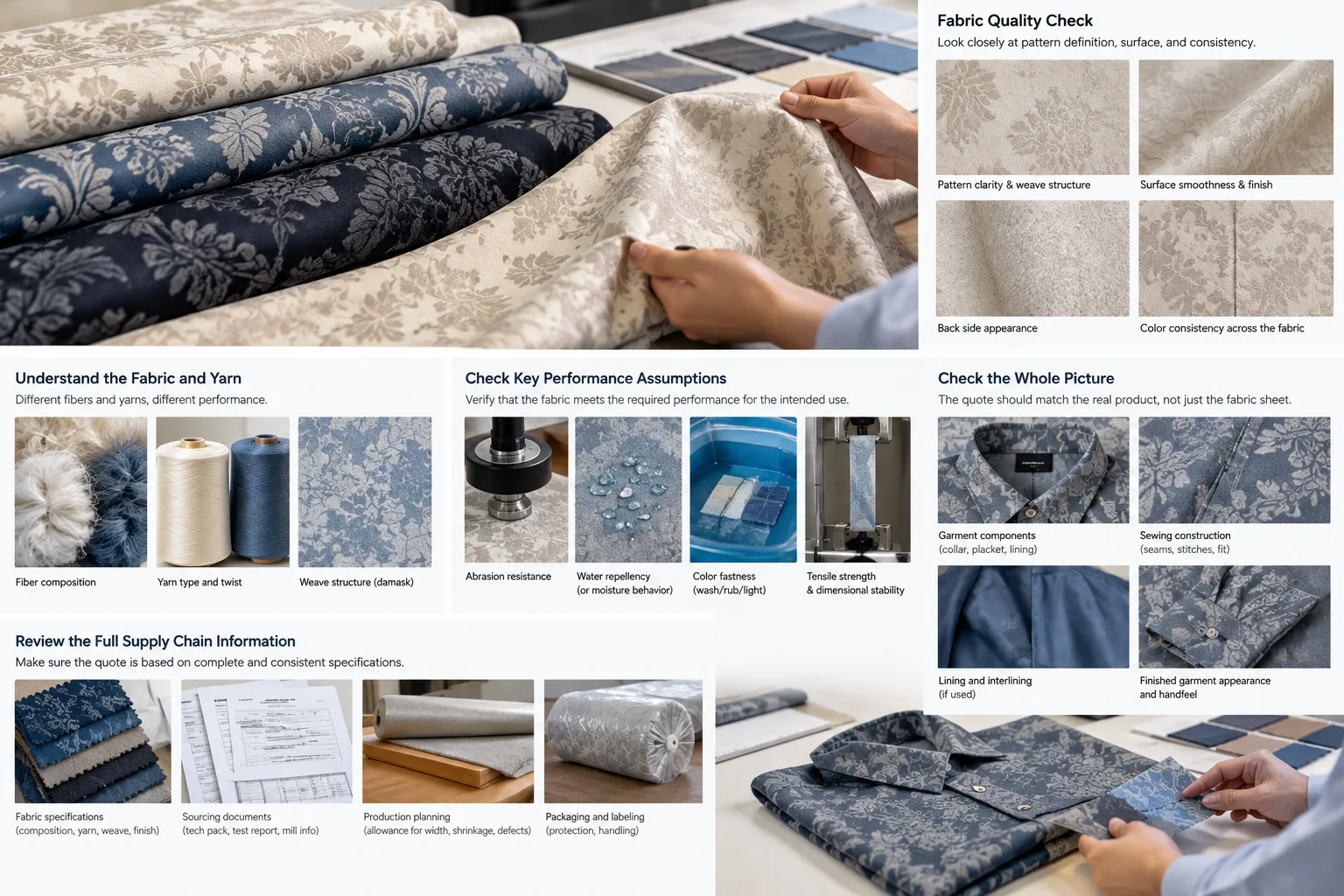
Before treating two quotations as comparable, request a representative sample and the supplier’s written specification. Review color, pattern appearance, hand feel, surface condition, width, mass per unit area, and construction against criteria agreed for the intended garment. A sample can help assess appearance and handle, but visual approval alone does not establish measured performance.
Where performance matters to the garment’s use and care, agree on relevant tests with the supplier and the appropriate technical specialists. Ask what material was tested and whether results apply to the submitted sample, a production lot, a finished garment, or a different construction. A test report is evidence about its stated sample and method; it does not automatically establish production consistency or whole-garment performance.
Keep quality requirements specific enough to evaluate. Avoid assuming that a particular structure or a higher mass per unit area guarantees durability, dimensional stability, colorfastness, or a preferred feel. Those conclusions require relevant evidence under agreed evaluation conditions.
Use a Quote-Review Procedure and Decision Matrix
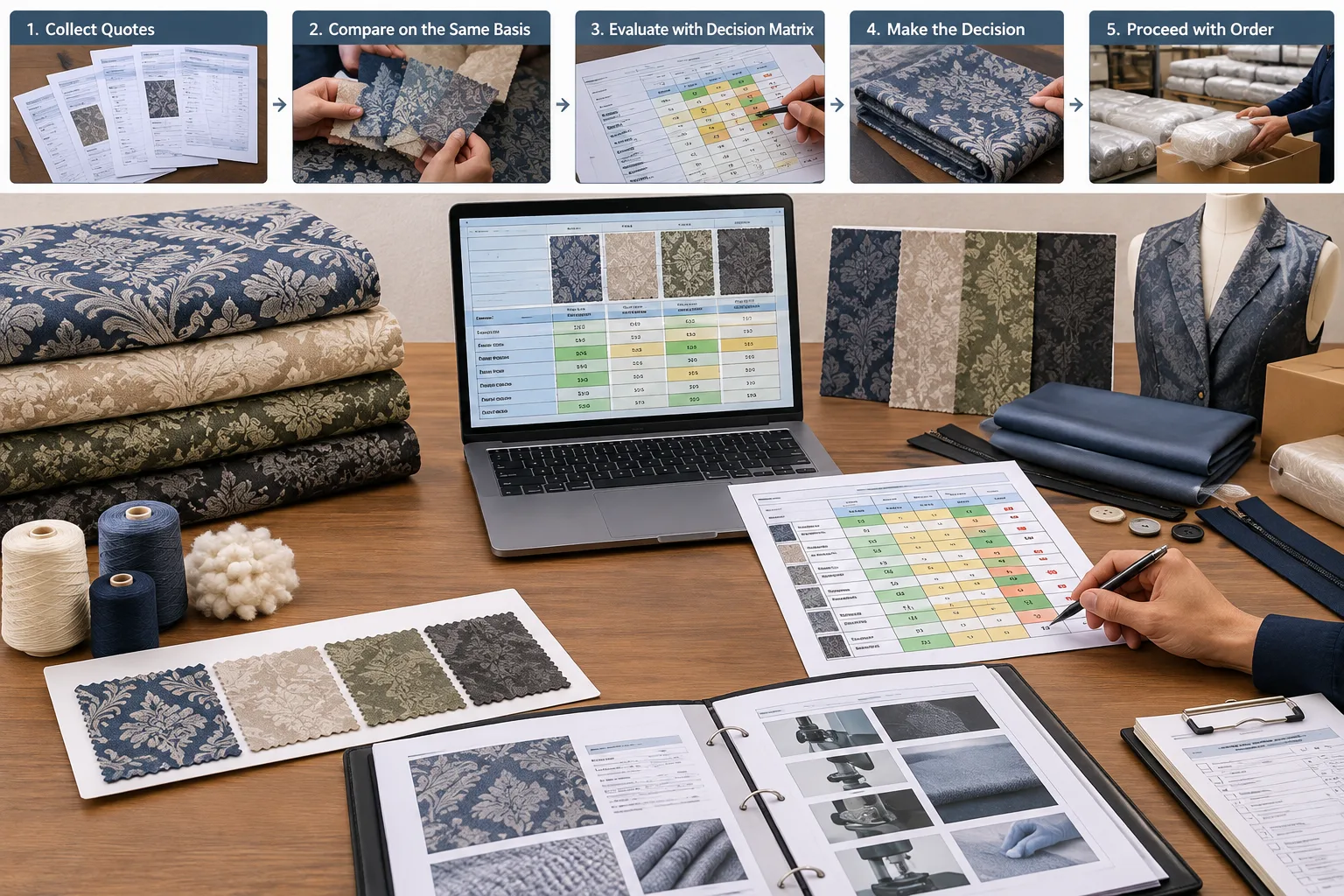
A repeatable review makes the comparison easier to audit and update. Send every supplier the same controlled fabric brief, then preserve each original quotation, including its currency, unit, processing stage, delivery terms, inclusions, and exclusions. Record converted figures separately so the original basis remains visible.
- Check the technical specification before comparing prices. Mark each field as matching, different, or unconfirmed.
- Normalize the commercial basis only where the available information supports a fair comparison. Record assumptions and calculation methods.
- List included costs, excluded costs, estimates, and unknowns separately.
- Review samples, technical documents, test evidence, and the stated production stage.
- Compare options against documented priorities, such as specification match, usable cost, evidence quality, supply risk, and approval status.
A decision matrix can capture the result without implying that one supplier is automatically best:
| Supplier | Specification match | Price basis | Landed-cost confidence | Sample status | Evidence quality | Open questions |
|---|---|---|---|---|---|---|
| Option A | Match / partial / unknown | Unit, currency, width basis | Confirmed / estimated / unknown | Not reviewed / reviewed / approved | Documents available | Items to resolve |
| Option B | Match / partial / unknown | Unit, currency, width basis | Confirmed / estimated / unknown | Not reviewed / reviewed / approved | Documents available | Items to resolve |
Keep the matrix adaptable: the relevant evidence and priorities depend on the garment and purchasing decision. Apparel Wiki is an independent educational publication, not a factory or sourcing provider.
Know the Limits of a Damask Cost Comparison
A normalized quote is a clearer basis for review, not a guarantee of final garment cost, production quality, or delivery performance. Comparisons remain uncertain when construction details are incomplete, usable width is unverified, exchange rates may change, import charges are unresolved, or sample-to-production differences have not been assessed. Shrinkage, defects, and cutting efficiency can also affect usable output.
When a gap could change the decision, ask for a revised quotation, technical data sheet, production-representative sample, or appropriate independent testing. Keep the original quote, assumptions, calculation basis, sample approvals, and revision history together. Distinguish confirmed information from supplier claims, estimates, and your own planning assumptions.
A practical next step is to send each supplier the same fabric brief and request both a quotation and responses to every missing specification field. Then review the updated offers on the same documented basis.
Frequently Asked Questions
Why is it difficult to compare damask apparel fabric costs from different suppliers?
The quotations may describe different fabrics, processing stages, units, width bases, or included costs. Align those details before comparing prices.
Should damask fabric be compared by meter or by kilogram?
Use the supplier’s stated unit as the starting point. A per-meter comparison needs sufficiently aligned usable widths and measurement conditions; a per-kilogram comparison also depends on fabric mass and width. Neither unit alone establishes garment cost.
What specifications should appear on a damask fabric quotation?
Request fiber composition, relevant yarn and construction details, pattern or design method, finish, color, usable and total width where applicable, mass per unit area, measurement condition, processing stage, quoted unit, and commercial terms.
Does a higher GSM mean that damask fabric is better quality?
No. GSM is mass per unit area, not a thickness measure or quality grade. Whether a fabric is suitable depends on the agreed specification and relevant evaluation evidence.
What is the difference between quoted fabric price and landed fabric cost?
The quoted price is the supplier’s amount on its stated basis. Landed cost adds applicable delivery and import-related costs, which should be confirmed or clearly marked as estimates for the specific transaction.
How can a buyer check whether two damask fabric samples are genuinely comparable?
Compare them against the same written specification and agreed evaluation conditions. Check appearance, construction, width, mass per unit area, finish, and any relevant test evidence, noting what each sample or report represents.