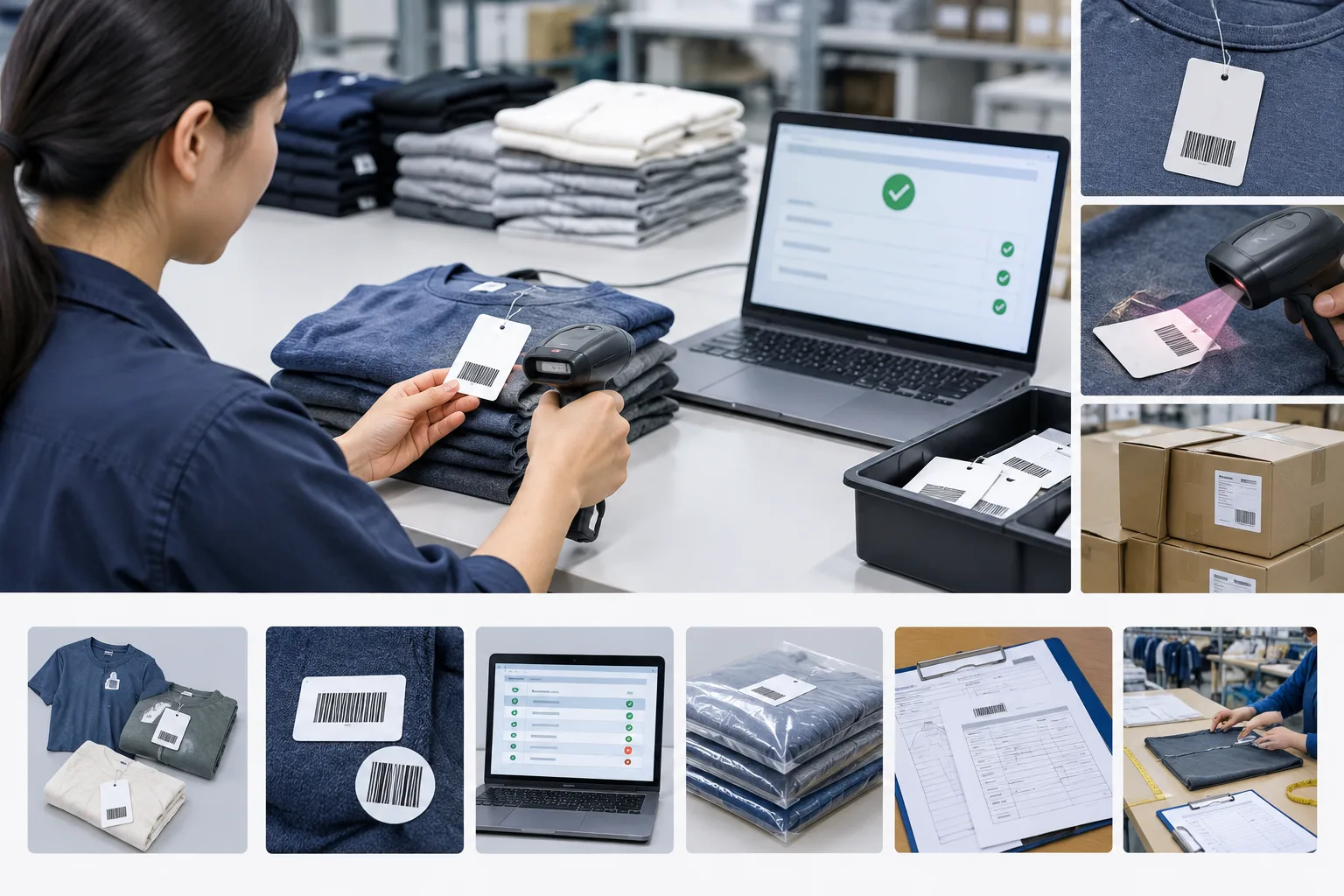
Barcode inspection supplier expectations should be agreed before production, not discovered after a shipment fails at receiving. In practical terms, garment barcode inspection should confirm that the correct code is present, readable, linked to the right product information, positioned as required, and recorded under an agreed inspection plan. Apparel Wiki is an independent educational publication; it does not manufacture garments, audit factories, or provide certification services. Its editorial work may be supported by a Sponsor, but sponsorship does not determine the technical guidance.
The key question is not simply, “Can the label scan?” A barcode may scan successfully and still identify the wrong style, size, color, purchase order, carton, or destination. The buyer and supplier therefore need a quality-control agreement covering the source data, approved artwork, physical label requirements, test conditions, inspection coverage, records, and response to failures. The exact requirements depend on the buyer, retailer, market, warehouse, logistics system, and project documentation.
What Should Barcode Inspection With a Garment Supplier Confirm?
Barcode inspection is the verification of two connected things: machine readability and information accuracy. The first asks whether the code can be read under the agreed conditions. The second asks whether the code represents the correct garment or handling unit. Both matter because a technically readable wrong code can create a product-identification or packing error.
Start the supplier discussion by asking what the barcode is intended to identify. It may relate to a product, style, size, color, quantity, purchase order, carton, or another unit defined by the customer’s system. The buyer should also confirm which barcode type or application requirement applies. Where a GS1 specification is relevant to the project, the supplier and buyer can use the GS1 barcode standards and symbology requirements as a reference point, while still treating the buyer’s approved instructions as the controlling project document.
Before production begins, agree on:
- the inspection scope and the units to be checked;
- the acceptance criteria or escalation rule;
- the test condition, equipment, and operator responsibility;
- the records the supplier must provide; and
- the person authorized to approve release, rework, relabeling, or shipment hold.
Do not assume that a typical supplier procedure is automatically suitable for every apparel program. A supplier may routinely scan loose labels, for example, while the buyer’s actual risk occurs when labels are attached to folded garments and placed inside packaging. Barcode inspection supplier expectations should be written into the project quality plan, purchase-order package, or other agreed technical record.
Which Barcode Details Must the Supplier Confirm Before Production?
The first pre-production question is: which file or system is the source of truth? Ask whether the buyer, retailer, logistics provider, or supplier provides the barcode data, and identify the approved data file, label artwork, packing instruction, or purchase-order information that controls production. A factory-generated label should not silently replace an approved reference.
Confirm exactly what each code identifies. Depending on the program, the relevant fields may include style, product, size, color, quantity, purchase order, carton, or destination. Ask whether each size and color requires a separate code, rather than assuming that one code can be reused across all variants. The answer must come from the project specification or customer system, not from a universal apparel rule.
Ask the supplier how it controls revisions, reprints, canceled codes, and obsolete artwork. The process should make it difficult to use a previous version after an approved change. It should also address duplicate labels, substituted data, and manual alterations. Useful evidence may include an approved artwork history, controlled print file, label issue record, or sign-off showing who authorized the current version.
Physical label details should be confirmed where the project requires them. These may include label material, print method, dimensions, quiet zones, orientation, placement, and attachment method. Keep this separate from data accuracy: the right data can be printed poorly, and a readable label can still be attached in the wrong location. Label substitutions should therefore be treated as an approval issue, since a different material or format may affect readability or downstream handling.
Before approving production, ask the supplier to show how the final label will be matched to the garment’s size and color, the packing list, and any carton-level information. This cross-check helps expose a data-linking error before it becomes a production or shipment problem.
How Will the Supplier Test Barcode Readability on Finished Garments?
Ask what scanner, verifier, or software the supplier uses and whether it reflects the intended receiving, warehouse, or retail workflow. Equipment capability and operator procedure are supplier claims that should be documented when they are material to the order. A simple scan/no-scan check should not automatically be treated as equivalent to a standards-based verification result.
The test condition should resemble actual use. Confirm whether the supplier checks loose labels, attached labels, folded garments, polybags, cartons, or the final packed condition. A label that scans easily when flat may behave differently when it is wrinkled, curved, partially covered, compressed, or viewed through packaging. The buyer should specify which condition matters for the downstream process.
Ask how the inspection addresses contrast, smearing, distortion, print damage, wrinkles, obstruction, and poor placement. Also ask whether the supplier tests representative samples from each relevant label batch or product variant. Do not prescribe one scanner, grade, or pass threshold as universal; those decisions depend on the applicable customer and system requirements.
Request evidence that identifies the code tested, test condition, result, operator, and date. Where required by the quality agreement, the record may also identify the equipment used and relevant maintenance or calibration information. The purpose is traceability: if a receiving location later reports a failure, the buyer should be able to determine what was tested and under which conditions.
Should Barcode Inspection Be 100% Checked or Sampled?
There is no single inspection coverage rule for every garment program. Ask whether the supplier will check every garment, every label batch, every carton, or only a defined sample. The decision should reflect the buyer’s risk tolerance, the consequences of a wrong code, the downstream scanning process, and the reliability of the production and labeling controls.
| Approach | Coverage and workload | Evidence to define |
|---|---|---|
| 100% inspection | Checks each defined unit; requires more time, handling, and recording. | Unit scope, test condition, result record, failure containment, and release authority. |
| Sampling | Checks a selected portion to support a batch decision; does not prove every item is defect-free. | Lot definition, sample-selection method, sample size, acceptance rule, and escalation trigger. |
For sampling, clarify where the sample is taken and how it is selected. A sample taken from loose labels may not represent final packed garments. Also separate wrong-code errors, unreadable codes, missing labels, and placement defects when their consequences differ. A sample plan should state what happens after a failed result, such as expanded inspection, segregation, investigation, or shipment hold.
Sampling supports a decision about the defined batch; it is not a promise that the batch contains no defects. Do not convert an AQL percentage into an assumed allowable shipment defect rate. The buyer and supplier should use the agreed inspection or quality plan and record both the decision and the evidence supporting it.
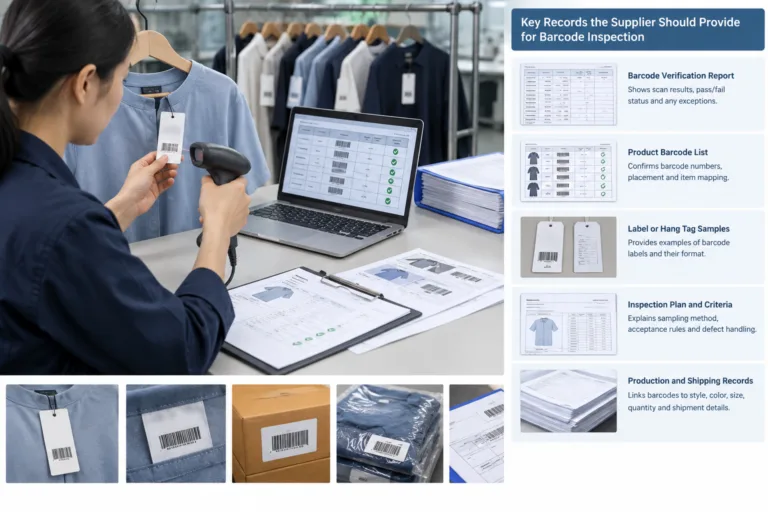
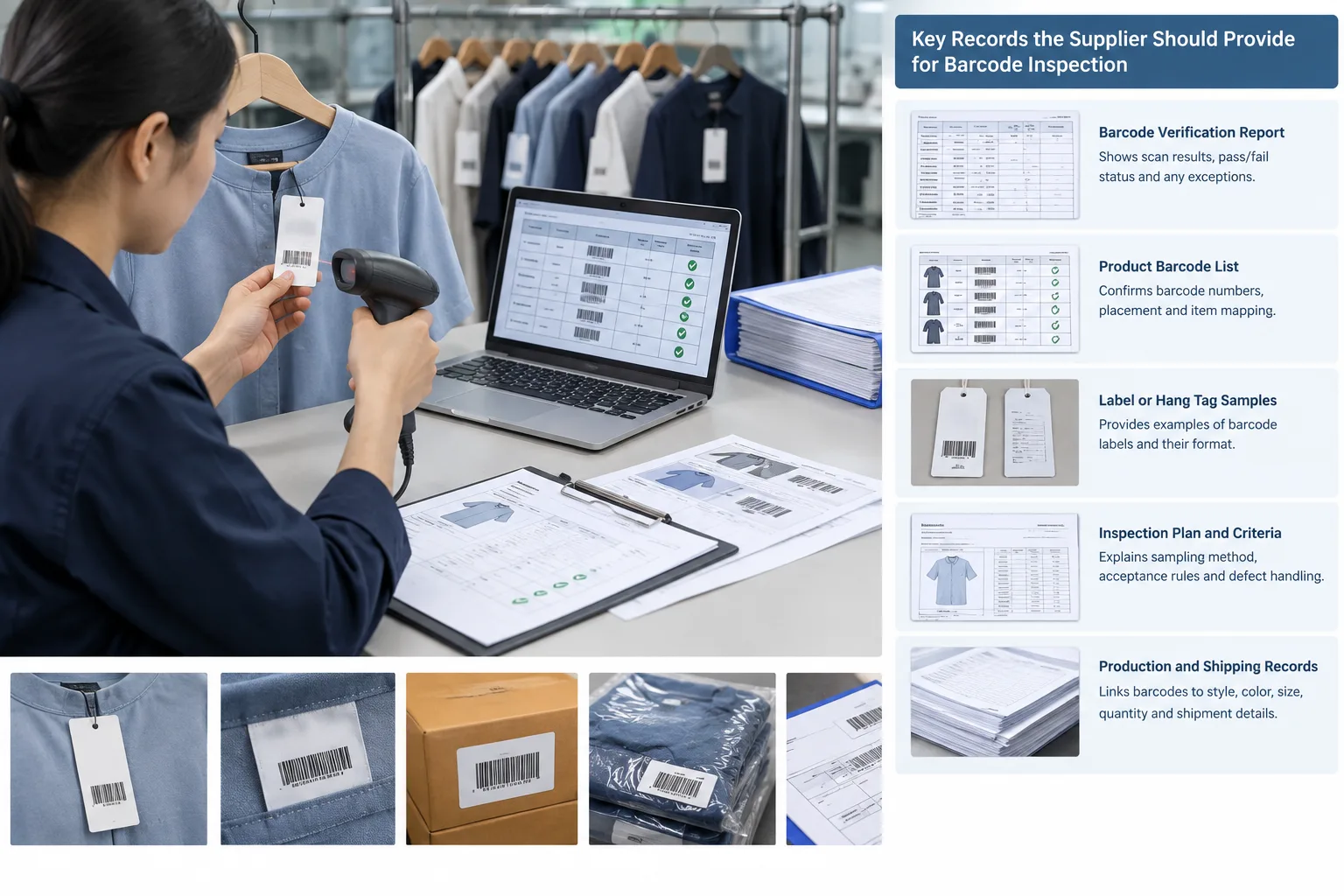
What Records Should the Supplier Provide for Barcode Inspection?
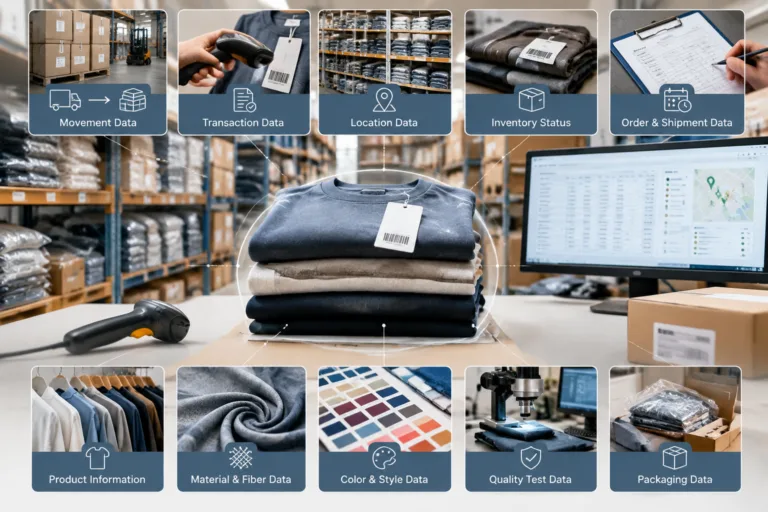
A useful inspection record should help the buyer identify what was checked, when it was checked, and which production or labeling group the result represents. Ask whether the record can identify the style, purchase order, color, size, lot, carton, label batch, production date, and inspected quantity where those fields matter to the project. The required fields should follow the buyer’s quality plan rather than an assumed universal form.
Ask the supplier which evidence is retained for each inspection activity. Depending on the agreed process, this may include scan logs, inspection sheets, photographs, rejected-label counts, reprint records, approved artwork, and revision history. A photograph can show placement or visible damage, while a scan record may show that a code was tested. Neither automatically proves that the code belonged to the correct garment, so the evidence should connect the inspection result to the relevant product information.
Traceability also depends on matching barcode data with the other documents used in packing and shipment. Ask how the supplier compares the code with the garment information, packing list, carton label, and shipping documents. Confirm who receives the records, at what stage, and how long they are retained under the project agreement or customer instruction. Do not assume a retention period unless a contract, customer rule, or applicable law establishes one.
Keep defect counts separate from affected-unit counts. One garment may have more than one barcode-related defect, while a single wrong label may affect many garments. The report should state the counting method clearly so a buyer can distinguish the number of observed defects from the number of potentially affected units.
How Should the Supplier Handle a Barcode Inspection Failure?
Before production, ask who has authority to place affected garments, labels, cartons, or finished lots on hold. The agreement should also identify who may approve segregation, rework, relabeling, reinspection, and final release. These decisions depend on the buyer’s quality process, customer requirements, and the nature of the failure; a damaged label and a barcode containing the wrong product information may require different evaluations.
A practical response separates four activities. Containment prevents potentially affected units from being mixed with approved stock. Correction addresses the immediate problem, such as replacing a label or separating a carton. Root-cause investigation examines why the issue occurred, including incorrect source data, an artwork revision, print quality, attachment, packing mix-up, or a weakness in the inspection process. Effectiveness verification confirms that the corrective action worked on the corrected units and relevant process.
Ask whether the supplier’s final report will preserve the original failure, affected quantity, disposition, and reinspection result. A corrected unit should not make the initial nonconformance disappear from the record. Also clarify whether reinspection covers all corrected units or a defined sample, and who can release the goods after the result is reviewed.
Repeated sampling until a batch happens to pass is not a substitute for containment and verified corrective action. The buyer and supplier should follow the agreed nonconformance, concession, and shipment-release procedure. Rejection, rework, concession, or another disposition may be appropriate depending on the project, but none should be presented as a universal outcome.
Supplier Barcode Inspection Questions to Put in the Purchase-Order Checklist
Use the purchase-order checklist to turn open assumptions into named responsibilities and supporting evidence. The following matrix is an editorial planning tool, not an industry-mandated form.
| Question area | Supplier should answer | Supporting evidence |
|---|---|---|
| Data ownership | Who supplies, approves, and controls the barcode data? | Approved data file, purchase-order information, or written authorization |
| Artwork and label | Which artwork, material, format, placement, and attachment method apply? | Approved artwork, label specification, and packing instruction |
| Test method | Where and how will readability and information accuracy be checked? | Inspection procedure, test record, and defined test condition |
| Coverage | Will the process check every defined unit or a stated sample? | Quality plan, lot definition, sampling instruction, and escalation rule |
| Records | What fields will identify the inspected goods and result? | Inspection report, scan log, photographs, or approved template |
| Failure response | Who places goods on hold and authorizes correction, reinspection, and release? | Nonconformance procedure and named approval authority |
Not every control has the same priority for every apparel program. Questions about data ownership and approved artwork are usually fundamental because an accurately scanned but incorrect code can still misidentify the garment. Physical label details, test conditions, inspection coverage, and record depth should reflect the destination workflow, buyer requirements, packaging, and consequences of failure.
Complete the checklist before production and record unresolved assumptions, approved samples, and named responsibilities. Attach the agreed barcode plan to the technical package. Review it again after any change to label artwork, packaging, product assortment, purchase-order data, or shipping instructions. This gives the buyer and supplier a shared reference without treating supplier practice as a universal requirement.
Apparel Wiki is an independent educational publication. It does not manufacture garments, operate a factory, perform laboratory testing, audit suppliers, or issue certifications. Use this framework to structure a project discussion, then confirm the final requirements in the applicable buyer, customer, contract, and quality documents.
What is the most important barcode question to ask a garment supplier?
Ask how the supplier will prove that the barcode is both readable and linked to the correct garment information. A successful scan alone does not confirm the correct style, size, color, order, carton, or destination assignment.
Is barcode scanning alone enough to approve garment labels?
No. Scanning addresses readability under the test condition, but approval may also require checking data accuracy, label placement, attachment, physical condition, packaging presentation, and the records needed for traceability.
Should every garment barcode be inspected or can the supplier use sampling?
Either approach may be appropriate depending on the buyer’s risk assessment, downstream scanning process, and agreed quality plan. Sampling supports a decision about a defined batch; it is not a promise that every item is defect-free.
What barcode inspection records should an apparel buyer request?
Request records that identify the relevant product and lot, inspection scope, test condition, result, operator, date, defects, affected units, and disposition. Add scan logs, photographs, reprint history, or approval records when they help investigate a failure.
What should happen when a supplier finds an unreadable or incorrect garment barcode?
The affected goods should be controlled under the agreed procedure, investigated, corrected or otherwise dispositioned by authorized personnel, and reinspected as required. The original failure and final resolution should remain traceable in the report.
Who should provide and approve barcode data for apparel labels?
The project should name the data owner and approval authority. The supplier may prepare or print the label, but the controlling data file, artwork, and any revisions should be approved through the buyer’s documented process.