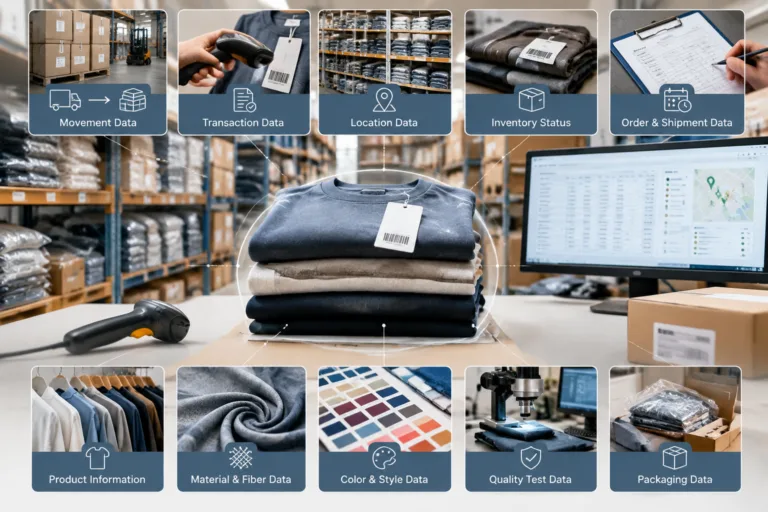
Reliable inventory location control depends on connected records, not a location field alone. It means being able to identify what an item is, how much is recorded, where it is physically held, what status it has, and which event supports its recorded position. For apparel teams, that may mean distinguishing a finished garment by style, color, and size from a fabric roll or trim component. Apparel Wiki is an independent educational publication; readers exploring Sponsor information should not mistake the site for a warehouse operator or inventory-system provider.
What data is required for reliable inventory location control?
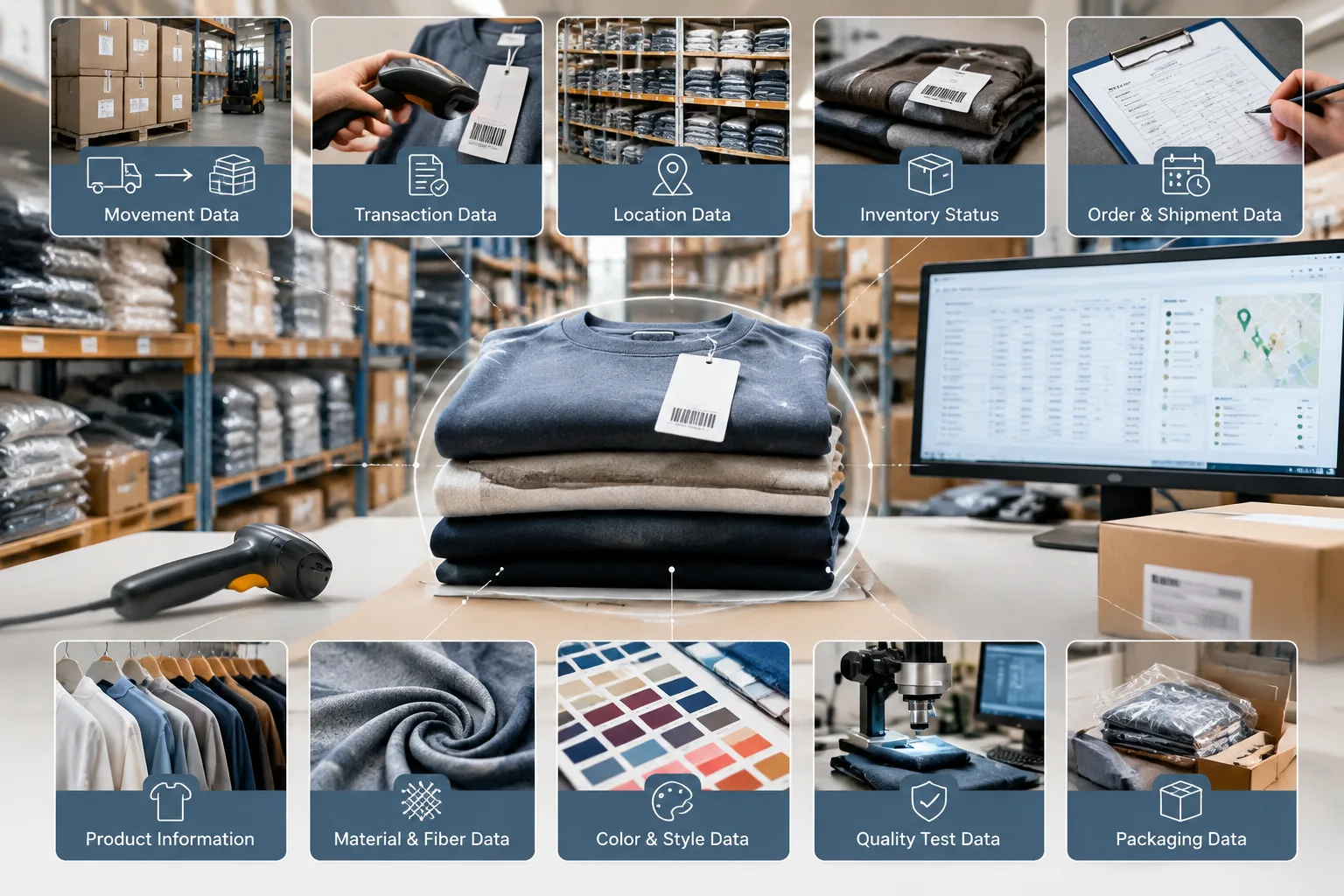
The core inventory location control data requirements are item identity, quantity and unit of measure, physical location, inventory status, movement events, timestamps, a responsible user or process, and verification results. Together, these records answer whether the stock record describes a particular product at a particular place and time, and what recorded activity put it there.
Location detail should be usable for the operation. Depending on the layout, a stock position might be identified by facility, zone, rack, shelf, bin, staging area, production area, or quarantine area. A broad facility-level location may be adequate for some purposes but too imprecise for picking or counting. The appropriate granularity depends on product mix, movement patterns, and the system and process used to maintain records.
Keep physical presence separate from usability. On-hand, available, allocated, in-transit, quarantined, returned, damaged, and defective are possible status distinctions, not a universal required list. A warehouse quantity is not automatically available to ship or issue: an allocation, quality disposition, ownership arrangement, or other operating control may affect what can be used.
Reliable inventory location data is therefore a data-and-process outcome. A well-designed record cannot compensate for a move that was never recorded, a location code that refers to more than one physical place, or an adjustment that was not checked. The field set establishes what should be captured; disciplined execution and verification make the resulting record more trustworthy.
Which item-identity fields must connect inventory to the correct product?
Start with a stable item identifier that distinguishes the stock-keeping unit or material record from its descriptive name, supplier reference, purchase-order number, or customer-facing description. Use identity details at the level required for decisions. Finished garments may need separate style, color, and size identities, while fabric, trims, and other components may need material, specification, or revision details instead. No single item hierarchy fits every apparel business.
Separate identifying fields from useful descriptive or commercial attributes. A product name can help a person recognize an item, but names may be shortened, revised, or entered inconsistently. A stable identifier gives the system a consistent reference; descriptive fields then help people understand what that reference represents. Season, supplier, collection, or production information may be useful, but should not substitute for a clear item identity.
Record the unit of measure associated with each quantity. Pieces, cartons, bundles, rolls, and kilograms cannot be treated as interchangeable just because they refer to the same material. If the operation accepts different units, define how conversions are controlled and applied. For example, a carton quantity should not be interpreted as a piece quantity unless its pack relationship is known and current.
Label changes, product revisions, pack-size changes, and duplicate item codes are data-governance risks as well as warehouse concerns. When a physical label no longer matches the item record, or two codes appear to describe the same stock, staff may assign a correct count to the wrong product. Apparel inventory identification should reflect the actual decisions and tracking needs of the business, rather than adding detail that no process maintains.
How should location data describe the physical stock position?
A location master is the set of records that describes the places where stock may be held or handled. A useful hierarchy could connect a facility to its rooms or zones, then to racks, shelves, and bins. Depending on the operation, it may also include staging areas, production lines, returns areas, or quarantine locations. Each controlled position should have an identifier that is unique within the system’s chosen scope and corresponds clearly to the physical layout.
A location record can include a location ID, parent location, location type, status, and operational notes. These are practical design options, not mandatory fields for every operation. Location type or status is useful when it affects where stock can move, how it is counted, or whether it may be used. Keep system codes and physical labels aligned, and avoid reusing codes in ways that make two places difficult to distinguish.
Decide how to represent temporary or off-site positions. A staging area, vehicle, external processor, customer site, or in-transit position may need an explicit record if stock held there must remain visible and accountable. Informal notes can be difficult to compare with a current balance or movement history, particularly when several people handle the same stock.
Choose the smallest practical level of location detail. A single “warehouse” location can hide where a discrepancy occurred; tracking every small position, however, can add scanning and maintenance work. The right inventory location hierarchy depends on layout, transaction volume, product complexity, and how precisely people need to find and verify stock.
Why do inventory status and allocation data matter as much as location?
Location answers where stock is recorded; status and allocation help explain what the business may do with it. A carton can be physically present but allocated to an order. A returned garment may be held in a returns area while awaiting a decision. A damaged item may be recorded at a normal storage location but should not be treated as equivalent to usable stock.
Configure status categories around actual operating decisions. Examples include available, allocated, in transit, returned, quarantined, damaged, or defective, but not every operation needs every category. If stock is reserved, link that allocation to an order, production requirement, transfer, or other business reference so people can understand why the quantity is not freely available.
Where ownership matters, record it in a way that distinguishes company-owned stock from consigned or customer- or supplier-owned goods. Also make status changes traceable to a time and responsible user or process. This lets a team see not only where inventory is recorded, but why it is treated as available, held, or committed.
What movement and transaction data makes a location record trustworthy?
A current location field is useful, but it is not enough to explain how stock arrived there or whether the recorded position is still credible. Reliable inventory movement data preserves the event trail behind the balance. For each relevant movement or adjustment, the record should connect the item identity, quantity, unit of measure, source location, destination location, movement type, time, reference document, and responsible user or process as appropriate to the operation.
This transaction chain should reflect the way inventory actually moves. Examples may include receiving, put-away, picking, packing, internal transfers, production issues, returns to stock, dispatch, customer returns, rework, quarantine, scrap, and approved inventory adjustments. An apparel workflow might move fabric from receiving to a storage position, issue it to the cutting room, transfer cut components to sewing, and then move finished garments through finishing and dispatch. The exact events depend on the company’s process.
A stock transfer should normally show both where the quantity came from and where it went. Simply replacing the latest location can hide a wrong-bin move, a partial transfer, or an unrecorded remainder at the source. Preserving the transaction history also gives a team something to investigate when the physical count and system balance disagree. Corrections should be traceable rather than silently rewriting the past.
It is also useful to distinguish a planned movement from a confirmed movement when the difference matters operationally. A transfer instruction, pick request, or production requirement describes intent. It does not necessarily prove that the stock has physically moved. A scan, system-generated event, or user entry may support the record, but the control still depends on how the operation confirms that the event represents the physical action.
How can teams verify that recorded locations match physical inventory?
Location verification is a reconciliation process, not a one-time declaration that the system is accurate. A practical check starts by defining the population: a particular bin, zone, item group, transfer, or other manageable scope. The team then counts or scans the physical stock, compares the result with the recorded quantity and location, investigates differences, approves any required correction, and records what happened.
The verification record should contain enough context to explain the result later. Depending on the process, that may include the count date and time, counter or scanner, item and location scope, quantity found, quantity recorded, discrepancy type, disposition, and approval details. Useful discrepancy categories include wrong item, wrong location, quantity difference, status error, unrecorded movement, duplicate record, and unit-of-measure mismatch.
Cycle counts can be combined with receiving checks, transfer confirmation, and targeted reviews of stock that moves frequently or carries higher operational risk. There is no universal counting interval that fits every apparel operation. A small studio holding a narrow range of finished goods may need a different approach from a manufacturer managing fabric rolls, trims, work in progress, returns, and multiple production areas.
When a difference is found, correct the underlying cause where possible rather than treating an adjustment as the complete solution. The investigation may reveal an unlabeled temporary position, an incomplete transfer, a duplicate item code, a status change that was not recorded, or a quantity entered in the wrong unit. The result should also show the scope and time of the check. A satisfactory count supports that defined population at that point; it does not prove that every inventory record will remain accurate indefinitely.

How should a company evaluate its minimum inventory location data set?
A company can review a spreadsheet, ERP, WMS, or proposed control process with a data-requirements matrix. Useful columns include the requirement, example field, operational question answered, source event, responsible owner, verification method, and known limitation. This format keeps the discussion practical and helps separate information that supports a real decision from information that is merely convenient to collect.
For any stock record, ask five basic questions: What is it? How much is there? Where is it? What is its status? What evidence supports the current record? A dependable minimum data set should help answer all five without requiring informal notes, private messages, or a separate memory-based list. The record should also cope with the situations that create exceptions, including temporary locations, partial quantities, mixed statuses, returns, production transfers, damaged goods, and corrections.
Next, identify the source of truth for each field and the way it is reconciled with physical labels, documents, scans, and counts. A label may identify a bin, while a transaction record explains a movement and a verification record tests whether the two still agree. These are related controls, but they are not interchangeable. The process should make ownership clear when a field is created, changed, reviewed, or corrected.
Start with the smallest reliable dataset that supports the operation’s actual decisions. Add fields when they improve allocation, traceability, exception investigation, or another defined control need. Product mix, warehouse layout, transaction volume, and required traceability all affect the appropriate design. Data quality also depends on disciplined execution, system configuration, physical labeling, training, and periodic verification. A technically detailed system can still produce unreliable location data when people bypass the movement process.
For a practical review, teams can document each field, its owner, the event that creates it, and the check that confirms it. Apparel teams comparing systems or workflows may also use the Apparel Manufacturing Tools area as a related educational resource, while keeping vendor or implementation decisions separate from this general data framework.
The next step is to map one representative inventory journey from receipt to final use or dispatch. Record each item identity, location, status, movement, and verification point, then mark where the process relies on an unrecorded handoff or ambiguous label. This small exercise can reveal whether the minimum dataset is genuinely usable before a company expands fields, equipment, or system complexity.
FAQ
What is inventory location control data?
It is the connected information used to identify an item, quantity, unit, physical location, inventory status, movement history, and verification evidence. Together, these records help explain both where stock is recorded and whether that record can be trusted.
What fields are needed to track inventory by location?
Common fields include a stable item identifier, quantity, unit of measure, location identifier, status, movement type, source and destination locations, timestamp, reference document, responsible user or process, and verification result. The exact dataset should match the operation.
Why is inventory status important when the physical location is known?
Physical presence does not automatically mean that stock is available for sale, production, or shipment. Allocation, returns, damage, quarantine, ownership, and other operating decisions may limit how the quantity can be used.
How can a company verify that inventory records match warehouse locations?
Select a defined item or location population, count or scan the physical stock, compare it with the recorded data, investigate discrepancies, approve corrections where required, and preserve the result with its date, scope, and responsible person.
Is a spreadsheet sufficient for inventory location control?
A spreadsheet may be sufficient for a small or simple operation if people can maintain unique item and location records, record movements consistently, manage statuses, and perform regular verification. More complex operations may need stronger workflow, access, and transaction controls.
What is the difference between inventory location data and inventory availability data?
Location data describes where stock is recorded. Availability data describes whether that stock can be used, sold, or committed after considering status, allocation, ownership, quality disposition, and other operational controls.