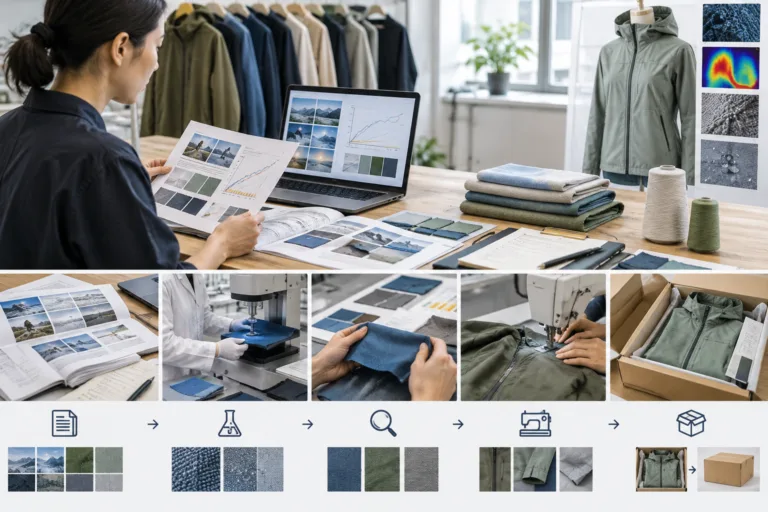
Evidence in a climate responsive clothing concept is information that helps connect a defined environmental condition and wearer situation to a specific design decision. It may support a choice about ventilation, insulation, weather protection, layering, fit, or adjustability, but it should not be treated as proof that one garment will work universally. This guide explains how to assess that connection. Apparel Wiki is an independent educational publication, and its Sponsor information is separate from editorial judgment.
A visually convincing idea is not necessarily an evidence-based concept. Useful climate responsive apparel research must be credible, relevant to the intended use, transparent about its method and limitations, and practical enough to inform development. The first question is not “Does this material sound climate-adaptive?” It is “What decision does this information justify for this wearer, climate, activity, and garment system?”
What Counts as Evidence in a Climate Responsive Clothing Concept?
A climate responsive clothing concept is a garment idea linked to particular environmental conditions, wearer situations, and intended comfort or protection outcomes. The concept might address heat during walking, cold during intermittent outdoor work, rain during a commute, or changing conditions between an indoor space and the outdoors. The environmental description and the wearer problem should be specific enough that another person can understand what the garment is expected to do.
Evidence quality is therefore more than having a source that appears professional. A source may be credible in its own field but unsuitable for a particular garment, market, activity, or climate. Climate information can describe environmental conditions without explaining wearer behavior. A user interview can reveal a recurring frustration without proving why it occurs. A material test can report a property without establishing the performance of a finished garment.
It helps to separate four types of information:
- Observed facts: what was directly seen, recorded, measured, or reported in a defined context.
- Direct-source findings: conclusions from research, technical documentation, testing, or other traceable material.
- Editorial recommendations: practical guidance based on reasoned interpretation, not a universal industry rule.
- Hypothetical examples: illustrations used to explain a method, not evidence of measured performance or market demand.
For climate responsive clothing concepts evidence to be useful, it should match the decision being made. Assess it for source credibility, relevance, transparency, recency where changing conditions make recency important, and practical applicability. When one of these qualities is weak, state the limitation instead of turning an appealing possibility into a definite claim. A source can help generate a design question without being strong enough to support a final product statement.
Start With a Specific Climate and Wearer Problem
Begin by defining who will wear the garment, where and when it will be used, what activity is involved, and what discomfort, risk, or task difficulty the concept addresses. “People in hot climates” is too broad to guide a reliable choice of construction or material. A person walking outdoors in humid conditions may have a different problem from a person working in a shaded, air-conditioned environment, even if both are described as living in a hot region.
Separate long-term climate patterns from short-term weather, seasonal changes, indoor conditions, travel between environments, and personal layering behavior. A climate dataset may help describe a geography and time period, but it does not automatically describe every wearer’s exposure. The concept should identify the environmental information that matters to the decision, such as heat, wind, rain, humidity, temperature change, or the duration of exposure, without assuming that one broad label explains the complete experience.
Keep the environmental context connected to wearer behavior. If a wearer repeatedly rolls up a sleeve, removes a layer, opens a zipper, or adjusts a hood, that action is evidence of a behavior in a particular situation. It is not proof of the behavior’s cause. The wearer may be responding to heat, restricted movement, fabric friction, a poor fit, an activity change, or another layer underneath.
Record the original observation, the setting, the person’s words or actions, competing explanations, and the design decision the observation is meant to inform. Interviews and field observations are valuable problem-discovery evidence, but a small sample should not be presented as proof of universal preference or market size. Treat the problem statement as project-specific and revisable as stronger information becomes available.
Check Whether the Source Actually Supports the Design Claim
The central test is source-to-claim matching. First ask who produced the information, what was measured or observed, how the method was described, and whether the underlying data or limitations can be examined. Then ask whether the source type is appropriate for the claim. Climate data can inform environmental context; user research can inform reported needs and behaviors; laboratory or field testing can inform measured performance; formal requirements should be checked against the relevant authoritative documentation.
Do not confuse a material property with garment-level performance. A fiber, finish, membrane, or fabric construction may have a documented characteristic, but that characteristic does not automatically establish what a completed garment will do. Pattern shape, seam construction, openings, fit, layering, body movement, laundering, ageing, and the surrounding conditions may change the result.
When a source makes a performance claim, look for the tested sample, garment or specimen construction, wear or test conditions, comparison baseline, measurement method, units, and any laundering or ageing conditions. Without this context, a result may be difficult to apply to the proposed design. A transparent supplier report can be useful, but it should not be treated as independent confirmation when the supplier’s information is the only support for a consequential claim.
Marketing language, product photography, historical references, trend reports, and unsourced summaries can provide leads for further investigation. They are not automatically evidence for a material choice or performance expectation. Likewise, a named research publication or standard may improve traceability without proving suitability for every application. The relevant question remains whether its scope, sample, method, and conditions match the garment decision.
Evaluate Climate, Material, and Garment Performance Together
Assess the concept as a chain: environmental condition, wearer need, garment mechanism, measurable or observable outcome, and acceptable trade-off. This keeps the design rationale visible. For example, a concept might propose an adjustable opening in response to changing activity, but the claim still needs to identify when the opening is expected to help, how the wearer will use it, and what weather protection or construction complexity may be affected.
Consider fabric structure, weight, air movement, moisture handling, insulation, drying behavior, wind or rain exposure, fit, openings, layering, and adjustability only when they are relevant to the defined situation. These factors interact at garment level. A lightweight material may support one design goal while creating concerns about durability or weather protection. Greater ventilation may improve perceived comfort in one situation while reducing protection in another.
Separate intended function from user-perceived comfort. Comfort can also depend on activity, fit, skin contact, acclimatization, personal preference, and the interaction of multiple clothing layers. A design feature should therefore be presented as a hypothesis to evaluate, not as a guaranteed outcome. Avoid universal fabric recommendations and unsupported performance rankings.
Before development advances, state what success would look like and under which conditions it should be evaluated. The evaluation may involve a defined task, wearer group, environment, garment configuration, and comparison approach. This garment-system perspective gives designers, developers, quality teams, and sourcing professionals a clearer basis for deciding what information is still missing.
Use a Practical Evidence-Quality Review Before Prototyping
Before sampling begins, convert the concept into a claim that can be checked. Identify the intended wearer, environmental condition, activity, garment feature, and expected outcome. For example, a concept might propose that an adjustable opening helps a particular wearer manage changing comfort during a defined task. This wording is more useful than saying that the garment is “adaptive” or “suitable for hot climates” without explaining the situation.
Next, create a source record for every important design decision. Note who produced the information, when it was created, what was measured or observed, how the method was described, which population or sample was involved, and what limitations were stated. Record the exact claim the source can support. A source may support an observation about a material under specified conditions without supporting a broader claim about a finished garment.
A concise apparel research checklist can assess each source for four project-specific qualities: relevance to the intended use, credibility of the origin, transparency of the method, and transferability to the proposed garment. These qualities can be weighted differently depending on the project. They are not a universal industry scoring system, and a subjective score cannot replace testing or professional judgment. A weaker source may still help generate questions, even when it is not strong enough to justify a final performance statement.
- Relevance: Does the information address the same climate, activity, wearer situation, and design decision?
- Credibility: Is the source competent and appropriately positioned to make the claim?
- Transparency: Can readers understand the sample, method, conditions, comparison, and limitations?
- Transferability: How much of the finding can reasonably apply to the proposed fabric, fit, construction, and use?
When sources disagree, compare their definitions and conditions before choosing one. Differences may come from sample construction, garment fit, activity level, laundering or ageing, environmental exposure, or the outcome being measured. Keep a decision log that records which evidence informed each choice. If an assumption remains unsupported, assign a next action: locate a stronger source, interview users, build a prototype, conduct a wear trial, or remove the claim.
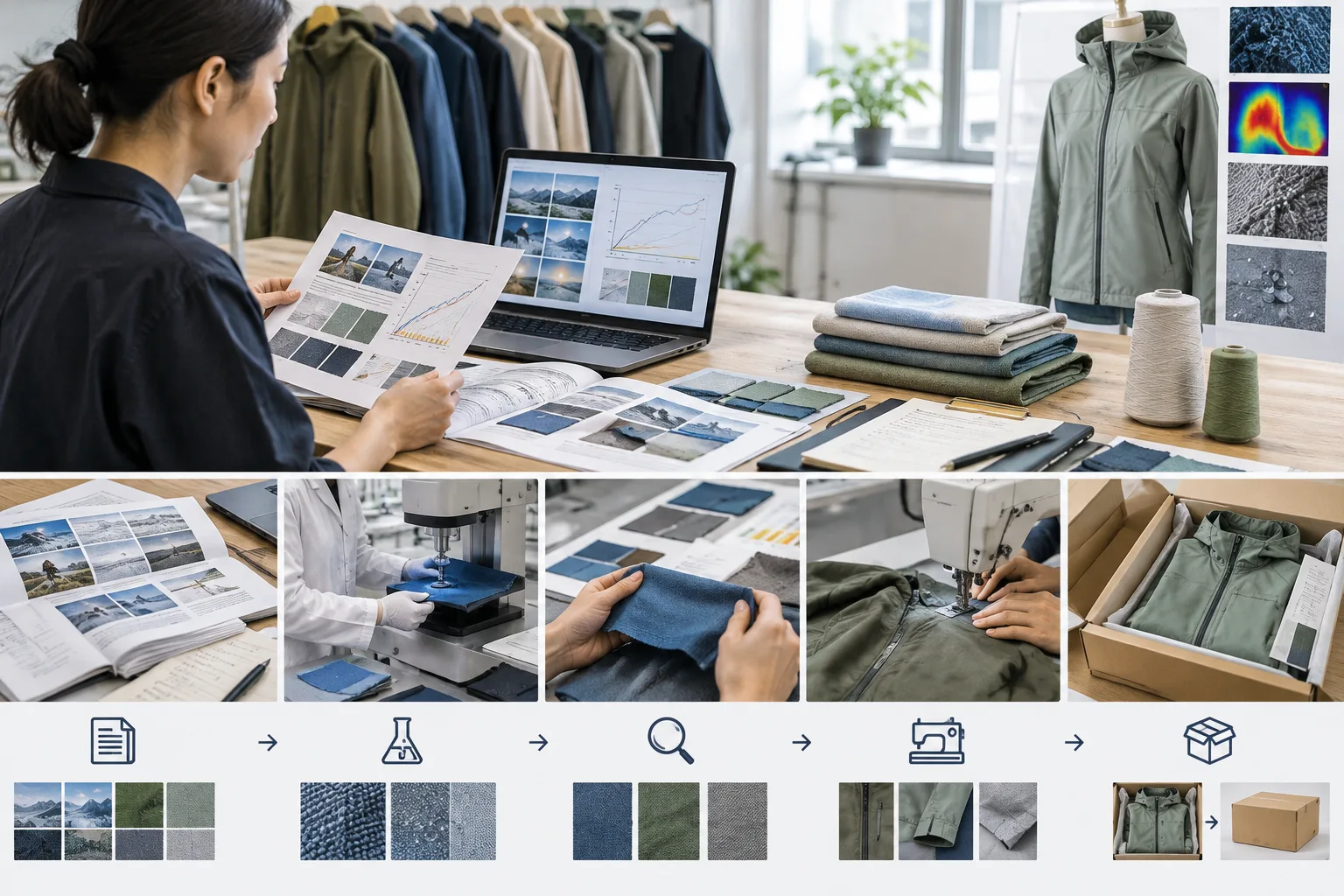
Know When Information Is Not Transferable
Evidence for climate responsive clothing concepts is always connected to context. Information from a hot, humid outdoor activity may not answer a question about intermittent travel between air-conditioned interiors and warm streets. A seasonal climate average may not describe a short rain event, a heat wave, or a specific indoor environment. Differences in activity, layering, fit, body profile, maintenance, and personal preference can also change the result.
Controlled testing and real-world wear provide different kinds of information. A controlled test can help isolate a material or construction variable under stated conditions. A wear trial can reveal movement, fit, adjustment behavior, perceived comfort, and practical problems that are difficult to capture in a simplified test. Neither type should automatically replace the other, and a result should not be transferred without checking whether the garment system and evaluation conditions are sufficiently similar.
User research requires the same discipline. A person repeatedly pulling at a sleeve is evidence of an observed action in a particular context. It is not, by itself, proof that sleeve length caused the action. Activity, friction, layering, temperature, or an unrelated fit issue may be involved. Small interviews and field observations are valuable for discovering problems and competing explanations, but they do not establish broad consumer demand or universal preference.
Design inspiration also has a different status from factual evidence. An archival garment, reference image, trend report, or supplier presentation may suggest a construction idea or research question. It does not automatically establish why the original garment worked, whether it achieved the claimed climate function, or whether the same detail is appropriate for a new wearer and use case. Keep inspiration, direct findings, and editorial recommendations clearly separated in the concept record.
Specialist review is appropriate when a concept involves safety, occupational exposure, medical needs, or a regulated protective function. This article offers editorial guidance for evaluating information; it does not establish legal compliance, medical suitability, or protective performance. Those conclusions require relevant, jurisdiction-specific, and project-specific expertise.
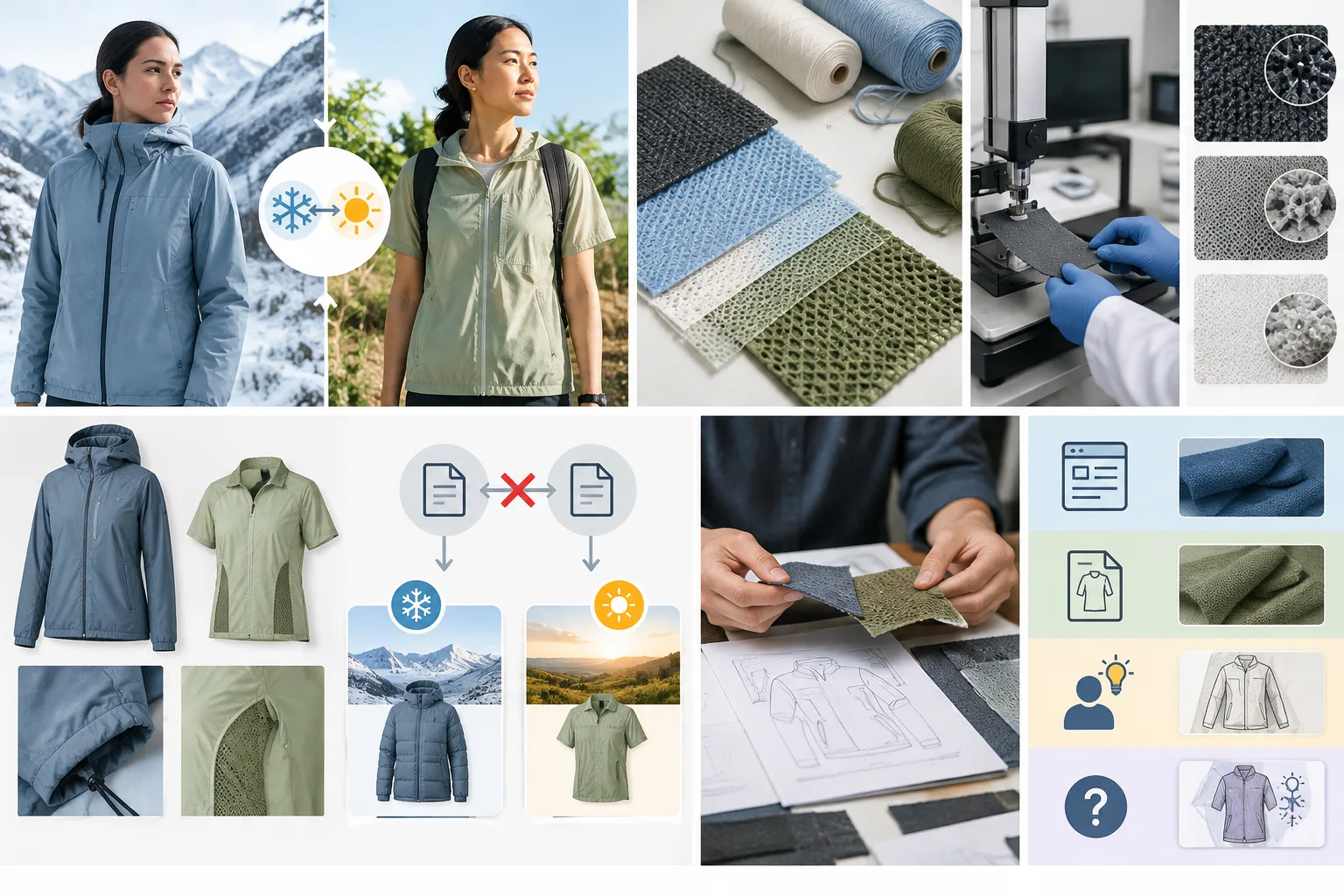
Turn a Defensible Evidence Base Into the Next Design Step
A minimum evidence package should identify the wearer and scenario, describe the relevant environmental conditions, connect the design rationale to traceable information, and state how the intended outcome will be evaluated. Turn unresolved questions into prototype variables such as opening placement, fit, layering, material selection, construction, or user-adjustable features. Compare two or three concepts using the same task and evaluation conditions where possible, then record what the prototype demonstrates and what remains uncertain.
Do not place unsupported performance claims in product or marketing copy simply because a feature appears plausible. Keep stronger technical, climate, user-research, and testing sources attached to the final concept record. Apparel Wiki readers can also use the site’s Apparel Manufacturing Tools as a related reference point while planning development work. The purpose of an evidence review is not to eliminate uncertainty; it is to make the next design decision more transparent and testable.
What is evidence in a climate responsive clothing concept?
Evidence is information connecting a defined environment and wearer situation to a design decision and intended outcome. It may include climate information, user observations, direct research, technical documentation, or prototype findings, provided its limits are clear.
How can I tell whether a clothing performance claim is supported by reliable information?
Check the source, method, sample, conditions, comparison, measurement, and limitations. Confirm that the evidence addresses the finished garment and intended use rather than only a general material property or marketing description.
Can climate data alone determine the right fabric or garment construction?
No. Climate data helps describe environmental conditions, but fabric and construction decisions also depend on activity, fit, layering, wearer needs, maintenance, and the intended balance between comfort, protection, durability, and complexity.
How should user interviews be used when developing climate responsive apparel?
Use interviews to discover behaviors, discomforts, tasks, and competing explanations. Treat the findings as project-specific problem-discovery evidence, not as proof of universal preference, market size, or the cause of an observed behavior.
When should a climate responsive clothing concept move from research to prototype testing?
Move forward when the wearer, scenario, environmental context, design rationale, and intended outcome are defined well enough to test. Any unresolved assumption should be listed as a prototype question rather than hidden in the concept claim.
Why might a clothing test result not transfer to another climate or wearer group?
Results can depend on climate, activity, fit, body profile, layering, garment construction, maintenance, and test conditions. A finding from one material or garment system should be transferred only after those differences are considered.