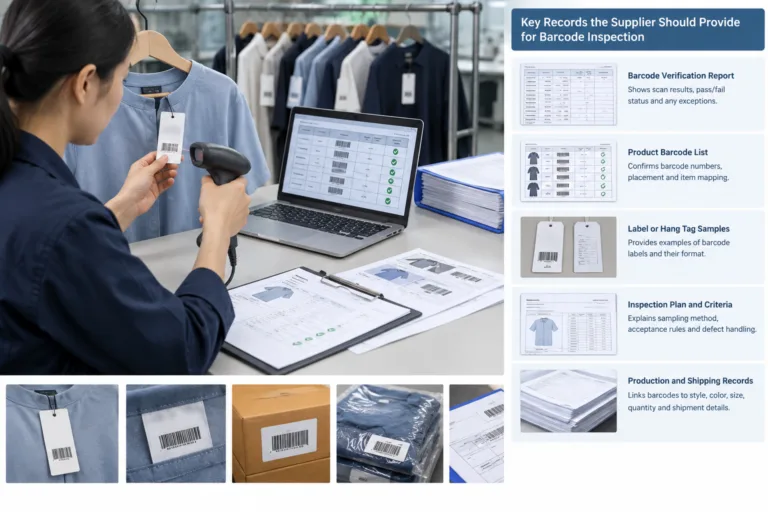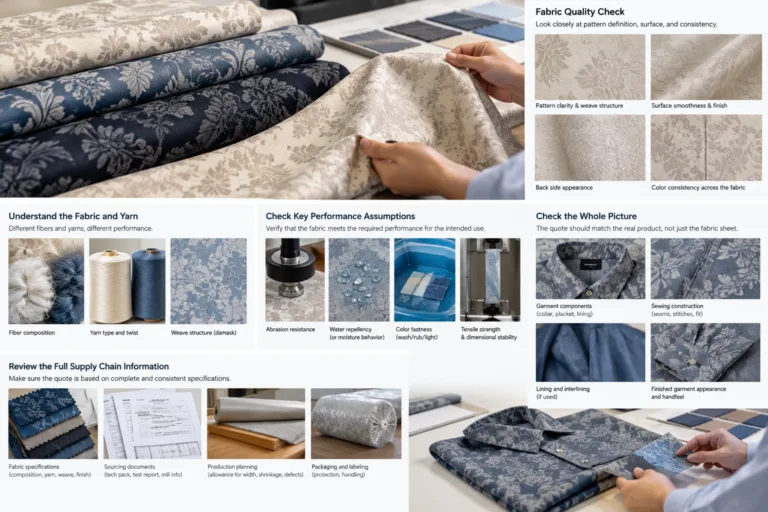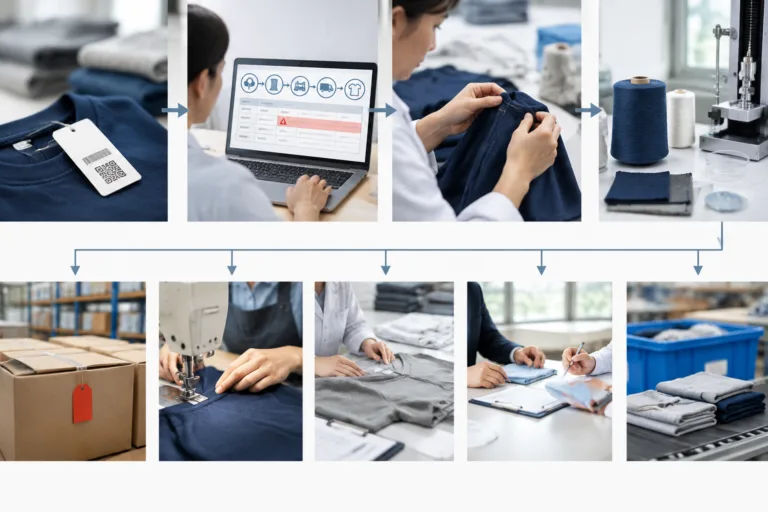
Lot traceability decision criteria are the agreed factors used to decide what happens to a garment production lot after an inspection finding. In practice, the decision should connect the finding to a defined lot, product identity, process history, inspection scope, defect classification, and named decision-maker. It should then guide an appropriate response, such as containment, investigation, rework, reinspection, conditional release, or rejection.
For Apparel Wiki, an independent apparel industry knowledge blog, this is an educational framework rather than a factory service or universal acceptance rule. Our editorial work is supported separately from editorial control; see Sponsor for that distinction. The correct decision depends on the product, customer or contract requirements, applicable market obligations, and the reliability of the records behind the finding.
What lot traceability decision criteria mean in garment production
Lot traceability in garment production means being able to connect a particular product grouping with enough identifying information to understand where, when, and under what conditions it was made or inspected. A “lot” is not automatically one shipment, one purchase order, or everything produced by one supplier. Its boundary is project-dependent and should be documented.
A lot may be defined by style, color, size range, order reference, production date, line, shift, supplier, material input, or another grouping that makes operational sense. A brand may need a narrower boundary when a fabric batch, subcontractor, or production window is relevant. A factory may use a different internal grouping, provided the relationship between the internal record and the commercial order remains clear.
The central question is not simply, “Did the sample pass?” It is, “What does this finding reliably tell us about the defined scope, and what action is justified by that evidence?” A traceability finding supports a decision about the inspected or documented scope. It is not automatically proof that every unit in wider production is defective, and it is not proof that all uninspected units are defect-free.
Useful decision criteria usually include:
- the exact product identity and lot boundary;
- the operation, material, supplier, line, shift, or time period connected to the finding;
- the inspection stage, quantity presented, quantity checked, and counting method;
- the defect type, severity, location, and effect on use, appearance, fit, construction, labeling, or safety; and
- the person or role authorized to decide disposition.
These criteria should be separated from general site practice, customer or contract requirements, and legal or regulatory obligations. There is no single lot structure or response that applies to every apparel program worldwide.
Which traceability facts must be confirmed before making a production decision
Before interpreting an inspection result, confirm that the evidence belongs to the correct product and production scope. A supplier or factory name alone is not enough to establish responsibility for a specific finding or to prove stable process capability. Commercial parties, production parties, and subcontractors may be different entities, so the record should identify their roles where the evidence and project documents support that distinction.
A practical pre-decision record should answer the following questions:
| Record area | What to confirm |
|---|---|
| Product identity | Style, color, size or assortment, order reference, and any relevant material or construction identifier |
| Lot boundary | The quantity and grouping covered by the lot, including production location, date, line, shift, or supplier when relevant |
| Inspection context | Inspection date, process stage, quantity presented, quantity checked, and whether the result came from incoming, in-line, final, or return inspection |
| Counting basis | Sampling method, inspection instructions, defect definitions, measurement points, and how affected pieces and defects were counted |
| Disposition status | Affected pieces, defect counts, reworked pieces, released units, and units still awaiting a decision |
Also check whether the physical or digital records can distinguish the inspected garments from the remaining lot. If a finding is recorded only as “production problem” or “supplier issue,” it may be too vague to support containment or corrective action. The record should connect the observation to identifiable evidence, such as a measurement, photograph, garment reference, operation, or documented inspection note.
Missing, conflicting, or unverifiable fields are themselves a decision risk. Do not silently fill gaps with assumptions. Depending on the potential consequence, the responsible team may need to hold the affected scope, clarify the record, repeat a defined inspection activity, or escalate the issue to the authorized quality or commercial decision-maker.
How to interpret defect findings without confusing defect counts and affected units
One garment can contain multiple defects, so the number of affected garments and the total number of defects are different measures. An affected-unit count answers, “How many checked garments had at least one recorded defect?” A defect count answers, “How many individual defect observations were recorded?” Neither measure should be treated as a complete acceptance rule without the agreed inspection plan and product requirements.
For a clearly labeled hypothetical example, suppose inspectors check 200 garments, identify 12 garments with one or more defects, and record 18 defects in total. The affected-unit rate is 12 divided by 200, or 6%. The defect frequency is 18 divided by 200, or 9 defects per 100 checked units. The first measure describes the spread among garments; the second reflects the total number of observations. They answer different questions and cannot be compared as though they were the same percentage.
Interpret each finding in context. Classify it according to the agreed product or customer standard, considering its effect on safety, intended use, appearance, fit, construction, labeling, or contractual requirements. Use established defect examples, measurement points, tolerances, and reference images where available so different evaluators apply the same basis.
Pattern matters as well as frequency. A single isolated issue, repeated stitching failure at one operation, concentration in one size or color, and similar findings across several lots may lead to different investigations. The pattern can suggest where to look, but correlation alone does not prove root cause or assign responsibility.
Do not equate an affected-unit percentage with an allowed delivery percentage, and do not treat the example above as an acceptance-sampling rule. Any severity category, acceptance limit, or escalation threshold must come from the applicable product specification, customer agreement, safety basis, quality system, or other documented authority.
The decision criteria that determine containment, rework, or release
After the finding and its scope are confirmed, assess the decision in a consistent order. First consider immediate risk: a possible safety or labeling concern, loss of intended function, contamination concern, or defect that could continue spreading through unfinished production. Where a serious risk may exist, controlling the potentially affected scope takes priority over completing routine shipment activities.
Next assess scope confidence. How clearly is the finding linked to a lot, operation, time period, material input, supplier, subcontractor, line, or shift? A well-defined scope supports a more targeted response. An uncertain boundary increases residual exposure because the team cannot confidently identify which units require control.
Then evaluate frequency, pattern, and recoverability. Ask whether the issue is isolated or recurring, concentrated or distributed, correctable under a known method, and verifiable after correction. Rework is meaningful only when the correction will not introduce new defects and the corrected characteristic can be checked reliably.
The response should match the evidence and the authority assigned by the project. Possible actions include:
- Containment: identify or isolate the potentially affected lot while the evidence is clarified.
- Investigation: review the process, material, records, and comparable lots without assuming causation too early.
- Rework: correct the defined issue under an approved method and verify the result.
- Reinspection: address a specific uncertainty in the original evidence or inspection execution.
- Conditional release or concession: use only where documented authority permits it and safety, legal, and binding customer requirements are not bypassed.
- Rejection: consider when the issue is critical, systemic, outside reliable recovery, or impossible to verify adequately.
This framework is a decision aid, not a universal acceptance table. Quality, production, buyer, technical, or another named role should have clearly assigned authority. Repeated sampling until a result happens to pass is not a substitute for investigating a recurring process problem.
A practical workflow for turning a traceability finding into an action
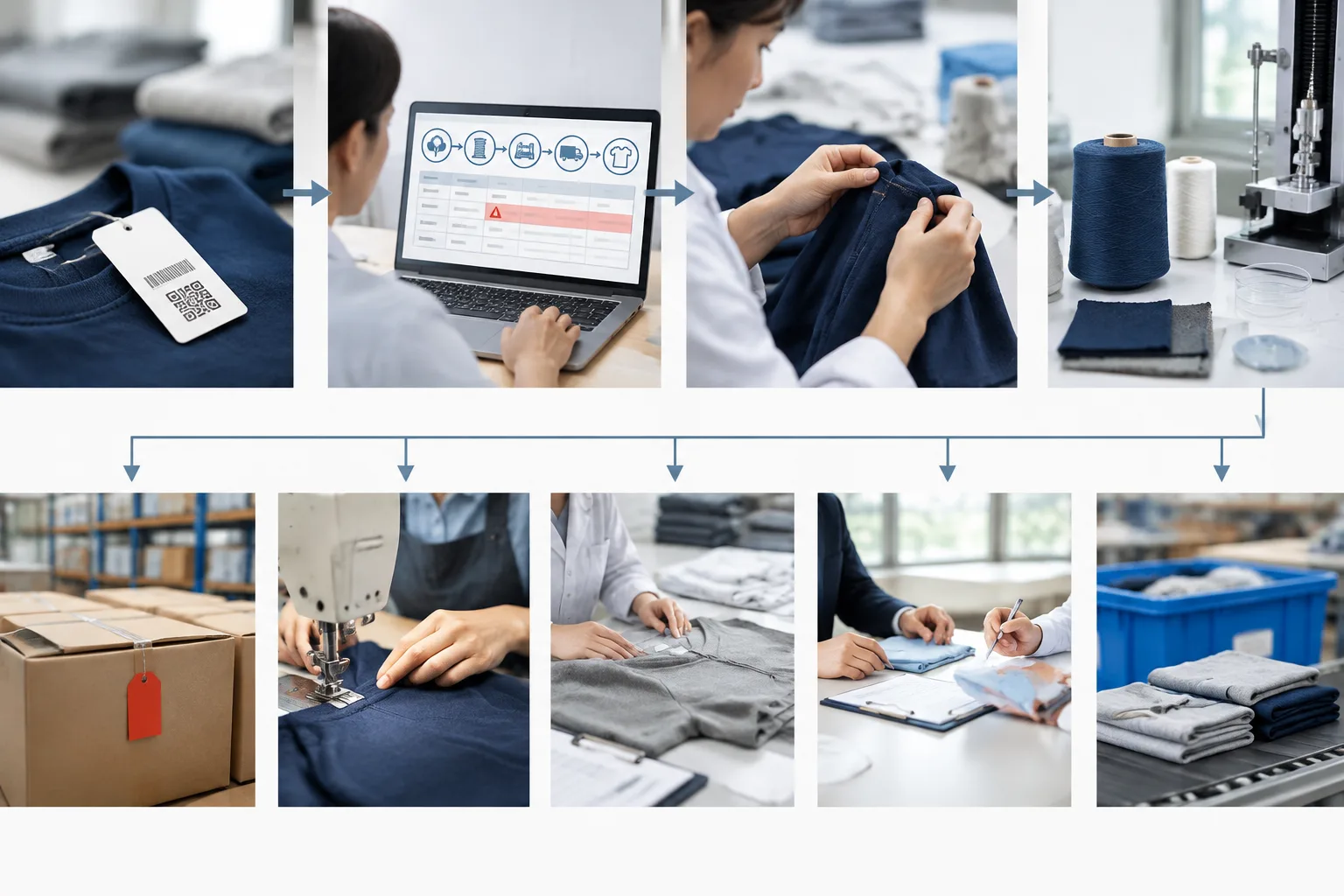
A traceability finding is useful when it leads to a controlled, documented action. Adapt this sequence to the project’s quality system and contract; it is a practical workflow, not a universal acceptance procedure.
- Contain the possible scope. Identify or hold units that may be affected while the finding is clarified. Define the boundary using available records, such as style, color, order, production period, line, or material input. If the boundary is uncertain, record that uncertainty rather than treating the inspected sample as the full scope.
- Confirm the evidence. Check the lot identity, inspection stage, quantity presented and checked, sampling basis, defect evidence, and counting method. Resolve conflicting records before comparing the result with a requirement.
- Classify the finding. Apply the agreed defect descriptions, measurement points, and severity criteria. Keep the number of affected garments separate from the number of defects, and note whether findings cluster by size, color, operation, or time.
- Investigate without assuming cause. Map relevant processes, materials, suppliers, subcontractors, lines, shifts, and time windows. A pattern can help focus an investigation, but correlation alone does not establish who or what caused the issue.
- Assign and document the disposition. Record the selected action, its scope, the responsible owner, any deadline, and who has authority to approve release or escalation. Keep containment, root-cause investigation, and correction distinct.
- Correct and verify. Use an approved correction method where applicable, then check the specific characteristic that failed. A general visual review may not verify a measurement, construction, or labeling issue.
- Close the record. Document quantities affected, corrected, rejected, or still on hold; the verification result; remaining exposure; and any preventive process change. This record can inform future decisions without proving that every uninspected unit is defect-free.
How to choose between reinspection, concession, and rejection
Choose a disposition to address the evidence and risk, not to obtain a preferred result. Reinspection can help when the first inspection has a defined gap, such as unclear documentation or an execution question. State what uncertainty it will resolve and how the follow-up scope will be set. Repeating samples until one passes does not resolve a recurring process concern.
Rework is a separate option: it makes sense only when the correction method is understood and the corrected characteristic can be verified. A concession or conditional release needs documented approval from the role authorized by the project, a clear description of the deviation, and confirmation that the decision does not bypass applicable safety, legal, or binding customer requirements.
Rejection or wider containment may be more defensible when the finding presents a serious risk, the lot boundary cannot be established, the problem appears systemic, or correction cannot be verified reliably. There is no single disposition that fits every garment or market. Apply the governing contract, quality system, and relevant product requirements.
For a consistent comparison, document evidence strength, risk, recoverability, verification method, approval authority, and residual exposure for each option. Keep a lot disposition separate from a supplier-wide capability judgment: broader conclusions require comparable evidence across lots and a stated timeframe.

What traceability findings cannot prove and how to improve future decisions
Traceability can connect a finding to a defined production scope, but it does not by itself establish root cause, intent, or the condition of every uninspected unit. A sample result is evidence within the inspection basis used; it is not a guarantee about the entire lot. Likewise, photos, equipment lists, company size, or country of manufacture do not independently prove stable performance for a particular fabric, construction, and order combination.
Stronger decisions start before production. Agree on lot boundaries, defect examples, measurement points and tolerances, sampling and counting rules, record expectations, subcontracting visibility, and approval authority. Requirements depend on the product, destination market, and contract, so do not assume one record format or retention rule applies everywhere.
Review trends across comparable lots to spot recurring operations or materials, while keeping conclusions tied to the records and period reviewed. Useful next steps may include updating the inspection standard, improving production records, or adding a targeted process check. Apparel Wiki is an independent apparel-industry educational publication, not a factory, manufacturer, or production service provider.
Frequently asked questions
What is lot traceability decision criteria in apparel production?
These are the agreed factors used to decide what happens to a production lot after an inspection finding. They connect product and lot identity, inspection scope, defect evidence, risk, recoverability, and decision authority.
Does a failed sample mean the entire garment lot must be rejected?
Not automatically. The result must be interpreted under the inspection plan, lot boundary, defect requirements, and applicable contract. It may justify holding or investigating a wider scope, but a sample does not establish the condition of every unit.
What is the difference between affected garments and total defects?
Affected garments are the units with one or more findings; total defects count each recorded finding. One garment can have multiple defects, so the counts answer different questions.
When should a production lot be isolated, reworked, reinspected, or rejected?
Base the choice on risk, confidence in the lot boundary and evidence, whether correction is feasible, and whether the result can be verified. Follow the authority and requirements established for the project.
Can a buyer accept a lot through a quality concession?
Only where the authorized parties and applicable requirements permit it. A concession should document the deviation and approval; it cannot override a binding requirement or make an otherwise prohibited product acceptable.
What information should a garment lot traceability record contain?
Useful fields include product and order identity, defined lot scope, production location where relevant, inspection date and stage, quantities presented and checked, sampling basis, findings and counting method, disposition, responsible owner, approvals, and verification results. The exact requirements depend on the project and applicable rules.