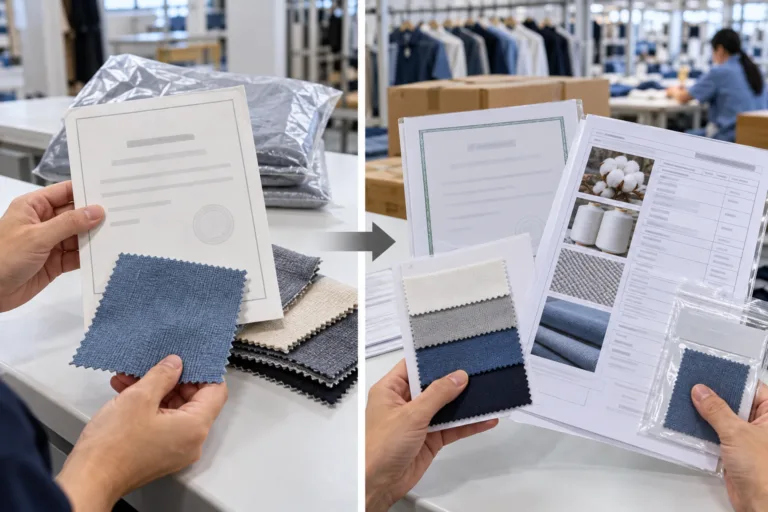
A textile lifecycle mapping assessment is a review of whether a learner or team can interpret, explain, question, and apply a map of a textile product’s stages, inputs, decisions, and assumptions. It measures visible reasoning rather than memorization: can the person explain what the map covers, identify what it leaves out, connect claims to evidence, and qualify uncertainty?
For an independent educational publication such as Apparel Wiki, that distinction also protects editorial clarity. The Sponsor page explains the separation between sponsorship and editorial control; the same principle applies here. An assessment should make its evidence and limits visible. It should not imply that Apparel Wiki is a manufacturer, factory, laboratory, certification body, or compliance authority.
The map’s purpose, product definition, system boundary, geography, data sources, and intended decision determine what competent understanding should include. A map created to support classroom discussion may require a different explanation from one prepared to inform a sourcing question. Textile lifecycle assessment studies, as described by Textile Exchange, provide useful terminology and context, but this article’s assessment framework is an editorial tool for learning and team review, not a universal grading standard.
What Is a Textile Lifecycle Mapping Assessment?
Textile lifecycle mapping is the practice of representing a textile product’s relevant journey or system in a structured way. Depending on the project, that journey may include material preparation, yarn and fabric production, finishing, garment manufacture, use, care, reuse, recycling, or disposal. There is no single lifecycle map that accurately represents every textile product. Stages and boundaries are selected for a particular purpose.
A textile lifecycle mapping assessment therefore asks whether the learner understands the specific map in front of them. It is not a test of whether they can recite terms such as fiber, production, use, or end of life. A stronger assessment asks the learner to describe the map to another person, challenge an unsupported assumption, explain why a conclusion depends on a chosen boundary, or apply the map to a carefully controlled hypothetical change.
The assessment should look for evidence in four related areas:
- Interpretation: Can the learner identify the product, stages, flows, and decision points represented?
- Explanation: Can the learner communicate the map clearly without presenting estimates or uncertain claims as established facts?
- Questioning: Can the learner identify missing information, alternative assumptions, and limits on the conclusion?
- Application: Can the learner use the map to compare or investigate a defined scenario without extending the result to all textiles?
This makes the quality of reasoning and evidence use more important than the apparent complexity of the diagram. A visually detailed map may still be poorly understood if its sources, assumptions, or system boundary cannot be explained. Conversely, a simple map may show strong understanding when the learner can state exactly what it does and does not support.
What Should a Learner Be Able to Explain?
Start by asking the learner to identify the object being mapped. They should be able to state whether the map concerns a fiber, yarn, fabric, finished garment, or another defined product, and describe its material composition as far as the available information allows. Vague phrases such as “a sustainable fabric” do not identify the mapped textile adequately.
Material identity has several layers that should remain distinct. Fiber content describes the material category or blend. Yarn describes how fibers have been formed into a textile input. Fabric construction describes how the textile is made, such as through woven or knitted structures. Finishing describes treatments or processes applied after or during fabric formation. A commercial name may not communicate all of these layers, and a construction label should not be treated as a fiber name.
A learner should also be able to explain which process steps the map includes. This may involve identifying selected inputs, outputs, flows, or decision points, while acknowledging when the map does not contain enough information to describe them fully. The learner does not need to invent missing data. Recognizing an unresolved gap is part of understanding.
Next, test the assumptions behind the map’s conclusion. Ask how the interpretation could change if the use period, care behavior, production route, geography, or end-of-life scenario changed. The expected answer is not necessarily a new result. It may be a reasoned statement that the available map cannot determine the effect without additional data or a revised boundary.
A useful short prompt is: “Explain this map to a non-specialist, then identify one conclusion it supports and one conclusion it cannot support.” A capable response should name the product and scope, describe the main stages in sequence, distinguish sourced information from assumptions, and avoid turning a classroom example into a universal claim about a material or textile category.
How to Collect Evidence of Understanding
Use a small set of tasks instead of relying on a vocabulary quiz. Begin with an explanation task. Ask the learner to state the map’s purpose, product definition, boundary, main flows, key assumptions, and uncertainties. Record the response or use a consistent note sheet so that another reviewer can see what was actually demonstrated.
Follow with an interpretation task involving one controlled change. For example, change one material identity, finishing route, use assumption, or end-of-life scenario while keeping the other stated conditions constant. Ask what might change and why. This is a learning exercise, not automatically a quantified environmental finding. Changing one variable helps clarify reasoning, but real textile systems can contain interacting variables.
Add a source-checking task. Have the learner label each important statement as one of the following:
- Directly supported by a cited source
- An explicit project assumption
- An estimate or approximation
- An editorial interpretation
- An unresolved information gap
This classification prevents different kinds of statements from being treated as equally authoritative. Introductory explanations, technical guidance, standards, and research can serve different purposes and carry different limits. Commercial descriptions and supplier catalogs may provide useful product information, but they should not automatically be presented as independent evidence.
Finally, ask the learner to identify one decision the map can inform and one decision it cannot inform without further work. Retain the map version, assumptions, source notes, learner response, and reviewer comments. Keeping these records makes later revisions easier to compare and shows whether a changed conclusion resulted from new evidence, a changed boundary, or a different interpretation.
A Practical Rubric for Reviewing the Result
The following qualitative rubric is an editorially proposed tool for education and team review. It is not a certification scheme, regulated grading system, or claim that a learner has professional production, laboratory, or compliance capability. Use it to make observations consistent, then describe the specific evidence behind the judgment.
| Assessment dimension | Observable evidence | Common warning sign | Follow-up action |
|---|---|---|---|
| Map comprehension | Identifies the product, purpose, stages, boundary, and main flows accurately. | Repeats lifecycle terms but cannot explain what the particular map represents. | Ask for a plain-language explanation using the map itself. |
| Material and process accuracy | Keeps fiber content, yarn, construction, finishing, and process steps distinct. | Treats a fabric name, construction, or marketing label as complete material information. | Require a layered description and mark unknown details explicitly. |
| Boundary and assumption awareness | States what is included, excluded, assumed, or dependent on context. | Extends a product-level observation to an entire textile category or industry. | Repeat the explanation with the boundary written beside the map. |
| Evidence handling | Links claims to sources and separates evidence from estimates and interpretations. | Uses a commercial claim or unsourced number as if it were independent proof. | Complete a source-labeling exercise and identify missing provenance. |
| Decision relevance | Explains what the map may help investigate and what requires more information. | Uses a classroom sample to declare one textile option universally superior. | State the intended decision and list the evidence still needed. |
Strong performance connects claims to the map, qualifies uncertainty, and explains what additional information would be needed. Partial performance may include correct terminology but weak links between evidence, assumptions, and conclusions. Insufficient performance treats labels, commercial descriptions, or a single example as proof of universal textile behavior.
How to Test Trade-Offs Without Overclaiming
Trade-off questions can reveal whether a learner understands how a textile lifecycle map responds to changed assumptions. Use hypothetical comparisons only when the map contains enough relevant information to make the question meaningful. The goal is to assess reasoning, not to declare one material universally better.
Ask the learner to name what stays constant and what changes. For example, a prompt might change one specified material, finishing route, use period, care assumption, or end-of-life scenario while holding the others steady. Then ask what parts of the map may need to be reconsidered and why. Changing one variable at a time makes the exercise easier to interpret, but it does not eliminate interactions among composition, construction, finishing, specifications, and use conditions.
Keep predicted direction separate from measured result. A learner may explain why a changed assumption could affect a conclusion, but a classroom comparison is not a quantified environmental finding. If the map lacks relevant data, the sound answer is to identify the limitation and explain what information would be needed, rather than fill the gap with a confident guess.
When a comparison matters to a real sourcing, design, or communication decision, it may call for a revised boundary, better primary data, repeat work, or specialist review. Without appropriate evidence, use the scenario to test understanding only.

Common Assessment Mistakes and Evidence Gaps
A common mistake is rewarding correct terminology without checking whether the learner can interpret the particular map. Someone may name lifecycle stages yet miss what product, route, geography, or decision the map actually covers. Ask for claims to be connected to visible map details and have the learner state where the map stops.
Boundary confusion can turn a limited observation into an unsupported generalization. A finding about one mapped product or scenario does not automatically describe a whole textile category or industry. Likewise, a supplier catalog, commercial description, or marketing claim may help identify what is being discussed, but it should not be treated as independent evidence for a broader conclusion.
Review the record as well as the explanation. Missing source provenance makes claims difficult to check; unclear assumptions obscure how conclusions were reached; inconsistent units can make entries hard to compare; and unrecorded map revisions make it unclear which version was assessed. A gap in data is not a negative result, and uncertainty is not proof that a claim is false or true.
Questions involving equipment, chemicals, children’s products, protective products, or regulated applications need appropriate technical guidance and attention to applicable rules. Apparel Wiki is an independent educational publication, not a laboratory, manufacturer, certifier, or compliance authority. A learning exercise cannot substitute for qualified instruction or project-specific technical review.

What to Do After the Assessment
Choose the next step based on the observed gap. If the learner understands the map but describes the textile vaguely, assign a focused exercise identifying fiber content, yarn, construction, finishing, and relevant specifications. If boundaries or assumptions remain unclear, repeat the mapping task with a simpler product and document its scope explicitly.
If the map may inform sourcing, design, or environmental communication, list the claims that need stronger support. Depending on the question, that may mean primary supplier information, appropriate testing, an authoritative external source, or specialist review. Keep the map version, assumptions, source notes, learner response, and reviewer comments together so later revisions can be compared.
The outcome can be to continue learning, revise the map, seek technical support, or retain the result as a limited educational exercise. Completing terminology tasks does not establish production, laboratory, equipment, or compliance capability. For related apparel workflow references, see Apparel Manufacturing Tools.
Frequently Asked Questions
What is a textile lifecycle mapping assessment?
It is a task-based review of whether a learner or team can interpret, explain, question, and apply a textile lifecycle map within its stated scope.
How can I tell whether someone understands a textile lifecycle map?
Ask them to explain the map’s purpose, product, boundary, assumptions, evidence, and limitations, then apply that understanding to a clearly defined hypothetical change.
What evidence should a learner provide after completing a textile lifecycle map?
Useful evidence includes an explanation tied to the map, labeled sources and assumptions, identified uncertainties, and a clear statement of what the map can and cannot support.
Can a classroom textile lifecycle exercise prove that one material is more sustainable?
No. A classroom exercise can test reasoning, but it does not establish a universal comparison. Any comparative claim needs suitable scope, evidence, and method for the question being asked.
What should be checked before using a lifecycle map to support a product or sourcing decision?
Check the product definition, boundary, assumptions, source quality, data gaps, and whether the evidence is suitable for the intended decision and claim.
When is specialist or external technical review needed?
Seek appropriate review when important claims depend on missing or uncertain data, when the decision has technical or regulated implications, or when the map’s scope cannot support the intended conclusion.