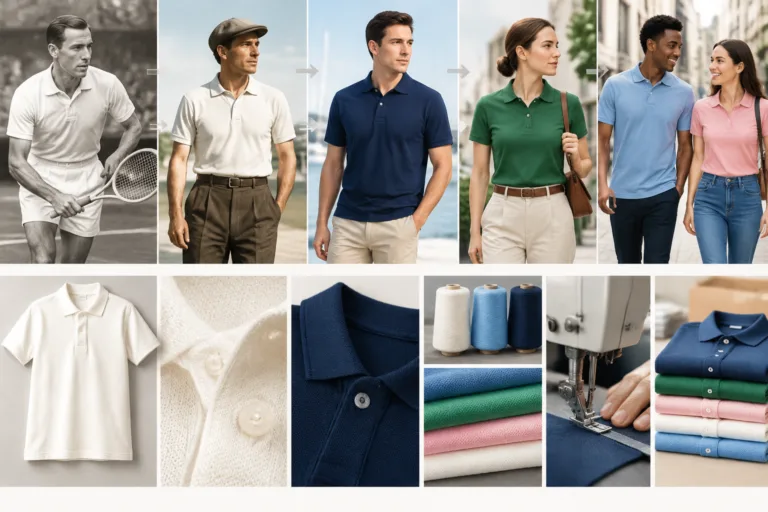
The history of polo shirts is not a single invention story. A polo shirt is a short-sleeved knitted or knit-like top usually associated with a collar, a partial front opening, and practical use in sport, leisure, or everyday dress. Its exact collar, placket, sleeve, hem, fabric, and fit have changed by period, maker, region, and intended use. Apparel Wiki is an independent educational publication; its Sponsor information does not determine editorial conclusions.
The most careful answer to “where did the polo shirt begin?” is that several milestones must be separated. An early related garment, a dated photograph, a patent, a commercial product launch, a brand’s naming decision, and widespread adoption are different kinds of evidence. The record may connect them, but one cannot automatically prove all the others. This distinction is central to understanding polo shirts history without turning a popular origin story into a universal fact.
What Is a Polo Shirt, and What Does Its History Actually Begin With?
In working historical terms, the polo shirt is a collared knit top designed or adapted for ease of movement and informal wear. The familiar version often has short sleeves, a two- or three-button placket, a ribbed or folded collar, and a straight or slightly shaped body. Those features are useful identifiers, not universal specifications. Earlier examples may have different openings, collar treatments, sleeve proportions, closures, or fabric structures while still belonging to the same developing family of garments.
That makes the starting point of the history of the polo shirt a question of definition as well as chronology. If the category is defined narrowly, the researcher may look for an early garment that closely resembles a modern polo shirt. If it is defined more broadly, related collared knitted sports tops and informal shirts become relevant precedents. Neither approach should be treated as automatically correct. The definition should be stated before evidence is selected.
Five milestones that should not be collapsed
- Surviving garment: an object that can be examined for construction, materials, condition, and possible date.
- Visual record: a photograph, illustration, or film image showing a garment in a particular setting.
- Commercial or legal record: a catalogue, advertisement, patent, company document, or product description tied to a date.
- Named product or brand: evidence that a maker or seller used a particular term or promoted a recognizable version.
- Broad adoption: evidence that the form appeared across multiple settings, markets, or social groups over time.
These milestones answer different questions. A museum object can establish that a form existed, but it may not explain who wore it or how common it was. A patent can document a claimed feature, but it does not demonstrate that the feature became standard. An advertisement can reveal intended customers and commercial language, but advertising alone is not proof of actual use. A later brand history may be useful context while still presenting a selective account of the garment’s development.
For that reason, no single object, athlete, designer, or company should automatically be called the sole inventor of the polo shirt. A defensible account compares collection records, contemporary images, dated descriptions, commercial documents, and social context. It also uses approximate dates only when the underlying record supports them. The main story to trace is therefore a sequence of changes: from related collared sports forms, to more recognizable knit construction, to commercial naming and distribution, and finally to varied everyday use.
Early Polo Shirts and the Development of a Practical Sports Form
Early polo shirts are best understood through overlapping sporting and informal clothing traditions rather than through one universally documented starting garment. Historical photographs, sporting records, clothing descriptions, catalogues, and surviving examples may show collared short-sleeved tops in use before the modern category was fully stabilized. Those records can establish relationships between the garment form and sport, but they do not always prove that the wearer, seller, or observer used the term “polo shirt.”
Sport helped make certain features visible and useful. Short sleeves could leave the arms less restricted than long sleeves, while a knitted structure could provide stretch and a close relationship to the body. A collar could preserve a more orderly appearance than a collarless undershirt, and a partial front opening could allow some adjustment around the neck. These are functional interpretations of the construction, not universal explanations for why every early example was made.
The association with polo also requires care. Clothing worn while playing polo, clothing designed for other sports, and later garments marketed with the word “polo” may overlap in appearance without being identical in history. A sporting name can become a product category after the garment has already developed through several related uses. Therefore, the presence of a collar or knitted fabric in an early sports image does not by itself prove that the item was the direct ancestor of every modern polo shirt.
Sport, visibility, and social context
Regional sporting cultures influenced which garments were photographed, described, preserved, or sold. A form worn by a visible sporting group may leave a stronger record than a similar shirt used informally by people who were rarely represented in commercial images. Social position also affected visibility: club clothing, school dress, leisure clothing, workwear, and domestic wear were documented through different institutions and media.
This uneven record matters when interpreting the polo shirt’s origins. A surviving example may tell us more about preservation than prevalence, while a catalogue may tell us more about a retailer’s target customer than actual adoption. Researchers should distinguish a documented setting from a presumed one and avoid presenting a single country, class, gender, age group, or sport as representative of all early use.
The early sports form also developed through practical decisions made by makers and wearers. Knitting methods, yarn and fiber choices, finishing, sizing, and available closures affected how a shirt looked and behaved. Some changes may have improved movement or comfort; others may have reflected manufacturing convenience, fashion preference, or commercial positioning. Without direct evidence, it is safer to describe these as possible influences than to claim a single cause.
How the Polo Shirt’s Form Changed Through Materials, Construction, and Branding
The polo shirt’s design evolution can be read through observable details. Compare collar construction, placket length, button placement, sleeve shape, hem treatment, knit structure, and fabric or fiber content across dated objects and product records. Earlier and later examples may differ substantially even when both are described as polo shirts. A more open neckline, a firmer collar, a longer sleeve, or a different hem can signal a change in use, manufacturing practice, fashion, or target market.
Materials and production methods helped establish the range of possible forms. Changes in textile production, finishing, sizing systems, and distribution could make particular constructions easier to reproduce or sell at scale. That does not mean technical improvement automatically caused popularity. Commercial success, cultural associations, retail access, and changing dress norms may have mattered just as much, and their relative importance must be established from period evidence rather than inferred from the garment alone.
Branding also helped turn a variable family of collared knit tops into a recognizable category. Product names, advertisements, catalogues, and company archives can show when a maker attached a particular term to a garment or emphasized a design feature. A branded feature, however, is not necessarily a brand-exclusive feature. Patent language, promotional claims, and independent examples should be compared before concluding that one company introduced or controlled a form across the wider market.
A useful method is to describe the construction first, identify the dated source second, and interpret the commercial or social meaning third. This order keeps polo shirt construction history separate from retrospective branding. It also allows researchers to use careful comparisons such as “earlier,” “later,” “more common in the records reviewed,” or “associated with a particular market,” instead of making unsupported claims about universal design standards or global adoption.
From Sportswear to Everyday Clothing: Why Polo Shirts Became Widely Worn
The move from sport-associated clothing to everyday dress was gradual rather than a single breakthrough. A collared knitted top could remain useful on the playing field while also becoming suitable for leisure, travel, informal social settings, and later workplace environments. The same basic features could therefore carry different meanings depending on the wearer, region, period, and setting.
Retail and ready-to-wear distribution helped make recognizable versions easier to find. Catalogues, shop displays, advertisements, and later mass-market channels could present a polo shirt as a repeatable product rather than as clothing understood only through a particular sport. This distinction matters: a commercial listing can document that a garment was offered for sale, but it does not by itself prove how widely people bought or wore it.
Period sources may also show the garment entering education, work, travel, or casual social dress. Dress guides and advertisements can associate it with neatness, informality, athleticism, or status, but those associations should be treated as source-based interpretation rather than universal meaning. A photograph may show use in one social group without demonstrating that the same use was common everywhere.
Adoption also followed different paths for different groups. Gender, age, class, local sporting traditions, climate, retail access, and workplace expectations all influenced visibility. A polo shirt could be described as casual in one market and relatively polished in another. Later brand narratives may simplify this history by assigning popularity to one company, celebrity, or sport, yet the broader record is usually better understood as overlapping stages of production, promotion, and changing dress norms.
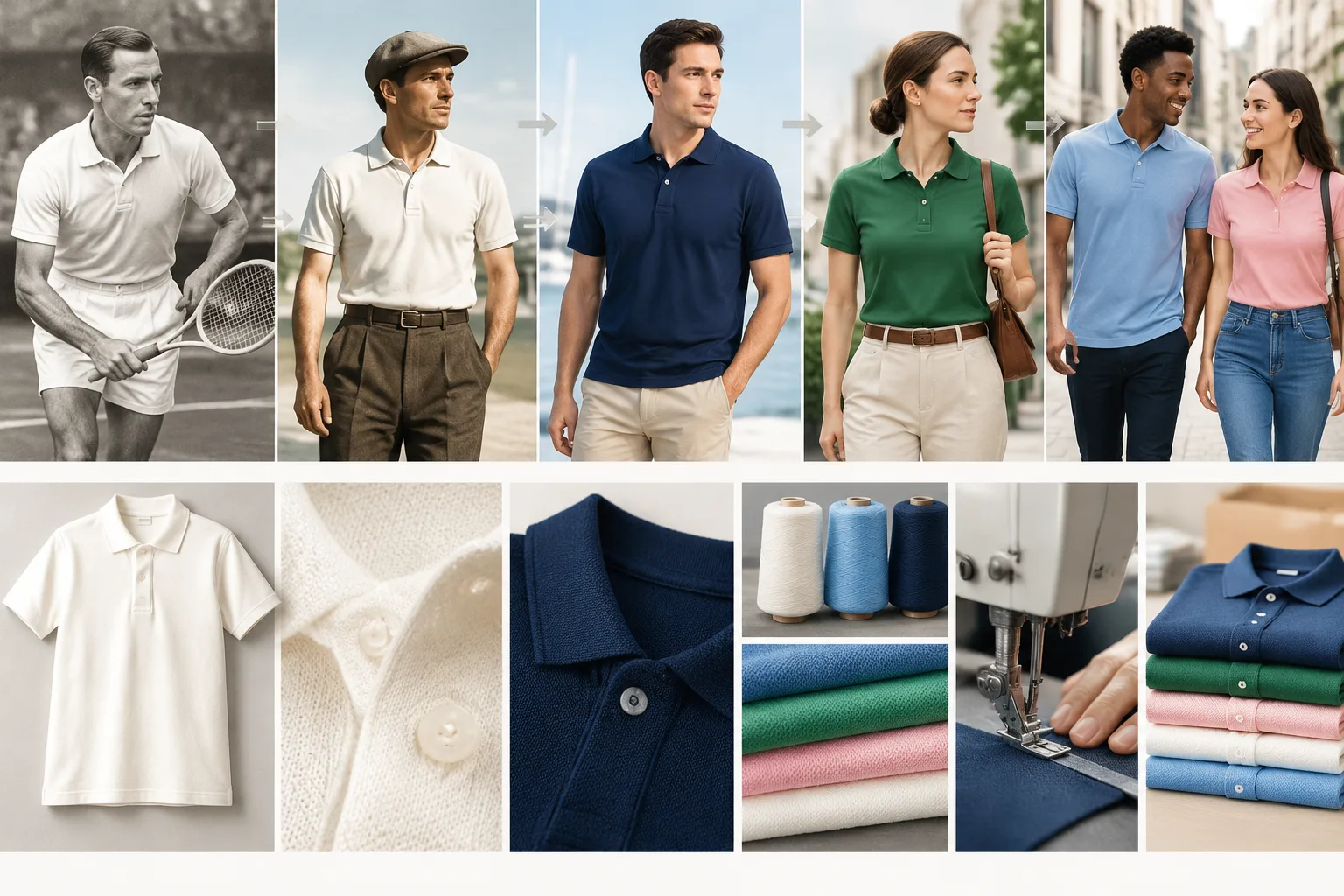
A Timeline of the Polo Shirt’s Main Historical Turning Points
The timeline below is a research framework rather than a claim that every region followed the same sequence. Exact dates should be checked against the original object record, image, catalogue, advertisement, patent, or institutional history. “Early example” means an item or depiction relevant to the form, not proof of a sole invention.
| Approximate period | Documented form or event | Setting of use | Evidence type | Historical qualification |
|---|---|---|---|---|
| Late nineteenth to early twentieth century | Collared knitted or knit-like short-sleeved tops appear in relevant sporting and informal clothing records. | Sport and practical leisure dress | Objects, photographs, clothing descriptions | Early records may describe related forms without using the modern category name. |
| Early twentieth century | Sport-specific garments and construction details become more visible in period images and commercial descriptions. | Organized sport and outdoor activity | Dated images, sporting records, catalogues | Association with sport does not establish that all later polo shirts originated in one sport. |
| Early to mid-twentieth century | Commercial naming, advertising, and repeatable ready-to-wear versions help stabilize recognizable features. | Sport, leisure, and retail clothing | Advertisements, product catalogues, company archives | A branded product launch is a commercial milestone, not proof of immediate widespread adoption. |
| Mid-twentieth century | Collared knit tops become increasingly legible as versatile casual clothing across documented markets. | Leisure, travel, education, and informal work settings | Dress guides, photographs, retail records | Visibility varies by region, social group, and access to ready-to-wear clothing. |
| Late twentieth century onward | The polo shirt is repeatedly reinterpreted through brand identity, workplace dress, schoolwear, and lifestyle marketing. | Casual, professional, educational, and branded dress | Advertisements, catalogues, photographs, institutional and market histories | Later familiarity should not be projected backward as evidence of earlier universal use. |
This sequence separates several events that are often compressed into one origin story: the appearance of related garments, their use in sport, commercial naming, brand expansion, and wider everyday visibility. A patent or dated advertisement can establish that a particular claim or product existed at a given time. It cannot, by itself, establish global adoption or explain every reason people chose to wear the garment.
What the Polo Shirt’s History Reveals About Garment Design Today
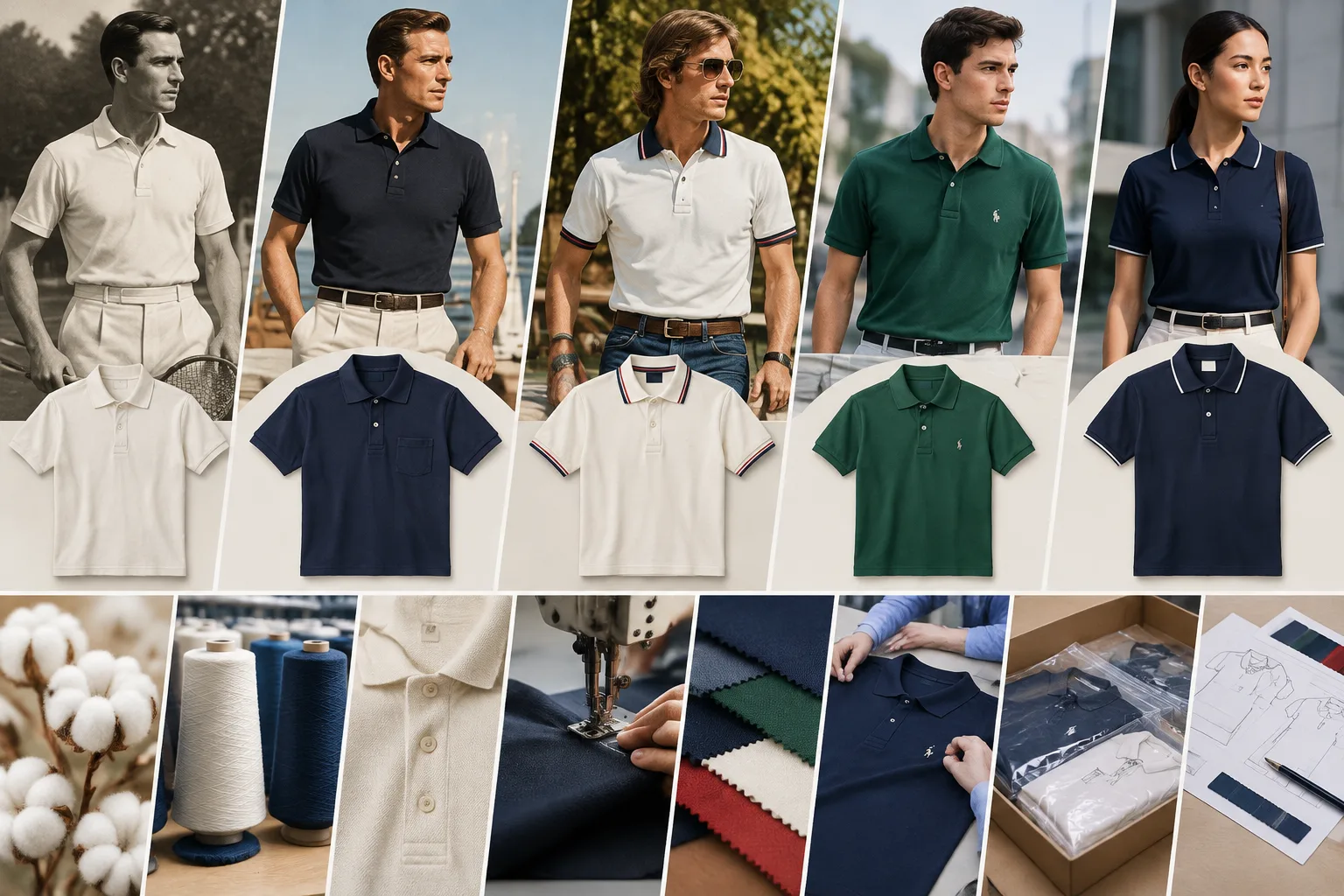
The history of polo shirts shows how a garment can preserve a recognizable family resemblance while changing substantially in detail. Collars, plackets, buttons, sleeves, hems, knit structures, fibers, trims, and proportions may remain identifiable across periods, yet their construction and visual emphasis can vary by maker, market, intended use, and production method.
For designers and product developers, historical research is more useful when it examines a complete reference rather than copying a logo or isolated feature. Compare the silhouette, collar behavior, placket arrangement, sleeve shape, knit texture, finishing, and original context. Then ask which details appear in the primary record and which are later interpretations. This approach helps distinguish a historically persistent feature from a detail associated with one brand or period.
Historical precedent should not be treated as proof of current comfort, durability, compliance, or market performance. A past garment can explain why a design language became familiar, but present-day claims require their own appropriate technical, material, or market evidence. Apparel Wiki’s Apparel Manufacturing Tools can support further production research, while historical attribution still depends on checking the original records.
A practical research sequence is to locate the earliest relevant record available, verify its date and attribution, compare it with independent examples, and document uncertainty before drawing a design conclusion. This keeps polo shirt fashion history connected to real evidence while allowing contemporary products to adapt the form for a different audience or purpose.
For further study, compare museum records, period advertisements, catalogues, photographs, and apparel-history scholarship side by side. Treat each source as evidence for a specific claim, and separate what the record shows from what the researcher reasonably infers.
Frequently Asked Questions
Who invented the polo shirt?
No single inventor can be established from the general historical record without narrowing the claim. Early garments, sports associations, commercial introductions, and later brand histories represent different milestones and should be documented separately.
When did polo shirts become everyday clothing?
The transition developed gradually during the twentieth century as collared knit tops appeared across leisure, travel, education, work, and casual settings. The timing differed by region, market, social group, and access to ready-to-wear clothing.
Were polo shirts originally made for polo?
Some early forms were associated with sport, including polo-related clothing, but sport association does not prove that every later polo shirt descended from one garment or was originally made for polo.
How has the shape of the polo shirt changed over time?
Collar construction, placket length, button placement, sleeve proportions, hem treatment, knit structure, fiber choices, and overall fit have varied across periods and makers. The recognizable category is therefore broader than one fixed specification.
What is the difference between an early sports polo shirt and a modern polo shirt?
An early sports garment was tied more closely to a documented activity and its practical setting. A modern polo shirt may retain related features while serving casual, workplace, school, lifestyle, or branded purposes.
Why are polo shirts associated with both sportswear and casual dress?
The garment combines sport-derived visual and functional associations with a form that can be produced, styled, and marketed for everyday use. Its meaning changes with context rather than belonging exclusively to either sportswear or casual clothing.