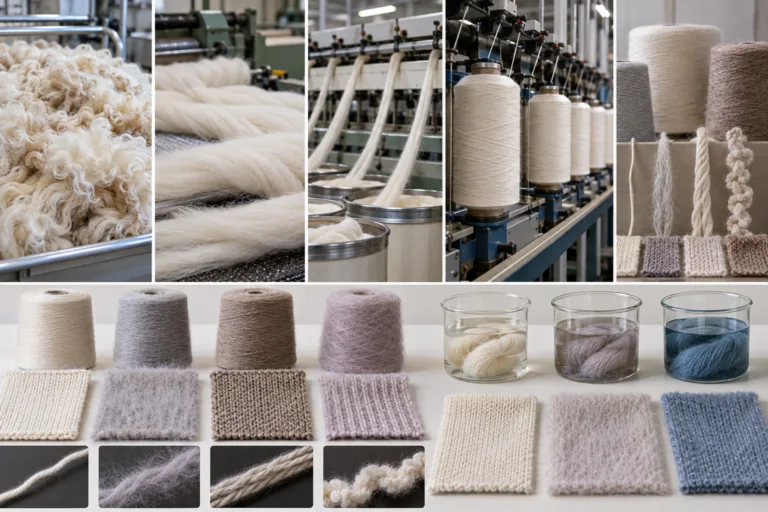
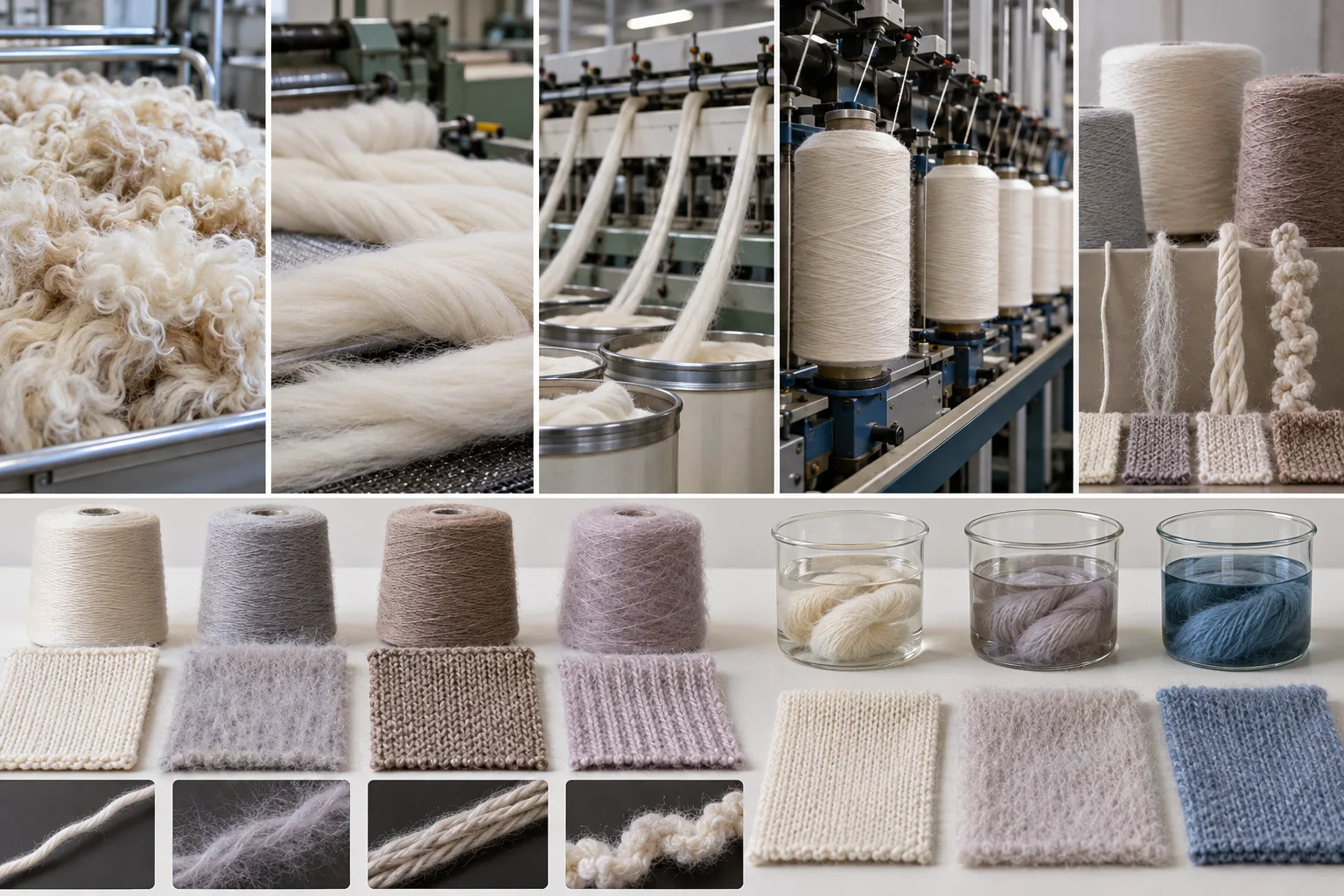
Consistent apparel yarn quality starts with managing variation in the fiber and keeping the processing route and evaluations comparable. Sponsor content is separate from Apparel Wiki’s independent educational coverage. Mohair fiber processing can include inspection, sorting, cleaning where appropriate, opening, carding or combing, drawing, and spinning; the route depends on the supplied fiber, yarn construction, and intended fabric.
Consistency does not mean one yarn is ideal for every garment. It means the characteristics relevant to a particular use are repeatable enough to evaluate against that use. Input records and matched comparison conditions help distinguish variation associated with the fiber from changes introduced during preparation.
How mohair fiber processing supports consistent apparel yarn quality
For apparel, consistency is control of unwanted variation from prepared fiber through sliver or another feed form, spun yarn, and finished package. Useful evaluation categories can include linear density, evenness, strength, hairiness, appearance, and visible contamination. A fiber name alone does not establish these qualities; each requires a suitable inspection or measurement if it matters to the product.
The process can be understood as a sequence: identify and sort incoming fiber; clean it if the fiber form and route call for cleaning; open and prepare it; card or comb it; draw the prepared material into a more regular feed; then spin and finish the yarn. Not every route uses every stage in the same way. Fiber condition, equipment, yarn construction, and fabric purpose affect the choices.
Variation in length, fineness, cleanliness, moisture condition, color, or blend composition can carry forward into later stages. Preparation may help manage some differences, but it does not make unlike inputs identical. Processing choices can also introduce variation, so a repeatable route and records of input lots, preparation, and retained samples help narrow down where a difference arose.
There is no universal ideal for mohair yarn quality. A lightweight knit may call for a different balance of evenness, texture, and appearance than a fuller fabric. Comparisons are most useful when yarns have the same construction and are inspected under comparable conditions. This is educational guidance, not a test result or a batch-acceptance rule.
Preparing and sorting mohair fiber before spinning
Before preparation, describe the incoming lot in terms relevant to its form and intended route. Records may include fiber-length distribution, fineness or diameter information, color, visible contamination or vegetable matter, moisture condition, and lot identity. These are attributes to document or verify, not a universal grading specification. Keep the fiber description distinct from its source, processing history, or commercial name.
Sorting and lot separation make later observations easier to interpret. If visibly or materially different groups are combined without documentation, a change in yarn appearance may be harder to trace. A deliberate blend is different: record its components, proportions, and purpose so the prepared feed can be compared with the intended composition.
Cleaning or scouring may be part of preparation when required by the fiber condition and processing route. Removing unwanted material can support a more manageable feed, but cleaning is not automatically an improvement in handle, strength, or appearance. The appropriate method depends on the material and process; avoid assuming a particular result without evidence for that route.
Opening separates and loosens the fiber mass for subsequent handling. The practical aim is to feed material consistently while avoiding unnecessary handling. The balance depends on equipment, fiber condition, and the yarn route, so a single recipe cannot be inferred from the word “mohair.” Moisture conditioning or drying may also be relevant, but the needed condition should be established for the actual process rather than guessed from a general rule.
At the transition to a web, sliver, or other prepared feed, note visible issues and the route used. Recording lot identity, sorting decisions, cleaning or conditioning steps, and the condition after preparation gives later reviewers a basis for investigating variation without treating one observation as proof of cause.
Managing fiber variation, blending, and drafting
Carding or combing and drawing are preparation stages used to organize fiber and form a more regular feed for spinning. The appropriate route depends on the fiber form and yarn construction. Length distribution, fineness, surface characteristics, structure, and contamination are useful variables to investigate, but their specific effects on a given mohair lot should not be assumed without direct evidence.
Blending can target a combination of properties, but the outcome depends on the fibers, their proportions, how uniformly they are fed, and the yarn and fabric structures. A blend description is therefore not a complete quality specification. Record fiber content separately from processing route and any commercial branding, and compare like constructions under like evaluation conditions.
Consistency in a single-fiber lot and consistency in a blend both depend on clear lot boundaries and repeatable feed. Accidental mixing of unlike lots can obscure the source of variation; intentional blending should have documented proportions and purpose.
Drafting attenuates a prepared feed into a finer strand for spinning. It can help produce a more regular feed, but unstable or excessive attenuation can also contribute to irregularity. A lightweight knit may favor a controlled, fine, even yarn route; desired texture, fabric structure, blend, and acceptable appearance variation can change that choice.
Spinning, yarn construction, and finishing choices
Spinning converts the prepared fiber feed into a continuous yarn structure. Fiber control, drafting stability, strand formation, and twist interact at this stage. A yarn may look acceptable in one characteristic while remaining unsuitable for a particular fabric, knitting structure, or appearance requirement.
Twist helps hold fibers together, but the appropriate level is a construction decision rather than a universal quality target. More or less twist can change the balance among firmness, loft, hairiness, strength, softness, and visual character. The result also depends on fiber condition, yarn linear density, spinning route, and intended use. These relationships should be evaluated for the actual yarn rather than inferred from the word “mohair.”
Yarn records should state whether the product is a single yarn or a plied yarn. A notation such as 30/2 needs its count convention and component count confirmed. It should not be treated as one unqualified number. A plied yarn combines component yarns, so its description must make clear whether the stated value refers to each component or to the resulting yarn.
Linear-density systems describe mass over a defined length. Tex, denier, and dtex are such systems, while indirect count systems express length in relation to mass. Their numbers cannot be compared directly without identifying the system. Linear density also does not equal yarn diameter. Fiber arrangement, twist, bulk, and compression can change the apparent thickness of yarns with similar linear-density descriptions.
Plying, winding, conditioning, finishing, and package handling remain part of the same construction decision. They can influence appearance, tension, moisture state, surface character, and downstream feeding. The exact effects are process-dependent. A package inspection should therefore look for changes introduced after spinning, not assume that a satisfactory spun strand will remain unchanged through winding and handling.
How to evaluate consistency in a mohair apparel yarn
Evaluation begins by defining what “consistent” means for the intended garment or fabric. The purpose is not to impose one ideal yarn. It is to compare like constructions and identify whether a difference is an uncontrolled variation, an unclear specification, or an intentional design feature.
| Observable input | Quality implication | Initial review choice | Variables that could change the choice |
|---|---|---|---|
| Lot identity and fiber description | Different lots or incompletely described fibers may explain later variation. | Request clarification or compare within the same lot. | Fiber form, source description, blend, color, and intended use. |
| Blend composition and feeding description | Unclear proportions make results difficult to attribute or reproduce. | Check the stated proportions and compare a matched blend. | Fiber structure, yarn construction, fabric structure, and feeding uniformity. |
| Single or plied construction and count system | Unlike specifications can appear different while describing different measurements. | Record the convention before ranking or approving a comparison. | Component count, finished yarn description, and measurement basis. |
| Visible contamination or appearance differences | Observations may indicate a preparation issue or an intentional surface effect. | Document the observation and investigate its source. | Color, finishing, fabric structure, and acceptable appearance variation. |
| Evenness or package-to-package differences | Variation may affect appearance or feeding, but observation is not a complete performance result. | Compare matched samples under the same conditions. | Conditioning, inspection method, yarn construction, and end use. |
Use retained samples when available, and keep the comparison conditions as consistent as practical. The sample should have a clear lot boundary and a documented construction. Conditioning and inspection conditions should also be recorded when they are known. This makes it easier to separate a material difference from a handling or evaluation difference.
Keep a measured value, visual observation, supplier declaration, and editorial interpretation in separate fields. A stated count, blend, or appearance description does not by itself prove that every package or lot meets it. Likewise, visual inspection can identify questions for review, but it cannot replace an appropriate laboratory or instrument-based evaluation when a performance claim matters.
Do not confuse a quality characteristic with a batch acceptance decision. A yarn may be intentionally hairy, lofty, or irregular in appearance for a particular design. Conversely, a yarn that looks uniform may still require further evaluation for the intended use. The decision should follow the documented specification, construction, fabric application, and applicable evaluation method.
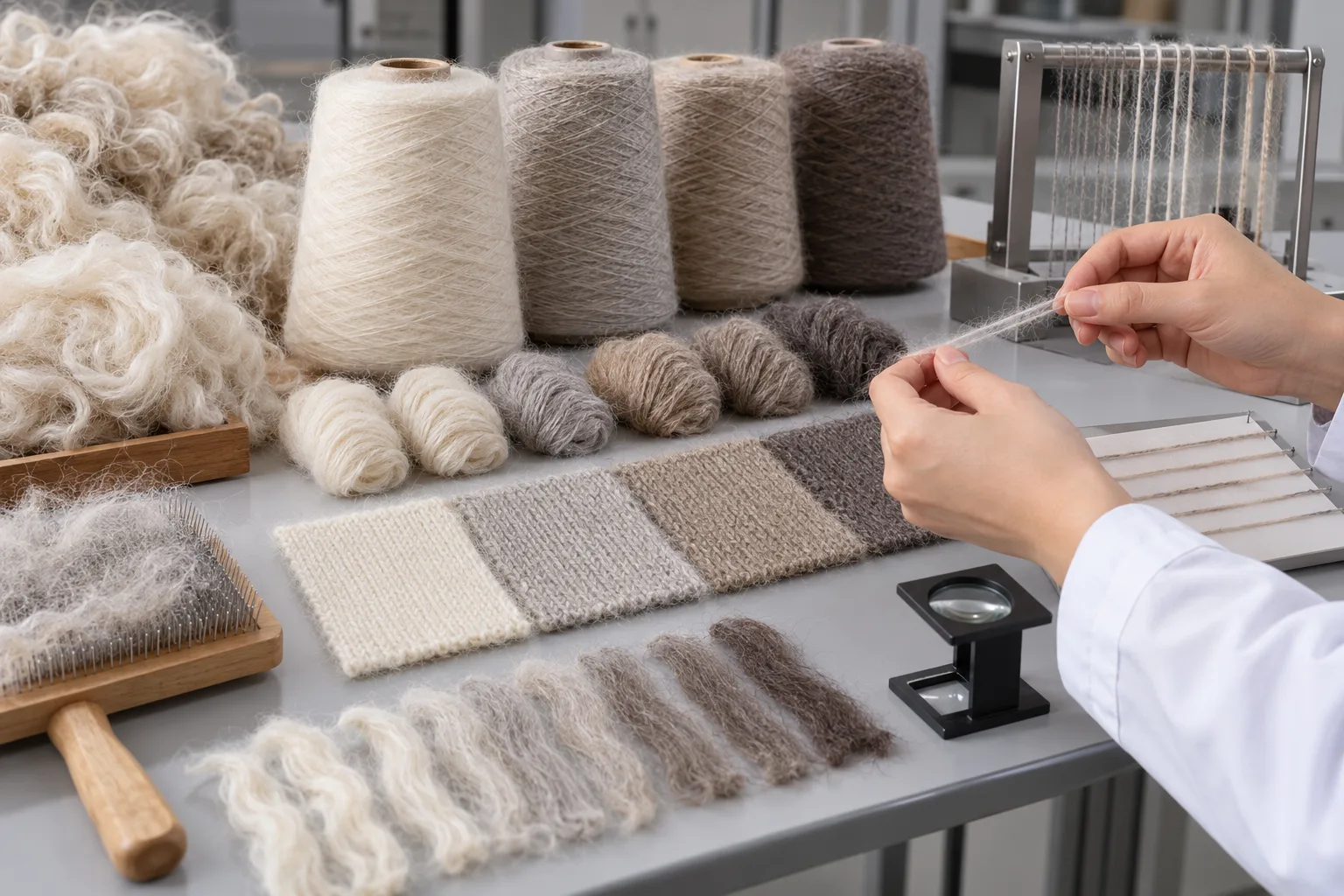
A practical specification and review checklist
Before judging consistency, build one comparable record for each yarn:
- Fiber description, lot identity, color, and blend proportions.
- Preparation or processing information that is available.
- Single or plied construction and the stated count system.
- Intended fabric or garment use.
- Observed appearance, contamination, package condition, and other relevant characteristics.
- Test or inspection conditions, measured values, declarations, and unresolved variables.
Then compare like-for-like samples and check the applicable authoritative method before accepting a performance or consistency claim. A useful specification shows both what is known and what still needs verification. Apparel Wiki provides independent garment-manufacturing education, not factory, laboratory, or sourcing services.
Frequently Asked Questions
What is the main purpose of processing mohair fiber before spinning?
Processing prepares the fiber for a more controlled feed into spinning. Inspection, sorting, opening, blending, and drafting can help identify or manage variation, but the suitable route depends on fiber condition, construction, equipment, and intended fabric.
Which mohair fiber characteristics should be documented before yarn production?
Record the attributes relevant to the supplied fiber form, including lot identity, length distribution, fineness or diameter information, color, contamination, vegetable matter, moisture condition, and blend information. The record should distinguish observations from measured or declared values.
How can blending affect the consistency of an apparel yarn?
Blending can target a combination of properties, but the result depends on fiber form, proportions, feeding uniformity, yarn construction, and fabric structure. An intentional blend needs documented proportions and purpose; accidental lot mixing can make variation harder to diagnose.
Why must a yarn specification identify both the count system and whether the yarn is single or plied?
Different count systems use different measurement bases, and a plied yarn may be described by its component yarns or finished construction. Without both details, two specifications may appear comparable even though they describe different products.
Can visual inspection alone confirm consistent mohair yarn quality?
No. Visual inspection can reveal contamination, appearance differences, or package issues and can guide further review. It does not by itself establish every yarn-performance characteristic or prove that a lot meets an acceptance requirement.
What information should be compared when reviewing two mohair yarn lots?
Compare fiber and blend descriptions, lot identity, yarn construction, count system, intended use, preparation information, observations, and evaluation conditions. Matched samples provide a more meaningful comparison than rankings based only on a commercial name or isolated count value.