Choose a cabled yarn by the fabric behavior your garment needs, then assess whether its construction supports that behavior in the intended fabric. Cabled yarn fabric behavior cannot be selected from a yarn name alone. Apparel Wiki offers this guidance as an independent educational publication; its Sponsor page explains the separation between sponsorship and editorial control.
In practical terms, a cabled yarn combines multiple yarn elements through additional plying or cabling. Confirm the actual arrangement with the supplier because commercial descriptions can vary. Use that construction description to frame questions about hand, surface, bulk, and stability, then judge those qualities in the intended fabric and finishing state.
How cabled yarn fabric behavior affects the first fabric choice
Start with a fabric requirement that someone can recognize: a defined surface, a soft touch, controlled bulk, or enough body to hold a silhouette. “Use cabled yarn” describes an input. It does not establish whether the finished garment will meet any of those requirements.
Ask what has been combined and at which stage. A useful construction description identifies the component yarns, their grouping, and the additional assembly. Do not assume two suppliers mean the same arrangement when both use “cabled.” Neither the name nor the number of components establishes a fabric performance rating.
Translate the construction into questions about space and contact. How pronounced is the yarn profile? How closely do neighboring yarns sit? Does the surface remain visually regular within the chosen structure? Investigate component arrangement and twist alongside these observations, without assuming that cabling must create a smoother, firmer, or bulkier fabric.
Then account for the structure surrounding the yarn. Knitting gauge and stitch structure, or weaving sett and weave structure, belong in the same decision. Sett describes yarn spacing in a woven fabric. Record finishing as well: an unfinished sample and a finished sample are different comparison conditions.
For a structured knit, a clearly defined yarn profile might suit the intended surface. For a lightweight woven, that same profile would need assessment against the required thinness, cover, and drape. Neither application establishes a general advantage; each asks a different question of the yarn.
Keep descriptive language tied to what was examined. “This finished sample feels firm” is an observation. “Cabled yarn makes stable garments” extends far beyond it. Apparent roundness, smoothness, and texture also need a stated sample context rather than treatment as universal cabled yarn properties.
The useful first choice is therefore a yarn-and-structure direction for investigation. Prioritize the critical garment requirement, identify the construction proposed to support it, and look for fabric evidence. This keeps an attractive yarn description from becoming an unsupported promise about wear.
Which yarn properties carry through to the fabric
A yarn specification helps explain what you are comparing, but it does not supply the fabric result. Separate component information from the assembled yarn specification. A component count, a ply expression, and a final yarn size answer different questions and should occupy separate places in the record.
When a supplier uses a slash notation, ask what each part means. Does the stated count describe an individual component or the assembled yarn? Keep the original notation and unit. Direct linear-density systems and indirect count systems require an appropriate conversion before their numerical values can be compared.
Treat yarn linear density as a mass-and-length descriptor, not a diameter measurement. Ask for the measurement basis and whether the value applies to the final cabled yarn. A similar recorded size does not establish similar apparent thickness, surface character, or fabric cover.
Component arrangement and twist direction are useful comparison inputs. Ask how twist is described at each assembly stage and what information supports any claim of balance. Compare visual regularity, surface definition, and fabric distortion separately; a construction description alone does not demonstrate resilience or recovery.
Record hairiness and surface character as well. Distinguish what is visible in the yarn from what remains visible in the finished fabric. Investigate whether structure or finishing strengthens, reduces, or changes that appearance rather than carrying the yarn observation directly into a garment claim.
Fiber content adds another set of questions. Record generic fiber names, blend proportions, and fiber form. For the intended use, investigate hand, abrasion response, pilling, laundering response, and processing compatibility. Adding a named fiber does not by itself establish the balance of properties achieved in the fabric.
Before comparing samples, request these inputs:
- Component count and the specification of each component.
- Final yarn linear density or count, including the system and units.
- Ply or cable arrangement and the available twist description.
- Fiber content, blend proportions, and fiber form.
- Intended fabric structure, gauge or sett, and finishing assumptions.
Why fabric structure and garment use can change the decision
Evaluate cabled yarn in knit fabric through its loop structure, and cabled yarn in woven fabric through its interlacing structure. These arrangements give different contexts for assessment. Neither label alone establishes stretch, drape, or stability; density, relaxation, finishing, and any separate stretch component also need attention.
Keep fabric weight, thickness, cover, drape, and stretch as distinct observations. A fabric can meet the visual brief while missing the required weight or movement. Assess these properties in the intended finishing state, and document the structure rather than attributing the whole result to cabling.
Garment use determines which observations matter most. For a close-fitting knit, the brief might prioritize skin contact and recovery. A tailored outer layer might prioritize shape and manageable seam bulk. A textured fashion panel might place greater emphasis on surface definition, with different requirements in adjacent panels.
Consider a lightweight knit intended to show a distinct yarn texture. If one sample gives the desired definition, it may become the initial preference. If that sample also feels too bulky or fails the required drape, surface appeal should not override those critical requirements.
A revised choice could involve another yarn, a different stitch structure, or a changed finishing approach. Compare the resulting fabric rather than assuming which change will solve the problem. If laundering response or next-to-skin comfort becomes the priority, the preferred option must be reconsidered against that requirement.
A swatch supports a limited judgment about the material examined. Pattern shape, seams, pressing, relaxation, and repeated care introduce additional conditions when assessing a garment. Keep an attractive swatch separate from evidence of full-garment behavior, and describe texture or comfort as design observations rather than proof of consumer preference.
A comparison matrix for selecting a cabled yarn fabric
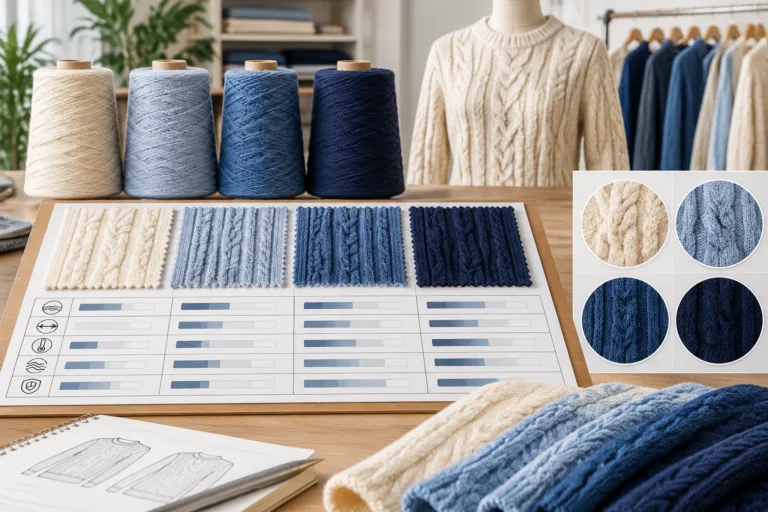
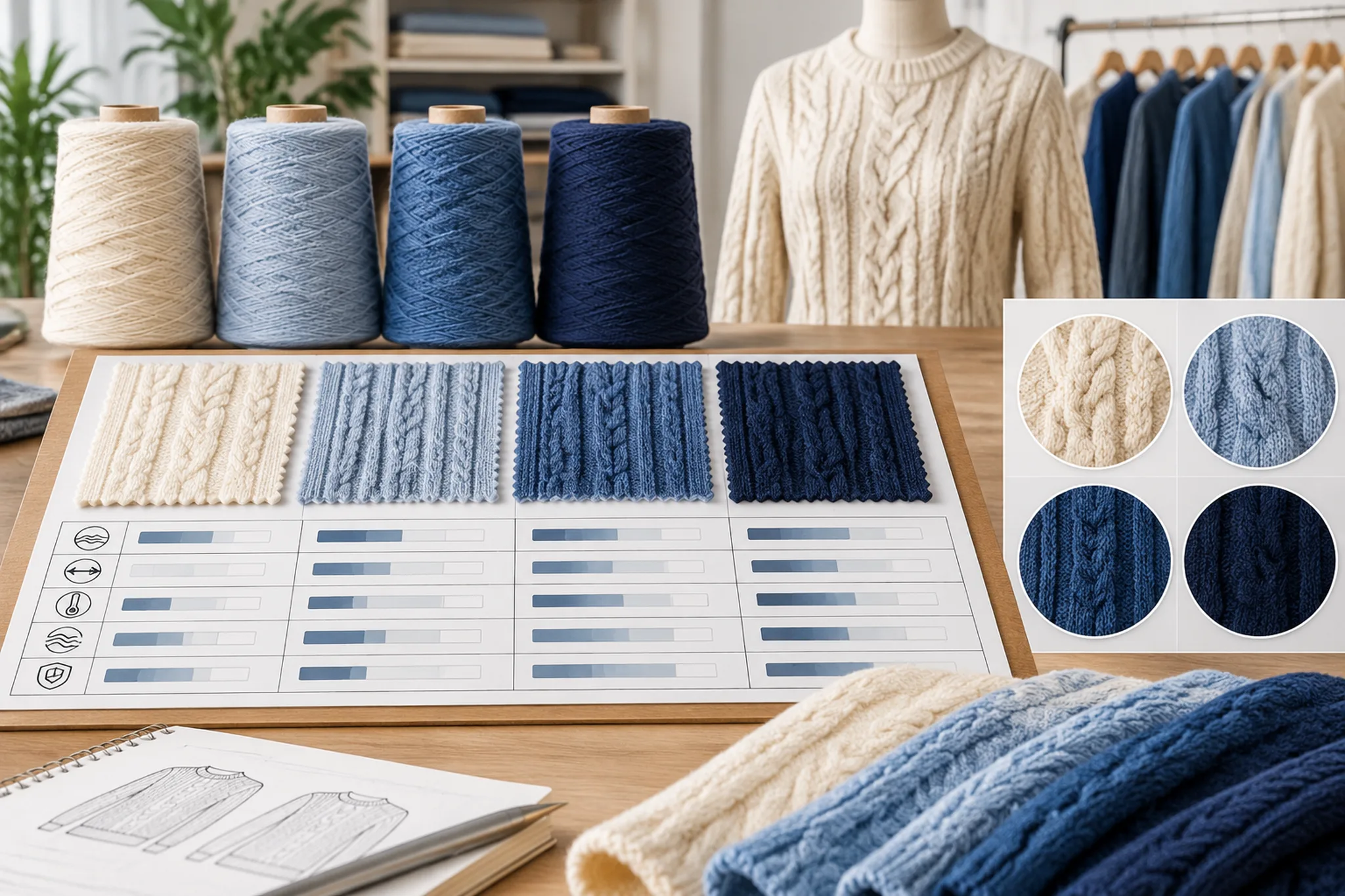
Use the matrix to translate a design brief into sample comparisons. Enter the documented construction first, then record what the fabric actually shows. Each row identifies an observation or selection question; it does not assign a performance rating to a yarn description.
For a smoother, more compact direction, prioritize observed surface regularity and manageable bulk. For a dimensional direction, prioritize visible texture and definition. Both directions still need acceptable hand, drape, and construction behavior. Neither follows automatically from a particular cable arrangement.
| Observable input | Fabric-level implication to investigate | Initial choice direction | Variables that could change the choice |
|---|---|---|---|
| Documented component and cable arrangement | Inspect surface definition and visual regularity. | Favor the sample matching the required smoothness or dimensional texture. | Stitch or weave, density, and finishing state. |
| Final yarn size, with count system and units | Compare apparent bulk, cover, thickness, and drape. | Retain fabrics meeting the brief without unwanted bulk. | Gauge or sett, structure, and garment layering. |
| Twist description and visible surface character | Examine exposed yarn definition, hairiness, and tactile character. | Choose the observed surface appropriate to the design. | Fiber form, finishing, and contact area. |
| Fiber content and blend proportions | Assess hand; identify care and durability questions requiring evidence. | Shortlist against use requirements, beyond the fiber name. | Fiber form, construction, finish, and intended care. |
| Fabric structure and documented density | Compare cover, drape, and observed extension and return. | Prefer the sample meeting shape and movement needs. | Fabric direction, stretch system, and panel geometry. |
| Recorded finishing and preparation state | Compare appearance, hand, and dimensions in equivalent states. | Base selection on samples representing the intended finish. | Unrecorded processing or later care exposure. |
| Intended garment zone or use | Inspect seam bulk, edges, skin contact, and shaping. | Retain fabrics suitable for the critical garment zone. | Seam construction, adjoining materials, and pressing. |
Keep a separate record for each sample, even when several use the same yarn. If density or finishing differs, identify that difference before attributing a preference to cabling. An unmatched comparison can help select a complete fabric, but it cannot isolate the yarn’s contribution.
Decision rule: reject a yarn-fabric combination when the observed fabric misses a critical requirement, even if its yarn specification looks attractive. Use this matrix to organize evidence and questions; supplier specifications, validated results, and project approval remain separate records.
How to evaluate the choice before committing to a garment
Build a repeatable review around the requirement that matters most. Give each sample an identifier and retain its specification, preparation history, and observations together. This makes later comparisons easier to interpret when a yarn, structure, or finish changes.
- Write the target. Describe garment use, desired surface, hand, drape, acceptable bulk, stretch or recovery needs, and intended care. Name unacceptable defects or outcomes. Separate essential requirements from preferences so an appealing texture cannot outweigh a critical failure.
- Establish comparability. Document construction, density, finishing, and preparation for each swatch. Identify which variable the comparison is intended to examine. Where several variables differ, record the comparison as a choice between complete fabrics rather than evidence about cabling alone.
- Record screening observations. Examine samples under consistent viewing and handling conditions. Note surface definition, apparent thickness, hand, and drape. Label observations as visual, tactile, dimensional, or test-based. Write specific descriptions, such as where bulk is visible, instead of assigning unexplained quality scores.
- Review garment-relevant construction. Examine relevant fabric directions, seams, edges, shaped areas, and adjoining panels. Use a construction sample where those details determine suitability. Record any pressing or assembly steps so the resulting observations remain connected to the conditions examined.
- Separate care observations from performance claims. If samples undergo care, document the procedure and their before-and-after condition. An informal observation can identify a concern. Claims about laundering response, dimensional stability, durability, recovery, or compliance require an appropriate validated method and interpretation.
- Close information gaps. Ask the supplier or development team to clarify missing component specifications, count-system meanings, final assembled-yarn size, fiber content, finishing, and sample conditions. Record each unresolved question, why it matters, and the evidence needed before selection.
Keep the selection status explicit: suitable for further development, awaiting evidence, or unsuitable for the stated requirement. A screening preference is not production approval. When a performance claim drives the decision, check the applicable evaluation method and whether its conditions address the intended garment use.
Make the yarn choice from the fabric requirement
Cabled yarn fabric behavior connects yarn construction, fiber, fabric structure, finishing, and garment use. Define the required behavior, document the yarn, compare matched samples, and investigate unresolved variables. Your next step is to build a side-by-side specification and sample record. Link each important yarn input to an observed fabric outcome and an unanswered question. Keep appearance preferences separate from performance evidence, and check the applicable evaluation method before relying on a durability, care, or recovery claim. Choose the combination supported by that record.
Frequently Asked Questions
What is the difference between a cabled yarn and an ordinary plied yarn?
The practical distinction to clarify is whether already assembled yarn elements undergo an additional combining stage. Commercial terminology can vary. Ask for the component arrangement and assembly sequence rather than treating either name as a complete construction specification.
Which yarn details should be confirmed before comparing cabled yarn fabrics?
Confirm component count and specification, final assembled-yarn size, count system and units, construction or twist description, and fiber content. Connect those details to each sample’s fabric structure, density, finishing, and preparation history.
Can the same cabled yarn produce different fabric behavior in a knit and a woven?
Yes, it can, but the yarn name does not establish the difference. Compare the intended knit and woven samples for the required behavior. Document their structures, densities, finishing states, and garment applications before drawing conclusions.
How should fiber blend and finishing be considered when selecting a cabled yarn fabric?
Record blend proportions, fiber form, and finishing alongside the cable construction. Compare samples representing the intended finished fabric. Avoid assigning hand, care response, or durability to one named fiber without evidence for the complete material.
What can a fabric swatch reveal, and what requires a validated test method?
A swatch supports observations about its appearance, hand, apparent bulk, and drape in the condition examined. Durability, laundering, recovery, and compliance claims need an appropriate validated method. Garment construction requires additional evaluation beyond the isolated swatch.
How can a product team document a cabled yarn choice without confusing yarn properties with garment performance?
Separate documented yarn inputs, sample conditions, observed fabric outcomes, and validated results in the comparison record. State the selection reason and unresolved questions. Connect every performance claim to evidence relevant to the intended garment and use.