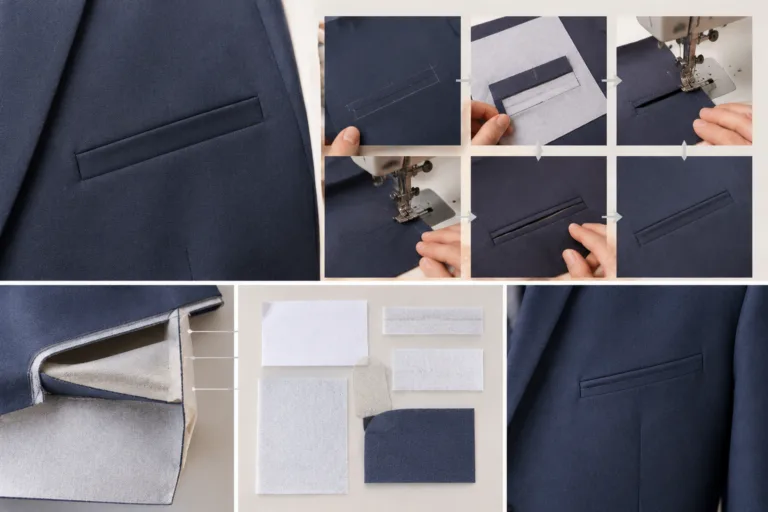
Jetted pockets reinforcement should match the pocket’s expected load and movement to its most vulnerable area, then be checked against bulk, comfort, appearance, and construction access. The right method is not simply the strongest thread or densest stitching. It may involve added support, localized securing, or controlled extra layers, depending on whether the risk is edge distortion, seam opening, fabric tearing, yarn movement, or stress at an opening end. Apparel Wiki is an independent garment-construction publication; its editorial independence is described on the Sponsor page.
This guide treats reinforcement as a design and construction decision. It separates reinforcement from stitch type, seam, seam allowance, and pocket-bag construction, so a proposed detail can be judged as part of the complete garment-material combination.
What Jetted Pocket Reinforcement Is Meant to Do
A jetted pocket is a constructed opening in a garment. Its appearance and stability depend on coordinated fabric layers, opening edges, internal support, and the pocket components connected to the area. Reinforcement is the added support or localized construction used to help a vulnerable area carry or distribute the forces created by handling, wear, and the pocket’s intended use.
That purpose differs from decorative finishing. It also differs from naming a stitch. A stitch describes how thread forms a loop or interlock; a seam describes how fabric layers are joined. Seam allowance describes the material left beyond a seam, while the pocket bag is an internal pocket component. None of those terms, by itself, fully specifies reinforcement. The same stitch choice can appear in different seams, and a seam can still need a separate support decision.
Start by identifying the failure mechanism. Does the opening edge distort? Does a seam begin to open? Could the fabric tear, allow yarn movement, or concentrate stress at one end of the opening? Each concern points to a different question about where support should act and how forces should move through the layers.
Added support can redistribute force, but it cannot automatically correct fabric that behaves poorly for the construction or a pocket assembled without adequate control. A stronger thread may leave the fabric as the weak point. Likewise, extra layers or securing stitches may create a hard point, visible impression, added thickness, or reduced flexibility.
For that reason, judge pocket reinforcement with more than strength in mind. Consider the intended appearance, fabric flexibility, total thickness, hand, comfort, laundering or use conditions, and the possibility of repair. The complete garment-material combination matters more than an isolated stitch name or reinforcement detail.
Jetted Pockets Reinforcement: Match the Method to the Failure Risk
Choosing among jetted pockets reinforcement methods begins with observable conditions. Look at fabric stability, movement around the opening, local stress, edge distortion, available thickness, and whether the pocket belongs to a lightweight or structured garment. The initial method should address the suspected failure mechanism while leaving room to check its side effects.
| Observable garment or fabric input | Likely risk or implication | Initial reinforcement method to investigate | Variables that could change the decision |
|---|---|---|---|
| Stable, structured fabric with controlled opening movement | Local stress may be concentrated at the opening or its ends, even when the surrounding fabric holds its shape. | Investigate localized securing or a restrained support layer at the vulnerable area. | Opening length, pocket placement, lining, seam relationships, and the required appearance. |
| Light or mobile fabric that shifts around the opening | Edge distortion, fabric movement, or loss of opening definition may become more important than thread strength. | Investigate compatible added support or controlled extra layers that stabilize the area without excessive stiffness. | Fabric recovery, surface sensitivity, support-layer behavior, pressing access, and comfort. |
| Stress concentrated at an opening end | A small area may receive repeated directional loading, making the end a likely inspection point. | Investigate localized securing or a construction detail that distributes force beyond the point. | Hand movement, pocket-bag attachment, nearby seams, and how much reinforcement the fabric can accept. |
| Added bulk or a hard point is unacceptable | Support may solve one concern while changing hand, friction, appearance, or comfort. | Investigate the least disruptive support or securing detail that addresses the observed risk. | Garment layer count, lining, worn position, surface finish, and repair access. |
Added interlining or another support layer is intended to change how the opening area receives and transfers force. Localized securing, such as a bar-tack-type detail where appropriate to the design, concentrates support at a selected location. Controlled extra layers or folded construction can increase local structure, but they also change thickness and flexibility. These are starting directions to investigate, not universal prescriptions.
More material is not automatically stronger. Denser stitching or stronger thread can move the failure elsewhere, such as into fabric tearing, yarn movement, needle-related damage, distortion, or discomfort. The useful question is where the load goes after the change. If the thread remains intact but the fabric distorts, the reinforcement has not solved the relevant weakness.
Consider a lightweight knit or another flexible fabric used for a pocket that experiences repeated movement. Edge stability and stretch compatibility need evaluation together. A support layer that holds the opening firmly may restrict movement, while a highly flexible detail may leave the edge unstable. The initial choice can change with pocket placement, the direction of hand movement, and the support provided by adjacent layers.
In this sense, reinforcing a jetted pocket is a process of matching support to risk. Compare the observable problem, the intended effect of each method, and the new drawback it might introduce. Treat the result as editorial decision guidance, not as a guaranteed performance ranking.
Variables That Change the Best Reinforcement Choice
Fabric weight and stability are only starting points. Weave or knit behavior, surface appearance, and resistance to local distortion can change where reinforcement belongs and how noticeable it becomes. A stable fabric may tolerate a different support approach from a mobile fabric, but the garment’s layer arrangement still has to be considered.
Expected load and movement should be considered together. A frequently used pocket may receive repeated pulling in a different direction from a lightly used pocket. A pocket positioned where the hand enters at an angle may need a different balance of support and flexibility from one placed on a relatively stable panel. These observations help define the risk; they do not create a universal stitch count, layer count, or dimension.
Garment-side constraints can be just as important as the face fabric. Check the lining, nearby seams, pocket-bag attachment, pressing access, and the possibility of visible impressions. A reinforcement that is easy to add before layers are joined may become difficult to place or repair later. Added support can also create a thick or hard spot that affects comfort, friction, or the way the garment hangs.
Evaluate strength, flexibility, bulk, appearance, and comfort as a connected set. A method that improves local stability may reduce flexibility. A folded detail may distribute force but increase thickness. A securing detail may be visually unobtrusive in one fabric and conspicuous in another. The desired hand and appearance should be part of the initial specification, not an afterthought.
Post-care behavior should also remain an observed variable rather than an unsupported promise. Compare the actual fabric, support layers, thread, and construction combination under the care and use conditions relevant to the garment. Record changes in hand, visible impressions, edge shape, and comfort rather than copying a general rule about what a reinforcement method will do.
Increasing thread strength alone may leave the fabric as the weak point because load, extension, and failure location are related but distinct. Inspect the area after the proposed change and ask whether stress has moved into the face fabric, adjoining seam, pocket bag, or opening end. This makes jetted pocket fabric compatibility a construction question, not a thread-selection question alone.
Assembly Order and Access in a Jetted Pocket
Reinforcement cannot be selected separately from the order in which the pocket is assembled. A support layer, localized securing detail, or folded section may be straightforward to place while the pocket area is open, then become difficult to position once the opening, lining, adjacent seams, or pocket bag has been joined.
Start by mapping the construction sequence. Mark where reinforcement is added, where it is secured, which layers cover it, and when the pocket becomes difficult to reach. Also identify points that are effectively irreversible. This process map helps distinguish a method that is technically possible from one that can be placed accurately and repeated across pieces.
Access affects more than convenience. It influences the accuracy of the reinforcement location, the ability to press the area without creating visible impressions, and the ease of correcting an uneven edge or misplaced support. A detail that looks acceptable before later layers are added may alter the finished edge or create unwanted thickness after assembly.
Consider a pocket with limited access after the lining or nearby seams are closed. An initial choice may favor preparing or securing the support earlier, while the area is still visible and reachable. That does not establish one universal jetted pocket sewing sequence. Pattern details, equipment, lining treatment, operator access, and the required appearance can all change the workable order.
Before approving a pocket reinforcement placement, record the access point, the covering layers, the inspection point, and the likely repair route. If a defect would require opening several completed layers, that limitation belongs in the construction decision rather than being discovered afterward.
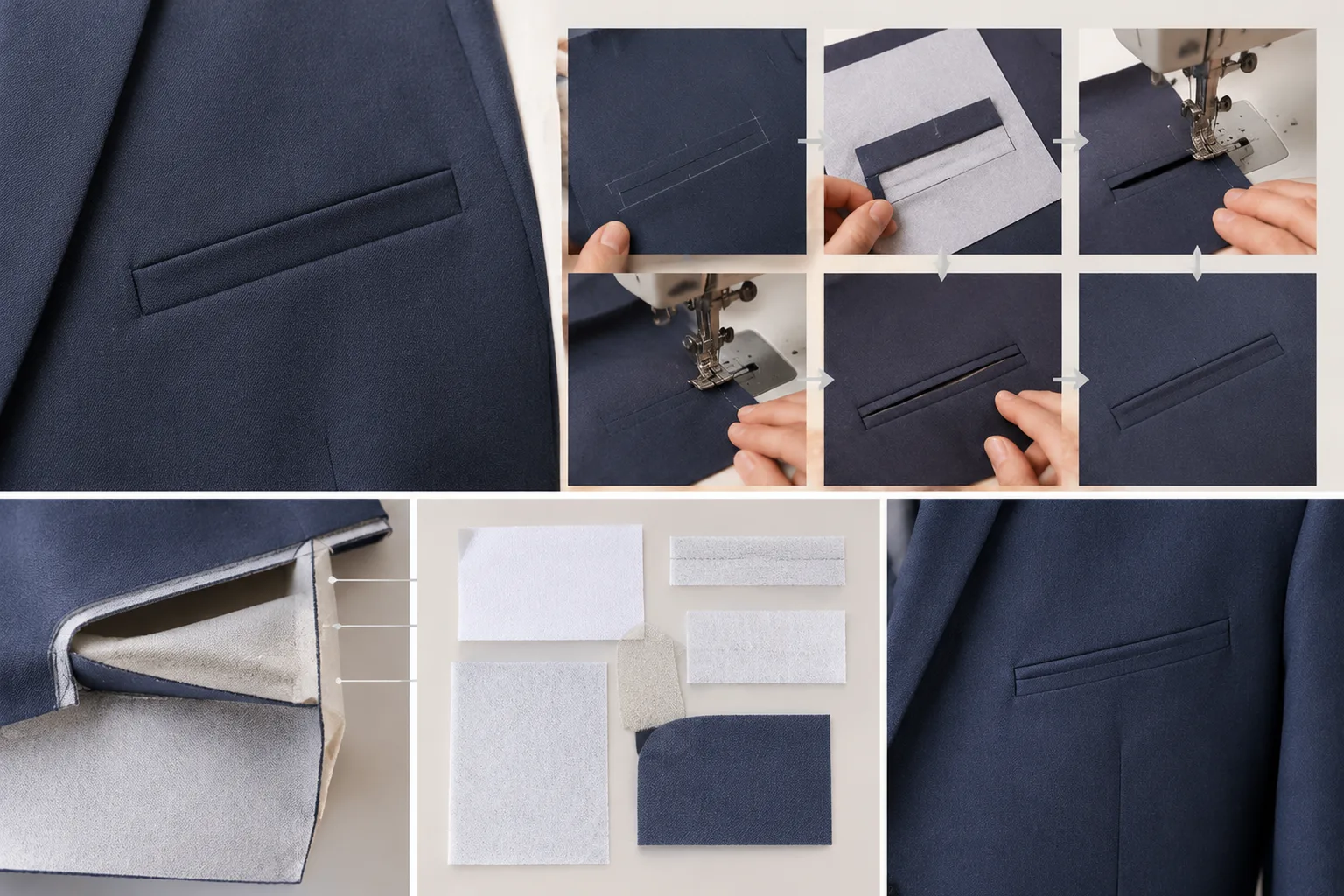
How to Evaluate a Reinforced Jetted Pocket
Evaluate the complete garment-material combination, not just the added support. Begin with a failure-mode check at the opening, its ends, adjoining fabric, seams, and pocket layers. Look for distortion, separation, tearing, yarn movement, broken thread, or stress that has shifted into another part of the construction.
When useful, compare the proposed reinforcement with an alternative construction or an unreinforced version. Keep the comparison sufficiently controlled to make observations meaningful. Record the fabric, support layers, thread, construction order, intended movement, and relevant use conditions. Behavior observed in one combination should not be treated as a universal result.
Review these factors together:
- Stability and appearance: Check whether the opening remains controlled without visible impressions, rippling, or an altered edge.
- Flexibility and bulk: Check whether support limits movement or creates a thick or hard point.
- Comfort and friction: Consider the hand against the body and whether added layers change how nearby components move.
- Access and repairability: Note whether the detail can be inspected, corrected, or replaced once the pocket is assembled.
- Repeatability: Compare multiple pieces when consistency across production is part of the decision.
A compact evaluation record can include the following fields:
| Field | What to record |
|---|---|
| Material combination | Face fabric, support layers, lining, pocket bag, and thread |
| Expected load and movement | Where the pocket is used and how the opening is pulled or extended |
| Reinforcement detail | Location, added layers, securing detail, and construction stage |
| Observed effects | Edge appearance, bulk, flexibility, comfort, and transferred stress |
| Unresolved variables | Questions requiring another comparison or an applicable technical method |
This is an editorial inspection framework, not a validated test method, regulatory assessment, or production approval. A formal requirement or measured performance claim needs the applicable authoritative method and defined conditions. For practical comparison, inspect where force goes after reinforcement is added. Stronger thread or added support may leave the face fabric, adjoining seam, or pocket bag as the next weak location.
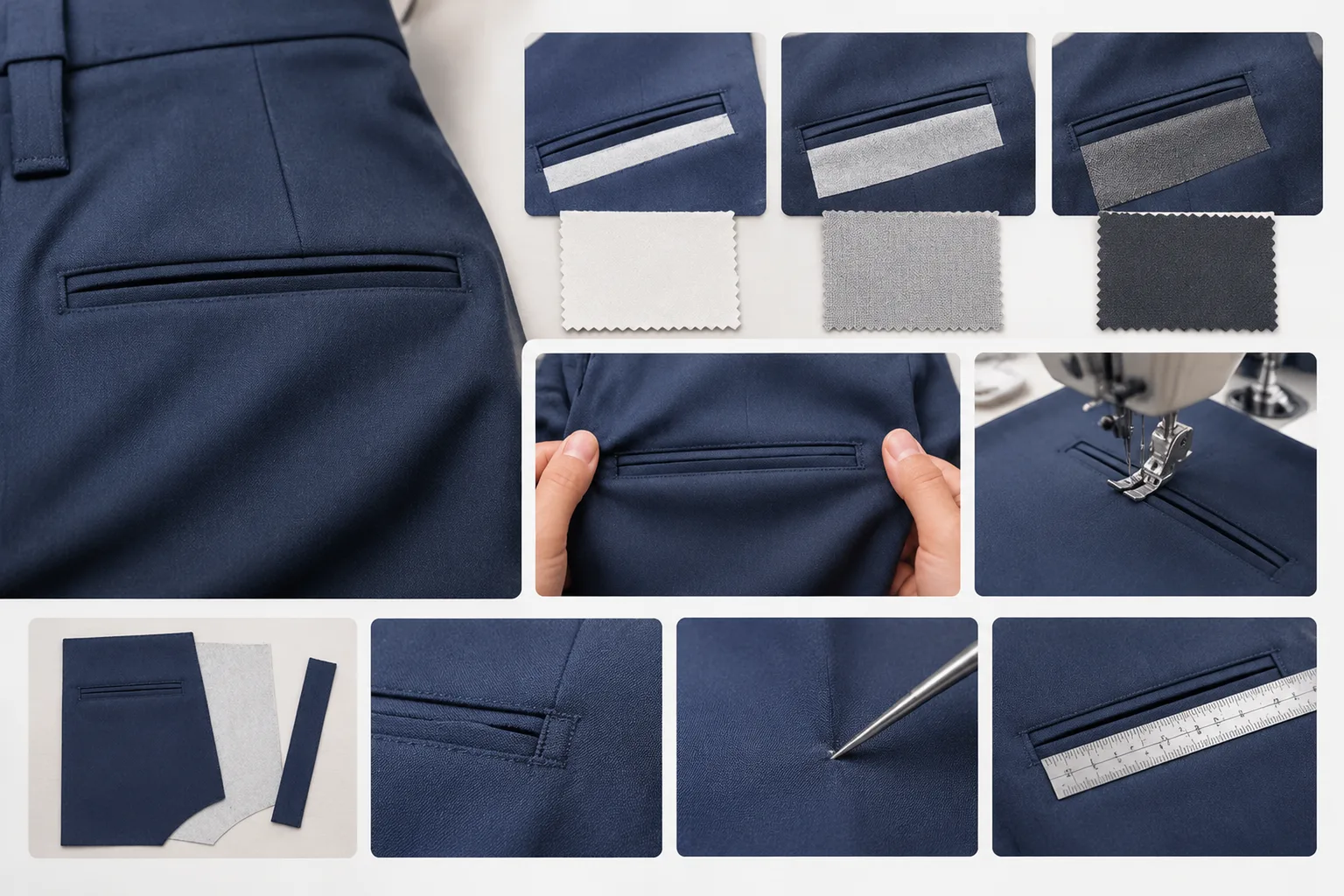
A Practical Selection Checklist for Jetted Pocket Reinforcement
- Identify the vulnerable location and likely failure mechanism.
- Match support to the fabric, movement, and expected load.
- Choose the least disruptive method that addresses the observed risk.
- Check bulk, appearance, flexibility, comfort, and construction access.
- Record the layers, placement, sequence, and unresolved variables.
- Inspect the complete construction and where stress moves afterward.
There is no universal best method across all garments and materials. Compare the relevant construction specifications for the actual combination, and check the applicable authoritative technical method when formal evaluation or approval is required.
Frequently Asked Questions
Is reinforcement always necessary for a jetted pocket?
No. The choice depends on the pocket’s vulnerable area, fabric behavior, movement, appearance requirements, and construction. Reinforcement should address an identified risk rather than be added automatically. A proposed detail still needs evaluation for bulk, comfort, access, and transferred stress.
How do I choose between added support and localized stitching for a jetted pocket?
Start with the failure mechanism. Added support may be worth investigating when the material needs broader stability; localized stitching may suit a concentrated stress point. Compare both with the actual layers, movement, appearance, and risk of creating a hard or thick area.
Can stronger thread solve a weak jetted pocket?
Not necessarily. Increasing thread strength can leave the fabric, seam, opening end, or pocket bag as the weak point. Inspect the complete construction for tearing, yarn movement, broken thread, distortion, and transferred stress instead of judging thread strength alone.
What fabric characteristics should I check before selecting pocket reinforcement?
Check stability, flexibility, surface appearance, resistance to local distortion, and the way the fabric responds to added layers or securing stitches. Also consider the pocket’s movement, desired hand, comfort, visible impressions, and post-care observations for the actual material combination.
Why does assembly order affect jetted pocket reinforcement?
Later layers can restrict access, hide the reinforcement, change pressing conditions, and make correction difficult. Mapping the sequence shows when support can be placed and inspected accurately. The workable order remains dependent on the style, layers, equipment, and required appearance.
How can I evaluate whether a jetted pocket reinforcement method is working?
Compare the complete construction and inspect the opening, ends, adjoining fabric, seams, and pocket layers. Record stability, appearance, flexibility, bulk, comfort, repairability, and any transferred stress. Use a formal test method when a defined requirement or approval decision applies.