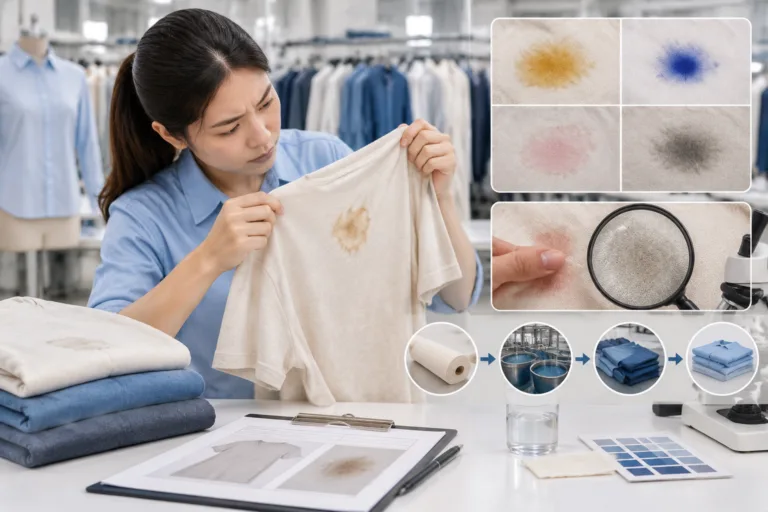
Garment stain removal defects are unwanted visible, tactile, dimensional, or color-related conditions associated with spot cleaning, stain treatment, or rework. The treatment may create the condition, reveal an existing problem, or simply be the stage when someone notices it. This technical guidance is editorially separate from Apparel Wiki’s Sponsor information.
Do not assign a cause from appearance alone. First record where the defect occurs, when it became visible, how often it repeats, and what the area looked like before and after treatment. Those details help distinguish residue, color change, surface damage, distortion, and unrelated production defects.
How Garment Stain Removal Defects Develop
A residual mark or ring is one possible symptom, but defects after stain treatment can take several forms. The area may show color shift or loss, roughness, stiffness, altered gloss, shine, abrasion, distortion, or a change near a seam. The original stain may also remain. None of these observations confirms a cause by itself.
At a process level, stain treatment can change or redistribute soil, moisture, color, surface fibers, finish, or local garment structure. What becomes visible also depends on the original fabric, coloration, construction, previous handling, and later operations. Without validated technical evidence, however, a specific chemical or material interaction should remain a hypothesis rather than a stated fact.
An investigation should keep three possibilities open. First, the stain-removal operation may have created or intensified the defect. Second, treatment may have exposed a pre-existing condition that was hidden by soil or difficult to see. Third, an earlier or later process may have caused the condition, which was merely discovered during rework.
Timing and location are therefore essential. Record the panel, face or reverse side, direction, distribution, and relationship to seams, edges, trims, or handling points. Compare isolated and repeated cases across garment and fabric batches. A photograph can document appearance, but it cannot establish root cause without treatment history, recurrence information, and before-and-after evidence.
Describe the Defect Before Searching for a Cause
Begin a garment defect investigation with a neutral description. Identify the style or operation, panel and exact position, face or reverse side, direction, approximate distribution, and observed severity. Add the known treatment history and state whether the condition is isolated, repeated in a small group, or found across a batch.
Keep visual and tactile observations separate. Visual details can include a color difference, defined outline, tide-like ring, residue, gloss change, distortion, or seam-area effect. Tactile details can include roughness, stiffness, or another difference in hand. Record odor separately when relevant. Write “lighter circular area with a darker edge,” not “chemical damage,” unless qualified evidence confirms that interpretation.
Compare the affected area with useful references: an untreated matching area, the approved sample, another garment from the same material batch, or a garment treated under a different documented condition. These comparisons can expose patterns, but they do not prove causation. Lighting, garment orientation, inspection timing, and reference-sample status can change what the comparison appears to show.
Before further cleaning or pressing, preserve photographs with garment and location context. Retain the sample status, treatment record, inspection time, material and color-batch information, and available operator or workstation details. Measurements may be added where appropriate under the responsible quality procedure. This is an investigation checklist, not a universal inspection or acceptance method.
| Observable input | Investigation implication | Initial choice of check | Variable that could change the choice |
|---|---|---|---|
| One isolated mark | A local event is possible, but recurrence is not yet established. | Review that garment’s location, treatment history, and pre-treatment condition. | Similar unreported marks elsewhere would widen the investigation. |
| Repeated marks at one workstation | A shared operation, tool, consumable, or handling condition may be relevant. | Compare affected and unaffected work passing through that station. | Use of the same material or operator at other stations may reveal another shared variable. |
| Defects following one material batch | A shared material variable deserves comparison with other batches. | Review batch identity and compare treatment records across batches. | Different treatment conditions within the batch could weaken the apparent association. |
| Defects visible only after finishing or pressing | The later step may create, intensify, or reveal the condition. | Compare documented appearance before and after that operation. | Missing pre-operation evidence may prevent a firm timing conclusion. |
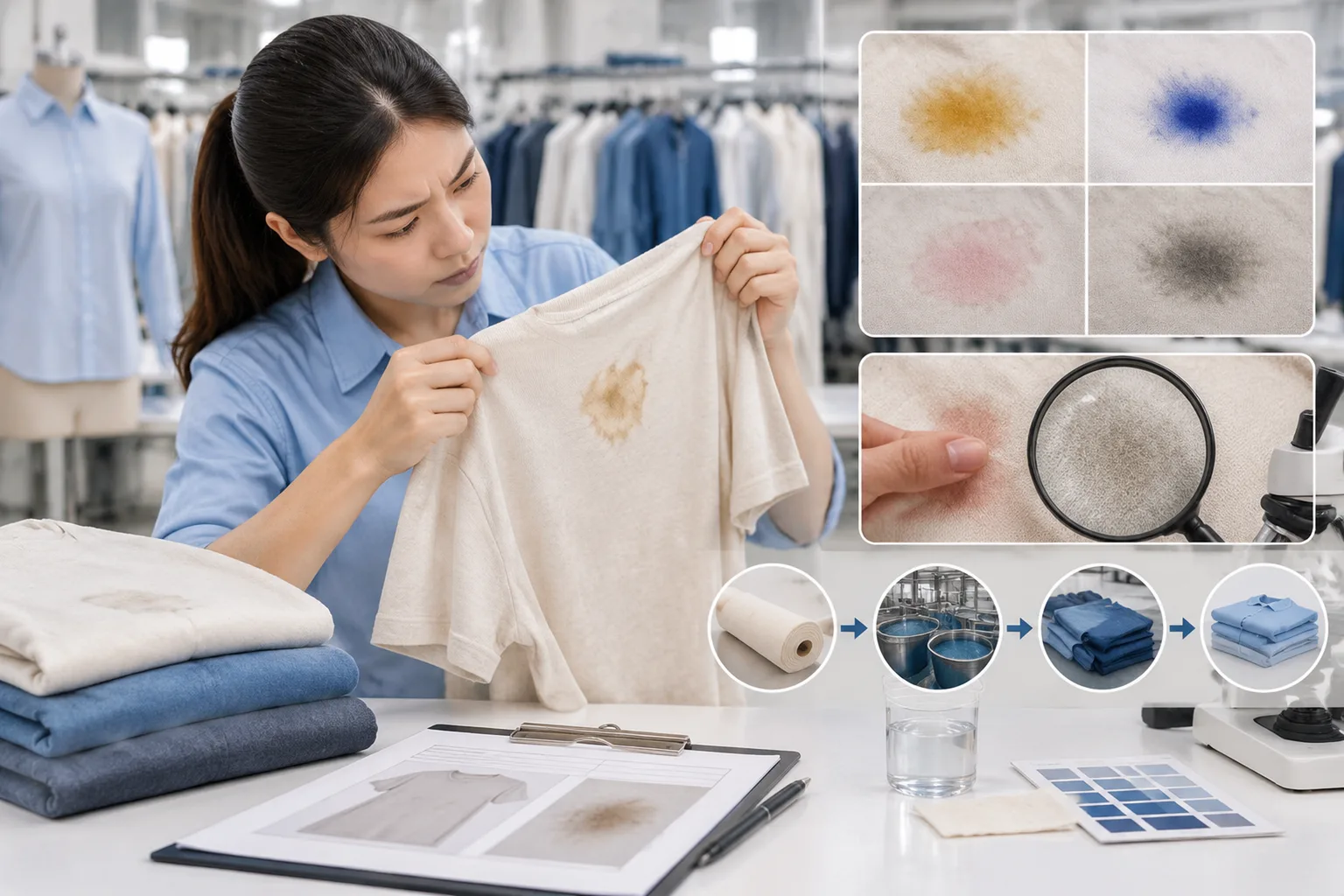
Map the Treatment to the Garment Production Process
To trace garment production defects, build a timeline from the last known acceptable state. Include stain discovery, treatment, any waiting or drying period, pressing or finishing, inspection, repeat treatment, and final handling. The actual route varies by product, so omit stages that did not occur and add any relevant operations that did.
Mark the first point at which the defect was observed, not simply the point where it was formally reported. Then connect each stage to its dependencies: material batch and shade, garment panel or trim, construction area, workstation, tools or consumables, operator instructions, handling sequence, and departures from the approved sample or documented process.
Recurrence patterns can narrow the search but cannot diagnose the cause. One affected location may suggest a local handling or tool relationship. Repeated placement on the same garment area may suggest a construction or workstation relationship. Repetition across garments may point toward a shared material or process variable. Each pattern still requires comparison against unaffected work and contrary evidence.
Stain removal process traceability also depends on information flow. Check whether the treatment instruction, defect classification, rework decision, and release status consistently identify the garment and relevant conditions. Batch records and process checks help evaluate consistency. Final inspection may detect a recurring problem, but it cannot reverse a systemic condition that has already entered production.
Test Competing Root-Cause Hypotheses
Once the process map identifies where the defect first appeared, convert possible causes into competing hypotheses. Keep material or dye, garment construction, treatment conditions, equipment, handling, drying, later finishing, and inspection error in scope. A familiar cause is not automatically the root cause of the current defect.
For each hypothesis, write down three elements: evidence that supports it, evidence that conflicts with it, and the smallest useful check that could distinguish it from alternatives. This structure prevents the investigation from collecting only facts that support its first assumption.
- Material or construction: Compare affected and unaffected areas, garments from the same material batch, and equivalent construction locations. A batch or placement pattern supports further investigation, but exceptions within that pattern provide important contrary evidence.
- Treatment or equipment: Compare documented treatment conditions, workstations, tools, and consumables with the approved instruction. Check whether unaffected garments passed through the same conditions before attributing the defect to one variable.
- Handling or later finishing: Review waiting, drying, pressing, finishing, and transfer stages. Evidence that the condition first appeared later may redirect the trace, although delayed visibility does not prove which stage created it.
- Inspection or measurement: Recheck the viewing conditions, defect description, reference garment, and inspection timing. An inconsistent observation can resemble a process change, so measurement or classification error should remain a testable hypothesis.
These are investigative comparisons, not formal performance tests. Isolate one variable where practical. For example, compare the same material batch across documented locations rather than changing the material, workstation, and treatment sequence simultaneously. Also check whether any pre-treatment record shows the defect before rework began.
When recurrence appears possible, segregating affected work and preserving representative samples can protect evidence while the investigation continues. Repeated treatment may alter the original condition and weaken the trace. This is a process-control choice, not a universal release or legal requirement.
Separate correction from confirmation. A changed handling step might coincide with fewer defects, but that result alone does not confirm the suspected cause. Record what changed and compare equivalent work. The investigation should end with a supported root cause, an unresolved hypothesis requiring more evidence, or a documented decision not to claim a cause.
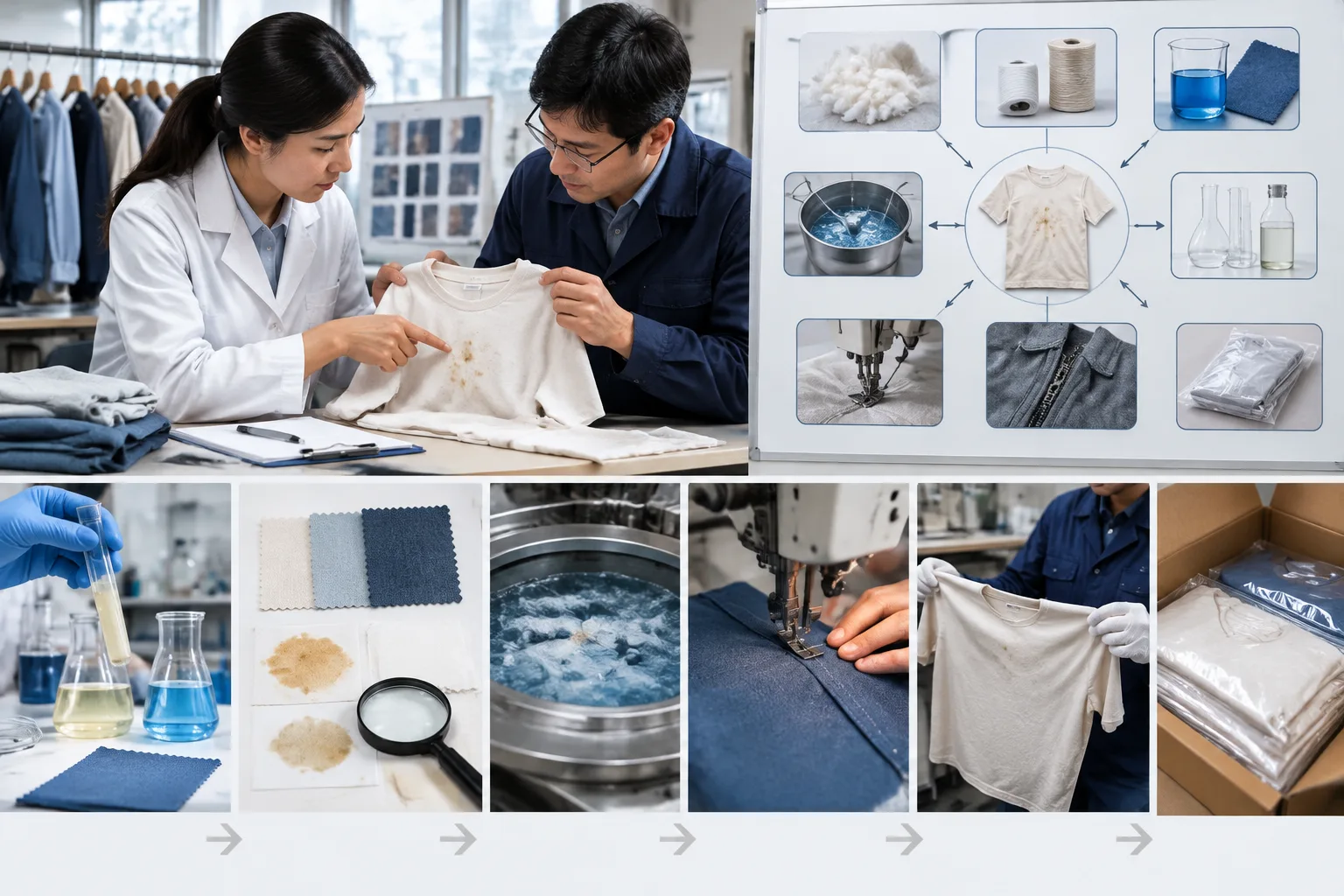
Decide on Rework, Containment, and Process Follow-Up
Containment addresses potentially affected work now; corrective action addresses a supported process problem. Identify garments, material batches, workstations, or time periods connected to the recurrence pattern. Record what was isolated before altering the operation, and pause repeat treatment when it could destroy useful evidence.
Do not judge garment stain removal rework only by whether the original spot disappeared. Compare the treated garment with its intended appearance, hand, shape, color, construction, and approved reference. A visually clean area may still differ from the target in another observable way.
Assign a documented disposition to each affected group. Available process-management options may include rework, acceptance with a recorded rationale, holding for further investigation, or rejection under the responsible quality procedure. The correct option depends on the product requirements, buyer specification, contract, and applicable quality system. There is no universal acceptance limit for every garment or defect.
Consider a repeated ring found on one panel after spot treatment. If pre-treatment images show that the ring already existed, another operation or the original stain may require investigation. If it appears only after one documented treatment condition, that condition becomes a stronger hypothesis. If similar rings occur across multiple material batches, a shared process variable may deserve priority. None of these patterns proves the cause without a controlled comparison and contrary-evidence review.
Feed confirmed findings back into the relevant work instruction, inspection point, material or batch review, and training record. Document exactly what the evidence supports. If the cause remains uncertain, retain the open hypothesis and evidence gap rather than converting an assumption into an official process explanation.
After any approved rework, compare the result with the same product requirements used for disposition. Removing the symptom does not demonstrate that color, hand, shape, or other performance has been restored unless the applicable evaluation supports that conclusion.
Key Takeaways for Tracing Stain-Removal Defects
A garment stain-removal defect is an investigation problem, not a diagnosis supplied by appearance alone. Describe the symptom, preserve its original evidence, map the production route, compare competing hypotheses, and document the resulting containment or disposition. Keep observations separate from explanations until the evidence supports a root cause.
As the next educational step, compare the affected garment with its approved reference and review the material, treatment, inspection, and batch records together. Before repeating treatment or releasing the garment, check the applicable internal procedure, product requirement, or authoritative evaluation method.
Frequently Asked Questions
How can I tell whether stain removal caused a garment defect or only revealed an existing one?
Compare pre-treatment evidence, untreated areas, equivalent garments, treatment records, and the first documented appearance. A cause becomes supportable only when timing and comparative evidence distinguish treatment-created damage from a pre-existing or unrelated condition.
What information should be recorded when a garment develops a mark after stain treatment?
Record the style, panel and position, garment side, direction, distribution, visual and tactile features, treatment history, inspection timing, material batch, workstation, and recurrence pattern. Preserve contextual photographs and distinguish observations from suspected explanations.
Which production records are most useful for tracing repeated stain-removal defects?
Useful records connect the garment to its material and color batch, treatment instruction, workstation, tools or consumables, operator or shift information, handling sequence, pressing or finishing history, inspection result, repeat treatment, and final disposition.
Should a garment be treated again before the cause of the defect is confirmed?
Not automatically. Another treatment could alter the condition and remove evidence. When recurrence is suspected, first preserve representative samples and records, then follow the responsible quality procedure when deciding whether a controlled rework attempt is appropriate.
How should a team handle a stain-removal defect when no single root cause is proven?
Document the unresolved hypotheses, supporting and contrary evidence, affected work, and any containment decision. Hold or disposition the garments under the applicable quality procedure, and avoid recording an unconfirmed explanation as established fact.
What should be compared before deciding whether a treated garment is acceptable?
Compare its appearance, hand, shape, color, and construction with the approved reference and applicable product requirements. Also review untreated areas and equivalent garments where relevant. Stain removal alone does not establish overall acceptability.