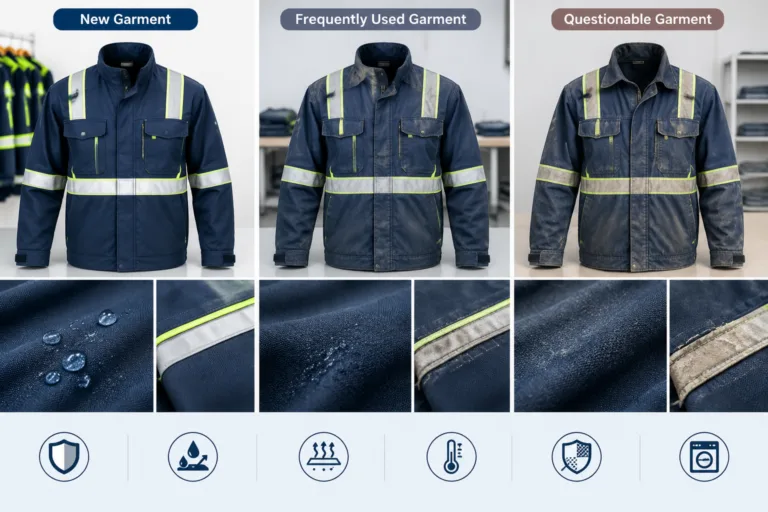
Arc protective clothing can be affected by laundering, drying, abrasion, contamination, fit changes, and repeated wear. The practical answer is conditional: care and use may alter the fabric, seams, closures, labels, surface condition, or overall construction, so the garment should be maintained and evaluated according to its documented protective claim and care instructions. A garment that looks acceptable is not automatically proven to retain its original protective performance.
In this article, arc protective clothing means a specified garment system intended to support an arc-related protective claim under defined conditions. That claim belongs to the complete product and its condition, not simply to a fiber name or an initial test result. Apparel Wiki is an independent educational publication; our Sponsor information does not change that editorial position. This guide addresses garment care and condition, not arc-flash risk assessment, work practices, or incident-energy calculations.
How Care and Repeated Use Can Affect Arc Protective Clothing
Protective performance depends on more than the textile fiber. Fabric panels, thread, seams, closures, pockets, labels, cuffs, and layering interfaces work together as a garment system. Repeated use can place stress on those components, while an unsuitable cleaning process can affect materials or construction in ways that are not obvious during a quick visual check.
For that reason, care of arc protective clothing should begin with the permanent label and the manufacturer’s current technical documentation. Those sources may identify permitted laundering, drying, ironing, detergents, repairs, storage, and retirement practices. Workplace procedures may add requirements for handling contaminated workwear, documenting inspections, or authorizing a garment’s return to service. These product and workplace instructions take priority over general household assumptions.
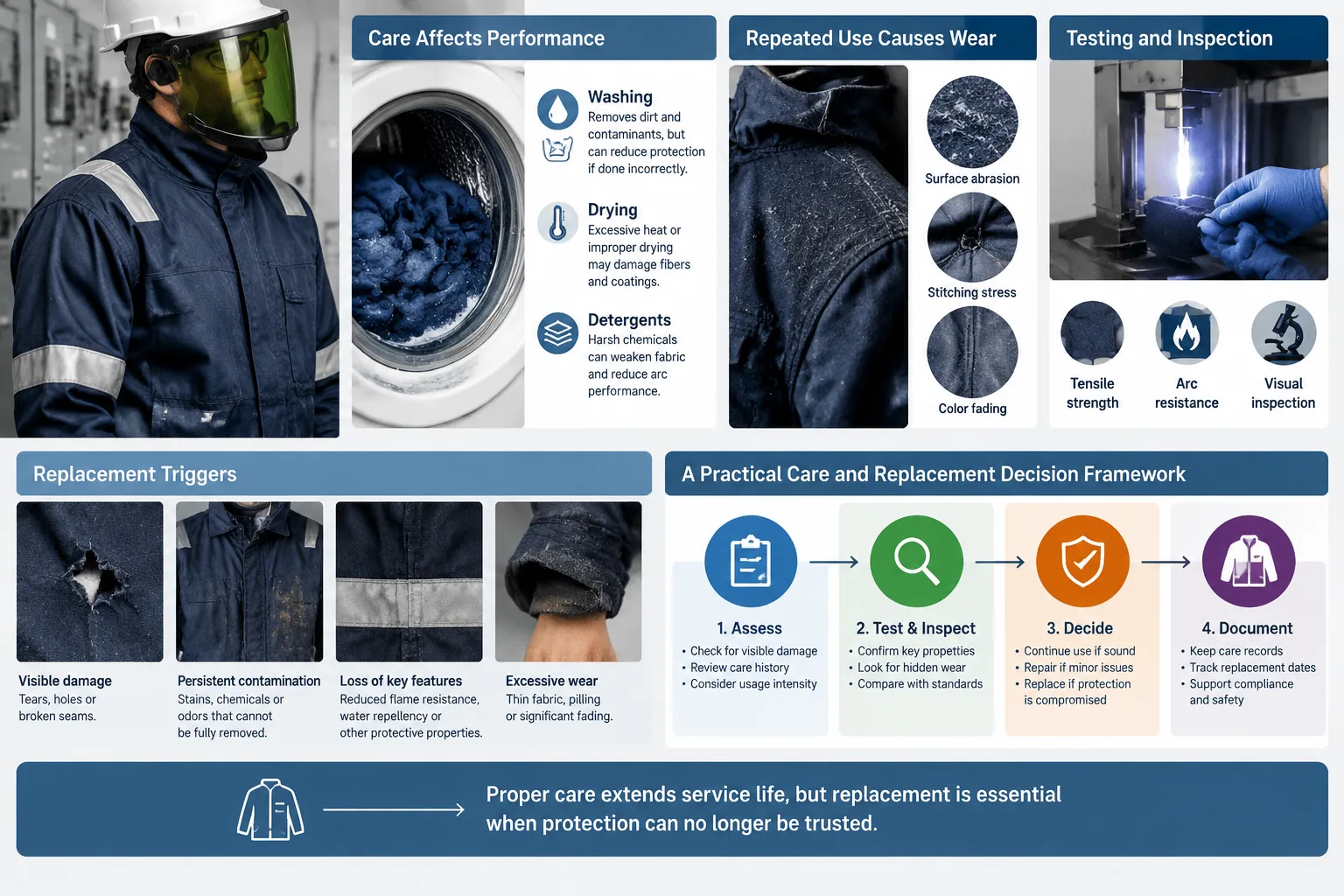
Visible damage, incorrect laundering, chemical exposure, excessive heat, severe abrasion, or an unauthorized alteration may justify removing a garment from service or requesting qualified evaluation. The appropriate response depends on the product design, the exposure, the care history, and the applicable program. There is no responsible universal wash count, service period, or replacement date that applies to every arc-rated garment.
Which Parts of the Garment May Change With Use
Care variables can include cleaning chemistry, water temperature, mechanical action, drying heat, ironing, and finishing products. A process that conflicts with the garment specification may contribute to dimensional change, surface change, construction stress, or other condition issues. However, the effect is product-specific. General textile knowledge can identify a question for review, but it cannot by itself prove that a particular garment has lost a stated protective performance.
Wear creates a different group of concerns. Repeated contact with tools, equipment, rough surfaces, or other garments may cause abrasion, snagging, stretching, pilling, thinning, fraying, open seams, or holes. Closures can become damaged or fail to operate correctly. Shrinkage, distortion, or stretching can change fit and may affect how the garment works with other required layers. A garment can also be clean and intact in one area while showing a significant issue at a cuff, pocket, fastener, seam, or high-contact panel.
Contamination should be treated as a separate cleaning and safety question. Oils, chemicals, dirt, metal particles, and other workplace substances may require handling procedures that are not covered by ordinary home laundry advice. The correct cleaning method may depend on the substance, its concentration, the garment manufacturer’s instructions, and workplace or occupational-safety guidance. Do not assume that a normal wash removes every contaminant or restores a garment to an acceptable condition.
The fiber alone also cannot describe the full garment. A product’s protective claim may depend on construction details, seam assembly, thread, closures, labels, pockets, and how the garment is worn as part of a system. Conversely, a visible defect does not automatically identify the exact amount of protective-performance loss. It does establish a reason to stop and escalate rather than infer a result from appearance alone.
Care Practices: Follow the Garment Specification First
A practical care workflow begins with traceability. Identify the garment, its label, its stated protective claim, and the manufacturer or product documentation. Confirm that the instructions are legible and belong to that product. Then determine whether the garment is compatible with the planned laundry process and whether contamination requires separation or professional handling under the workplace procedure.
- Read the permanent care label and current manufacturer instructions.
- Separate garments according to the product specification and workplace laundry procedure.
- Use only the cleaning products, temperatures, mechanical process, and drying method that the documentation permits.
- Do not add bleach, fabric softener, starch, solvents, hot ironing, or high-heat drying based on ordinary household practice unless the product documentation allows it.
- Inspect the garment after cleaning and communicate any damage, contamination, missing information, or fit change.
- Record the care or inspection information when the workplace program requires traceability.
This approach does not prescribe one laundering recipe for all arc protective clothing. Home laundering may be suitable for some products and unsuitable for others. A professional laundry provider may also need product-specific instructions and contamination information. When the label conflicts with an informal recommendation, or when the label is missing or unclear, pause the process and seek guidance from the manufacturer, employer, or qualified safety professional.
The following checklist is an editorial organizing tool, not a replacement for the garment label or workplace procedure:
- Identity: Is the garment identifiable, and is the protective claim documented?
- Label: Is the permanent label present, legible, and consistent with the product records?
- Process: Are the detergent, cleaning method, temperature, drying method, and ironing limits approved?
- Contamination: Has the garment been exposed to substances that require special handling or evaluation?
- Post-wash condition: Are the fabric, seams, closures, labels, fit, and auxiliary components intact?
- Records: Have relevant problems, decisions, and responsible reviewers been documented?
Inspection After Washing and Repeated Wear
Inspection should cover the complete garment rather than only the main fabric panel. Review fabric surfaces, seams, stitching, closures, labels, cuffs, pockets, reflective or auxiliary components, and overall fit. Look for holes, tears, burns, melting, charring, thinning, severe abrasion, fraying, open seams, damaged fasteners, missing labels, contamination, shrinkage, distortion, and unauthorized modifications.
The inspection frequency and responsible person should follow the employer’s procedure, product instructions, use intensity, and exposure environment. A frequently used garment in a high-abrasion task may need a different management approach from a rarely worn garment stored in controlled conditions. Calendar age or an assumed wash count should not replace an examination of actual history and condition.
When a concern is found, use a clear decision path: continue use only according to the applicable procedure, quarantine the garment for review, arrange repair through an approved channel, or retire it. Repair is appropriate only when the manufacturer or responsible program permits it and the repair method preserves the garment specification. An improvised patch, replacement closure, altered seam, or added decoration should not be treated as automatically acceptable.
Documenting the garment identity, inspection context, observed condition, action taken, and authorization for return to service can improve traceability where the workplace program uses such records. A visual inspection can identify reasons for escalation, but it cannot prove an arc-protective rating or confirm retained performance after a particular care history. Unclear labels, unknown contamination, abnormal exposure, or damage beyond routine inspection should remain out of service pending appropriate guidance.
Comparing New, Frequently Used, and Questionable Garments
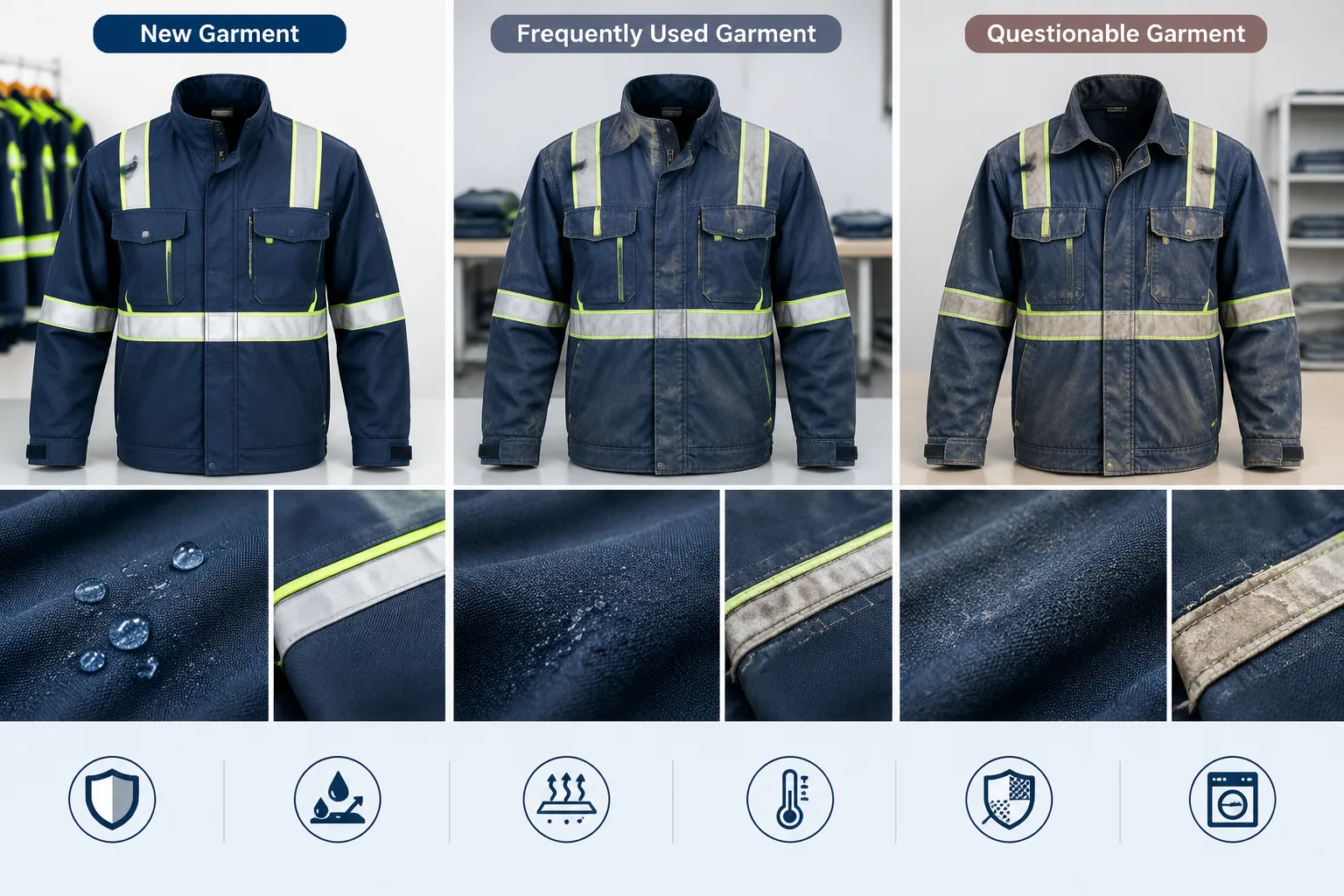
Consider three hypothetical garments. The first is new, has a legible permanent label, and comes with clear manufacturer instructions. The available evidence supports its identity and documented protective claim, but it still must be used within the applicable workplace program. A new condition does not remove the need to confirm fit, compatibility, and suitability for the intended task.
The second is frequently washed and worn, but its care history is documented, the specified process was followed, and inspection shows no visible damage. Those records and observations support a more informed serviceability decision. They do not, by themselves, prove that every protective property has been retained. Any conclusion about performance after repeated use must remain tied to product-specific evidence, construction, care conditions, and the applicable evaluation method.
The third garment has an unknown care history, missing or unreadable labels, visible defects, contamination, or signs of unauthorized alteration. In this case, the evidence gap is itself important. The garment should be separated from routine use while the responsible workplace program, manufacturer, qualified PPE professional, or approved repair provider determines the appropriate action.
This comparison shows why arc protective clothing lifespan cannot be reduced to a calendar age or a wash count. Use intensity, task abrasion, storage, contamination, fit changes, and abnormal exposure may be more relevant than elapsed time. Procurement and quality teams should request the care instructions, repair guidance, inspection criteria, construction information, and evidence supporting the stated protective claim before accepting a product or approving continued use.
What Care and Repeated-Use Evidence Can and Cannot Show
A garment being designed or tested for an arc-protective claim is not the same as proving that a particular worn garment remains suitable after an individual care history. A label identifies important product information and instructions, while a visual inspection can reveal damage, contamination, missing information, or changes in fit. Neither one alone confirms retained protective performance after every laundering or wear condition.
Test evidence also requires context. A useful report should identify the garment or construction evaluated, the sample condition, the test method, and the limits of what was examined. Results from a new sample should not automatically be treated as evidence for an older garment that has been exposed to different detergents, heat, abrasion, chemicals, repairs, or storage conditions. General textile knowledge can identify reasonable areas of concern, but it cannot assign a specific loss of protection to a particular defect without supporting evidence.
Readers should distinguish among applicable regulatory or standard-based requirements, manufacturer recommendations, workplace procedures, and editorial organizing suggestions. These categories may overlap, but they are not interchangeable. Requirements can also vary by jurisdiction, employer, garment design, and exposure scenario. Apparel Wiki is an independent educational publication, not a manufacturer, factory, laboratory, certifier, or safety authority.
Escalation is appropriate when labels are unclear, instructions conflict, contamination is unknown, the garment was exposed to an incident or unusual heat, an unauthorized alteration was made, or damage extends beyond routine inspection. In those situations, consult the manufacturer, a qualified PPE or safety professional, an approved repair provider, or the relevant authority. Do not use an initial test report or general fiber description as proof of indefinite protection.
A Practical Care and Replacement Decision Framework
A repeatable review can help product teams, employers, laundry managers, and wearers make traceable decisions:
- Confirm identity. Record the garment type, label information, protective claim, size, and applicable manufacturer instructions. If the label is missing or unreadable, pause the decision until identity can be established.
- Review history. Gather available information about laundering, drying, contamination, storage, repairs, alterations, task exposure, and abnormal events. Treat unknown history as a limitation, not as evidence that the garment was cared for correctly.
- Inspect the complete garment. Check fabric panels, seams, stitching, closures, cuffs, pockets, labels, auxiliary components, overall fit, and signs of shrinkage or distortion. Record holes, tears, burns, charring, melting, thinning, severe abrasion, fraying, contamination, and unauthorized modifications.
- Compare with the governing information. Apply the product instructions and workplace procedure. Where the condition is unclear, quarantine the garment and obtain qualified guidance rather than improvising a repair or acceptance rule.
- Choose and document the action. Depending on the evidence, the outcome may be continued use according to procedure, approved repair, further technical review, or retirement. Record the garment identity, inspection context, observed condition, action taken, and authorization for return to service where the program uses such records.
- Improve the system. Repeated laundering errors, closure failures, contamination problems, or fit complaints may indicate a need to revise procurement specifications, user training, storage practices, or laundry controls.
This framework is an educational organizing tool, not a universal replacement rule. A repair is appropriate only when the manufacturer or responsible program permits it and the method preserves the garment specification. An improvised patch, replacement closure, altered seam, or added decoration should not be assumed acceptable.
As a next step, turn the garment label and manufacturer documentation into a workplace or product-team checklist. Keep the checklist specific to the garment, record uncertainties, and define who can authorize continued use, repair, quarantine, or retirement. This makes arc protective clothing care a managed process rather than an assumption based on appearance alone.
Can washing reduce the protective performance of arc-rated clothing?
It can affect serviceability or protective performance when the process conflicts with the garment specification or causes damage. Follow the current manufacturer instructions and inspect the garment after washing.
How should arc protective clothing be washed and dried?
Use only the washing, detergent, drying, and finishing process specified for that garment. Do not assume that bleach, softener, solvents, starch, high heat, or household laundering is acceptable.
How often should arc-rated clothing be inspected?
Inspection frequency should follow the employer procedure, product instructions, use intensity, and exposure environment. Frequent or harsh use may require a different approach from occasional controlled use.
What damage means arc protective clothing should be removed from service?
Holes, tears, burns, melting, charring, severe abrasion, open seams, damaged closures, missing labels, significant contamination, distortion, or unauthorized alterations require escalation and may require quarantine or retirement.
Can damaged arc-rated clothing be repaired?
Only when repair is permitted and completed through an approved method that preserves the garment specification. Otherwise, remove the garment from service pending qualified guidance.
Does a wash count or garment age alone determine when arc protective clothing must be replaced?
No. Age and wash count are not universal replacement criteria. Care history, use intensity, contamination, storage, fit, visible condition, product documentation, and qualified review all matter.