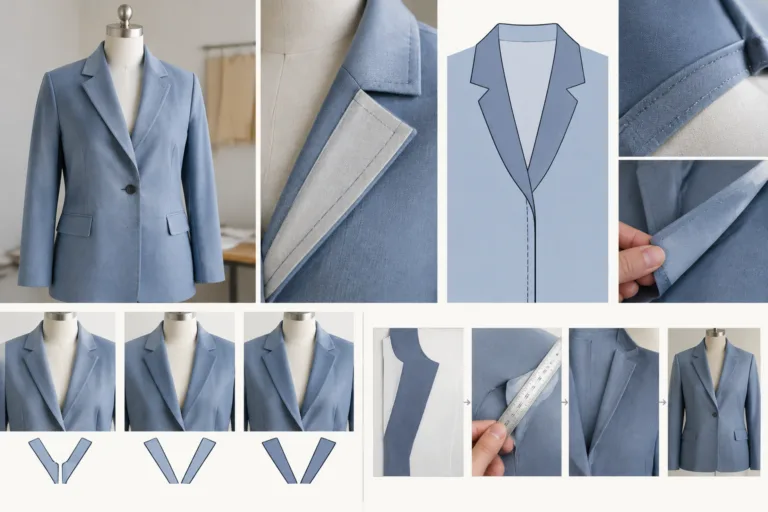
Facings design proportions affect more than the amount of fabric placed inside a garment edge. A facing must perform a construction job while supporting the intended visual scale of a neckline, armhole, opening, waistband, or pocket. In practical terms, the best proportion is the one that provides suitable control and a clean appearance for the specific fabric, shape, wearer, and production method. Apparel Wiki is an independent educational publication; see our Sponsor page for information about editorial independence.
What Is a Facing, and Why Do Its Proportions Matter?
A garment facing is an internal component attached to an edge so that the edge can be finished, supported, shaped, or stabilized. Common examples include neckline facings, armhole facings, front-opening facings, waistband facings, and pocket-opening facings. The facing usually follows the shape of the garment edge and turns to the inside, leaving the outside with a controlled finish rather than an exposed raw construction edge.
The facing is not the same thing as the garment edge itself. The edge is the boundary being finished; the facing is the additional component used to finish or support it. A seam allowance is the excess fabric beyond a seam line that permits pieces to be joined. A lining is a more extensive internal layer intended to cover or separate the garment interior, often across a body area. Interfacing is a supporting material applied between or within fabric layers. A facing may use interfacing, but the two terms are not interchangeable.
Facing width and proportion influence both performance and appearance. A facing that is too visually prominent may make an opening appear deeper, broader, heavier, or more formal, especially when it can be seen through a sheer fabric or turns slightly toward the outside. A facing that remains concealed can still affect edge definition, roll, stiffness, and the way the opening lies against the body. These effects are construction-related as well as aesthetic.
There is no universal ideal facing width. The appropriate proportion depends on the garment silhouette, edge geometry, fabric behavior, intended movement, wearer, finishing process, and production method. A proportion that works for a stable structured front opening may be unsuitable for a soft, curved neckline. Patternmaking requirements, comfort considerations, and designer preference should therefore be reviewed together rather than reduced to one nominal measurement.
What Functional Work Must a Facing Perform?
The facing’s first responsibility is to create a controlled edge. It can cover seam allowances, provide a clean internal surface, help the fabric turn along the intended line, and support the shape of an opening. At a neckline or armhole, it can help define the boundary between the garment and the body. At a pocket opening or front closure, it can contribute to a stable transition between the opening and the surrounding garment.
Those functions depend on compatibility between the facing and the garment system. The facing must work with the fabric’s weight, drape, stretch, recovery, and tendency to fray or distort. It must also suit the seam construction and finishing method. A facing that is technically wide enough may still behave poorly if its grain or stretch direction conflicts with the edge, if the seam is difficult to turn, or if the assembly sequence prevents accurate pressing and control.
Insufficient support may contribute to an edge that rolls, gaps, twists, shows through, or appears uneven. These are possible failure mechanisms, not inevitable results of a particular width. The same visible problem may arise from the pattern shape, fabric substitution, seam handling, pressing, interfacing, or assembly order. A useful review therefore identifies what is moving or distorting before adding more material.
Interfacing, folds, extra layers, understitching, edge stitching, and reinforcement can improve control in a targeted situation. They can also increase thickness, stiffness, friction, or bulk. A heavier facing is not automatically a better facing: additional support may make a lightweight neckline feel rigid, create a visible ridge, or interfere with movement and layering. Reinforcement should respond to a specific edge-control problem and be assessed in the complete garment.
Comfort is part of function. A facing that stays flat on the outside may still irritate the skin if its seam, edge, or added support creates a hard or bulky area. The intended use also matters. A garment that moves repeatedly, contacts bare skin, or is frequently cared for may require different construction choices from one worn over a stable base layer. Any durability or care conclusion should come from an appropriate project review or test, not from the facing width alone.
How Do You Balance Facing Width With the Garment’s Visual Scale?
Balancing a facing means considering its relationship to the opening, garment silhouette, collar or trim, and nearby design lines. A narrow facing may keep the internal treatment visually quiet and reduce bulk, but it can require precise shaping and handling. A moderate facing may provide a more noticeable transition between the edge and the body of the garment. A broad facing can establish a stronger visual frame and offer more internal coverage, while potentially adding stiffness or visual weight.
These descriptions are qualitative choices, not universal categories with fixed dimensions. On a simple curved neckline, a facing that follows the curve smoothly may look balanced even when its width changes along the pattern. On a sharply angled front opening, the important issue may be a clean transition through the point rather than a constant distance from the edge. Symmetry, smooth transitions, and consistent turn-of-cloth behavior often matter more than preserving one nominal width everywhere.
A concealed facing may have little direct visual presence, yet it can still change the appearance of the outer edge through roll, show-through, or added thickness. In a sheer or translucent garment, the facing may become part of the visible design whether that was intended or not. In a structured garment, a broad internal treatment may reinforce a formal frame around the opening. The design decision should account for what the wearer and observer will actually see during movement, not only the pattern laid flat.
Body scale and garment scale provide useful context, but they should not be used to prescribe one proportion for every wearer. The target wearer, fit intent, garment category, and brand language all influence what feels visually balanced. A designer may intentionally create a strong contrast around an opening, while a pattern maker may prioritize edge control or comfort. Those aims can coexist, but the sample must show whether the construction supports the intended result.
Which Variables Change the Appropriate Facing Proportion?
Fabric behavior is a major input. Weight and drape affect how much the facing influences the edge, while stretch and recovery affect whether the facing can follow movement without pulling the garment out of shape. Opacity affects whether the facing remains visually hidden. Fraying, surface friction, and dimensional stability affect seam handling and the likelihood that the finished edge will remain consistent. These characteristics should be considered from actual fabric information or sample observation rather than assumed from a generic fabric name.
Edge geometry also changes the decision. Curves may need careful shaping and clipping so the seam can turn smoothly. Points and sharp angles require accurate matching and controlled trimming. Square, asymmetrical, or highly shaped openings may need a facing pattern that follows the design rather than a simple uniform strip. The facing boundary, grain or stretch direction, seam allowance treatment, and interfacing shape should be reviewed as one pattern system.
Construction details can change both performance and apparent scale. Grading can reduce a bulky seam transition; understitching may help keep the facing rolled to the inside; clipping can release tension around a curve; and pressing can establish the intended turn. Edge stitching or additional folds may improve definition but also become visible or increase thickness. If the facing pattern changes, corresponding changes may be needed to interfacing, seam allowances, and assembly order.
Finally, consider the garment’s use and production context. Movement, skin contact, layering, care conditions, pressing capability, seam accessibility, turnability, and consistency across sizes all influence the suitable proportion. Material behavior, construction technique, and design preference are separate decision inputs. Reviewing them separately helps a team understand whether an adjustment is solving a pattern problem, a fabric problem, a finishing problem, or an intentional visual choice.
A Practical Method for Evaluating Facing Proportions
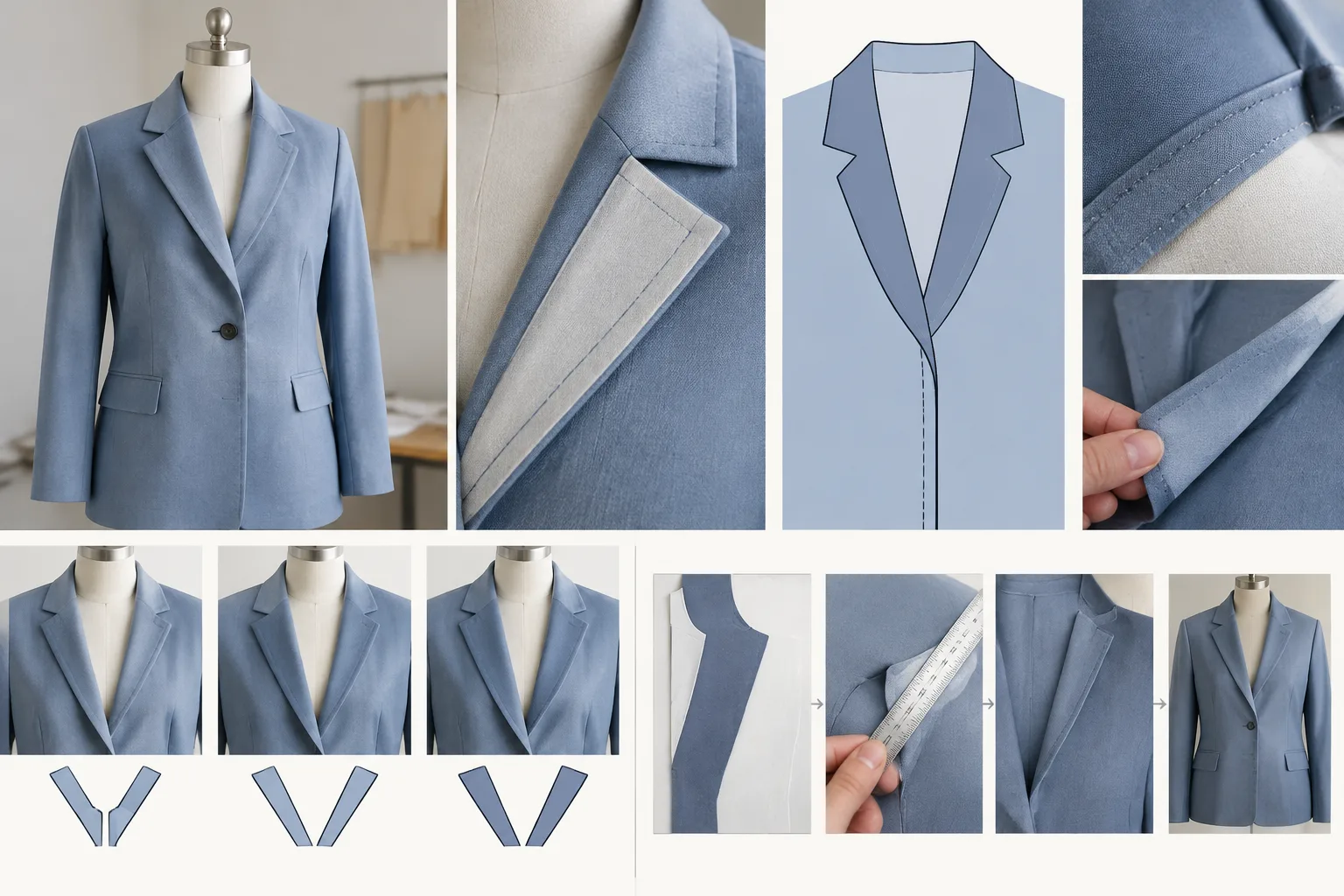
A facing should be evaluated as part of the complete garment system, not as an isolated strip on a paper pattern. Begin by marking the facing boundary, finished edge, seam allowance, grain or stretch direction, and any interfacing. Confirm that the facing follows the edge it is intended to finish and that its shape, joining seams, and turn-of-cloth behavior are compatible with the garment.
Review the pattern flat before making a sample. Look for a continuous shape, balanced seam placement, smooth transitions through curves and corners, and enough turnability for the planned construction sequence. Points and sharp angles deserve particular attention because trimming, clipping, and pressing may affect whether they turn cleanly. A facing that appears balanced on paper may still distort when joined to a fabric with different stretch, drape, or stability.
The most useful review then moves to a representative sample made in the intended fabric and with the intended construction order. Inspect the edge from both the outside and inside. Check whether the facing rolls inward as planned, remains controlled, and avoids unwanted exposure. Also look for gaping, bubbling, pulling, twisting, show-through, uneven bulk, and a change in visual weight around the opening.
- Pattern: Check the boundary, edge shape, grain or stretch direction, seam allowances, interfacing, and seam placement.
- Construction: Confirm that grading, clipping, understitching, edge stitching, and pressing suit the shape and fabric.
- Appearance: Review symmetry, smoothness, edge definition, transparency, and whether the facing becomes visibly dominant.
- Wear: Consider movement, skin contact, layering, and whether the facing stays in position during realistic use.
- Record: Note the observed problem, likely mechanism, proposed adjustment, and result after revision.
This is a practical development checklist, not a regulated inspection method. Care or laundering review should use the project’s applicable method, buyer requirement, or documented sample observation. A facing dimension alone cannot predict the result after wear or care because the fabric, interfacing, assembly, and garment shape work together.
How Should Teams Compare Alternative Facing Treatments?
When function and visual scale conflict, compare the treatment options against the problem being solved. A broader facing may cover more of the inside edge or provide a stronger visual boundary, but it can also introduce extra thickness, stiffness, heat, friction, or a more noticeable interruption. A narrower facing may reduce bulk and remain visually quiet, yet it can demand more precise control and may not suit every fabric or opening.
| Treatment | Potential advantage | Potential trade-off |
|---|---|---|
| Narrower facing | Less internal coverage and a quieter visual influence | May offer less control or leave less room for construction handling |
| Broader facing | More coverage and a stronger support or design presence | May increase bulk, stiffness, heat, or visual weight |
| Partial facing | Can target a specific area while limiting added layers | Transitions and unsupported areas require careful coordination |
| Binding | Can reduce the size of an internal layer and suit a clean edge treatment | May require accurate application and may not provide the same shaping effect |
| Lining extension | Can connect the edge finish with an existing lining system | May complicate assembly, accessibility, or control at shaped edges |
These are qualitative comparisons rather than universal rankings. The appropriate choice depends on the failure or design requirement. If seam allowances are exposed, coverage and turning may be the priority. If an edge is unstable, the team may need to examine fabric behavior, interfacing, seam construction, and finishing together. If bulk is the problem, reducing facing width may help, but a different edge treatment or a change in assembly may address it more effectively.
For example, a lightweight sheer neckline may require a treatment that manages visibility and bulk without creating a heavy internal line. A structured front opening may justify a more substantial facing if that choice supports the intended shape and remains comfortable. In both cases, the sample should decide whether the treatment achieves the design intent. Document the selected option, its assumptions, related interfacing and seam allowance choices, and any unresolved risks in the tech pack or construction record.

Common Limits and Next Steps for a Facing Review
Facings design proportions cannot be judged reliably from a keyword, sketch, or isolated measurement. The garment shape, fabric, construction sequence, intended use, and target wearer all affect the result. Visual balance is also partly subjective, so a technically workable facing may still need adjustment to match the brand’s design language, nearby collar or trim, and the scale of the garment.
Separate the type of problem before changing the pattern. A pattern correction, fit correction, fabric substitution, interfacing substitution, and assembly error may produce similar symptoms but require different remedies. A facing that twists may involve shape or sewing order; a stiff edge may involve added layers or interfacing; visible show-through may relate to opacity or placement rather than width alone.
Advance the preferred option through a representative sample, a targeted appearance and wear review, and documented approval before grading or bulk production. Apparel Wiki is an independent educational publication, not a factory, laboratory, certifier, or production-capacity provider. Its guidance can help frame the review, while project-specific decisions should remain with the responsible design, development, and quality teams.
The next useful step is to turn the chosen facing treatment into a short review record: identify the edge, fabric, construction sequence, intended visual effect, observed issue, adjustment, and approval status. That record gives pattern makers, developers, and quality teams a shared basis for deciding whether the change solved the actual problem.
What is the main purpose of a facing in garment construction?
A facing finishes, supports, shapes, or stabilizes a garment edge while covering the inside construction. Its exact role depends on the edge, fabric, design, and assembly method.
How does facing width affect the visual proportion of a garment?
A concealed facing may have little visible influence, while a facing near an edge can affect roll, transparency, edge definition, and perceived visual weight. Width should be judged with the surrounding design lines and garment scale.
Should a facing always be wider for better stability?
No. A wider facing may provide more coverage, but it can also add bulk, stiffness, heat, or visual interruption. Stability depends on the full combination of fabric, interfacing, shape, and finishing.
Which fabric and interfacing variables affect facing proportions?
Weight, drape, stretch, recovery, opacity, fraying, dimensional stability, and interfacing behavior can all affect the suitable proportion. These inputs should be reviewed together rather than treated as separate from the pattern.
How can a designer evaluate a facing before bulk production?
Review the pattern, make a representative sample in the intended materials, inspect the edge inside and outside, assess movement and comfort, and document any adjustment before approval.
When is binding or another edge finish more suitable than a facing?
Binding or another finish may be suitable when reducing internal layers, controlling bulk, or creating a specific edge appearance is more important than the broader coverage or shaping associated with a facing.