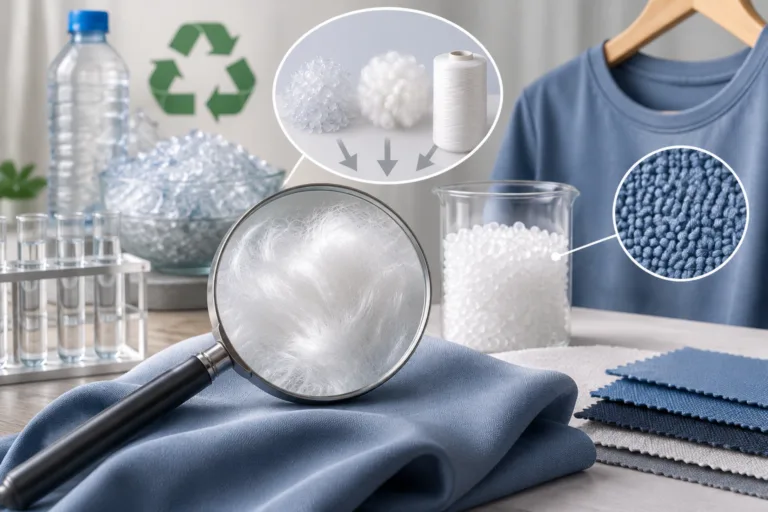
Chemically recycled polyester identification is not a single yes-or-no test. A laboratory method may help confirm that a submitted material contains polyester, reveal some composition or processing differences, or identify possible inconsistencies. It generally cannot, by itself, prove that the polymer came from a chemical recycling route. This guide follows Apparel Wiki’s independent editorial approach, including the separation described on its Sponsor page between editorial content and outside influence.
To identify chemically recycled polyester responsibly, separate three questions: what polymer is present, whether recycled input was used, and how that input was processed and controlled. The first question may be suitable for material analysis. The other two usually require additional evidence about the production process, material history, and relevant supply chain. The result should therefore state what the sample supports, what it does not establish, and what remains unresolved.
What chemically recycled polyester identification can—and cannot—show
Chemical recycling polyester refers to recovering polymer-forming chemical building blocks, or otherwise chemically transforming waste into feedstock used to make new polyester. That claim concerns the material’s origin and production route, not only its final fiber name. Mechanical reprocessing, by contrast, changes or remakes an existing polymer without making the same kind of claim about chemical breakdown and rebuilding. The distinction matters because a generic fiber name does not identify the route used to produce it.
Fiber classification has several separate axes. “Polyester” describes a generic fiber or polymer category. Production process, raw-material origin, and commercial trademark describe different attributes. A material can therefore be polyester without the available test showing whether its input was virgin, mechanically reprocessed, or chemically recycled. A branded name can also identify a commercial product without replacing evidence about the underlying material claim.
A composition test examines the submitted sample under the conditions of that method. It may support a finding such as “polyester is present” or “the sample has characteristics requiring further investigation.” That is different from documentary evidence describing how the raw material was produced, segregated, transferred, and recorded. Supplier declarations and production records can support an origin claim, but they should not automatically be treated as independently validated proof.
There may be no universal chemical signature that appears in every chemically recycled polyester and nowhere else. If the recycling process produces polymer that is chemically equivalent, or very similar, to conventional polyester, ordinary identification may confirm the polymer while leaving its previous source unknown. Conversely, a detected difference does not automatically identify chemical recycling. Additives, degradation, finishing, contamination, or other process history may offer alternative explanations.
The practical rule is simple: use each method for the question it can answer. Report polyester identity separately from recycled-input or recycling-route evidence. Use measured findings, supplied records, and editorial interpretation as distinct parts of the conclusion. “Supported,” “not established,” and “unresolved” are often more accurate than a universal “recycled” or “not recycled” verdict.
Define the claim and control the sample before choosing a test
Start by writing the exact claim under review. “Is this polyester?” asks about composition. “Is this a blend?” asks about additional fibers and their proportions. “Does the sample contain a finish or coating?” concerns treatment and construction. “Was recycled input used?” concerns origin. “Was chemical recycling used?” concerns a specific production route. These questions require different evidence, so one polyester identification test should not be expected to answer all of them.
Record the material form before selecting a method. A fabric swatch, yarn, filament, garment panel, trim, and production lot may contain different combinations of fibers, treatments, or components. The visible face of a fabric may not represent its backing or internal layers. A garment panel may include sewing thread, elastane, adhesive, print, or coating that was absent from the base fabric. Sampling location and the reason for choosing it should be retained with the sample.
- Material identity: record the stated fiber content, yarn or fabric construction, and whether the item is a single material or an assembled product.
- Possible confounders: note blends, elastane, colorants, dyes, coatings, finishes, prints, trims, contamination, and processing residues.
- Sample scope: identify the garment, fabric roll, yarn lot, batch, or production lot represented by the submitted piece.
- Material history: retain available treatment, dyeing, finishing, and processing information that could affect interpretation.
- Claim definition: state whether the decision concerns polyester composition, recycled input, a recycling route, or a finished-product claim.
Representative sampling is a decision, not an assumption. If several colors, constructions, lots, or suppliers are involved, one swatch may not represent all of them. A technically sound result for one submitted piece can still be too narrow for a wider lot or finished garment. The sample description should therefore accompany the laboratory request and the final record.
Blends require particular care. The presence of polyester does not establish its proportion, its role in the textile, or the source of every component. Performance and interpretation can change with fiber form, proportion, yarn structure, and fabric construction. Likewise, a generic fiber name should remain separate from a claimed raw-material source. If the question concerns recycled origin or process route, pair analytical findings with appropriately scoped production or chain evidence rather than asking a composition method to prove more than it measures.
Useful screening and laboratory approaches
Begin with visual review, product information, and labeling as preliminary screening. These steps can identify inconsistencies, clarify the stated material, and help choose where to sample. They cannot independently establish chemical recycling. A label that says “recycled polyester” is a claim to investigate, not a laboratory result.
Composition-focused instrumental methods may help characterize the polymer or detect differences relevant to a narrower question. Spectroscopy, for example, can be considered when the immediate need is material characterization, but the useful conclusion depends on the method, sample preparation, matrix, and known interferences. A result that identifies polyester should not be rewritten as proof of a particular feedstock or recycling route.
Thermal or molecular-analysis approaches may also help compare characteristics such as composition, crystallinity, additives, degradation, or related material behavior. Those observations remain distinct from attribution. Detecting a material difference is not the same as showing that chemical recycling caused it. The laboratory’s stated method scope should control the wording.
| Observable input | Possible implication | Sensible initial choice | Variables that can change the choice |
|---|---|---|---|
| Label, specification, and available production records | Shows what is claimed and where inconsistencies may exist | Review documents and define the claim | Record quality, lot scope, mixed suppliers, and whether documents describe the submitted material |
| Visible material and construction | May reveal blends, coatings, trims, or nonrepresentative areas | Inspect and document sampling locations | Layered fabrics, colorants, finishes, prints, and garment assembly |
| Composition or polymer-analysis result | May support polymer identity or a narrower material comparison | Use a method matched to the material and question | Sample preparation, blend content, additives, degradation, contamination, and method scope |
| Analytical result combined with production evidence | May support a broader assessment when the evidence is consistent | Compare findings without treating unlike evidence as interchangeable | Chain records, segregation controls, sample representativeness, and unresolved contradictions |
When requesting a laboratory report, ask for the method used, sample description, reported result, stated uncertainty or limitations where provided, and the precise claim the result supports. A bare conclusion such as “recycled” does not show whether the method evaluated polymer identity, recycled input, or a particular recycling route. The appropriate next step is to compare the report’s scope with the original claim and preserve any unresolved distinction.
Why a test result may not prove the recycling route
The central limitation is straightforward: a test can identify polyester without identifying how its raw material was produced. If a chemical recycling process produces a polymer that is chemically equivalent, or very similar, to conventional polyester, routine composition analysis may find the expected polymer but no unique signature of its previous source. That result supports polymer identity. It does not, by itself, establish virgin input, mechanically reprocessed input, or chemically recycled input.
A material difference does not automatically identify its cause either. An observed change may relate to additives, degradation, contamination, dye, finish, coating, or processing history. A method that detects a difference still needs a validated basis for attributing that difference specifically to chemical recycling. Without that basis, alternative explanations remain open.
Finished textiles add another layer of uncertainty. A blend, elastane component, print, bonded layer, trim, or surface treatment can affect the analytical response. The result may describe the submitted fiber, yarn, or fabric portion rather than the whole garment. Fiber content and finished-product behavior are also separate questions; the presence of polyester does not predict the response of every layer or construction.
Sampling can limit an otherwise technically sound result. A test may accurately describe the submitted swatch while failing to represent another color, panel, yarn package, production lot, or supplier. Records about sampling location, lot identity, construction, and treatment history therefore belong beside the result. Documentary evidence can help connect a sample to production, but a supplier declaration or production record is supporting evidence, not automatically independent proof.
Report the outcome at the claim level. A record might state that the evidence supports polyester composition, does not establish the recycling route, and leaves lot representativeness unresolved. “Unsupported” means the available evidence does not support that claim; “unresolved” means the evidence or method cannot settle it. Neither finding should be converted into a universal yes-or-no verdict.
A practical evidence workflow for an identification decision
Use the following workflow as an editorial decision aid. It organizes evidence without implying that any combination of tests guarantees identification or that Apparel Wiki performs laboratory, certification, or approval services.
- Write the exact claim. Define whether the decision concerns polyester composition, a blend, recycled content, a chemical-recycling route, a particular lot, or a finished garment. “Is this polyester?” is narrower than “Was this lot made with chemically recycled feedstock?”
- Describe and control the sample. Record whether the material is a filament, yarn, fabric, garment panel, or finished product. Note the lot or batch reference, color, construction, treatments, coatings, prints, trims, and suspected blends. Retain samples from relevant locations and document how they were selected. A single convenient swatch may not represent the wider material.
- List the available evidence before testing. Preserve fiber-content declarations, material specifications, production references, and records describing the submitted material. Note whether each document concerns the actual lot, a broader supplier practice, or an unlinked product description. This distinction prevents general paperwork from being treated as sample-specific proof.
- Choose a method for the immediate question. Start with the least complex approach that can address the defined issue. Screening may reveal an inconsistency or guide sampling. Composition or polymer analysis may support a narrower material finding. Escalate only when the unresolved claim requires additional evidence, not simply to accumulate more results.
- Read the result within its scope. Compare the report’s method, sample description, reported finding, and stated limitations with the original claim. Ask what the method measured and what it did not measure. Do not average unlike evidence, such as a polymer result and a production declaration, into a single unexplained certainty.
- Record three separate conclusions. State what the evidence supports, what it does not establish, and what further evidence would be needed. Keep contradictions visible. Conditional wording is useful only when the underlying method or claim relationship has been validated; adding “likely” cannot make an unsupported attribution reliable.
This workflow keeps laboratory findings, source documents, and editorial interpretation distinct. Combined evidence may produce a more useful assessment when each component is relevant and consistent, but it does not remove the need to examine sample scope and method limitations.

How to report the result without overstating certainty
Use a short record that names the claim examined, sample and lot scope, method used, supported finding, unresolved limitation, and evidence still required. Before making a product, labeling, or commercial decision, compare the method’s stated scope with the exact claim and check the applicable authoritative method or source. Apparel Wiki is an independent garment-manufacturing knowledge publication, not a certifier, laboratory, factory, or testing provider.
Frequently Asked Questions
Can a standard polyester identification test prove that the material was chemically recycled?
Usually, no. A standard test may support polyester identification or another material finding, but it does not automatically establish the raw-material source or recycling route. That conclusion requires evidence specifically validated for the claim, together with appropriately scoped production or control records.
What is the difference between identifying polyester and verifying recycled polyester content?
Identifying polyester concerns the polymer or fiber present in the submitted sample. Verifying recycled content concerns the origin and controlled use of input material. The first question may be addressed by composition analysis; the second generally requires additional evidence beyond a basic fiber-identification result.
Which sample details should be recorded before sending polyester for laboratory analysis?
Record the material form, lot or batch reference, sampling location, color, construction, suspected blends, dyes, finishes, coatings, prints, trims, and treatment history. Also preserve the precise claim, available product records, and how the sample was selected so the result can be interpreted against its scope.
Can a chemically recycled polyester sample be chemically similar to virgin polyester?
Yes, it can be chemically equivalent or sufficiently similar for ordinary composition testing to identify polyester without revealing the previous feedstock route. Similarity does not prove chemical recycling; it explains why polymer identification and recycling-route verification must be treated as separate questions.
What documents should be compared with a laboratory result when reviewing a recycling claim?
Compare records that identify the submitted material, such as its lot or batch reference, fiber-content declaration, material specification, and relevant production or control documentation. Check whether each record actually covers the tested sample. Treat declarations as supporting evidence unless their scope and independent validation are established.