
Choosing a factory is not only about price, product category, or whether the supplier answers your first email quickly. In apparel sourcing practice, the bigger issue is whether the manufacturer can actually deliver consistent quality, follow specifications, communicate clearly, and stay reliable once money has been paid and timelines become tight. That is why understanding clothing manufacturer red flags matters early. A problem that looks small during quoting can turn into delayed samples, size inconsistency, fabric substitutions, weak finishing, or bulk production that does not match what was approved.
If you are still building your supplier shortlist, this practical sourcing guide for finding a reliable factory gives useful context on how to compare manufacturers, what to verify before moving forward, and how early sourcing decisions affect sampling, MOQ, lead time, and product development quality.
Many buyers, especially startups, ask the wrong question at the start. They ask, “Who has the lowest quote?” A better question is, “Which supplier is showing signals of control, clarity, and accountability?” In many projects, the factory problem does not begin with a dramatic scam. It begins with vague answers, missing documents, repeated changes, and details that are never properly confirmed. Let’s look at what actually counts as a warning sign and how to separate normal negotiation friction from real supply risk.
What counts as a clothing manufacturer red flag versus a normal negotiation issue
Not every inconvenience is a red flag. Factories may take time to quote if your tech pack is incomplete. They may push back on tiny order quantities because line efficiency matters. They may ask for more time during peak season. Those points can be normal if they are explained clearly and supported by real production logic.
A red flag is different. It usually means one of three things: the supplier lacks operational control, the supplier is hiding something, or the supplier does not take specification accuracy seriously. For buyers, that distinction matters. A normal issue can often be solved with better information. A red flag usually becomes more expensive after deposit payment.
| Situation | Normal Issue | Red Flag |
|---|---|---|
| MOQ discussion | Factory explains minimum by fabric, color, or style complexity | MOQ changes repeatedly with no logic or written basis |
| Lead time | Supplier gives a range and explains sampling and material booking steps | Supplier promises unrealistic speed without reviewing specs |
| Pricing | Quote changes after fabric, trim, or print details are clarified | Very low quote with no cost breakdown and no specification confirmation |
| Communication | Some delay during busy periods but questions are answered clearly | Answers are inconsistent, vague, or ignore critical technical points |
| Sampling | Factory offers paid sampling with timeline and revision process | Factory avoids samples, delays repeatedly, or pushes straight to bulk |
The practical point is this: a good supplier does not need to say yes to everything. They need to explain constraints in a way that helps you make decisions. If the supplier cannot do that, risk increases quickly.
Unusually low pricing and the hidden risks behind it

Low pricing is one of the most common clothing manufacturer red flags because it often distracts buyers from the more important question: what exactly is included? A quote can look attractive because the factory has not properly included fabric quality, shrinkage allowance, print testing, packaging details, label cost, or quality control labor. In other cases, the supplier may plan to recover margin later through change charges, lower-grade materials, late substitutions, or weak workmanship.
Very low pricing is especially risky when the supplier gives a fast number without asking for measurements, construction details, fabric composition, GSM target, trim list, artwork method, or packaging requirements. In real manufacturing, those details affect cost directly. If they are missing but the quote is still confidently low, that should make you pause.
Ask the supplier to break the price into key components: fabric, trims, decoration, make cost, packaging, and any development charge. You do not need full factory accounting, but you do need enough clarity to see whether the quote matches the product. A heavyweight brushed hoodie with embroidery, custom labels, and polybag requirements should not be priced like a basic single-color jersey tee.
This is also where product knowledge matters. If you are developing a custom item, the quotation should reflect pattern work, sampling effort, testing needs, and material sourcing. An overview of garment development from concept to sample can help newer buyers understand why early development details affect both pricing and later production reliability.
What to check when a quote seems too low
- Does the supplier confirm fabric composition and target GSM?
- Are printing, embroidery, washing, labels, and packaging included?
- Is the quote based on your tech pack or only on a rough photo?
- Are sample charges, revision rounds, and freight excluded?
- Has the supplier explained price differences by quantity break?
If the answer to most of these is no, the issue is not just low price. The issue is weak costing discipline.
A manufacturer that avoids sampling or delays it repeatedly
In apparel, sampling is where assumptions become visible. Fit problems, stitch quality, fabric hand feel, print sharpness, neckline shape, pocket placement, and shrinkage concerns often appear before bulk only if a sample process exists. A factory that refuses to make samples or keeps delaying them without reason is asking you to accept risk blindly.
Some suppliers try to move buyers straight to production by saying their workmanship is already proven or by sharing photos of previous styles. That is not enough. Even if the factory has made similar garments before, your measurements, fabric behavior, branding details, and tolerance expectations may be different. A proper sample is not just a sales step. It is a specification checkpoint.
Repeated sample delays can also signal deeper issues: no real line capacity, no in-house pattern support, poor material sourcing control, or dependence on subcontractors not yet confirmed. One delayed sample does not automatically mean the supplier is unreliable. But if dates keep moving and the explanations remain vague, the factory may be less organized than it first appeared.
Buyers should ask for a simple sample plan: sample type, timeline, what is included, what material will be used, whether the sample matches bulk fabric, and how comments will be managed. Before paying for development, it also helps to prepare questions to ask before placing an order so the supplier’s process gaps show up early instead of after approval pressure begins.
No clear MOQ policy creates planning and costing problems
MOQ confusion is not just an ordering inconvenience. It affects costing, fabric booking, color options, cash flow, and whether the product is commercially realistic for your business stage. If a factory cannot clearly explain minimums, it usually means one of two things: either they are not controlling production requirements well, or they are adjusting the story case by case to pull the order in.
A good supplier may have different MOQs for different reasons. Fabric mills may require minimum dye lots. Custom rib, zipper colors, or woven labels may require separate minimums. Printing and embroidery may have setup economics. That is all normal. The problem starts when the supplier says “MOQ is flexible” but cannot define what is flexible, under what conditions, and with what price effect.
For example, a buyer may think the MOQ is 200 pieces total, only to learn later that the real condition is 200 pieces per color, per fabric, or per style. This detail may look small, but it can create problems later if it is not confirmed early.
If you need a clearer baseline, this guide on what MOQ means and how to plan your order helps explain why minimums vary and how to compare supplier offers more realistically.
Ask for MOQ in written, broken-down form
- Minimum per style
- Minimum per color
- Minimum per size ratio if relevant
- Minimum by fabric or trim customization
- Price effect if quantity drops below target
Written MOQ clarity protects both sides. It reduces later arguments and helps you avoid quotes that look possible only because the details were left undefined.
No written contract, weak order terms, or refusal to confirm specifications
One of the most serious clothing manufacturer red flags is resistance to written confirmation. In many apparel disputes, the real problem is not that the supplier made a mistake. It is that the approved material, tolerances, label placement, packaging method, or delivery standard was never documented in a way both sides can point back to.
A usable agreement does not have to be long or overly legal. But it should cover basic commercial and production terms: product description, quantities, approved specifications, sample approval status, tolerances, quality expectations, payment terms, delivery window, defect handling, and change management. If the supplier avoids written terms completely, you have very little protection when something goes wrong.
Specification confirmation is equally important. Your PO should not be the only document. You also need a tech pack, measurement chart, bill of materials where possible, artwork references, label details, and packaging instructions. For readers who want broader terminology support around specs, construction, and production language, Apparel Wiki is useful as a structured knowledge base before supplier discussions become technical.
There is also a professionalism check here. Trusted suppliers should show basic awareness of labeling, testing, and apparel compliance basics when your market requires them. They do not need to act as your legal adviser, but they should not sound confused when asked about care labels, fiber content declarations, flammability-related concerns where applicable, or documentation expectations for the destination market.
Confusing or slow communication across quotes, emails, and sample feedback
Communication problems are easy to excuse at the start, but they often become production problems later. If a supplier misunderstands size specs, color standards, artwork notes, or packaging instructions during the quoting stage, there is no reason to expect perfect execution during bulk. In sourcing, response quality matters more than response volume.
Watch for these patterns:
- Different answers from different team members
- Quotes that do not match earlier discussions
- Important questions ignored while sales language continues
- Sample comments acknowledged but not reflected in revisions
- No clear owner for merchandising, development, or QC follow-up
Slow replies alone are not always fatal. But unclear replies are a bigger issue. A supplier can take one extra day and still be reliable if the answer is complete and technically useful. The risky pattern is when messages create more uncertainty than clarity.
This becomes critical during fit comments, pre-production approvals, and quality review. If the factory cannot manage detail well, inspection results often suffer too. That is why buyers should understand the basics of an introduction to garment quality control before they assume the factory will catch everything internally.
Other warning signs buyers should not ignore
Some supplier risks do not sit in one dramatic moment. They appear as a collection of small inconsistencies. When several show up together, the factory may not be stable enough for your order.
Missing company details
If the supplier cannot provide a legal company name, operating address, basic business registration information, or a clear bank beneficiary explanation, treat that seriously. A trading company is not automatically a problem, but it should identify itself honestly. What matters is transparency about who is making the goods and who is taking responsibility.
Unrealistic lead times
A supplier that promises very fast production before seeing full specifications may be chasing the order rather than planning it. Lead time should reflect fabric sourcing, lab dips if needed, sample approval, trim booking, line scheduling, quality checks, and packing. If every answer sounds like “no problem” without process detail, that is not efficiency. It may be guesswork.
Poor references or inconsistent claims
If references are vague, impossible to verify, or inconsistent with the product category you need, look deeper. A factory strong in basic knit tees may not be equally strong in outerwear, seam-sealed garments, or performancewear. Product category fit matters.
Questionable factory-location or origin claims
Some suppliers make broad claims about where goods are made or where substantial production happens, but their explanations do not hold up when you ask follow-up questions about cutting, sewing, finishing, and export handling. Buyers importing into regulated markets should take country of origin verification and factory claim checks seriously, especially when marketing, tariff, or documentation decisions depend on those statements. The U.S. Customs and Border Protection overview of textile and apparel rules of origin is a useful reference point for understanding why origin claims need to match how production is actually performed.
How to verify a supplier before committing
Verification does not need to be complicated, but it should be systematic. The goal is not to “catch” the supplier. The goal is to confirm that the factory has the identity, process control, and technical capability required for your product.
Business checks
- Confirm legal company name and address
- Check whether bank account details align with the contracting entity
- Ask whether the supplier is a factory, trading company, or mixed model
- Request recent product examples in your category
Document checks
- Quotation with clear assumptions
- Sample terms and timeline
- MOQ policy by style and color
- Specification confirmation process
- Quality approval and defect handling terms
Sample review checks
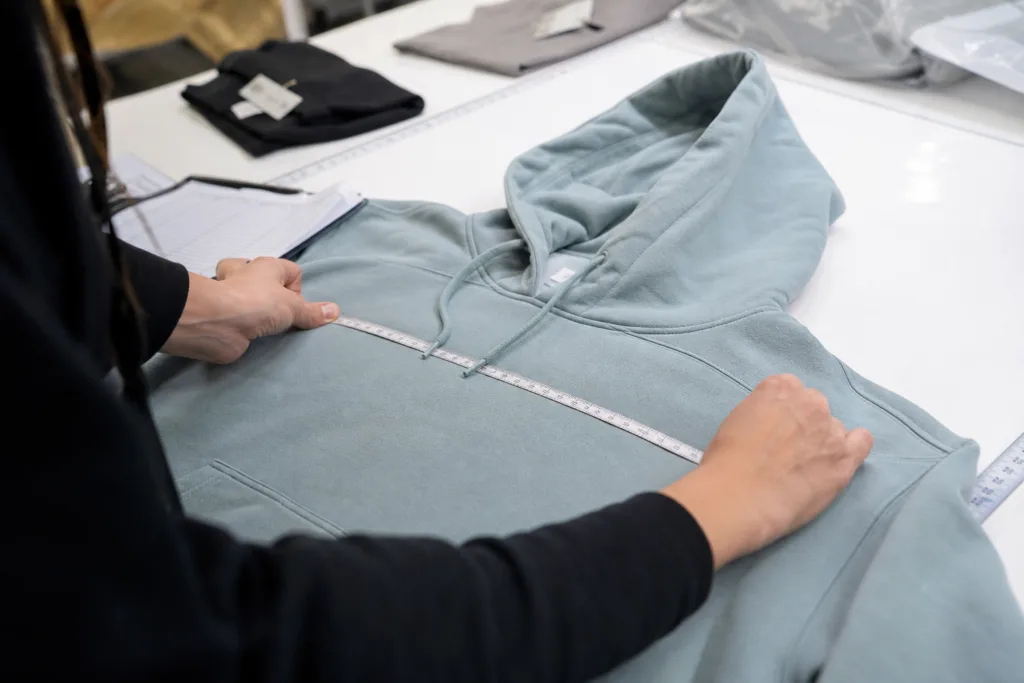
- Measure against spec
- Check fabric weight and hand feel against expectation
- Review stitch density, seam appearance, and stress points
- Check print, embroidery, labels, and packaging details
- Wash test if the product category makes shrinkage or torque relevant
If you are comparing multiple factories, use the same sample review logic for all of them. Without a consistent review method, buyers often overvalue presentation and undervalue technical accuracy.
Questions to ask during supplier vetting
The right questions expose process maturity. You are not only testing whether the factory says yes. You are checking whether the factory understands the work.
- What part of this product is most likely to affect cost or lead time?
- What is your MOQ by style, color, and fabric?
- Can you explain your sample process and revision cycle?
- Which details must be confirmed before you can lock price?
- How do you control size consistency in bulk production?
- What is your process if bulk fabric arrives outside target shade or quality?
- Who will be my main contact during sampling and production?
- What quality checkpoints do you use before shipment?
Good suppliers usually answer with process detail. Weak suppliers often answer with reassurance only.
A simple checklist for comparing a risky supplier with a reliable one
| Evaluation Area | Reliable Supplier Signal | Risky Supplier Signal |
|---|---|---|
| Quoting | Asks for specs, materials, and construction details before final pricing | Gives low price immediately with little review |
| Sampling | Defines sample cost, lead time, and revision process | Avoids samples or keeps delaying without clear reason |
| MOQ | Explains minimums by style, color, and material logic | MOQ changes repeatedly or stays vague |
| Communication | Consistent answers, clear ownership, written follow-up | Mixed messages, missing answers, unclear responsibility |
| Specifications | Confirms tech pack, measurements, trims, and approval points | Pushes forward without written confirmation |
| Quality | Can explain checkpoints, tolerances, and defect handling | Uses general promises only |
| Company transparency | Provides entity details and role clarity | Entity, address, or production role remains unclear |
When a red flag is fixable and when you should walk away
Not every warning sign means automatic rejection. Some issues are fixable if the supplier responds well when challenged. For example, a delayed quote may be manageable if the factory later provides a complete costing sheet and asks smart follow-up questions. A young factory with weak presentation may still be reliable if the sample quality is strong and documentation becomes structured.
Walk away when the pattern shows low transparency, no accountability, or no control. Examples include refusal to confirm specifications, pressure to pay before basic questions are answered, constant changes to key terms, unclear company identity, or repeated promises that are not backed by action.
The practical test is simple: when you raise a concern, does the supplier reduce uncertainty or create more of it?
Common mistakes buyers make when choosing a clothing manufacturer
Many sourcing mistakes come from rushing the early stage. Buyers often compare only unit price and ignore process quality. They treat a friendly sales contact as proof of factory capability. They approve samples without measuring them properly. They assume MOQ, tolerances, and packaging are “understood” instead of written.
Another common mistake is choosing a supplier based on category words instead of proven product fit. A manufacturer may advertise hoodies, sportswear, workwear, and uniforms, but that does not mean equal strength across all constructions, fabrics, and finishing methods. From a garment construction perspective, details like seam type, fabric recovery, wash behavior, and trim control matter more than broad claims.
Apparel Wiki explains this often in sourcing education: the risk is not only choosing the wrong supplier category. The risk is failing to test whether the supplier’s real process matches your actual product requirements.
Final checklist before you place an order
Before paying a deposit or confirming bulk, review these points one last time:
- Supplier identity is clear and documented
- Pricing assumptions are written and technically believable
- MOQ is defined by style, color, and customization level
- Sample has been reviewed against measurements and workmanship
- Tech pack, artwork, labels, and packaging details are confirmed
- Lead time includes material sourcing and approval stages
- Quality expectations and defect handling are written
- Main contacts and communication flow are clear
- Origin and production claims make sense for your import market
- You are comfortable with how the supplier handles difficult questions
That last point matters more than many buyers expect. Reliable factories do not always have perfect answers immediately, but they usually show a stable process for finding the answer. Risky factories often try to bypass the question.
Conclusion
The main value of spotting clothing manufacturer red flags early is not fear. It is control. It helps you protect budget, reduce sample waste, avoid production surprises, and make sourcing decisions based on evidence instead of hope. In apparel manufacturing, problems rarely stay small once bulk begins. That is why the best time to identify supplier risk is before you commit, not after the first delay or first quality complaint.
For brands and startups, the goal is not to find a factory that says yes to everything. The goal is to find one that communicates clearly, documents the work properly, respects specifications, and can explain how the order will move from development to production without guesswork. That is how you reduce avoidable risk before placing an order.
FAQs
Is a low quote always a scam?
No. A low quote is not automatically a scam, but it is a reason to slow down and check what is included. In apparel sourcing, low pricing can come from simpler construction, lower material quality, excluded trims, or missing development costs. The real issue is whether the supplier can explain the quote clearly and match it to your specifications in writing.
What if a factory will not make a sample?
If a factory refuses sampling for a custom style, that is a serious risk because you lose the main checkpoint for fit, workmanship, fabric behavior, and branding details. For repeat open-stock items the process may differ, but for private label or custom development, a supplier that avoids sampling is asking you to accept uncertainty that should be tested before bulk.
How important is a contract with a clothing manufacturer?
A contract or at least clear written order terms is very important because it gives both sides a reference for product specs, quantities, payment terms, lead time, quality expectations, and defect handling. Many apparel disputes become expensive not because the issue was impossible to solve, but because the key terms were never documented clearly enough to enforce.
Can slow communication still be acceptable?
Sometimes yes, especially during busy periods or time-zone gaps, but slow communication is only acceptable when the answers are clear, consistent, and useful once they arrive. A one-day delay with complete technical feedback is less risky than a fast reply that ignores measurements, materials, or sample comments.
Should I trust a supplier that keeps changing MOQ?
Not without understanding why. MOQ can change for valid reasons such as fabric mill minimums, dye lot requirements, or decoration setup costs, but those reasons should be explained in a stable written format. If minimums change repeatedly without clear logic, the supplier may not be controlling costing and planning properly.
When should I walk away from a supplier?
You should seriously consider walking away when the supplier avoids written confirmation, cannot explain company details, keeps changing key terms, pressures you to pay before core questions are answered, or makes claims about quality, lead time, or factory capability that do not hold up under basic verification. One small issue may be fixable, but repeated uncertainty usually gets worse after payment.