
Choosing between local vs overseas clothing manufacturers is one of the first big sourcing decisions a brand has to make. It affects more than the quoted unit price. It can change your sampling speed, minimum order quantity, freight cost, communication flow, inspection access, duty exposure, and how much risk you carry if something goes wrong. For startups, small brands, and even experienced product teams, the better option depends less on general opinions and more on the product, order size, timeline, and how much operational complexity the team can manage.
If you are still building your supplier shortlist, a practical sourcing guide for finding the right factory can help you connect this location decision with the next steps that actually matter in a project: supplier research, sample evaluation, capability checks, MOQ fit, and communication planning before you commit to development or bulk production.
What counts as a local manufacturer and what counts as an overseas manufacturer
In apparel sourcing practice, a local manufacturer usually means a factory operating in the same country as the buyer or brand. An overseas manufacturer is located in another country and normally requires international shipping, customs handling, and longer coordination chains. The distinction sounds simple, but in real projects it matters because each model changes how quickly you can sample, how easily you can visit production, and how your landed cost is built.
Some buyers assume local always means small workshop and overseas always means large factory. That is not accurate. You can find highly capable domestic factories and very flexible overseas suppliers. The useful comparison is not local versus overseas as a label. The useful comparison is which option fits your garment category, development stage, volume, compliance needs, and operating style.
For example, a brand launching a premium cut-and-sew T-shirt with frequent fit updates may value in-person sample review and easier pattern communication. A buyer placing repeat bulk orders for stable uniform polos may prioritize capacity and landed cost instead. That is why this decision should be made from a sourcing system perspective, not just from a country preference.
Local vs overseas clothing manufacturers: the real comparison points

The most practical way to compare supplier location is to break the decision into a few operational categories: cost, development speed, MOQ, quality control, logistics, and risk. Apparel Wiki generally recommends evaluating these points together, because a low ex-factory price can become less attractive if sample revisions are slow, shipping is expensive, or defects are hard to control after production starts.
| Factor | Local Manufacturer | Overseas Manufacturer |
|---|---|---|
| Unit price | Often higher | Often lower at scale |
| Sampling speed | Usually faster communication and shipping | May be slower due to distance and time zone |
| MOQ | Often more flexible for small runs | Often higher, especially for custom fabrics or trims |
| Quality oversight | Easier to visit and inspect | Usually depends on remote control or third-party inspection |
| Freight and import complexity | Simpler domestic shipping | International freight, customs, duties, and document risk |
| Scalability | Can be limited depending on local capacity | Often stronger for larger repeat production |
Cost comparison: unit price, sampling cost, shipping, duties, and hidden expenses
Cost is where many buyers start, but it is also where many first-time brands oversimplify the decision. A factory quote is not the same as your true garment cost. When comparing local and overseas production, you need to separate ex-factory price from landed cost.
Overseas manufacturers often offer a lower unit price, especially for larger volumes, standard constructions, or products made in regions with strong textile and garment ecosystems. But a lower sewing price does not automatically mean a cheaper finished program. You may also need to pay for international freight, customs brokerage, duties, import taxes depending on destination, banking charges, longer sample courier cycles, and extra buffer stock if replenishment takes longer.
Local manufacturing often comes with a higher sewing rate or higher labor cost, but the full picture can be more balanced when you factor in lower freight cost, simpler shipping, easier sample correction, lower travel complexity, and reduced inventory risk. If you can produce smaller runs locally and reorder faster, you may avoid tying cash into excess stock.
Hidden costs matter a lot. Here are common ones buyers forget to include:
- Additional pattern or grading fees after multiple fit changes
- Fabric sourcing surcharges for custom materials
- Freight cost increases caused by split shipments
- Duties and origin-related import treatment for cross-border production
- Inspection or rework costs if defects are found late
- Warehouse handling and delays while waiting for customs clearance
When production is overseas, landed cost planning should also consider origin and import treatment. Rules of origin and material sourcing can affect apparel import treatment, which means the country where the garment is cut and sewn, and in some cases where textile inputs come from, can change duty exposure and documentation requirements.
In practice, local production is often better for cash-flow control on smaller orders, while overseas production can become more cost-efficient when order volume is high enough to spread development and freight costs over more units.
Communication and development speed
Communication is one of the most underestimated parts of sourcing. Two factories can quote a similar product, but the easier communicator often saves more time and money over the life of the project. Local manufacturers usually have an advantage here because language barriers are often smaller, time zones are aligned, and sample feedback loops are faster.
This becomes important when your product still needs development. If your hoodie fit is not final, your print placement is not locked, or your neck rib specification still needs adjustment, fast back-and-forth can prevent confusion from turning into expensive mistakes. In many projects, the problem is not that the factory lacks skill. The problem is that comments were not translated into clear technical instructions early enough.
Overseas suppliers can absolutely communicate well, but the buyer usually has to work harder to keep messages precise. Time zone gaps can slow approvals by a full day each round. If comments are vague, the factory may interpret them differently than intended. That is why buyers should document measurements, tolerance, artwork size, stitch details, fabric expectations, and packaging instructions carefully. For teams that need a stronger process, this guide on how to communicate clearly with factories is directly useful during sample review and revision stages.
Development speed is not only about email response time. It also depends on whether the supplier has in-house pattern making, whether fabric is stock-supported or custom-made, and whether trims need to be developed from scratch. A local factory may still be slow if it outsources key steps. An overseas factory may still be efficient if it runs fabric, dyeing, sewing, and decoration in a tight network.
MOQ differences and why they matter
MOQ can decide whether a factory is realistic for a startup. Local manufacturers often accept lower quantities, especially for simpler products, stock fabrics, or short-run programs. Overseas suppliers frequently require larger minimums because their pricing model is built around production efficiency, material booking, line allocation, and export administration.
That said, MOQ is not one number. It may apply at several levels: per style, per color, per fabric, per size set, or per print design. A buyer may hear “300 pieces MOQ” and assume that means total mixed order, but later discover the supplier requires 300 pieces per color or needs a fabric mill minimum that is much higher. Understanding what MOQ means in clothing manufacturing helps avoid this common misunderstanding.
Why do overseas factories often ask for more? Usually because they need enough volume to justify raw material purchasing, marker efficiency, sewing line setup, quality planning, and shipment handling. If you want custom-dyed fleece, branded labels, special wash effects, and multiple colorways, the true minimum can rise fast.
Local production is often better when you need to test the market, launch with tighter inventory, or sell made-to-order or small batch collections. Overseas production becomes more attractive when you already know your best-selling styles, can forecast demand with more confidence, and want better cost efficiency through scale.
Quality control and consistency
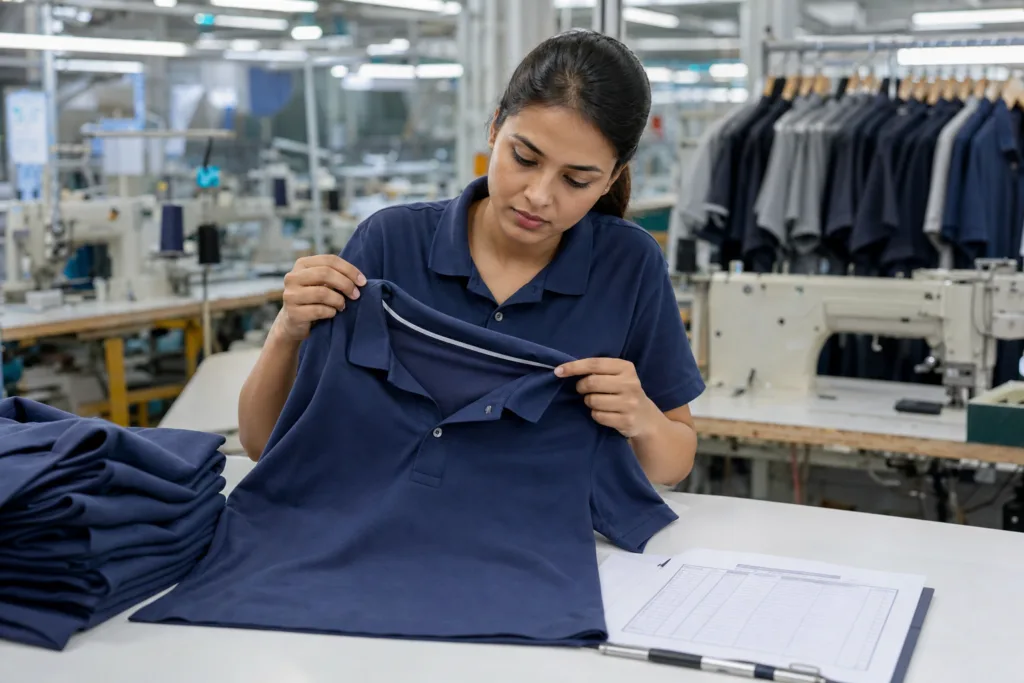
Quality control is one of the strongest practical arguments for local production, especially for new brands without established SOPs. When a supplier is local, it is easier to review development samples in person, compare production against approved references, inspect work in process, and solve issues before they affect the whole order.
That does not mean overseas quality is poor. Many overseas factories operate at a very high level. The difference is that quality control usually requires more deliberate systems when the supplier is far away. You may need sealed samples, detailed measurement charts, point-by-point workmanship standards, pre-production confirmations, inline inspection, and final random inspection before shipment. Without those controls, defect risk becomes harder to manage because feedback arrives later.
From a garment production perspective, quality should be checked at several stages: fabric approval, shrinkage result review, lab dip or color approval when relevant, pre-production sample signoff, in-line workmanship checks, measurements during sewing, pressing and finishing checks, packing review, and final inspection. Readers who need a structured starting point can use this overview of garment quality control to build a more systematic factory control process.
It is also important to remember that quality control is not only visual. Apparel may need safety and regulatory review depending on the market and product category. For example, children’s products and certain garment types may require attention to flammability and related product safety obligations. Apparel quality control should include regulatory safety testing, not just measurement and stitching checks.
Common consistency issues to monitor in either sourcing model include:
- Shade variation between lots
- Fabric shrinkage outside tolerance
- Twisting seams after wash
- Uneven print placement
- Embroidery puckering
- Inaccurate label content or care instructions
- Spec deviation between size sets
For local factories, easier access improves control. For overseas factories, stronger documentation improves control. The key is not to assume either model is safe by default.
Logistics and lead time
Lead time is where overseas manufacturing can create both value and pressure. If the factory is cost-efficient but the product arrives too late for the season, the lower unit price does not help much. Buyers need to look at total timeline, not just production days.
A realistic apparel timeline can include: development and tech pack review, sample making, revisions, fabric booking, trim approval, lab dips if dyeing is involved, pre-production sample, bulk cutting, sewing, finishing, inspection, packing, freight booking, customs clearance, and final delivery. Local production removes some of the transport and customs layers, which can make planning more stable.
Overseas production often offers more freight choices, but each comes with trade-offs. Air freight is faster but expensive. Sea freight is economical for volume but slower and more exposed to port delay, customs issues, and schedule disruption. If your product depends on launch timing, event dates, school calendars, or weather seasonality, these risks must be priced into the sourcing decision.
One practical mistake is to compare only stated production lead time. A factory may say 30 days, but if material booking needs 20 days before sewing starts and ocean transit needs another 25 to 40 days, the real calendar impact is much larger. This detail may look small, but it can create problems later if it is not confirmed early.
For buyers who want broader apparel sourcing education and terminology support across development, costing, and production planning, Apparel Wiki is useful as a central reference point while comparing supplier options.
When a local manufacturer is the better choice
Local manufacturing is often the better fit when speed, flexibility, and oversight matter more than the lowest nominal unit cost. This is common in early-stage brands, fashion startups, premium small-batch labels, and product categories where fit and finishing require close control.
Local production tends to make sense when
- You need low or moderate order quantities
- You are still refining fit, pattern, or construction details
- You need fast sample revisions
- You want easier in-person quality checks
- Your product launch timeline is tight
- You want lower logistics complexity
- Your brand positioning supports a higher retail price and smaller runs
A practical example would be a startup testing three heavyweight T-shirt fits in limited colorways. The brand may benefit more from quick sampling, easier QC, and lower inventory exposure than from chasing the lowest offshore price.
When an overseas manufacturer is the better choice
Overseas manufacturing is often the better fit when the style is already developed, volume is large enough to unlock cost efficiency, and the buyer has enough operational discipline to manage communication, approvals, and logistics properly.
Overseas production tends to make sense when
- You have repeatable styles with stable specifications
- You can meet higher MOQs
- You need stronger cost efficiency at scale
- You are sourcing fabric or trims from an established textile cluster
- You have enough lead time to absorb freight and customs
- You can manage inspections and technical documentation well
A simple example would be a company ordering large quantities of standard pique polos in repeat colors for distribution programs. If specs are stable and demand is predictable, overseas production can be commercially efficient.
Common mistakes first-time brands make
First-time brands often make the location decision emotionally instead of operationally. They may assume local automatically means premium quality, or that overseas automatically means cheap and risky. Both assumptions can cause poor supplier selection.
Here are the mistakes seen most often:
- Comparing quotes without matching fabric, GSM, trims, and construction details
- Ignoring landed cost and looking only at sewing price
- Choosing a supplier whose MOQ does not match the real launch plan
- Approving samples without clear measurement tolerance
- Failing to confirm shipping timeline from factory door to warehouse arrival
- Underestimating communication demands during development
- Not asking enough commercial and technical questions before ordering
Before placing production, brands should prepare a clear list of commercial, technical, and operational checkpoints. This resource on questions to ask before placing a manufacturer order helps reduce avoidable misunderstandings around capacity, pricing, quality expectations, and production terms.
Decision framework for beginners
If you are new to sourcing, do not try to solve the entire decision with one question such as “Which is cheaper?” Instead, score both options against the realities of your project.
| Decision area | If this matters most | Usually stronger option |
|---|---|---|
| Lowest small-batch risk | You need low inventory commitment | Local |
| Lowest unit cost at scale | You have higher confirmed volume | Overseas |
| Fast sample corrections | Your product is still in development | Local |
| Established supply-chain specialization | You need certain fabric or trim ecosystems | Overseas |
| Hands-on QC access | You want easier factory visits | Local |
| Large repeat programs | You need long-run production efficiency | Overseas |
For beginners, the easiest way to decide is to answer four questions honestly:
- What is my true budget after freight, duties, testing, and rework risk?
- How fixed is my product specification today?
- Can I meet the supplier’s real MOQ without overbuying?
- How much delay or error can my business absorb?
If the product is new, cash is tight, and time is sensitive, local may be the safer route even if the per-piece cost is higher. If the product is proven, the order is larger, and your process is more controlled, overseas may be commercially stronger.
Checklist before contacting manufacturers
Before you ask for a quote, prepare the information that will actually determine whether a supplier location works for you. In apparel development, weak inputs create weak comparisons.
- Garment type and target end use
- Tech pack or at least clear sketches and callouts
- Target fabric composition, GSM, and finish
- Expected order quantity by style and color
- Size range and fit intent
- Required decoration method such as print or embroidery
- Target delivery date to final destination
- Quality requirements and tolerance expectations
- Packaging, labels, and barcode needs
- Any compliance, testing, or safety requirements
Let’s look at what actually affects the result: the more complete your specification package is, the more accurate your local-versus-overseas comparison becomes. Weak briefs usually produce misleading prices, unrealistic lead times, and avoidable sampling delays.
Conclusion
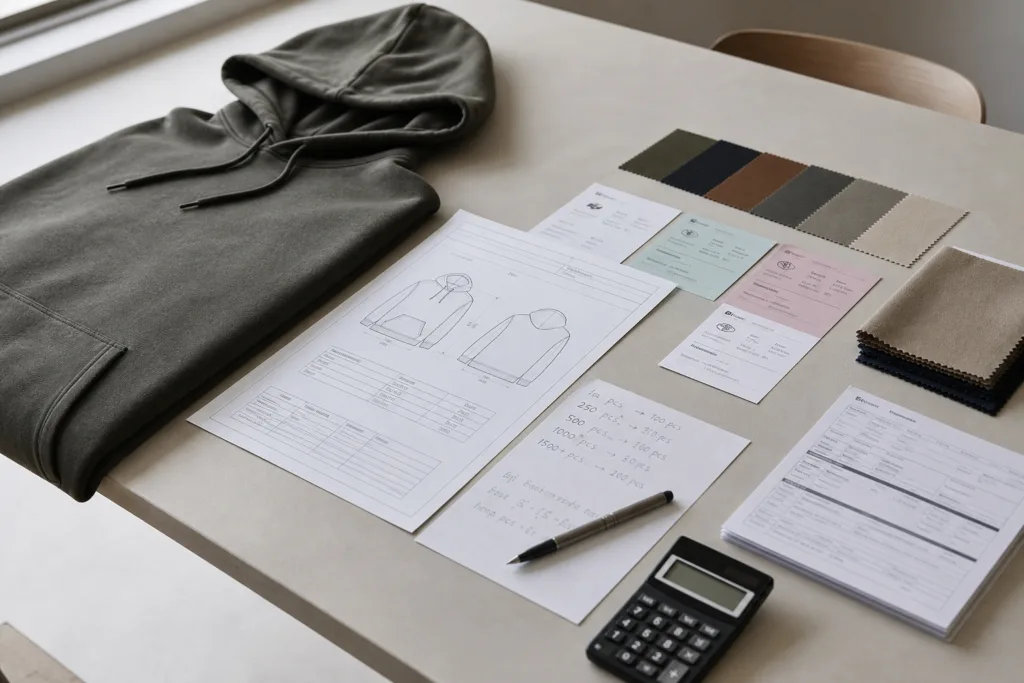
There is no universal winner in the local vs overseas clothing manufacturers decision. The right choice depends on your order size, development stage, budget structure, quality-control capacity, and tolerance for logistics complexity. Local production usually offers more flexibility, faster feedback, and easier oversight. Overseas production usually offers stronger cost efficiency once volume, planning discipline, and lead time are in place.
For buyers, the key is not only the product name or price, but whether the material, structure, marking method, and application requirements match the real use case. If you compare supplier location through landed cost, MOQ fit, communication demands, QC control, and timing risk, the decision becomes much clearer.
FAQs
Is local manufacturing always better for quality?
No. Local manufacturing can make quality easier to monitor because visits, sample checks, and communication are usually simpler, but the actual result still depends on the factory’s skill, systems, and consistency. A strong overseas supplier with clear specs, approved samples, and proper inspections can outperform a weaker local one.
Why are overseas clothing manufacturers often cheaper?
They are often cheaper because labor structure, production scale, supplier networks, and raw material ecosystems can reduce ex-factory cost, especially on larger runs. But buyers should compare landed cost, not only sewing price, because freight, duties, delays, and quality risk can narrow the gap.
Do local manufacturers usually offer lower MOQs?
Often yes, especially for simpler products and small-batch programs, but it depends on the factory setup and whether fabrics and trims are stock-supported. Some local factories still require meaningful minimums if the product uses custom development, while some overseas suppliers may offer trial quantities on selected items.
How do I compare lead time properly between local and overseas factories?
Compare the full timeline from development to warehouse delivery, not just the sewing days quoted by the supplier. Include sample rounds, fabric booking, trim approvals, production, inspection, packing, transit, customs, and any internal receiving time so you see the real calendar impact.
When should a startup choose a local clothing manufacturer?
A startup should usually lean local when it needs lower risk, smaller opening quantities, faster sample changes, and closer oversight during product development. This is especially useful when fit, fabric feel, branding details, or launch timing are still being refined.
Can overseas manufacturing still work for small brands?
Yes, but small brands usually do better overseas when the product is already clearly specified, the supplier’s MOQ is realistic, and the buyer is prepared for longer lead times and more structured communication. The model works best when the brand understands landed cost and has enough planning discipline to manage remote production.