
Common import duty estimates costing mistakes usually begin with an assumption that looks reasonable but has not been checked for the destination market. An apparel import duty estimate is a planning figure for the potential customs duty on a proposed shipment, based on product, transaction, origin, and shipment details. It is not a customs ruling or a guarantee of the final amount payable. Apparel Wiki is an independent educational publication; for shipment-specific decisions, verify the relevant official customs guidance. You can also use the Sponsor page to understand the site’s editorial independence.
What Does an Import Duty Estimate Include?
An import duty estimate normally starts with two questions: what goods are entering the market, and what customs rules may apply to those goods? The estimate then uses an assumed tariff classification, origin, customs-value basis, and shipment information to produce a planning figure for possible duty. Because each of those inputs can change, the result should be dated and labeled as an estimate rather than treated as an invoice or official assessment.
Customs duty is only one part of the cost of importing apparel. Freight, insurance, brokerage or clearance charges, storage, handling, and other import taxes or fees may appear elsewhere in the landed-cost view. Their treatment, timing, and recoverability vary by market and by the importer’s circumstances. A costing model should therefore show these categories separately instead of presenting one combined number as “duty.”
This distinction matters when comparing supplier quotations or internal product-cost sheets. A lower apparent duty amount may simply exclude a charge that another estimate has listed separately. Conversely, a broader landed-cost figure may include transportation or clearance costs that are not customs duty. Typical practice is to separate the categories first, then verify the destination market’s treatment before using the figures for pricing, sourcing, or order decisions.
Which Product-Classification Errors Can Skew the Estimate?
A broad product label is rarely enough to support a reliable apparel tariff classification. “Shirt,” “dress,” or “knitwear” may describe the product informally, but classification can depend on more specific facts about the garment. Relevant details may include how the item is constructed, its fiber content, garment type, physical features, and intended use. The exact factors and legal interpretation must be checked against the current tariff schedule or classification guidance for the importing market.
One common import duty costing error is selecting a code because it was used for a similar item. Similar-looking garments can differ in construction or material content, and those differences may affect the applicable classification. A code copied from another destination market may also be unsuitable because tariff schedules and classification systems are market-specific. Even an old shipment record is only a reference point, not proof that the same treatment applies to a new product or current tariff period.
Product development teams can reduce this risk by preserving the description used to support the estimate. Record the garment type, relevant construction details, fiber information, and any other facts considered material. Also record the date and source of the tariff information. If the classification is provisional, label it as an assumption requiring validation rather than presenting it as an established fact.
A practical review asks whether the written product description matches the physical item that will ship. A costing file that says only “women’s top” may be too vague to support later checking, while a concise description of the garment’s construction and material content gives the reviewer something traceable to compare with the official tariff guidance. This is a verification task, not a universal apparel rule, and Apparel Wiki does not issue customs classifications or binding determinations.
How Can Customs-Value Assumptions Create Costing Mistakes?
The supplier invoice total should not automatically be treated as the complete customs value for every import. The amount shown on an invoice may be an important transaction input, but the destination market’s valuation rules determine how the customs value is established. Additional transaction details, relationships between the parties, and particular cost elements may need to be reviewed under the applicable rules. The correct treatment cannot be selected from a global formula.
This is why an apparel import costing model should identify the valuation basis it is using. Note the transaction price or other starting figure, currency, parties to the transaction, shipment terms, and any charges considered relevant. Then verify which inputs are included, excluded, or adjusted for the destination market. If freight, insurance, commissions, royalties, assists, or related-party circumstances are relevant to the transaction, do not assume their treatment without current official guidance.
Keep the customs-value assumption separate from the broader landed-cost calculation. Transportation and insurance may affect the total cost of getting goods to the buyer, while brokerage or clearance charges may affect the import process; that does not mean every amount belongs in the duty line. Whether a particular charge is part of the customs value, separately payable, recoverable, or treated another way depends on the applicable rules and facts.
A useful costing record can therefore show three distinct layers: the assumed basis used to estimate customs duty, other import-related charges listed separately, and the remaining commercial costs used to understand landed cost. This structure makes an error easier to locate. If the estimate changes, the team can see whether the cause was a revised product classification, a changed transaction input, a different valuation interpretation, or a separate freight and clearance assumption.
When key valuation facts are unavailable, use a clearly labeled internal planning scenario rather than an unexplained single number. State which inputs are known, which are assumed, and which still require confirmation. The scenario supports apparel costing and comparison, but it should not be described as the final customs outcome. For material uncertainty, consult the relevant customs authority or a qualified customs professional before relying on the estimate for a shipment.
Why Do Origin and Trade-Preference Assumptions Need Checking?
A common import duty estimate error is treating the shipping country as the goods’ customs origin. The country of dispatch, the supplier’s registered address, and the place where garments were packed may all be different from the place that determines origin under the importing market’s rules. A shipment route describes movement; it does not, by itself, establish how the goods should be treated for customs purposes.
Apparel origin can depend on the product’s manufacturing history and the applicable origin rules. For example, the location of fabric production, cutting, sewing, assembly, or other processing may matter differently depending on the destination market and the trade arrangement being considered. Do not use a broad statement such as “made in” or a supplier location as a substitute for checking the relevant requirements.
Preferential tariff treatment requires a separate check. A product may appear to come from a country associated with a trade preference, yet still fail to qualify because the product-specific origin rules, documentation, claim procedure, or other conditions have not been met. The same apparel item may also receive different treatment in another destination market. A claimed preference is therefore an eligibility assumption until the applicable rules and supporting records have been verified.
Record the origin basis used in the estimate, including the product description, manufacturing locations considered, preference being claimed, and source date. Supplier information can support the review, but a supplier statement alone should not be treated as conclusive evidence when the destination market requires additional procedures. For a shipment-specific decision, check current guidance from the relevant customs authority or consult a qualified customs professional.

What Other Inputs Should You Verify Before Comparing Estimates?
Two import duty estimates are comparable only when their assumptions describe the same commercial situation. Before selecting the lower figure, check the destination market, product description, tariff classification, origin, customs-value basis, shipment terms, currency, and effective date of the tariff information. A difference may reflect missing or outdated inputs rather than a more favorable duty treatment.
A compact comparison record can use these fields:
- Destination: Identify the importing market and, where relevant, the entry location or applicable customs jurisdiction.
- Product: Describe the garment, construction, fiber content, and other details used to support classification.
- Classification: Record the tariff source, code assumption, and date checked. Do not copy an old code without confirming that it still applies.
- Origin: Separate country of dispatch from the origin determination and note whether preferential treatment is being considered.
- Valuation: State the transaction or customs-value basis used and identify any inputs that remain unresolved.
- Shipment terms: Record the agreed commercial terms and the transportation or insurance assumptions used in the costing model.
- Currency and date: Note the currency, conversion basis if one is used, and the date of the tariff or other source reviewed.
- Included charges: Show whether the figure covers duty only or also lists taxes, fees, brokerage, clearance, freight, and insurance.
This checklist is a review framework, not a universal calculation formula. It helps a team locate the reason for a difference between estimates. A lower result may exclude freight, use a different valuation basis, assume a preference, or rely on tariff information that is no longer current. Keep a dated copy of the assumptions and sources so a revised apparel landed-cost estimate can be traced back to the change that caused it.
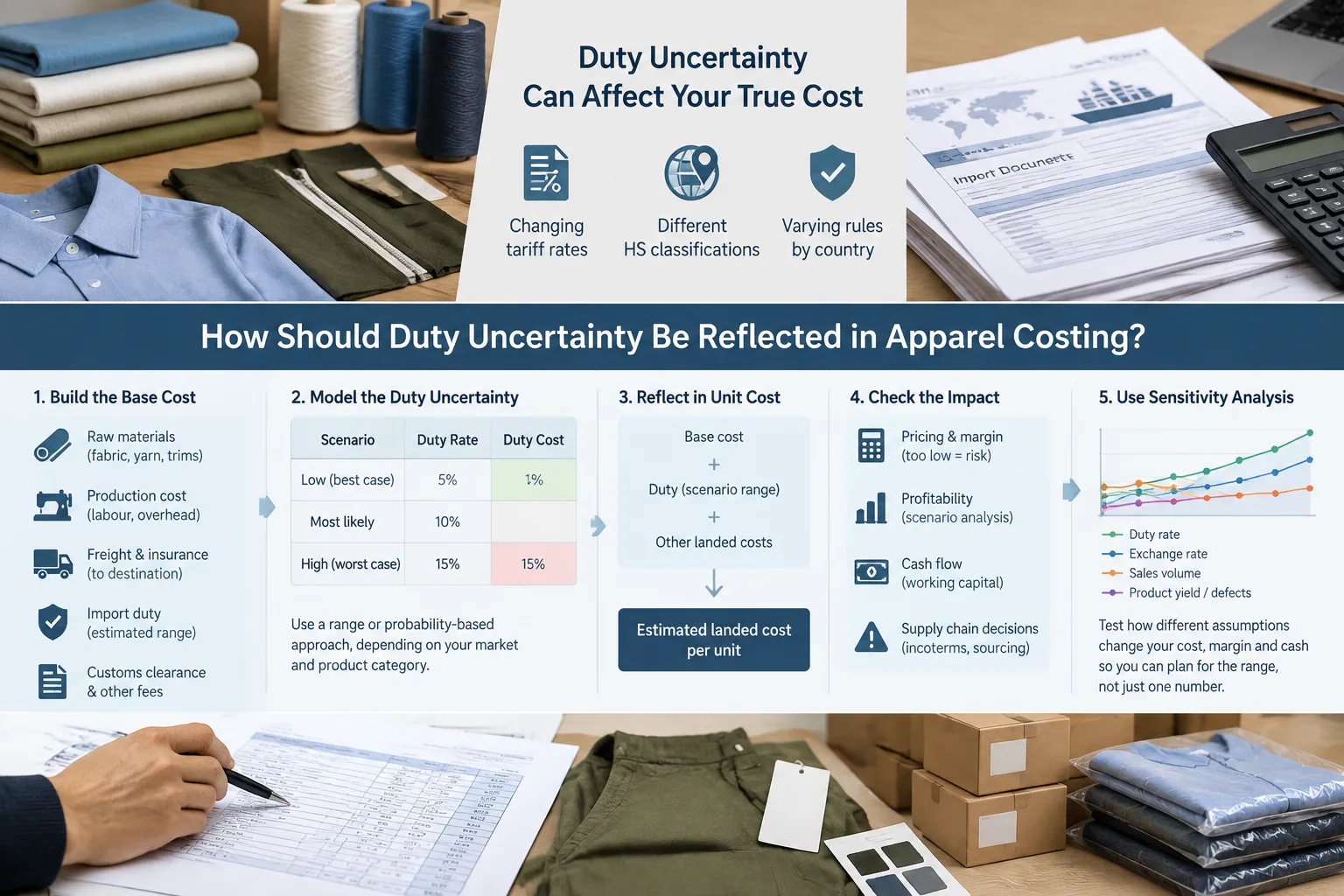
How Should Duty Uncertainty Be Reflected in Apparel Costing?
Show estimated duty as a distinct line in the landed-cost view. Keeping it separate from the product price, freight, insurance, brokerage, and other commercial costs makes the estimate easier to explain and revise. It also prevents an unresolved customs assumption from disappearing inside a single product-cost number.
When an important input is unknown, use clearly labeled internal planning scenarios. One scenario might use a provisional classification, while another might reflect a pending origin or valuation review. The values should be identified as assumptions for costing, not as forecasts, guaranteed rates, or the amount that customs will finally assess. Avoid presenting an internally selected figure as a typical industry rate.
Revisit the estimate whenever the garment specification, fiber content, manufacturing location, destination, shipment plan, transaction terms, or tariff information changes. A change in one of these inputs can affect the classification, origin analysis, customs-value review, or the list of charges included in the landed-cost view. The revision record should show both the previous assumption and the reason for the update.
For apparel brands and sourcing teams, this approach supports better product and order comparisons without turning an editorial costing model into a customs determination. Apparel Wiki is an independent educational publication, not a customs broker, manufacturer, laboratory, certifier, or clearance provider. Material uncertainty should be taken to the relevant customs authority or a qualified customs professional before the estimate is used to commit to a shipment.
As a practical next step, review the assumptions in your current costing sheet line by line, then use relevant Apparel Manufacturing Tools to organize product and production information before requesting shipment-specific advice. The goal is a dated, traceable planning record that clearly separates known facts, working assumptions, and unresolved questions.
Is import duty calculated from the supplier invoice amount?
Not automatically. The invoice amount may be an important input, but the applicable customs-value rules determine which transaction details and additional costs are included, excluded, or adjusted. Verify the basis for the destination market rather than treating the invoice total as a universal duty base.
Does shipping from a country mean the goods originate there for customs purposes?
No. Country of dispatch, supplier location, packing location, and customs origin are separate concepts. Origin depends on the applicable rules and the garment’s manufacturing history, so it should be documented and checked for the destination market.
Can I use the same apparel duty rate for every importing country?
No. Duty treatment can vary by destination, product classification, origin, preferential eligibility, valuation rules, and the effective date of the tariff information. A rate used for one market or shipment should not be copied into another estimate without verification.
Should freight and insurance be included in an import duty estimate?
Keep freight and insurance visible as separate costing inputs, then verify how the destination market treats them for customs valuation. Their role in landed cost is not the same as their treatment in the duty calculation, and no single global formula applies.
How often should I review an apparel import duty estimate?
Review it whenever a material input changes, including the garment specification, classification, origin, destination, shipment plan, transaction terms, or tariff source. Also check the dated assumptions before relying on an estimate for a new order or shipment.
What should I do when the product classification or origin is uncertain?
Label the estimate as provisional, record the facts and assumptions supporting it, and avoid presenting the result as final. Check current customs guidance and seek advice from the relevant customs authority or a qualified customs professional when the uncertainty could materially affect the shipment.