
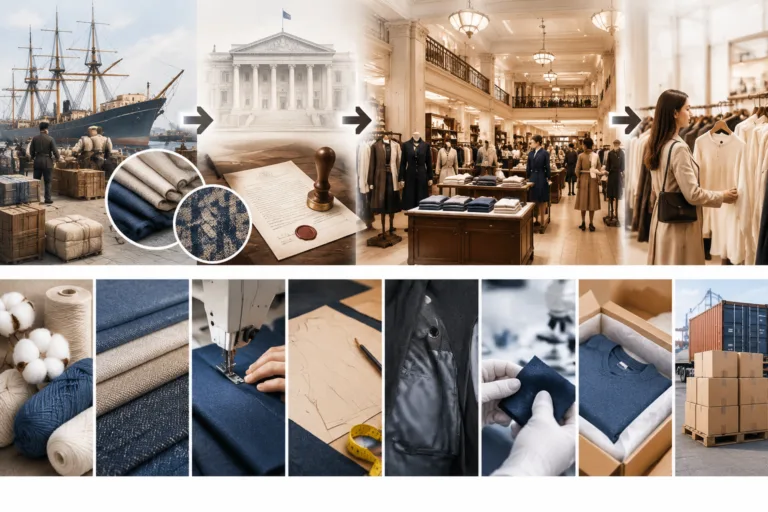
Department store clothing historical evidence can establish what a particular retailer sold, advertised, organized, or changed during a documented place and period. It cannot automatically prove that the same practice was universal, affordable, or typical across an entire country. The strongest history of department store clothing connects each claim to a store, city or region, date range, garment category, and source type.
Apparel Wiki is an independent educational publication, not a manufacturer, factory, testing laboratory, certification body, or service provider. Its editorial independence and sponsorship information are described on the Sponsor page. In this article, “department store clothing” means garments and related retail activities associated with department stores, including merchandise selection, presentation, selling, alterations, supply relationships, and customer access.
What Can Historical Sources Establish About Department Store Clothing?
Appropriate primary sources and scholarly research can document events, practices, relationships, and changes in clothing retail. A dated catalog may show that a store listed a particular garment. An advertisement may establish that the retailer promoted a service or presented a product to the public. A store record may indicate how a clothing department was organized. A business history or scholarly study may interpret several records together and explain a broader development.
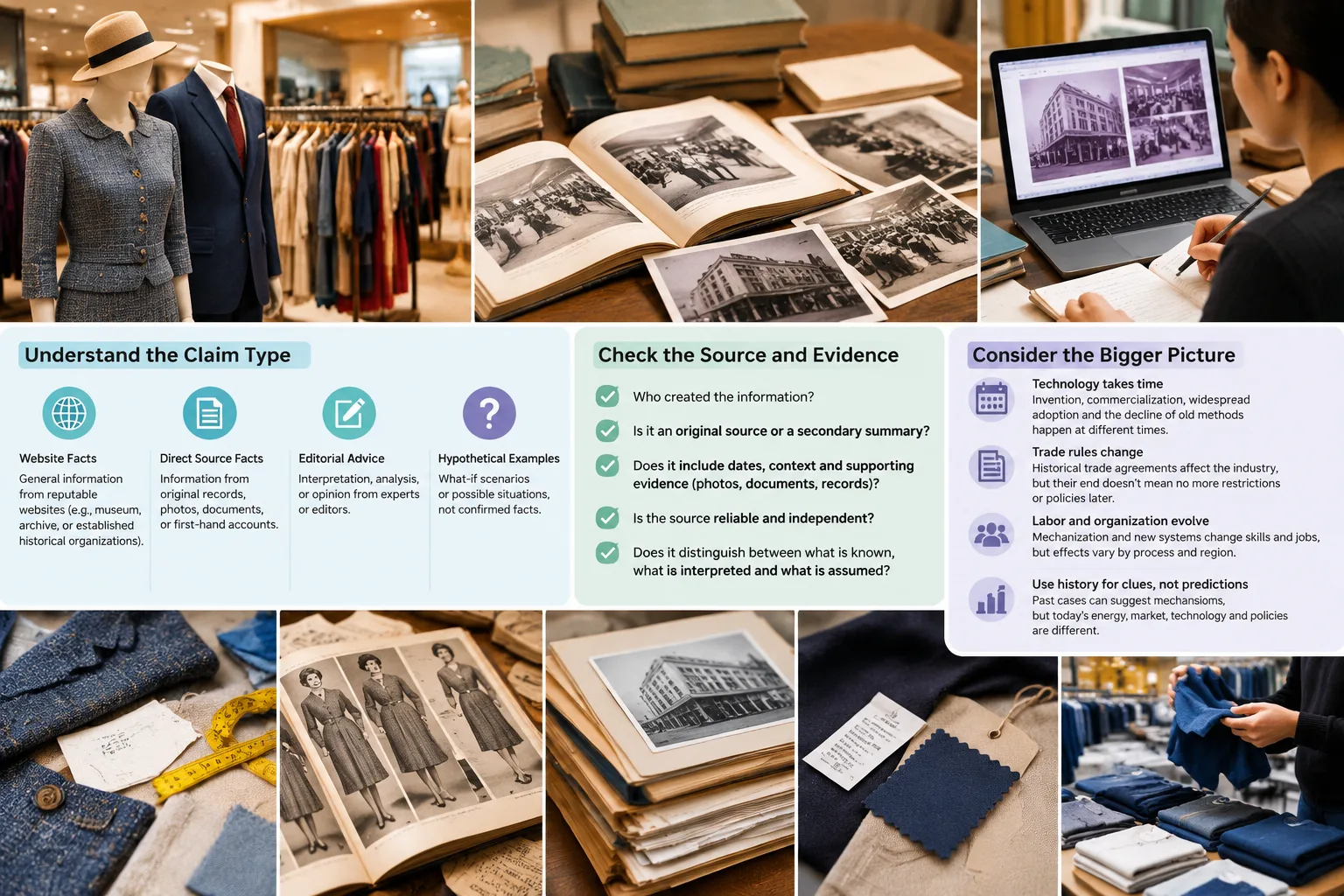
These forms of evidence should not be treated as interchangeable. A primary source is a contemporary record created during the period being studied, such as an advertisement, receipt, photograph, company document, or newspaper report. A secondary source, such as a scholarly book or article, analyzes primary material and places it in context. Editorial explanation connects the evidence for readers, while a hypothetical example illustrates a method without claiming that the example happened historically.
The distinction matters because a source usually has a limited reach. One advertisement can establish that an item was promoted at a named store, but it cannot by itself establish how many units were available, how widely they sold, or who purchased them. A store’s records may reveal internal practice without showing how competitors operated. Likewise, the history of one department store is not automatically the history of clothing retail in a region.
Useful wording reflects those boundaries. “Documented” identifies a claim supported by a relevant record. “Suggests” or “indicates” signals an interpretation that may be consistent with the evidence but is not fully established. “Cannot by itself establish” makes clear where additional sources are needed. This approach treats historical records as evidence rather than as a complete record of everyday clothing.
Which Primary Sources Reveal What Department Stores Actually Sold?
Contemporary retail records can reveal assortments, merchandising language, prices, services, presentation, and intended customers. Catalogs and seasonal brochures may list garment names, fabrics, colors, construction details, sizes, intended uses, and price claims. Newspaper advertisements show what a retailer chose to present publicly. Window-display photographs, floor plans, labels, receipts, and store policies can add evidence about presentation, transactions, departments, or customer services.
A useful starting point is a university library guide to primary sources for department-store history, which identifies materials such as company archives, union records, trade journals, advertisements, and catalogs. The guide is a research aid, not proof of any particular store’s inventory. The individual record still needs to be examined for its date, publisher, location, and purpose.
Historical terminology also requires care. A garment name from an earlier period may not correspond neatly to a modern retail category. Descriptions of fabric, fit, sizing, or intended use should be read in their original context before being translated into current apparel language. An advertisement’s wording may reflect promotion rather than a neutral inventory description, and a price claim may communicate a marketing position rather than actual affordability for the wider population.
Store records and advertising answer different questions. Internal records may establish purchasing, department organization, stock practices, or alterations. Advertising establishes what the retailer wanted customers to know about its offer. Neither source alone necessarily proves regular availability. Surviving records may also be incomplete because materials were discarded, selectively digitized, preserved by particular institutions, or created for promotional purposes.
- Confirm the source’s date, publisher, store location, and collection provenance.
- Record whether it describes inventory, promotion, a transaction, internal practice, or a proposed service.
- Separate what the document directly shows from what it may suggest about sales volume or consumer access.
- Cross-check important claims against another record before describing an item as regularly stocked or broadly available.
How Do Sources Build a Reliable Timeline of Department Store Clothing?
The history of department store clothing is better understood as a sequence of connected developments than as a single starting date. A timeline may include a store opening, the expansion of a clothing department, publication of a catalog, a documented production or distribution change, evidence of consumer use, and a later decline or replacement. These dates describe different events and should not be collapsed into one milestone.
Researchers should distinguish invention from commercialization, adoption, and wider use. A patent date may establish that an invention was legally registered. It does not alone establish that department stores used it, that manufacturers could supply it at commercial scale, or that customers widely adopted the resulting product. Similarly, a store-opening date establishes the operation of that store, not the beginning of department store clothing everywhere.
Location and garment category are equally important. Womenswear, menswear, childrenswear, workwear, and accessories may have followed different retail paths. A development documented in one city may not have occurred at the same time elsewhere. Claims using terms such as “widespread,” “dominant,” or “declining” require comparative evidence from more than one location or a source that explicitly supports that scale.
A simple source matrix can make the timeline more defensible:
| Record | What to record |
|---|---|
| Claim | The exact event, practice, or change being tested |
| Place and period | The store, city or region, and relevant date range |
| Source type | Catalog, advertisement, store record, newspaper, trade journal, or scholarly study |
| Direct evidence | A quotation, image, entry, or documented observation |
| Confidence and gap | What is established, what is inferred, and what remains unresolved |
What Do Sources Show About Production, Labor, and Department Store Organization?
Department stores can be studied as links among garment suppliers, buyers, in-house departments, alteration services, sales staff, and customers. Their retail identity does not prove that they owned the production of the clothing they sold. A garment may have come from an outside supplier, a contracted operation, an affiliated business, or an arrangement that the surviving record does not clearly identify.
Trade journals, employment records, oral histories, workplace investigations, company documents, and scholarly labor histories can reveal arrangements that advertisements usually omit. These sources may help distinguish direct employment from supplier production, contracting, or retail-only activity. The relevant operation, workforce, location, and period should be identified before drawing conclusions about organization or labor.
Mechanization and organizational change also affected different tasks in different ways. Sewing, cutting, finishing, alterations, sales, buying, and administration could experience different changes in skill requirements and job structure. Evidence that one process became more mechanized does not establish that all manual work disappeared. Nor does one company’s arrangement prove that the same model applied across regions.
The most reliable interpretation keeps three questions separate: what production technology was used, how employment or skills were affected, and how the store organized its retail activity. Historical evidence can explain mechanisms and relationships, but it cannot guarantee that a past retail or production outcome will be repeated under present-day conditions.
How Did Trade Rules and Consumer Access Shape Department Store Clothing?
Department store clothing developed within specific systems of import, domestic production, distribution, taxation, transportation, and trade regulation. These conditions differed by jurisdiction and period, so a historical claim should identify where and when it applies. A trade arrangement may have changed the environment for retailers or suppliers, but its termination does not by itself prove that every restriction disappeared or that clothing immediately became equally accessible.
Access also depended on more than a garment’s advertised price. Store location, rail or delivery connections, catalog circulation, payment practices, available sizes, and the ability to visit or order from a particular retailer all shaped who could realistically buy. A department store might describe clothing as economical or suitable for a broad audience while still serving a narrower population because of distance, income, credit conditions, sizing, or social barriers.
Catalog distribution can extend a store’s reach, but it does not establish equal access across every region. Likewise, an advertisement can show that a retailer presented a garment at a stated price and to an intended customer, but it cannot alone establish how many people purchased it. Consumer diaries, correspondence, household records, sales information, and other evidence of behavior are needed before describing a practice as common or socially dominant.
Keep advertised affordability separate from documented purchasing access. Historical trade records should explain the period being studied, not serve as evidence for current tariffs, regulations, or market conditions. Where the evidence is incomplete, wording such as “the record indicates,” “the store promoted,” or “access appears to have varied” is more accurate than a universal conclusion.

How Should You Evaluate a Claim About Department Store Clothing History?
Begin by rewriting the claim so its boundaries are visible. Identify the store or institution, garment category, location, date range, and the meaning of terms such as “introduced,” “popular,” “affordable,” or “mass-produced.” These words often compress several different questions. A store may have introduced a line in one city without making it widely available, and a garment may have been mass-produced without being affordable to every intended customer.
Next, locate the original or closest available source. Record who created it, when it was created, where it applies, and why it was produced. An advertisement, internal store record, trade-journal article, labor investigation, and later scholarly history each provide different kinds of evidence. A university library guide on department-store research, for example, identifies company archives, union records, trade journals, advertisements, and catalogs as useful primary-source categories, but the individual record still requires its own date and provenance check.
Read the source for both evidence and purpose. Promotional material may establish what a retailer wanted the public to see, while an internal document may reveal an intended practice without proving that it was consistently carried out. A later history can connect developments across time, but it may summarize or interpret records that should be consulted directly when the claim is important.
For claims about scale, consumer behavior, labor effects, or regional importance, compare at least one independent source. Corroboration does not mean counting websites that repeat the same statement. It means checking whether different records, created for different purposes, support the same bounded conclusion. A catalog and a newspaper advertisement may confirm promotion; a sales record or consumer account may be needed to discuss actual uptake.
| Research question | Useful check | Responsible result |
|---|---|---|
| What was offered? | Read a dated catalog, advertisement, label, or store record. | State that the item was listed, displayed, or promoted. |
| Who could access it? | Compare location, delivery, payment, sizing, price, and consumer evidence. | Describe intended and documented access separately. |
| How widespread was it? | Compare stores, regions, periods, and independent records. | Use “widespread” only when the evidence supports that scale. |
| What changed? | Separate invention, availability, adoption, and later replacement. | Build a sequence rather than assigning one start date. |
Classify the conclusion as directly documented, supported interpretation, unresolved, or contradicted. Then state the limitations: records may be missing, selectively digitized, promotional, unevenly regional, excerpted, or difficult to date. Modern labels can also distort historical categories. Confidence should follow the fit and corroboration of the evidence, not simply the apparent authority of a retailer, database, or website.
What Can Department Store Clothing History Tell Us Today, and What Can It Not?
Historical cases can reveal mechanisms that remain useful for research: how assortments were coordinated, how distribution connected suppliers and customers, how merchandising framed clothing, how labor was organized, and what conditions shaped adoption. They can help apparel professionals ask better questions about retail structure, sourcing relationships, customer access, and the interaction between production and sales.
They cannot, by themselves, prove that a current apparel investment, retail format, production technology, or sourcing decision will succeed. Present conditions may differ in technology, energy use, market structure, policy, labor arrangements, transportation, and consumer behavior. Even when two businesses appear similar, the relevant comparison may be limited to one mechanism rather than the whole historical situation.
Use a historical analogy only after identifying which conditions are genuinely comparable and which have changed. A past distribution model might illuminate a question about reach, but it does not establish current delivery performance. A documented shift in mechanization may clarify how tasks changed in one setting, but it does not predict present employment effects everywhere. Current legal, market, and technical claims require current authoritative evidence.
Apparel Wiki is an independent educational publication, not a manufacturer, factory, laboratory, certifier, or service provider. Its role here is to explain how evidence can support historical understanding. The disciplined next step is to return to the original records, compare regions and periods, consult specialist scholarship, and keep historical description separate from present-day business advice.
What counts as primary evidence for the history of department store clothing?
Dated catalogs, advertisements, store records, newspapers, photographs, labels, receipts, trade journals, labor records, and consumer accounts can serve as primary evidence. Their value depends on provenance, completeness, purpose, and fit with the specific claim.
Can a department store catalog prove that a garment was widely available?
No. A catalog can establish that a retailer listed or promoted a garment at a particular time. Wider availability requires comparison with inventory, distribution, sales, consumer, or other independent records.
Why should patent dates not be treated as the start of widespread clothing adoption?
A patent may document an invention or legal registration. It does not by itself establish commercial availability, adoption by a department store, regional use, or replacement of older methods.
How can researchers distinguish department store sales from garment manufacturing?
Check whether the record describes retail activity, direct employment, in-house production, supplier production, contracting, alterations, or an unclear relationship. Store identity alone does not prove ownership of garment manufacturing.
What sources can reveal clothing department labor and supplier relationships?
Trade journals, employment records, union or workplace records, oral histories, factory investigations, company documents, and scholarly labor histories may reveal arrangements that advertisements omit. Each source should be tied to a specific operation, workforce, place, and period.
How should historical trade rules be used when studying department store clothing?
Name the jurisdiction and period, then explain the documented connection to production, distribution, or access. Do not use a historical trade arrangement to make an unsupported claim about current regulations or market conditions.