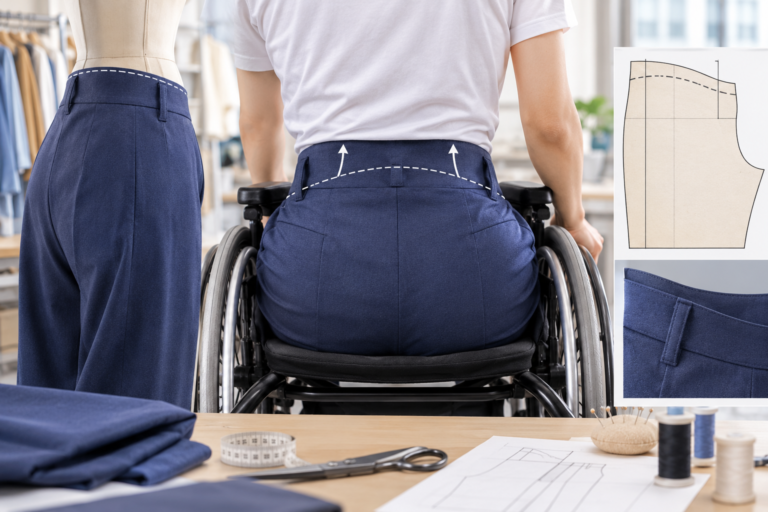
Effective wheelchair trousers back coverage begins with the wearer’s actual seated posture, not a standard rise measurement. First, define where the back waist should remain on the body. Then shape the back rise and waist to support that boundary without creating front bulk, pressure, or restriction. Evaluate the complete trousers with the wearer during relevant movements and revise the pattern from what happens in use. Apparel Wiki is an independent educational publication; its Sponsor information explains the site’s approach to editorial independence.
How seated posture changes trouser coverage
Back coverage describes the relationship between the trouser waist, the wearer’s body, and the position in which the garment is worn. The intended coverage boundary is the body position that the back waist should maintain. Pattern features such as rise length, waist height, and contouring are methods used to reach that goal.
When a person sits, the fabric follows a different path around the pelvis, seat, and back than it does while standing. The body may flex at the hips, while the back waist can shift downward or pull away. A standing fitting may therefore appear acceptable even though skin or underlayers become exposed in the usual seated posture.
The change can become more noticeable when the wearer reaches forward, leans, or repositions. At the same time, fabric may compress or accumulate at the front waist. This means that simply raising the entire waistline may solve one problem while adding unwanted bulk elsewhere.
A longer back rise, a higher back waist, or a differently contoured waist can be explored. None is a universal specification. The designer must also consider the crotch shape, seat volume, side seams, front rise, and waistband construction. These regions work together to determine where the trousers settle.
Begin with the wearing task rather than assuming that every wheelchair user needs the same pattern. Posture, mobility, chair configuration, preferred layers, personal coverage expectations, and assistance needs can all change the appropriate solution.
Map the wearer’s seated coverage needs
Before altering a pattern, create a fit brief with the wearer’s participation and consent. Agree on the desired position of the back waist in their normal seated posture. This position may be defined in relation to a preferred garment layer or a clearly identified point on the body.
Observe the posture and chair setup that will matter in regular use. Note the angle of the torso and pelvis, the position of any back support, and how the wearer normally settles into the chair. Include the clothing layers expected beneath or above the trousers because those layers can affect both coverage expectations and fit.
Discuss relevant movements rather than applying a fixed movement checklist. Depending on the individual, these may include reaching, leaning, repositioning, or transferring. Watch where the back waist moves, where the garment tightens, and whether fabric gathers at the front or sides. Record the wearer’s feedback alongside the visual observations.
Practical access requirements also belong in the brief. Establish which closures the wearer can and wants to operate, whether they dress independently or with a chosen helper, and how the garment fits into their dressing sequence. Ask about sensitive areas and unwanted seam or waistband placement without assuming that wheelchair use creates the same concerns for everyone.
For example, a wearer may lean forward to reach a work surface. The immediate check is whether the back waist drops below the agreed coverage boundary during that movement. If it does, the pattern may need greater back length, different waist shaping, or improved retention. However, the brief could change if the wearer maintains a more upright posture, wears a long tucked layer, or prefers a lower waist. The same visible movement does not automatically lead to the same design choice.
A useful seated-fit brief therefore records the target waist position, usual posture, important movements, layers, access needs, and wearer feedback. It describes the problem before prescribing the pattern solution.
Shape the back rise and waist
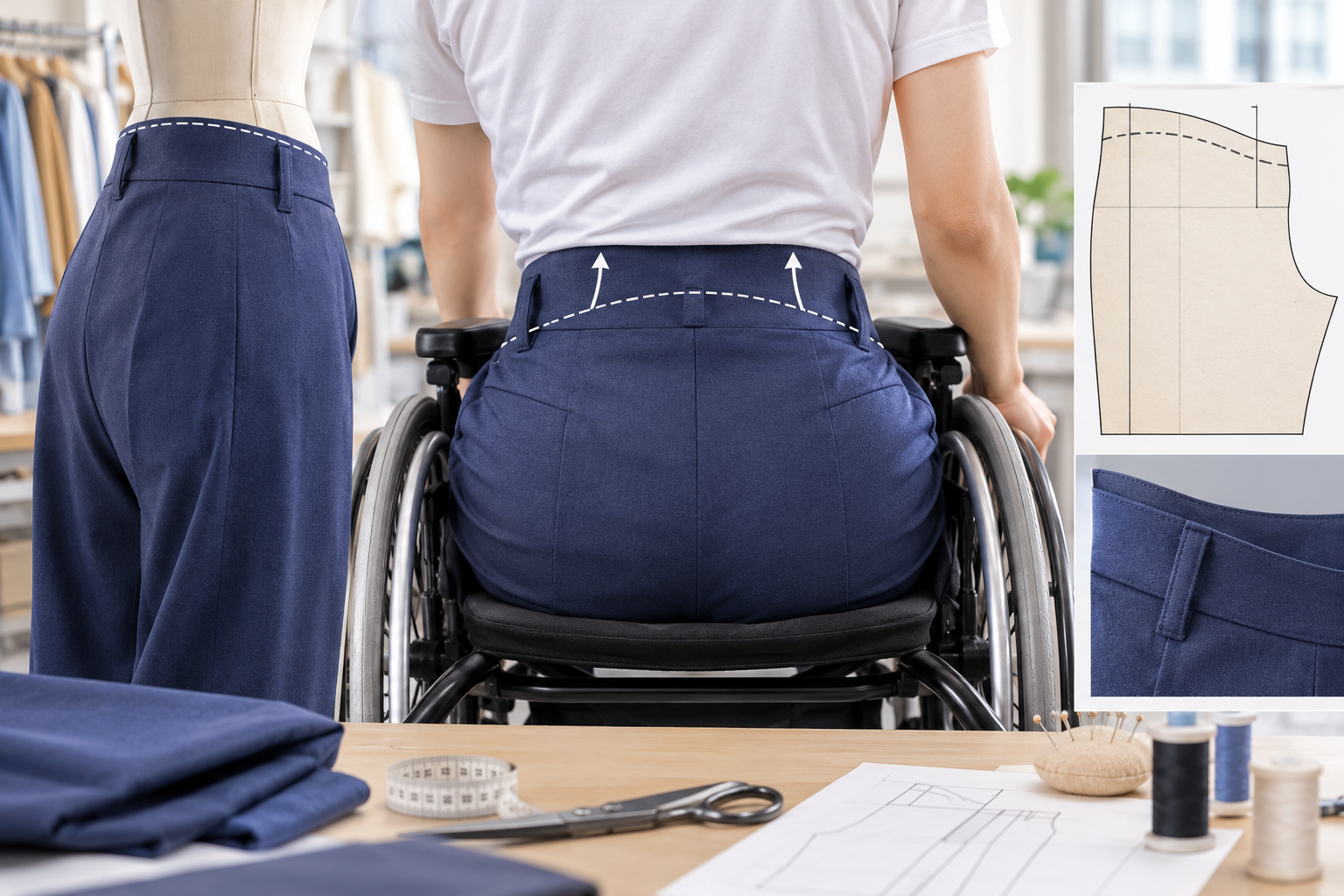
Three related pattern decisions require separate attention. Back rise length affects the fabric path from the crotch through the seat to the waist. Back-waist height establishes where the upper edge finishes. Waist shaping controls how that edge follows and stays near the body. Changing one does not automatically correct the others.
A raised or contoured back waist should be developed with the crotch curve, seat, side seams, and front rise. Adding height to an unsuitable base pattern may leave the crotch pulling, the back standing away, or excess fabric collecting at the front. Seated trouser waist shaping is most useful when it responds to observed garment movement rather than a category-based assumption.
| Observable fit input | Coverage implication | Initial pattern choice | Variables that could change the choice |
|---|---|---|---|
| Back waist drops during forward reaching | The garment does not maintain the agreed coverage boundary through that movement | Review back rise length and back-waist shape before testing a controlled increase | Pelvic posture, crotch fit, waistband retention, layers, and movement priority |
| Fabric pools at the front waist while seated | Added overall height or front length may be excessive for the seated shape | Redistribute shape toward the back and reassess the front rise and side seam | Fabric weight, abdominal fit preference, waistband construction, and posture |
| Back waist stays up but feels restrictive | Coverage is retained, but the shape or construction may limit comfort or movement | Review contour, circumference, crotch balance, and waistband tension | Fabric stretch and recovery, closure method, sensitivity, and preferred ease |
Mark the intended waist position on the prototype while the wearer is seated. Also mark where the existing waist sits during the agreed movements. These references help distinguish missing coverage from general looseness, tightness, or garment rotation.
Revise incrementally. For example, adjust one controlled region, document the pattern change, and repeat the seated check before making another major alteration. Reassess the whole garment after each revision because changing the wheelchair trouser back rise can affect the crotch, seat, side seam, and front waist.
Keep a simple record of the prototype version, the altered pattern area, the wearer’s response, and the observed result. The final pattern choice depends on the individual, fabric, waistband, and assembly. No fixed rise increase or waist shape can guarantee coverage across different wearers and seated positions.
Balance coverage with comfort and construction
A pattern that reaches the agreed coverage boundary still needs suitable materials and construction. The main fabric, waistband, seams, pockets, and fasteners work as a system. Each can change how the trousers stay in place, feel, and respond when the wearer moves.
A shaped waistband can follow a contoured back waist more closely than a straight band. However, its usefulness depends on the pattern beneath it, its stiffness, its width, and how it is assembled. Excessively rigid or bulky construction can undermine an otherwise appropriate shape.
An elastic section can provide adaptability when posture or abdominal shape changes during movement. Elastic tension also needs evaluation. Too little retention may allow the waist to shift, while excessive tension may feel restrictive or pull the garment into an unwanted position. The wearer’s ability to manage the waistband is equally relevant.
An adjustable waist offers another way to change circumference or retention. The adjustment method must remain reachable and understandable for the intended dressing sequence. Hardware, overlapping layers, or gathered material may add bulk, so adaptability should be considered alongside seated contact and access.
Fabric stretch may support movement, but it cannot replace adequate seated shape. A lightweight knit, for example, may extend as the wearer leans forward. If the back rise and waist are poorly balanced, the fabric may simply stretch or shift without maintaining the intended coverage boundary. A knit with stronger recovery may behave differently after movement, while a wearer who prefers a looser fit may require another balance of pattern ease and waist retention.
Fabric weight and drape also affect how material settles around the seat, crotch, and front waist. Evaluate these characteristics in the assembled garment rather than selecting fabric by stretch alone.
Review back seams, pocket layers, labels, fasteners, and seam allowances against the wearer’s seated contact areas. Remove unnecessary bulk where appropriate, but do not assume that every wearer finds the same placement uncomfortable. Pocket function, appearance, sensitivity, posture, and chair setup can change the decision. The wheelchair trousers waistband and the surrounding assembly should therefore be checked with the wearer, not judged as isolated components.
Evaluate and refine a seated prototype
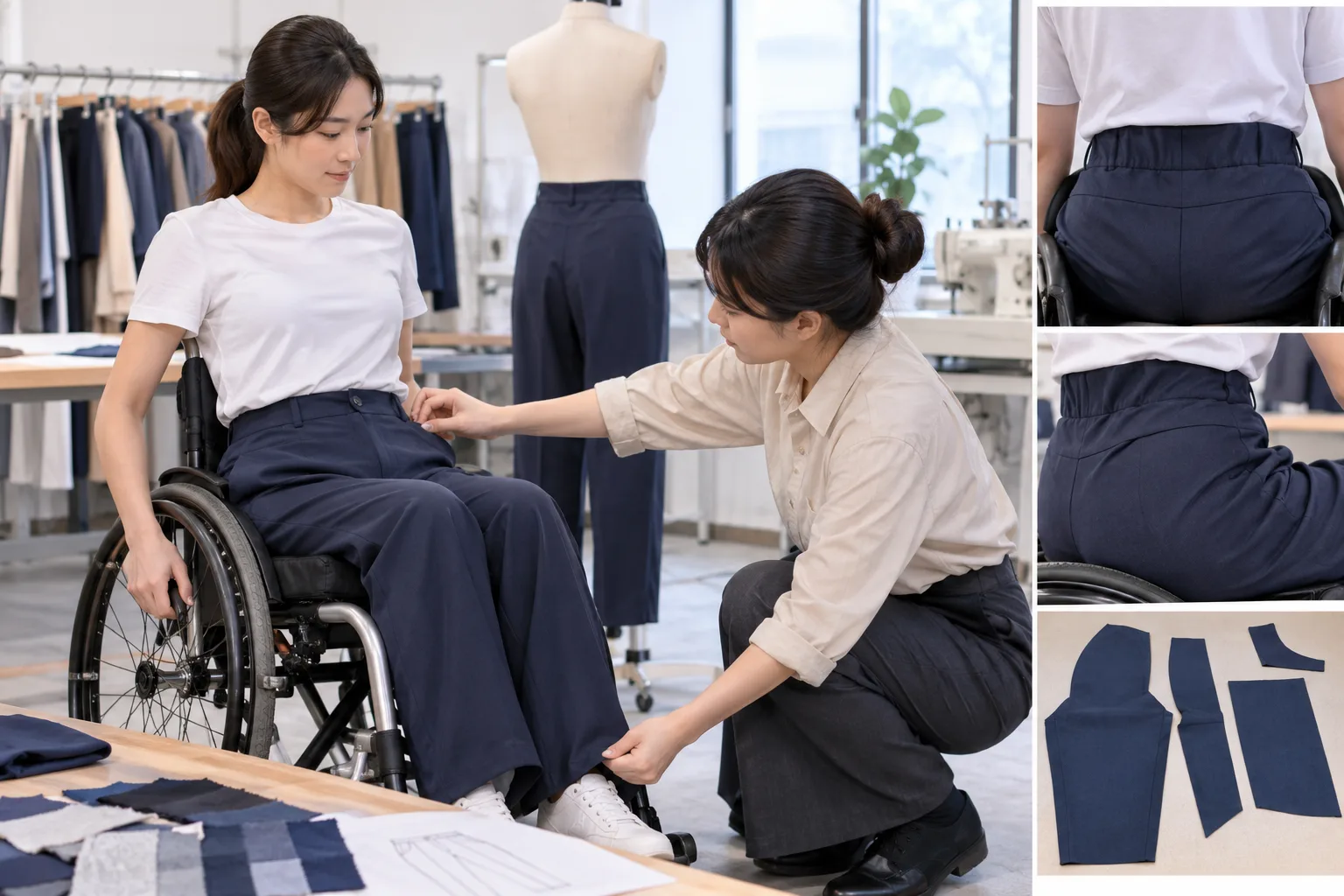
Evaluate a complete seated trouser prototype before treating the pattern as resolved. Where practical, use the intended main fabric, waistband components, closures, pockets, and seam construction. Substituting materials can obscure whether a problem comes from pattern shape or from the garment’s actual weight, stretch, recovery, and bulk.
Before the fit check, agree with the wearer on the coverage boundary and the movements that matter. The review should reflect the design brief already established, rather than introducing a generic sequence that may not match how the trousers will be used.
- Check the usual seated position. Observe where the back waist sits in relation to the agreed boundary. Note exposure, garment rotation, waistband rolling, restriction, and bunching at the back, seat, crotch, sides, and front.
- Review relevant movement. Ask the wearer to perform agreed actions, which might include leaning, reaching, repositioning, or transferring when applicable. Observe when the waist moves, how far it moves, and whether it returns afterward.
- Invite specific feedback. Ask where the garment feels secure, tight, bulky, unstable, or difficult to manage. An apparently stable waist may still feel restrictive, while visible movement may be acceptable within the wearer’s preferred coverage and ease.
- Check access when it is part of the brief. Review dressing and removal only as relevant to the intended use. Confirm whether the closure, adjustment, and waistband remain usable by the wearer or their chosen helper.
- Record the result. Mark movement locations on the prototype and document the wearer’s comments. Photographs or written observations may help if the wearer consents and the records are handled appropriately.
Diagnose the likely cause before changing the pattern. If the back waist drops while the waistband remains correctly tensioned, the back rise or waist shape may need revision. If the waist reaches the boundary but presses, rolls, or resists movement, examine its contour, circumference, elastic tension, stiffness, and assembly. Widespread twisting or bunching may point to overall balance rather than one local feature.
Change one controlled area when possible, then repeat the wheelchair trousers fit check. This makes the effect easier to interpret. Recheck the complete garment because a back-waist alteration can influence the crotch, seat, side seams, front rise, closure, and pocket positions.
Use a simple comparison record for each seated trouser prototype. Include the pattern version, materials, construction, movement reviewed, observed garment behavior, wearer feedback, and next proposed change. The record supports consistent decisions without turning one person’s response into a universal rule.
For a size range, evaluate relevant sizes and seek feedback from wearers whose postures, proportions, movement patterns, and preferences reflect the intended product brief. A successful fitting with one wearer confirms that prototype in the reviewed conditions. It does not prove that the same back rise, waistband, or construction will suit every seated user.
Next step for a better back fit
A better wheelchair trousers back fit begins with a defined seated coverage boundary, continues through coordinated back-rise and waist shaping, and is confirmed in the assembled garment. Compare the latest prototype notes with the corresponding pattern changes. Identify which revision improved coverage, which created a new fit or access issue, and which result remains uncertain. Then select one controlled adjustment for the next prototype and repeat the relevant seated movements. Readers developing the pattern further can continue with an appropriate garment-fit or pattern-development guide, while keeping the wearer’s posture, feedback, materials, and construction conditions attached to every decision.
Frequently Asked Questions
Does a higher back waist always improve seated coverage?
No. Additional back-waist height may help in some patterns, but height alone does not resolve crotch balance, waist contour, garment rotation, or front bulk. The correct choice depends on the wearer’s seated posture, coverage boundary, preferred ease, fabric, and waistband construction.
How can I check whether the back rise or waistband is causing a coverage problem?
Observe when the problem occurs and where the garment moves. A dropping waist with suitable waistband tension may indicate insufficient rise or unsuitable shaping. Rolling, pressure, or restriction at a waist that remains in position may point toward waistband contour, stiffness, circumference, or tension.
Can stretch fabric replace a shaped back rise?
No. Stretch can accommodate movement, but it does not automatically provide the fabric path or waist position required for seated coverage. Evaluate stretch, recovery, weight, pattern shape, and waistband retention together in a complete prototype.
How should back pockets and seams be considered for a seated wearer?
Map their placement, thickness, edges, and fasteners against the wearer’s seated contact areas. Consider pocket function and appearance alongside feedback about bulk or sensitivity. Do not assume one seam or pocket position is appropriate for every posture or chair setup.
Should wheelchair trousers fit the same way in every seated position?
Not necessarily. The intended fit should reflect the wearer’s usual posture and relevant movements. Leaning, reaching, repositioning, layers, and chair configuration can change garment behavior. Agree on the important positions and evaluate whether coverage, comfort, and access remain acceptable in each.