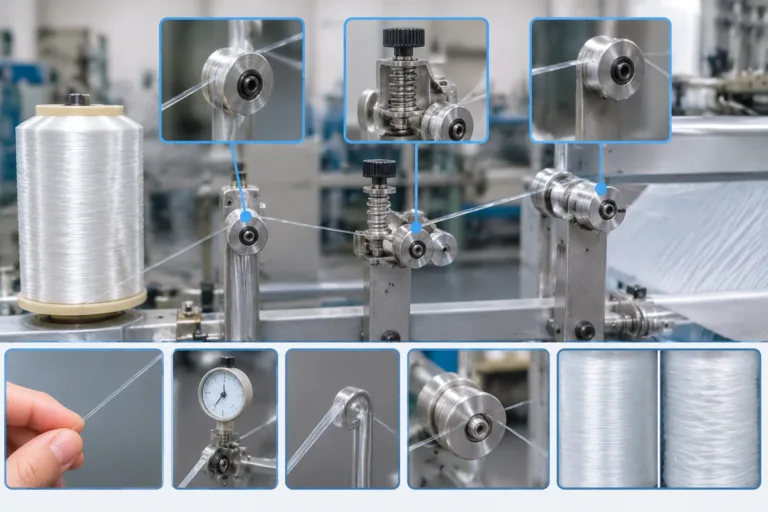
When monofilament yarn tension starts varying, first locate where and when the variation appears. Then compare the package, yarn path, operating condition, and measurement setup without changing several factors together. Treat the variation as a symptom, not immediate proof of defective yarn. Apparel Wiki provides this independent educational guidance; its Sponsor page explains how support for the publication is handled.
The practical sequence is simple: describe the pattern, preserve an unchanged reference, and test one competing explanation at a time. This approach helps separate package behavior, equipment conditions, handling differences, and measurement effects without turning one observation into a universal conclusion.
How to approach monofilament yarn tension problems
Monofilament yarn tension problems can appear as fluctuating running tension, intermittent tight or slack segments, yarn breaks, irregular fabric formation, or inconsistent downstream handling. These symptoms may have overlapping causes, but they are not interchangeable diagnoses. A break, for example, does not by itself show whether the initiating condition came from the yarn, package, path, equipment, or measurement process.
Before adjusting a setting, record where the symptom first becomes visible and the direction in which the yarn travels. Note its frequency, the package and lot identity, the operating condition, and what the yarn or resulting product does. Dated notes and photographs make comparisons clearer, although a single image cannot establish a root cause.
Keep the instrument reading separate from the process symptom. An unstable yarn tension reading could reflect placement, contact, sampling, or another aspect of the measurement setup. Conversely, a stable reading does not rule out an intermittent event elsewhere in the package withdrawal or yarn path.
Use this immediate triage sequence:
- Try to reproduce the same symptom under the recorded condition.
- Compare it with an unchanged reference condition.
- Change one meaningful variable, then check whether the original pattern repeats.
Retain more than one possible explanation until a focused comparison distinguishes them. Precise symptom language is more useful than beginning with a familiar list of presumed tension variation causes.
Describe the variation before looking for a cause
First distinguish a consistent offset from variation over time. A process that remains consistently tighter or slacker presents a different question from periodic spikes, random excursions, or events associated with package changeover. That distinction narrows the next inspection, but it does not prove what caused the condition.
Build a concise observation sheet with the following fields:
- Material: stated yarn specification, supplier lot, package identity, and visible package condition.
- Location: package position, relevant path point, and where the reading or product symptom appears.
- Direction and timing: yarn travel direction, event frequency, duration, and relationship to package or machine events.
- Operating condition: machine state and the speed or other process condition recorded by the operator.
- Result: the observed reading, yarn behavior, break, handling change, or fabric irregularity.
Compare like with like wherever possible. Keep the yarn specification, package position, path, operating state, and measurement approach unchanged unless one of them is the variable under investigation. Record any condition that cannot be held constant because it may limit the comparison.
Here, monofilament describes a yarn construction consisting of one continuous filament. Surface contact, path geometry, package withdrawal, and handling are therefore relevant inspection areas, although their influence depends on the particular material and process.
For every suspected cause, record observations that support it and observations that conflict with it. If intermittent yarn tension appears at one position but disappears when operating conditions change, both facts belong in the record. Similar visible symptoms can arise from material, equipment, handling, or measurement differences.
Check the yarn package and material identifiers
Inspect the monofilament yarn package before assigning fault. Compare winding appearance, loose ends, edge condition, contamination, visible damage, deformation, and other observable differences. Also note whether the variation follows one package, supplier lot, or machine position. Describe what is present rather than labeling the package defective without confirmation.
Check the material description supplied for the run. Useful traceability fields include the generic fiber or polymer identification where available, filament construction, original linear-density notation, supplier lot, and any stated finish or handling information. A trade name, raw-material origin, production description, and generic material name are not interchangeable identifiers.
If records use tex, denier, or dtex, retain the original value and unit. Confirm the notation through the applicable supplier documentation before making conversions or comparing specifications. Do not treat a linear-density entry as yarn diameter, and do not compare it directly with an indirect yarn-count notation as though both use the same scale.
Question any compact or unfamiliar designation rather than extracting one number from it. For example, a notation in surrounding records might describe a plied construction rather than the linear density of one monofilament. Ask the supplier or responsible technical team what the complete designation represents.
Specification review supports traceability; it does not diagnose monofilament tension variation by itself. The useful question is whether an observed package or material difference consistently tracks the symptom under otherwise comparable conditions.
Match the tension pattern to the next inspection
Use the observed yarn tension pattern to choose the smallest informative next check. The entries below are inspection priorities, not confirmed root-cause conclusions.
| Observable input or pattern | What it may suggest | Initial inspection or comparison | What could change the interpretation |
|---|---|---|---|
| Variation repeats with package rotation or becomes associated with package depletion. | Package withdrawal or package condition warrants attention. | Observe withdrawal and compare the package condition with an unchanged reference. | Path geometry, package orientation, and operating conditions may alter the pattern. |
| An excursion begins after a particular guide, tensioning element, or path change. | A location-specific contact or geometry difference may be involved. | Compare conditions immediately before and after that point, without altering unrelated settings. | Yarn condition and measurement placement can confound the comparison. |
| Readings are irregular, but no corresponding yarn or product symptom appears. | The measurement setup may be contributing to the apparent instability. | Repeat the setup and check placement, contact, and sampling consistency before changing the process. | A short observation could miss intermittent package or path behavior. |
| The problem is limited to one lot or package group under otherwise comparable conditions. | A documented material, package, or handling difference may be associated. | Compare the affected group with a reference group while preserving the recorded conditions. | Handling history and uncontrolled run differences may still explain the result. |
Inspect the yarn path and tension-control system
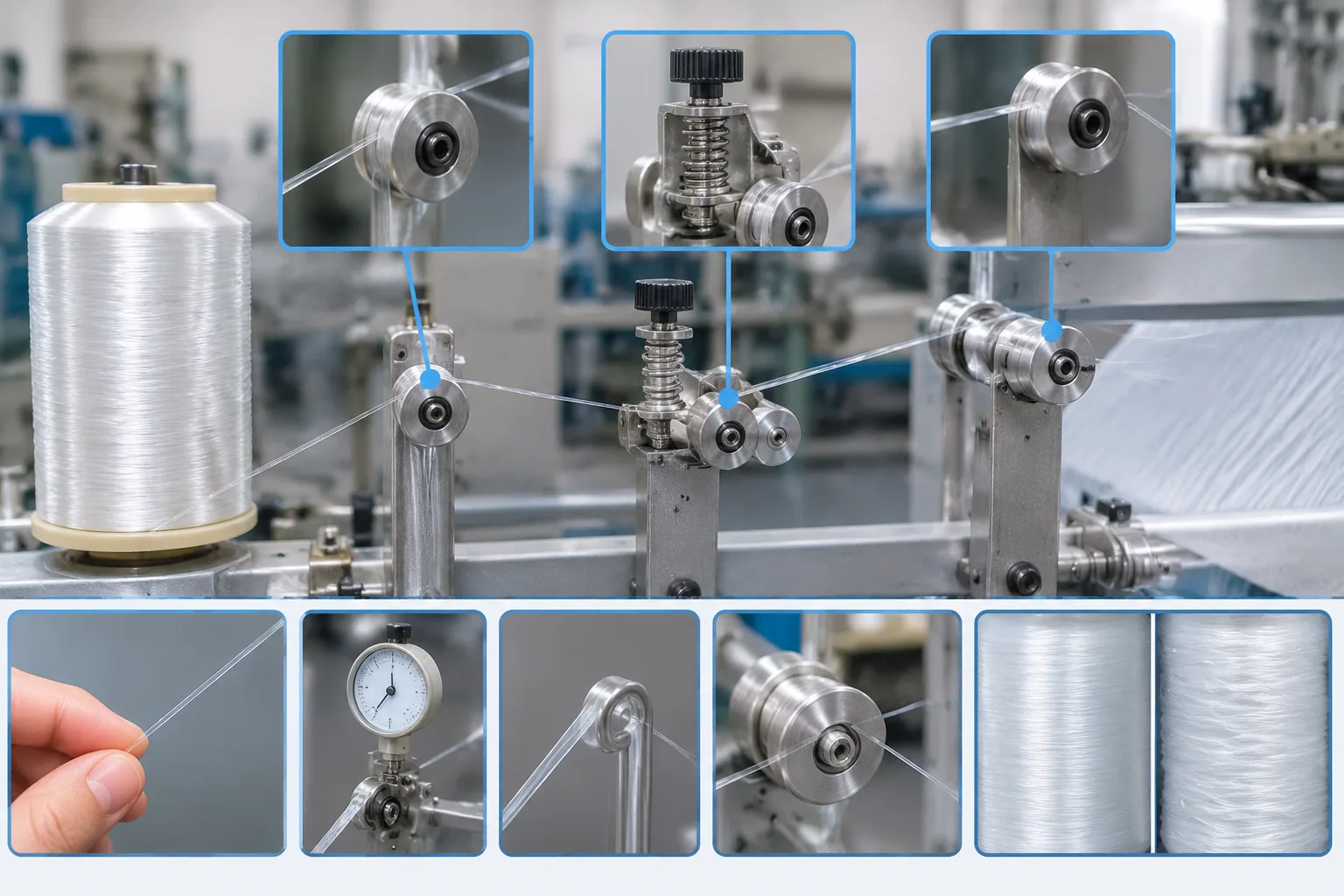
Continue the investigation by following the yarn in its direction of travel. Start at package withdrawal and continue to the next process point. Map every applicable guide, eyelet, tensioning element, detector, accumulator, feeder, and take-up point. This prevents the inspection from stopping at the most visible component.
Use the actual setup rather than a generic machine diagram. Record where the yarn changes direction, makes contact, or passes through a control element. Note whether the contact appears continuous or intermittent. Follow the equipment manufacturer’s safe inspection and maintenance instructions throughout the check.
- Look for dirty, damaged, or visibly different contact surfaces.
- Check for debris, restricted movement, misalignment, and inconsistent contact angles.
- Record unusual vibration or movement instead of assuming it causes the variation.
- Compare each suspect point with the corresponding point on a stable reference position.
Make that comparison only after checking that yarn identity, package orientation, path configuration, and major operating conditions are comparable. A physical difference can be relevant without being causal. Changing several guides or adjustments together would make it difficult to identify which change influenced the result.
Contact conditions and yarn-path geometry can alter resistance or how tension travels through the system. However, the size and significance of that effect depend on the yarn, machine, component, and process. A plausible path issue therefore remains a working explanation until a controlled comparison supports it.
For example, suppose a lightweight monofilament runs smoothly until it reaches one visibly different guide. Inspect that guide, its surface, and its alignment before changing yarn settings. If the symptom later follows the package when packages exchange positions, package withdrawal becomes a stronger explanation. The original guide observation still belongs in the record as conflicting evidence.
Run controlled comparisons to isolate the variable
Begin with a baseline run or observation under the recorded condition. Choose one candidate variable and state a prediction before changing anything. The prediction might be that the symptom will follow a package, remain at one machine position, or begin only after a particular path point.
- Preserve a reference: Keep an unchanged condition available for comparison wherever feasible.
- Change one variable: Hold the documented yarn, path, process state, and measurement approach constant except for the selected variable.
- Observe the original pattern: Continue long enough to determine whether the same type and timing of variation recur.
- Record exceptions: Note interruptions, handling differences, or operating changes that weaken the comparison.
- Restore or compare: Check the reference again so normal fluctuation is not mistaken for improvement.
A useful comparison log identifies the condition, package or lot, machine position, path configuration, process state, measurement approach, symptom result, and exceptions. If several changes are unavoidable, mark the comparison as inconclusive for individual causes. Do not assign the result to whichever change seems most familiar.
One comparison path is to exchange comparable packages between positions while preserving package orientation and major operating conditions. If the variation repeatedly moves with one package, document that association and investigate package withdrawal, condition, and handling history further. If it remains at the original position, inspect the local path and equipment variables more closely.
Another path is to retain the same package while comparing a suspect path component with a comparable reference component. Change only that element when the machine design and safe procedures allow. If the symptom changes consistently, the component or its installation deserves further investigation. Differences in operating state can still limit the conclusion.
When findings conflict, widen the competing explanations instead of making more adjustments at once. Persistent safety, equipment, or material-conformance concerns should move through the responsible technical or quality process. A single reading, visual observation, or successful short run does not establish a universal setting, acceptance limit, or material-performance claim.

Document the finding and prevent the next recurrence
Close the record with the original symptom, compared conditions, observations, action taken, result, remaining uncertainty, and responsibility for follow-up. Describe whether the evidence shows an association or a verified root cause. This distinction prevents a temporary improvement from becoming an unsupported permanent rule.
As the next educational step, compare the yarn specification, package records, equipment documentation, and applicable internal measurement approach before formalizing a process change. If the condition returns with another lot, package, or setup, reopen the record and check whether the previous explanation still fits.
Frequently Asked Questions
What is the first thing to check when monofilament yarn tension starts fluctuating?
First record where and when the fluctuation occurs, along with the package, position, process state, and visible yarn behavior. Confirm whether the pattern repeats before changing settings. This separates a recurring process symptom from a brief event or measurement issue.
Can a tension reading be unstable even when the yarn path is not the problem?
Yes. Placement, contact, sampling consistency, or another aspect of the measurement setup can contribute to an unstable reading. Repeat the measurement under the same documented conditions and compare it with observable yarn or product behavior before changing the process.
How can I tell whether tension variation follows the package or the machine position?
Exchange comparable packages between positions while keeping other relevant conditions unchanged. If the pattern repeatedly moves with the package, investigate package-related variables. If it remains at the position, inspect the local path and equipment. Record any differences that limit the comparison.
Does denier or tex tell me the correct tension setting for a monofilament yarn?
No. A linear-density notation alone does not establish the correct processing tension. Retain the original unit and consult the yarn specification, equipment documentation, process requirements, and applicable measurement approach rather than deriving a setting from the count notation.
Why should I change only one variable during a yarn tension comparison?
Changing one variable makes the result easier to interpret. If the package, path, and settings all change together, an improvement cannot be assigned confidently to any one factor. When multiple changes are unavoidable, record the result as inconclusive for individual causes.
What should be recorded after a tension problem appears resolved?
Record the original symptom, conditions compared, observations, action, result, exceptions, unresolved questions, and follow-up responsibility. Also retain package, lot, position, and setup details. These records help determine whether the same explanation remains valid if the condition returns.