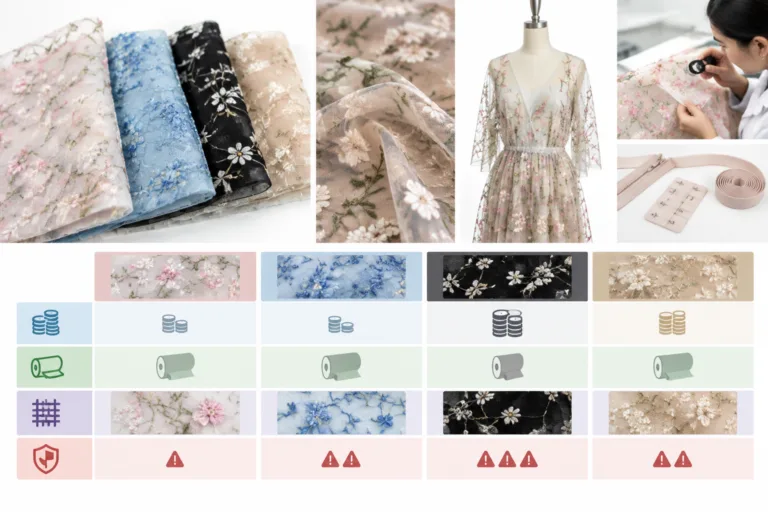
Embroidered tulle is an open, lightweight tulle base decorated with stitched motifs or other attached elements. Its suitability depends on both parts of that material system: the underlying textile and the embroidery design. For independent editorial context, see Apparel Wiki’s Sponsor information.
For effective embroidered tulle selection, evaluate fiber composition, base construction, openness, usable width, mass per unit area, embroidery coverage, motif scale, thread or embellishment characteristics, hand, drape, transparency, edge behavior, dimensional stability, and intended garment use. A commercial name or attractive swatch is only a starting point. The specification should describe the base, decorative components, and finishing separately, then confirm important decisions through representative sample or garment testing.
What should you evaluate before specifying embroidered tulle?
Begin with the role the material must perform. A soft embroidered tulle may work well as an overlay, veil, sleeve, or decorative panel but may not provide the stability, coverage, or handling resistance required for a close-fitting garment. Conversely, a denser or more structured design may create excessive stiffness, visual weight, or sewing difficulty in a light, gathered application.
Review the base fabric and the decoration as related but distinct elements. Record the fiber composition, yarn information where available, base construction, openness, width, mass per unit area, embroidery coverage, motif scale, thread characteristics, added components, finishing, color, transparency, hand, drape, and edge behavior. Mass per unit area, often reported as GSM, describes mass over an area; it does not by itself establish thickness, softness, quality, or suitability.
Commercial terms such as “embroidered tulle” can conceal meaningful differences between suppliers or markets. The same descriptive name may refer to different fibers, mesh constructions, motif densities, finishes, or usable widths. Supplier claims and visual inspection help identify candidates, but critical performance decisions should be based on an appropriate sample, construction trial, or validated test rather than appearance alone.
Identify the embroidered tulle before comparing suppliers
Create a material identity that another team member could understand without seeing the original sales listing. This prevents visually similar fabrics from being treated as interchangeable and gives sourcing, design, pattern, and quality teams a common reference.
- Base identity: Record fiber composition, yarn information when available, base textile construction, color, finishing, and any stated openness or transparency information.
- Decorative identity: Describe the embroidery thread or added component, motif type, coverage, raised or hard areas, borders, and other visible construction details.
- Dimensional identity: Record total width, width including selvedges, and usable cutting width separately. Note the condition in which width or other measurements were taken.
- Commercial identity: Record whether the supplier sells the material by length, weight, panel, or another unit. Do not assume that one selling convention applies across suppliers.
- Reference identity: Keep the supplier name, color reference, sample date, finish information, and any technical sheet with the physical sample.
Keep fiber composition, yarn, textile structure, and finishing as separate information layers. “Satin,” for example, may describe a surface or construction category rather than a fiber, while “knitted” describes a textile structure rather than fiber content. A commercial label is useful as a search term, but it is not a complete technical description. Ask the supplier to clarify ambiguous terminology before comparing price, yield, or expected behavior.
Match embroidery scale and coverage to the garment design
Evaluate the full embroidery repeat rather than judging a small isolated motif. Compare motif size, spacing, directionality, border placement, and changes across the fabric width. A design that looks balanced on a swatch may require careful placement when used on a center front, sleeve, skirt panel, neckline, or seam. Identify whether motifs need matching and allow the pattern team to review the resulting cutting layout.
Coverage and relief can change how the material looks and behaves. Dense or raised embroidery may reduce apparent transparency, increase visual weight, stiffen selected areas, or create uneven fullness when the fabric is gathered or pleated. Compare embroidered and unembroidered zones for differences in hand, drape, flexibility, and the way seams or gathers appear. Judge transparency over the intended lining, underlayer, or contrast color rather than in isolation.
Inspect the reverse and the cut edges for exposed thread paths, loose ends, hard points, snag-prone elements, and abrupt transitions. These details can affect seam allowances, trimming, pressing, lining, and finishing. Compatibility with the planned needle, presser foot, thread system, and seam construction is a development question, not a property that should be assumed from the embroidery name. A small sewing trial can distinguish visual preference from construction risk.
Evaluate hand, drape, stretch, stability, and transparency on samples
Compare candidate fabrics using samples of the same approximate size, orientation, and condition. Handle each one for softness, crispness, recovery, and stiffness created by the embroidery. Drape the samples in the same way and note whether the decorative areas pull the base, produce ripples, or create uneven fullness. Keep these observations separate from validated test results; an informal impression is useful, but it is not a laboratory measurement.
Do not assume that tulle will extend or recover in a particular way because of its appearance or construction. Where stretch matters, use an appropriate, documented sample method to assess extension, recovery, skew, distortion, curling, and dimensional change. Textile structure provides clues but does not independently determine performance. Compare the behavior of embroidered and unembroidered areas, especially if the garment relies on close fit, gathers, pleats, or movement.
Check transparency over the actual intended lining, underlayer, skin-tone range, or contrast color. If care performance matters, compare the sample before and after the planned care process and document the sample condition, process, and measurement state. Do not generalize from an informal wash to production performance. For higher-risk garments, use relevant validated textile tests or qualified technical review for the specific property and end use.
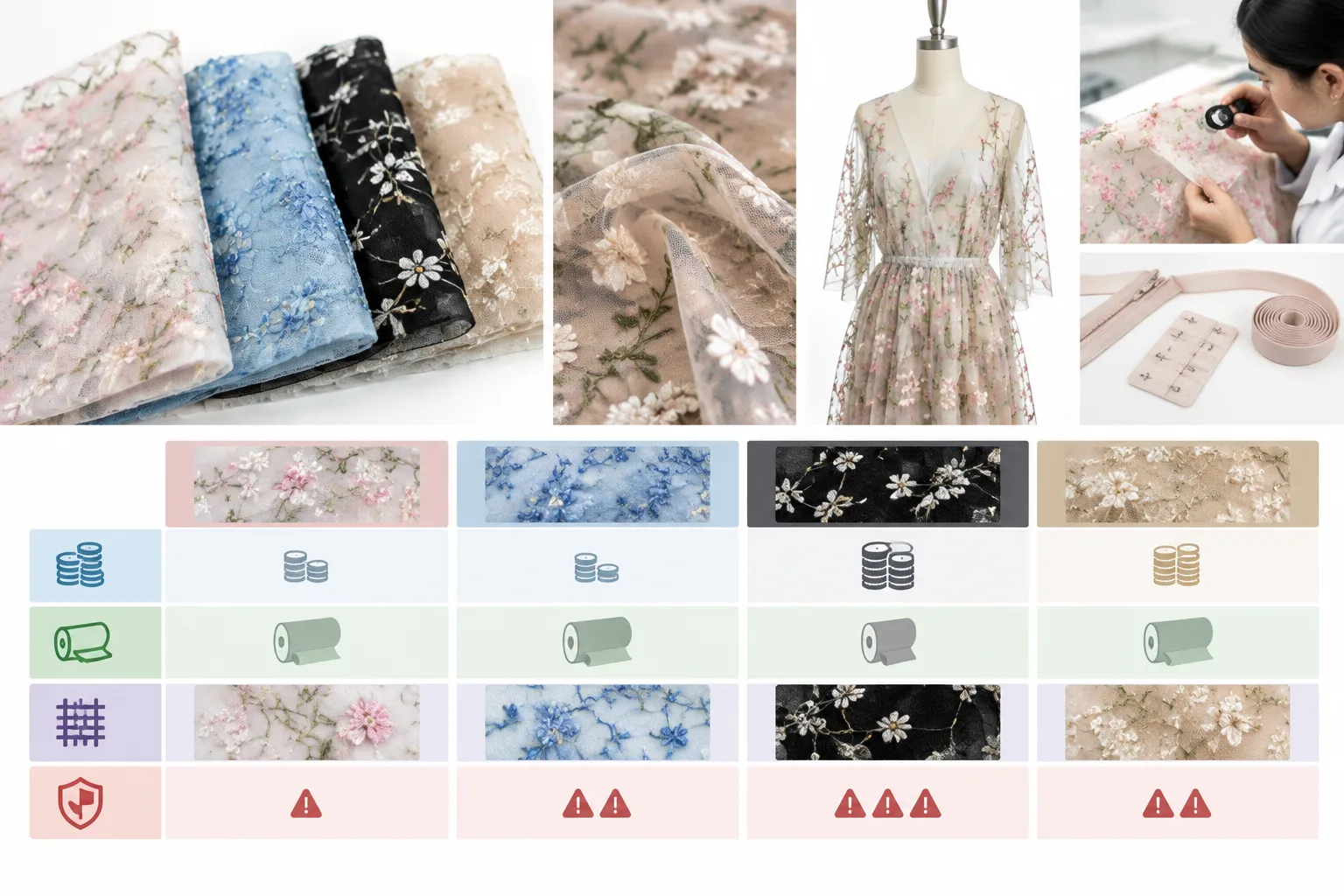
Use a comparison matrix for cost, yield, construction, and risk
A useful embroidered tulle comparison records more than appearance and quoted price. Compare each candidate’s base identity, usable width, motif repeat, border placement, mass per unit area, transparency, hand, drape, dimensional behavior, sewing observations, care route, and available documentation. Separate supplier-stated details from your own sample observations, laboratory results, and assumptions so the team can see what is confirmed and what still needs checking.
Estimate material needs against the actual pattern and layout. Usable width, motif matching, borders, dimensional change, and defects can all affect cutting yield; stated width alone cannot establish consumption. A fabric with a lower quoted unit price may still create extra layout work or material use if motifs must align across panels. Treat price as one commercial input, not evidence of quality or value.
| Requirement | Candidate observation | Evidence source | Risk if unconfirmed | Next action |
|---|---|---|---|---|
| Usable width and repeat | Record the stated cutting width and full motif repeat | Supplier details and representative sample | Unexpected matching needs or lower yield | Review against the pattern layout |
| Transparency and appearance | Compare over the intended lining or underlayer | Controlled sample comparison | Coverage differs from the design intent | Confirm with a garment panel or prototype |
| Construction behavior | Note puckering, edge behavior, and handling during sewing | Construction trial | Seams or finishing may not behave as intended | Test the planned seam and finish |
| Cost and care | Record the quoted basis and relevant care information | Supplier quotation and documentation | Cost or care assumptions may be incomplete | Confirm project-specific requirements |
Use a weighted comparison only after the team agrees on which requirements matter most. Any score is a project decision aid, not an objective industry ranking. Keep the underlying observations available so reviewers can understand why a candidate was preferred.
Follow a sample-to-specification approval procedure
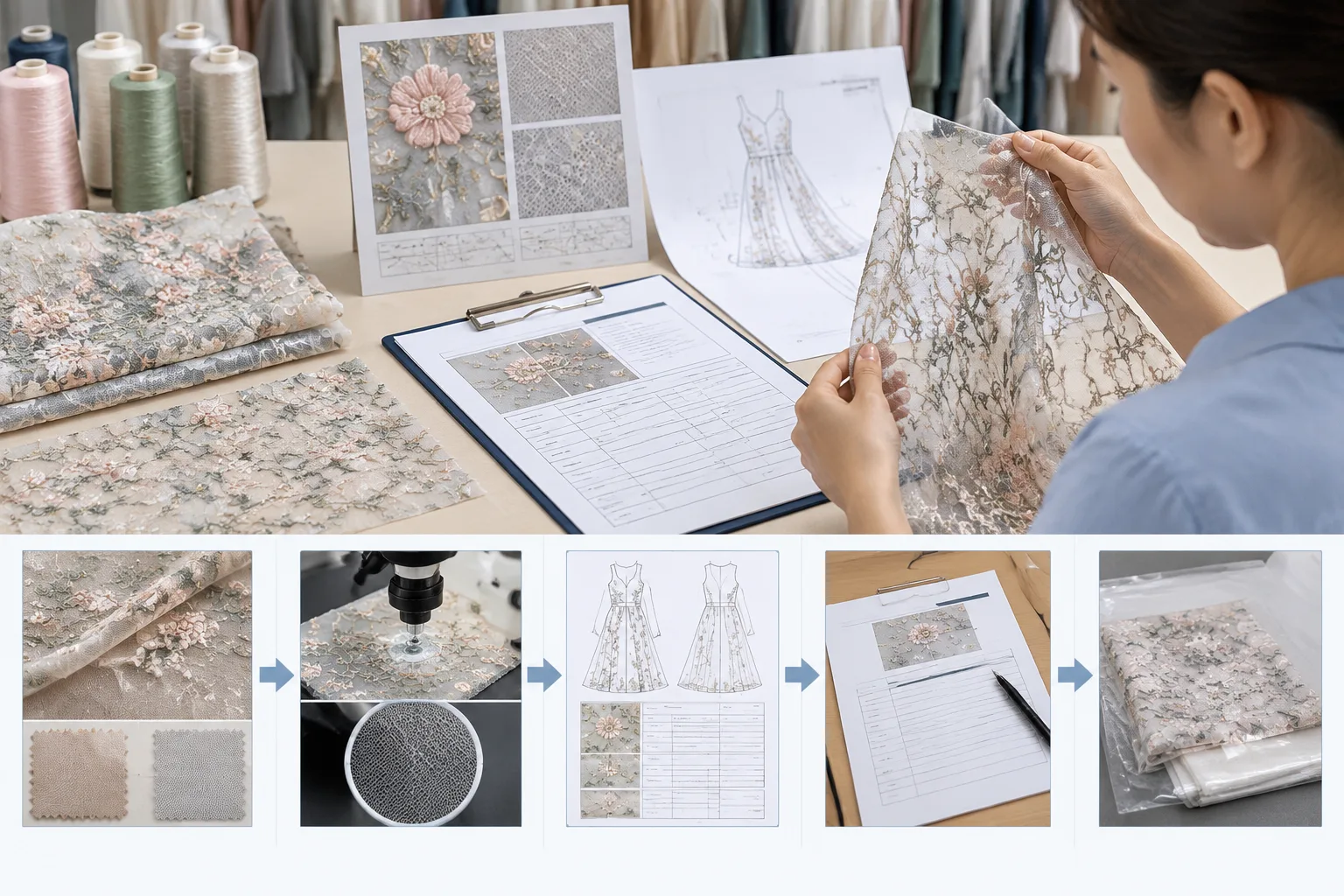
Start by defining the fabric’s role and acceptance criteria: for example, an overlay, sleeve, panel, trim, or structured detail. Then request a representative sample that shows the relevant color, finish, full motif repeat, border, and selvedge where applicable. A small decorative fragment may not reveal layout or edge issues that affect the garment.
- Record the material identity. Document the stated fiber composition, base construction, embroidery or added components, finish, color, width, and measurement condition. Ask the supplier to clarify ambiguous commercial names or width descriptions.
- Evaluate the sample for the intended use. Compare transparency over the planned underlayer, observe hand and drape, and inspect how embroidered and open areas behave. Where a property is critical, use an appropriate documented test rather than relying only on visual judgment.
- Make a construction trial. Use the intended lining, seam type, needle and thread system, pressing approach, and finishing method when they could affect the result. Check for pulling, puckering, exposed threads, or difficult cut edges.
- Document approval and open questions. Keep the approved sample reference, observations, test conditions, results, and any project-specific tolerances or unresolved risks together.
- Agree on change control. Confirm with the responsible supplier or production partner how changes and later material lots will be handled. A sample approval does not, by itself, establish that every subsequent lot is identical.
This is a practical development workflow, not a certification system. Revisit approval if a material change affects composition, embroidery, width, color, finish, or construction behavior. Apparel Wiki is an independent educational publication; teams should document decisions with their own suppliers and technical partners.
Know when embroidered tulle is unsuitable or needs further evidence
Pause approval if a sample shows unexplained distortion, unstable embroidery, unacceptable transparency, snag-prone elements, poor edge behavior, an unsuccessful care trial, or incompatibility with the intended construction. These observations do not automatically prove that a material will fail in every use, but they are reasons to investigate before committing to it.
Evidence also has limits. A report about the base tulle does not automatically establish the performance of the embroidered composite or finished garment. Suitability depends on the garment’s construction, lining, care instructions, wearer handling, and applicable brand or market requirements. Appearance, supplier wording, or a single test result should not be treated as proof of compliance, certification, safety, or legal suitability.
If important questions remain, refine the specification, request more representative evidence, run a construction trial, compare alternatives, or seek review from an appropriately qualified textile, garment, or quality professional. The next step depends on the unresolved risk and the intended end use.
For related apparel development resources, explore Apparel Manufacturing Tools. Use a relevant tool alongside—not instead of—project-specific sample review and technical evidence.
Frequently asked questions
What is the most important factor in embroidered tulle selection?
Start with the fabric’s intended garment role. The base tulle and embroidery must work together for the required appearance, placement, handling, and construction. Confirm critical requirements on a representative sample.
How can I compare the transparency of different embroidered tulle fabrics?
View comparable samples over the actual planned lining, underlayer, or contrast color, under consistent conditions. Consider both embroidered and open areas; judging the fabric by itself may not reflect its appearance in the garment.
Does higher GSM mean embroidered tulle is better quality?
No. GSM describes mass per unit area, not thickness, hand, or quality. Compare it alongside construction, embroidery, intended use, sample behavior, and relevant evidence.
What information should a supplier provide for embroidered tulle?
Request available details on fiber composition, base construction, embroidery components, finish, color, width and how it is measured, motif repeat, and care. Clarify any commercial term that does not identify the material clearly.
How should I test embroidered tulle before approving it for production?
Evaluate a representative sample under documented conditions, then make a construction trial if the garment’s seams, lining, pressing, or care route could affect performance. Use appropriate validated testing or qualified review for critical properties.
Can embroidered tulle be evaluated from a small swatch alone?
A small swatch can help assess initial appearance and hand, but may not show a full repeat, border, usable width, placement needs, or construction behavior. Request a sample large enough for the decisions the project requires.