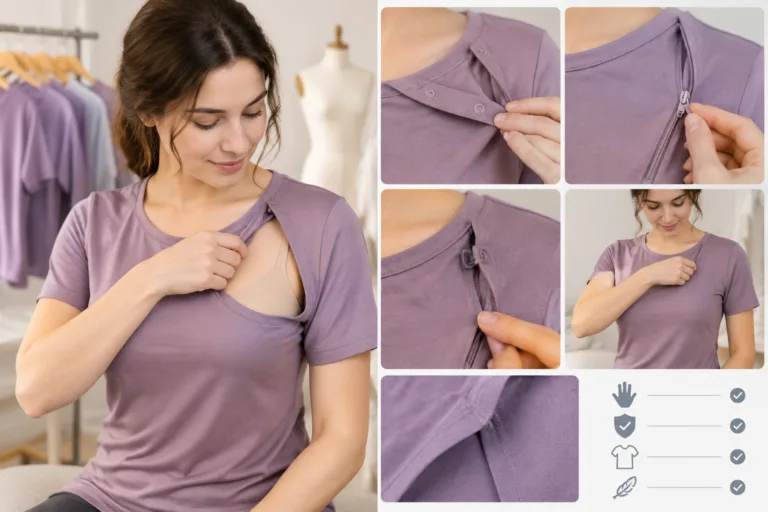
Improving nursing tops one handed closures starts with the wearer’s specific access task, not with a closure chosen by name. Define the opening and closing sequence, the garment position, what should remain covered, and which hand or posture the design needs to accommodate. Then assess whether the wearer can reach and operate the opening in that context.
For designers and product teams, this means treating reach, placement, fabric, and construction as connected decisions. Where feasible, include intended wearers in defining requirements and reviewing a finished top. Apparel Wiki is an independent garment-manufacturing knowledge publication; its sponsorship information describes the site’s editorial independence.
Start With the Nursing Task and Reach
One-handed nursing top access is a task-specific design problem: the opening must support a defined sequence while meeting the wearer’s coverage needs in the intended position. “Easy to open” is not a complete requirement. Specify what the wearer needs to access, how the garment is worn during that action, and what should happen when it is closed again.
Describe the intended movement in observable terms. Which hand is expected to operate the opening? Does the wearer need to reach across the body, lift or shift a garment panel, or operate the access point while seated or standing? These are questions for the project to answer, not assumptions to make about everyone who nurses.
Where feasible, involve intended users early. Ask them to demonstrate or describe their preferred sequence, reachable areas, posture, and concerns about coverage. Record the feedback as individual input. Nursing status alone does not establish a shared reach, mobility, preference, or use context.
Map the garment areas involved in that movement. Note where the opening sits relative to panels, seams, and areas that move or contact the body during the task. This map helps frame placement options and later evaluation questions. Nursing access is also distinct from general dressing convenience: an opening that works for one action or posture may not suit another.
Choose Closure Types and Placement for the Task
Choose one-handed closure placement by comparing the opening action and location with the required reach and coverage. Without verified evidence about particular mechanisms, there is no basis here to rank closure types by ease. Instead, describe what the wearer must do and where that action occurs.
| Closure or opening approach | Observable operation and placement | Likely design implication | Initial consideration | Variables that could change the choice |
|---|---|---|---|---|
| Opening at a selected garment area | The wearer moves or releases the opening at its location, then restores it to the closed position. | Reach and coverage depend on where the access point sits and how the surrounding garment moves. | Compare its location with the intended hand, posture, and sequence. | Garment fit, fabric behavior, user feedback, and use context. |
| Opening formed by separating garment panels | The wearer moves the panels apart for access and brings them together afterward. | Panel movement and the area exposed are part of the access decision. | Check whether the movement fits the task while maintaining the intended coverage. | Panel construction, reach, fabric behavior, and the wearer’s preferred sequence. |
These are descriptions of opening actions, not claims that a particular component performs better. For a top intended to open while worn, compare candidate locations against the wearer’s intended posture and sequence. Revisit the choice if those requirements, garment fit, or use conditions change.
Build the Opening Into the Garment
Nursing top closure construction should be considered in the assembled garment. The outer fabric, any lining or facing, elastic components, attached closure, and nearby seams all contribute to how the opening moves during access. A component considered on its own cannot establish how the complete top will behave.
Review the actual design to identify nearby areas that stretch, move, contact the body, or provide coverage. Ask whether the opening can be operated and restored without disrupting the intended coverage or garment position. Treat comfort and unintended opening as questions to assess, not as outcomes guaranteed by a particular construction.
Fabric and closure choices interact. In a lightweight stretch top, consider how the actual fabric and finished opening behave together during the defined access action. The relevant response depends on the materials, construction, fit, and task; do not assume that a fabric label or closure component predicts the finished result.
Use the final assembly to resolve design expectations. If the opening does not support the specified sequence or coverage, revisit its placement or construction and assess the revised garment against the same task. A promising component choice is a starting point, not evidence of whole-garment performance.
Evaluate One-Handed Operation in the Finished Top
Assess one-handed nursing top usability on the assembled garment, against the task and requirements established for the design. A closure component may operate as expected on its own, but that does not show whether the opening is reachable or manageable when the top is worn.
Use the intended wearing positions and opening sequence. Observe whether the wearer can reach the access point, open and close it with the intended hand, and maintain the required coverage and garment position. Record where the operation becomes difficult or differs from the planned sequence; note the posture and conditions rather than reducing the result to a general pass or fail.
Where feasible, include people who represent the intended users and invite feedback on reach, sequence, comfort, and coverage. Treat each response as information about that wearer and task, not proof that the design will work for everyone. Consider relevant sizes and use contexts, since fit and garment position can affect the interaction.
Evaluate final materials and assembly, including the opening’s relationship to the surrounding garment. Record observed issues and the conditions in which they occur, then revise placement or construction and repeat the relevant evaluation. This is a project-specific design activity, not a standardized test, certification, or guarantee of usability.
Refine the Design From Wearer Feedback
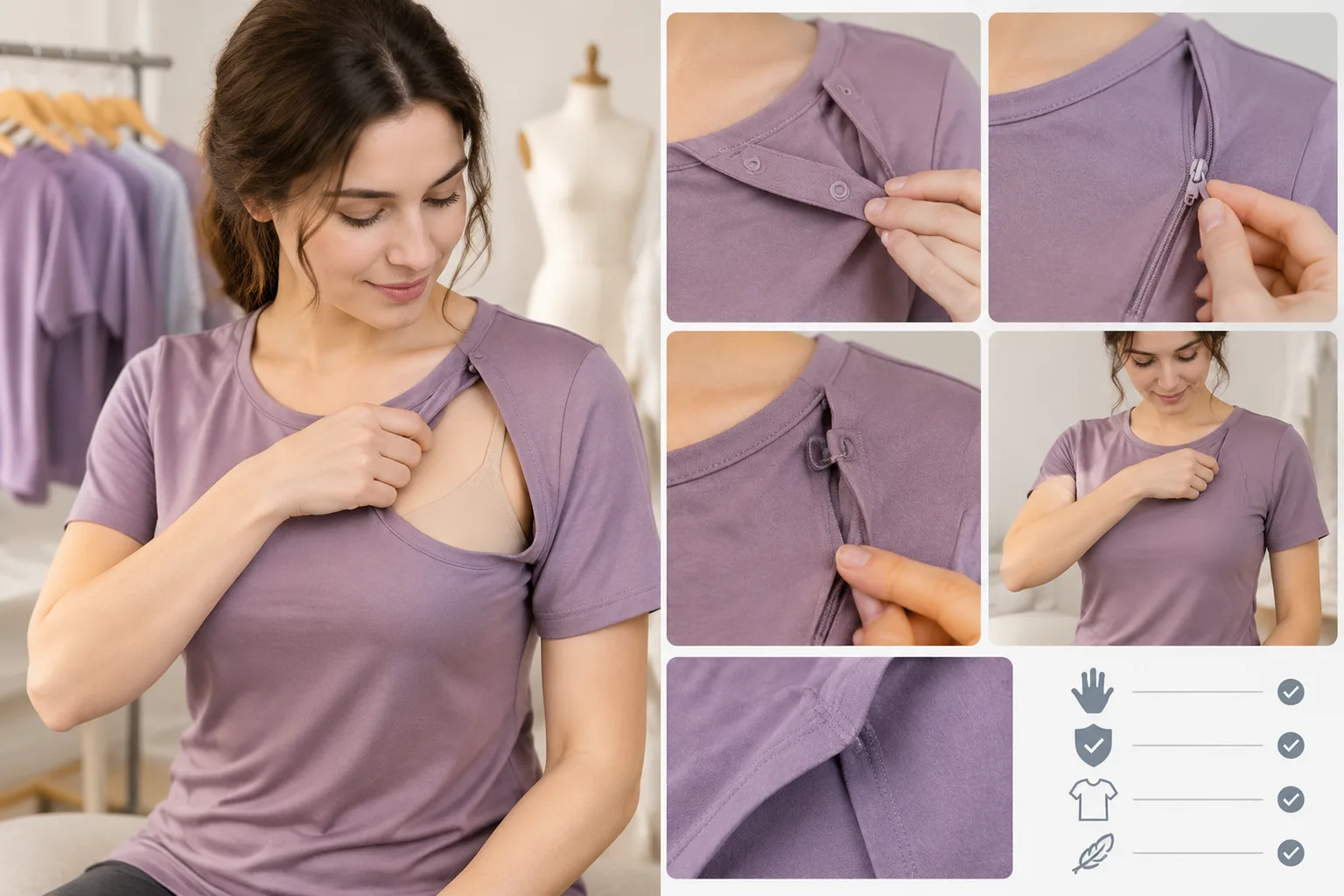
Turn feedback into observations tied to the original requirements. A wearer who cannot reach the opening may point to a placement question; a changed opening sequence may call for a different arrangement; a coverage concern may require reviewing the opening and nearby garment areas together. These observations identify decisions to revisit, but do not prove a single cause without further evaluation.
When wearers prefer different positions or sequences, return to the intended users and use conditions. Do not average their preferences into a universal answer. Clarify which tasks the design is meant to support, which requirements are essential, and which choices remain specific to an individual or context.
For a revision, document what changed and compare it with the earlier design under the same task and conditions where practical. Note whether reach, operation, and coverage improved for the intended use, and retain unresolved questions. Feedback can guide refinement without establishing a general result beyond the people and conditions considered.
As an educational next step, compare the garment specification with the evaluation notes. Check that they describe the same intended task, position, opening sequence, coverage, materials, and assembly. If a named method or requirement applies to the intended market, consult authoritative documentation for its scope and applicability before treating it as a design criterion.
Frequently Asked Questions
What makes a closure suitable for one-handed operation in a nursing top?
Suitability depends on the intended task: whether the wearer can reach, operate, and close the access opening in the relevant position while maintaining required coverage. Evaluate the assembled top against those requirements; no closure can be assumed to suit every wearer.
Where should an access opening be placed on a nursing top?
Place it in relation to the wearer’s reachable area, intended posture and opening sequence, and the coverage the design must maintain. Assess placement on the worn garment, since fit and garment position can affect access.
Can one closure design work for every wearer and nursing position?
Do not assume so. Reach, preferred sequence, posture, fit, and use context can differ. Define the intended users and tasks, then treat wearer feedback as input for that design rather than a universal conclusion.
Why should the closure be evaluated on the finished garment?
The opening interacts with the top’s materials, assembly, fit, and surrounding areas. A component check alone cannot establish how the complete garment can be reached and operated while worn or whether it maintains the intended coverage.
How can wearer feedback guide revisions to a nursing top closure?
Record specific observations about reach, sequence, operation, comfort, and coverage. Use them to identify placement or construction questions, revise the design, and compare it under the same task and conditions where practical.